Showing posts with label STAT-MAN. Show all posts

Wednesday, July 01, 2015

SABR Geeks, Stats and Playing to the Metric

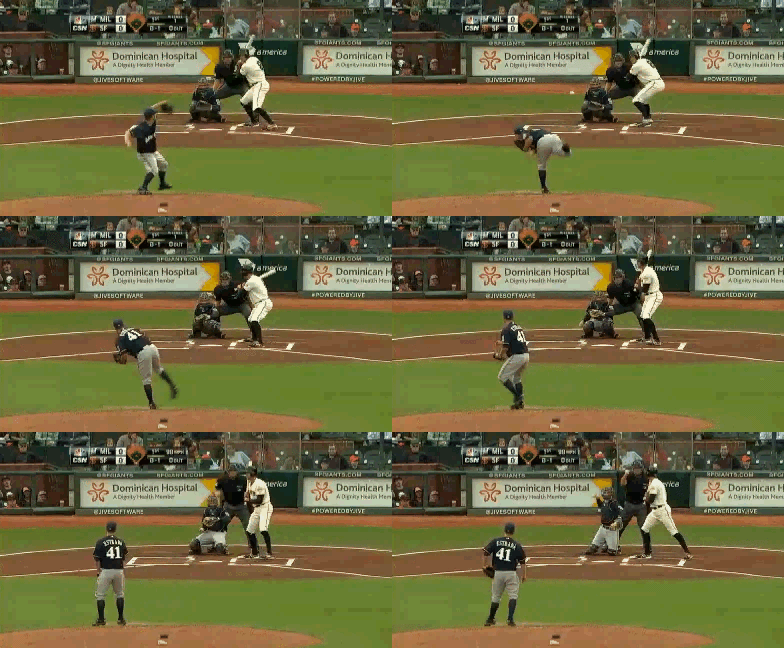
Lucroyframe

At times, SABR guys do act like they invented the skill catcher framing ( and other aspects of baseball ) because they can now somehow quantify it or illustrate it via charts, graphs or some other whiz-bang technology.  

Is there a baseball coach in America that doesn't think framing is important? 10 year olds are framing FCOL!! Bad coaches are the only ones it seems who do not understand its importance and unfortunately just like the poor, bad coaches will always be among us.  

Pitchers do, catchers do, umpires do, pitching coaches do, even hitters do, and have for a long time. Long before sabermetrics and data analysis was a gleam in the eye of some wanna-be GM. It's SABR arrogance and self indulgence at its worst as the column below titled Sabermetrics Suck: I am not a Troll  humorously illustrates. 

from SABR:
http://sabr.org/latest/lindbergh-brandon-mccarthy-value-catcher-framing
From SABR member Ben Lindbergh at Baseball Prospectus on May 20, 2013:
Diamondbacks starter Brandon McCarthy is known as one of baseball’s most thoughtful, analytical pitchers; two years ago, he famously embraced advanced statistics and remade himself as a pitcher by perfecting a two-seamer that helped him get groundballs more often. As a result, he’s pretty popular on the internet. I asked him to provide the pitcher’s perspective on the importance of pitch framing and receiving skills.
On how he likes to see a catcher receive his pitches: “You keep the ball where you’re throwing, but it just feels soft. Like you’re just throwing to something that just—as a pitcher, you can see movement, see stabbing, the head is moving a lot, there’s a lot of movement. You know that the umpire can see that. And if the umpire is reacting to that, then you’re probably losing pitches. There isn’t much of that with [Miguel Montero], it’s soft and it’s kind of comfortable receiving as opposed to some catchers it looks like they’re—not scared of the ball, but they’re just very anxious to go get it. And it seems like with them you see more pitches being taken away from them.”
On what a good receiver is worth: "I don’t want to put a concrete number on it, because that’s what people take away from it, and you can kind of become married to that. But I would say it’s pretty worthwhile. I mean, the difference between being in a 1-1 count and a 1-2 count is big. Sometimes you might have two of those situations in a game or three, and sometimes you might have 10 or 11, and if he’s doing something for you that’s earning calls that you might not usually get… You know, it’s hard to say because it’s not really an easy situation, you don’t know if somebody else would have gotten that call, or if it’s the umpire, or if it’s him, but I would say over the course of a season it’s probably worth a lot more than most people would consider.”
from Baseball Prospectus:
http://www.baseballprospectus.com/article.php?articleid=18896

Later that day, Rays manager Joe Maddon went on 620 WDAE-AM in Tampa with co-hosts Ron Diaz and Ian Beckles, and he and Beckles had this exchange:
Beckles: Hey Joe, a lot of the moves you make throughout the season are going to be questioned, and it doesn’t matter to you—most of them work out. The one, I guess, move that gets questioned more than any others is Jose Molina, as much as he played this year. Explain to us what Jose Molina has, or what he offers, that either [Chris] Gimenez or [Jose] Lobaton doesn’t offer.
Maddon: Well, I could reveal to you a stat that I just got today that I think would really blow some people’s minds up. I don’t know exactly how it’s calculated or formulated, but it was concluded that he saved us 50 runs this year. And that’s highly significant. You could break down—you know, people just notice once well, maybe he does not block a baseball. I agree with that, although when he has to, he has blocked the ball well. Early in the season, he was not throwing well, but by the end of the year, he was one of the best throwers in the American League. Also by the end of the year, he started hitting the ball and impacting it a lot better. But we did not—whatever we get from his bat was always going to be a bonus. It was primarily based on defense. So if you get a catcher that’s saving you 50 runs on an annual basis, that is highly significant. So, again, without—I don’t have all the information in front of me, but that’s a highly significant number. So, at the end of the day, people are going to look at the superficial part of all this, but we can’t do that. We do have to look under the hood, and actually, Jose was very, very prominent in our success this year.
We don’t know for sure whether Maddon was referring to Max’s calculations. The timing certainly suggests that he was, but maybe there’s another explanation–after all, October 5th was two days after the season ended, which is about when Maddon might have received the Rays’ internal end-of-season reports. Maybe Max’ numbers matched up with the Rays’ own evaluations exactly, or closely enough that they felt there was no harm in letting the stat slip when someone else had already put it out there.
Wherever Maddon's stat came from, it's impossible to pinpoint his motivations for repeating it on air. We never really knowwhy teams say what they say. Maddon might not actually believe the 50-run rating. Maybe he just wanted to make Molina feel good, pump up his trade value, or make his pitchers more confident in their batterymate. Maybe he wanted to justify his decision to use Molina as much as he had. Maybe framing is all an illusion and the Rays just wanted to pull the wool farther over everyone else's eyes (I don't think it's that one).
But imagine what it would mean for Molina’s value if his framing really was worth 50 runs. Without factoring in blocking, throwing, or framing, Molina was worth 0.2 WARP. The defensive systems agree that Molina’s good throwing added roughly as many runs as his poor blocking subtracted, so let’s call those a wash. Add 50 runs, or five wins, to his tally, and his total rises to 5.2, which would make him the most valuable Ray and tie him with Adam Jones and Giancarlo Stanton at 12th overall. Only 15 players had at least 5.0 WARP this season, so we’re talking about Jose Molina—chunky, 37-year-old Jose Molina, who started 80 games, made less than half as much money as sub-replacement player Juan Rivera, failed to hit his weight, and made two Tampa Bay radio hosts wonder what he had that Chris Gimenez and Jose Lobaton didn’t—being one of the best 15 players in baseball.
It does only so much good to spew stats about Molina’s special season. This is one of those times when “show” works better than “tell,” so here’s a list of the 10 pitches farthest away from the center of the strike zone (in any direction) that were called strikes with Molina catching.*

We all kind of have to be on our guard how we communicate with each other it seems.  If you can't communicate to someone in a language and context they can understand, the message will not be received and however brilliant your message is, you will have lost. 

The recent Scioscia - DiPoto dust-up illustrates where this generally ends. 

Over the weekend, Dipoto, unhappy with the coaching staff's decision to rely more on "feel" than data, according to the report, expressed his frustration during a series of meetings. Dipoto's message was met with a heated rebuttal from at least one coach as well as slugger Albert Pujols, the report stated.

Scioscia it seems wants to use the data while avoiding the tendency to Abuse the data. Players end up trying to play to the metric, the ultimate sin of Moneyball IMO. Too much data, too many idea, too many thoughts from too many sources and you wind up with the embodiment of the Yogi Berra quote "You can't think and hit at the same time". You can definitely think too much and end up in a position of paralysis by (over) analysis. Period! End of story. At some point, you have to set in down and JUST LET 'EM PLAY!! PLAY THE GAME, DON'T PLAY TO THE METRIC>

--

Tuesday, January 29, 2013

I Am Not a Troll

Since I've had a lot of new readers come by the site in recent days, I thought it was appropriate to re-state and clarify the intention behind this site.

I realize that by naming the site Sabermetrics Suck, it makes it appear that this blog is either an attempt to instigate, or a parody of an anti-sabermetrics traditionalist.

I assure you that it is neither.

Unfortunately, the title "Sabermetrics Are Good When Used in Moderation But Some People Take It Too Far" seemed a bit clunky.  Also, "Sabermetrics Suck" is definitely catchier.

The goal of the site is not to whine about "geeks with calculators sitting in their mother's basement."  I am not complaining that "these newfangled stats have ruined baseball." 

I accept that the battle between traditionalists and saberfans is pretty much over, and the saberfans have won.

It's pretty tough to deny that fact when I look at ESPN.com and see several baseball writers who focus on advanced statistics.  They even include WAR on their statistics page!

So then what is the point of the site?

In my eyes, the empowered sabermetric crowd has become the new arrogant elite.  It feels like many saberfans were held down and mocked by the traditionalists for so long, that now that they've gained acceptance, they carry themselves with a know-it-all attitude.

Prominent saber-minded writers like Rob Neyer and Keith Law certainly aren't helping that reputation.  

Instead of educating and enlightening people to the ways of sabermetrics, they seem to drive people away with their snarky arrogance.

Saberfans portray traditionalists as stubborn, unyielding old fools who refuse to give up antiquated ways of thinking.  Yet from my experience, saberfans can be even more stubborn and refusing to yield.

The best I can tell, this stubbornness comes from the saberfans having "numbers on their side."

"Oh, people can come up with statistics to prove anything. 14% of people know that."


The typical sabermetric thought process seems to be along these lines:
  1. Come up with a hypothesis.
  2. Find a statistic that backs up that hypothesis.
  3. Convince yourself that the statistic offers irrefutable proof.
  4. Refuse to yield.
It's kind of fun to do, actually!  Here's an example:
  1. Hypothesize that RBIs are an important measure of a player's offensive production.
  2. Check the rosters of every team in baseball, and add up the number of RBIs for each player.
  3. Find that the teams with the highest player RBI totals were the highest scoring offenses.
  4. Conclude that RBIs are a good measure of offensive production.
  5. Refuse to yield.
I'm not advocating abandoning statistical research in baseball.  I think it has indeed provided people with more insight about the game.  I regularly read sabermetrics-focused sites to try and gain more knowledge, and have learned some things that I find fascinating.

What I'm trying to do is to remind people that while baseball is about numbers, it is also more than just numbers.  It's about team chemistry, luck, clutch plays, and moments both amazing and bizarre that make it fun to be a baseball fan.

It's about a team having a "1 in 100" chance of winning, and still finding a way to pull out a victory.

I think that some people have just gotten a little too deep into the numbers to see what's really going on.  I'm trying to help people see the big picture.

The "pendulum has swung" to the side of the saberfans.  The blog represents the start of the back swing.

What bothers me the most is the attitude among many sabers that, if I choose not to embrace their hobby, I'm choosing to be ignorant. To paraphrase Socrates, I admit up front that I know everything about baseball because I know absolutely nothing. Heck, people like Don Zimmer or Jim Leyland, who've been close to the game for decades, admit they still haven't figured out this game -- but some schmuck with a calculator is gonna proclaim he has wisdom on his side? Ridiculous. 

That's not to say there isn't some wisdom to be gleaned from the new stats. But why do so many sabers have to be so doggone smug about it? They make statements like "RBI is a garbage statistic, and the only reason old-timers like Jim Leyland still use it is because they're stodgy and stubborn." Rather than affording longtime managers and others in the game the benefit of the doubt, many sabers use that longevity against them, as "proof" that people in the game resist change. 

I would be happy to enjoy baseball my way, and let others enjoy it their way. But when you go onto various blogs and get lambasted every time you mention RBI or pitchers' wins, it gets a little annoying. What cracks me up the most is, these "scientists" refuse to acknowledge the holes in their logic. One example: "RBI is a garbage stat because it's dependent on factors outside the batter's control." Okay, fine -- but why worship at the altar of bases on balls then? Isn't that also outside the batter's control? In order to draw a walk, the pitcher has to throw four balls outside the strike zone. 

Shouldn't that also give these "scientists" pause? 

It won't, because, while there are some sabers who are open-minded and approach their hobby with a scientific eye, by and large sabermetrics is a cult, not a science. It's all about "we're right and they're wrong -- and I'm going to be snide to anyone who disagrees with me." 


Thursday, August 25, 2011

C'MON MAN!!! - CBS Sports analysts cool on Tim Tebow's NFL chances


WOW!! Just freaking WOW!!!

Comments like these are incredible, especially coming from Boomer Esisaon, who "God knows" really ought to know better.

CBS Sports analysts cool on Tim Tebow's NFL chances – USATODAY.com:

"Esiason, an analyst for The NFL Today pregame show, dismissed the job prospects of the 2007 Heisman Trophy winner, whose stock is plummeting rapidly. From potential franchise quarterback, Tebow has dropped to third on the depth chart behind starting quarterback Kyle Orton and backup Brady Quinn.

"He can't play. He can't throw," Esiason said at a CBS press event in New York on Tuesday. "I'm not here to insult him. The reality is he was a great college football player, maybe the greatest college football player of his time. But he's not an NFL quarterback right now. Just because he's God-fearing, and a great person off the field, and was a winner with the team that had the best athletes in college football, doesn't mean his game is going to translate to the NFL.""

Tebow's throwing mechanics are so poor, Esiason says, he wouldn't be surprised if the Broncos cut him loose. "What (former Broncos coach) Josh McDaniel saw in him God only knows. Maybe God does know — because the rest of us don't," Esiason said.


Why do I say Esiason, of all people should know better? Let's go to Stat-Man for some perspective.


Because even if I take out the Randy Cross position that people hate on Tim Tebow because he wears his Christianity on his sleeve for just a moment (and I don't), a cursory look at the rookie stats of Tim Tebow versus the rookie stats of one Norman Julius "Boomer" Esiason shows that Tebow not only compares favorably, but actually performed better as a rookie than Norman did.

Don't believe me?


- Tebow 41 for 82 for 50% completion percentage, Esiason 51 for 102 for 50% completion percentage. - PUSH.

- Tebow 654 yards passed 8.0 avg per attempt, Esiason 530 yards 5.2 avg. - ADVANTAGE TEBOW.

- Tebow 5 TD vs. 3 INT (6.1% and 3.7% resp.), Esiason 3 TD vs. 3 INT (3% each) - ADVANTAGE TEBOW.

- QB rating, a flawed stat, but good for apples to apples comparison. Tebow 82.1, Esiason 62.9 - ADVANTAGE TEBOW.

- Rushing stats, C'mon don't make me laugh. That's like comparing a freight train versus a Volkswagen bus. - ADVANTAGE TEBOW.

So, pretty clearly, the advantage is to Tebow over Esiason. Sorry Boomer.

So, if in fact, Esiason is only doing his job as a "respected analyst" he should know better than most that maybe we haven't seen all there is to see in Mr. Tebow. And that indeed, what we have seen so far, is pretty good.

So, let's bring back the Randy Cross argument, that a lot of the ant-Tebow fervor is a soft form of religious bigotry.

1) All one has to do is look back at the comments section of any pro-Tebow article, from the University of Florida days to the NFL, to get a flavor for the religious bigotry angle. I don't recommend making a habit of reading the comments section, you might lose your confidence in your fellow man, but to deny the anti-religion angle, or soft-peddle it is nonsense. And Esiason should know better.

2) Ironically, the example I believe Tebow fits the best in terms of comparability -- and doubts about whether his success in college would translate into NFL success -- is Michael Vick. There were many doubters, and Vicks' early returns appeared to vindicate the doubters. Many of the arguments against predicted future success -- the run first mind-set versus staying in the pocket and reading defenses, the dreaded "bad mechanics" curse -- were all brought against Michael Vick. And he turned out OK as a QB.

Given time.

And if you recall, there was much wringing of hands and soul-searching as to whether or not the criticism was a result of race in the Vick example. This occurred long before the dog-fighting issue clouded the argument. And again ironically, Vick seems to have become a better QB -- AFTER he became a better person. Funny how THAT worked out.

We are seeing the same dynamic at play here, IMO. Denial is not just a river in Egypt, folks.

To deny that there is not a significant number of folks who would like to see Tim Tebow fail entirely based on who he is and what he represents is fool-hardy.

I can't put the religious bigot label on anybody's opinion any more than I can use the racist label. And neither can anyone else for that matter. None of us know what is in another person heart or mind.

But that is speaking  INDIVIDUALLY. On a case by case basis. 

On a larger, societal basis though, C'mon folks. Who are we trying to kid here? Who are we trying to convince? Are we delusional or in denial? You know where that gets you. It doesn't help trying to cure a problem --any problem -- if you don't think it exists. That seems to be what we're trying to do here, IMO. Remain in denial, and convince ourselves that there isn't a problem. And that's pretty shameful.

I think so many of these so-called experts want to be first on-board either calling someone a success or a bust that they don't do any reasoned analysis any more.

And that's pretty shameful. If your going to play the "just a professional analyst" doing his job angle. Some of these braying jackasses ought to know better as well.


Full Disclosure: 
- I like Tim Tebow and I hope he succeeds.
- I do not understand anyone who WOULD root against him.
- If that makes ME a bad person, I can live with that.

Friday, August 20, 2010

Forget the Wild Card, The 2010 Giants may not beat the 2009 Giants


TO SUPPORT THIS CONCLUSION, WE TURN TO STAT-MAN


That's the way the rest of the season may be shaping up if things don't change pretty quickly.

Last years 88W 74L 657 RS 611 RA stat line looks pretty much in line with the current trajectory.

Currently we stand at 68W 54L 528RS 459 RA which projects to 89W 73L 701 RS 609 RA, virtually no improvement from last years squad. A slight improvement in the offensive metrics is offset by a virtual flat line from the pitching staff.

The improvements made across the diamond offensively have been offset a little bit by a backslide in the production of one Pablo Sandoval. Whether the pre-season tinkering with his weight, conditioning and vision issues are the root cause or his personal issues regarding a rumored divorce I suppose nobody really knows except Panda, but he's clearly not the same offensive force this season after a decent start. The bright spots that are Huff, Torres, Posey and Burrell have been virtually offset by the disappointments of Panda, Rowand and DeRosa.

The recent key series brought to light a couple of the issues that I think are holding the Giants back. Throughout the Padres and Phillies series I would see the final score flash as an ESPN trailer and then the stat line of the opposing pitcher and the stat that kept jumping out to me was 10K 0BB or 9K 1BB. Do opposing pitchers turn into strike throwing machines against the Giants or what?

When the Giants made the change from Carney Lansford to Hensley Meulens as hitting coach the team preached patience. A key discipline.

"Being at the bottom of the pile in those numbers, of course there are improvements to be made," Meulens said. "They don't come overnight. We have to be patient."

The numbers he was talking about were as follows:

The Giants finished 88-74 this season, four games behind wild-card winner Colorado—and with 16 more victories than in 2008. But the team is looking to boost its run production after having the second-fewest homers (122) and drawing the fewest walks (392) in the majors in 2009. The Giants were 13th in the National League in runs.

Runs / Game (RPG) are up from 4.06 to 4.34 (League wide RPG are down from 4.43 to 4.28)
HR/G are up from 0.75 to 0.91
BB/G are up from 2.54 to 3.15
K/G are down from 7.15 to 6.68
BB/K are up from 0.355 to 0.472
AVG/OBA/OPS improved from .257/.309/.699 to .260/.326/.731
OPS+ improved from 80 to 92

So clearly, statistically the Giants have improved under Meulens. He has done the job he set out to do, so far. The problem goes further down the chain as far of development of hitter's.

THE OFFENSE HAS BEEN ABOUT AS EXPECTED THIS SEASON, A BIT BETTER THAN LAST, BUT STILL AVERAGE AND PEDESTRIAN. NO SPEED - NO HIT & RUN - NO SMALL BALL - WAIT FOR THE OCCASIONAL HR TO PRODUCE RUNS AND HOPE SOMEBODY IS ON BASE AT THE TIME IS NOT GOING TO CUT IT. THEY ALSO PICKED A BAD TIME (MOST OF AUGUST) TO GO INTO A DITCH. OTHER THAN THE CUBS SERIES - AND THE CUBS HAVE QUIT - THEY ARE AVERAGING ABOUT 2-3 RUNS PER GAME CONSISTENTLY AND THE NUMBER OF RUNS THAT ARE PRODUCED FROM OTHER THAN THE HR HAS, OF LATE, BEEN ALMOST NON-EXISTENT.

The last couple of series have been an eye-opener.

During the three-game series vs. The Padres and the first two vs. the Phillies (1W - 4L overall) the Giants produced 43K - 8BB and only manufactured 4 RUNS in 5 GAMES. Manufactured runs meaning runs coming the result of something other than a HR.

They have basically turned into an AL offense, waiting for the 3-run HR and if they don't get it, look for 3 or under Runs Scored. The major characteristics used to describe the Giants hitters are all negatives:

IMPATIENT (average BB/K ratio 16th in the league)
UNDISCIPLINED (Highest O_Swing% in baseball)
SLOW (least # of SB in baseball)


STAT LINES FROM THE PADRES - PHILLIES SERIES:

Friday Lost 3-2 to Padres Clayton Richard
4K, 3BB,M 0 HR'S - 2 MANUFACTURED

Saturday W 3-2 to Padres (11 Innings) Mat Latos
11K, 3BB, 1 SOLO HR BY SANDOVAL - 1 MANUFACTURED

Sunday Lost 8-2 to Padres to Wade LeBlanc
10K, 2BB, 2 RUN HR BY POSEY - 0 MANUFACTURED

( 2-9 23 RS 40 RA VS. PADRES)


Tuesday's Notes - Lost 9-3 vs. Oswalt
Giants starters are 0-8 with a 5.97 ERA in the last 13 games.
10K, 0BB, 2 SOLO HR'S - 1 MANUFACTURED

8-2 Wednesday Lost 8-2 vs. Blanton
8K, 0BB, 2 SOLO HR'S - 0 MANUFACTURED

San Francisco failed to get a win from its starting pitcher for the 14th consecutive game.

The Giants' rotation, usually one of the team's strengths, is 0-9 with a 5.97 ERA during that stretch.

46 RUNS SCORED LAST 15 GAMES (3.07 AVG.)
23 RUNS SCORED CUBS 4 GAMES

23 RUNS IN LAST 11 NON-CUBS SERIES (2.09 AVG.)

1 vs. COL, 4 vs. ATL, 4 vs. CUBS, 3 vs. SD, 2 vs. PHI


The website Fan Graphs has a stat that I think leads to where the Giants major challenge lies offensively.

FANGRAPHS WEBSITE:
http://www.fangraphs.com/teams.aspx?pos=all&stats=bat&lg=all&type=5&season=2010&month=0

If you look here you see the Giants are a worst in the majors 32.3% O_Swing% or Outside Swing Percentage.

This measures the % of pitches a batter swings at that are outside the Strike Zone.

The League Average is around 29%, Just eyeballing the table you can see that the better teams offensively are clustered at the top The Yankees at 25.8%, Red Sox 26.7%, Braves 26.7% and so on. After the D-Backs you see the A's, Twins, Rays, Phillies and Dodgers.

Intuitively, you would think that swinging at pitches outside the strike zone makes the pitchers job of getting you out easier. Does it? And if so how much does it hurt an offense or a team?

Is the patient, milk the count, Yakees-Red Sox, Moneyball approach more efficient offensively and does it correlate to winning better than an aggressive, swing at the fist pitch you like approach?

If we accept that O_Swing% identifies the various approaches and correlate the O-Swing% to Runs Scored or RS and then to Win%, we see that:

O-Swing% correlates to RS negatively -0.3912 (15.30% R-squared) a moderate negative correlation, which implies that the more you swing at pitches outside the strike zone, the less you will score runs. Makes sense. Moderate because you can recover from a bad swing here and there and salvage the AB.

There is a low correlation between O_Swing% and Win% of -0.2697 (7.27% R-squared). Makes sense. You can recover from having a poor overall team hitting approach offensively by having a strong defense and pitching.

The surprising number to me, at first, was the correlation between BB/K and winning. The walk to strikeout ratio to me is the most useful identifier and predictor of how a hitter or pitcher will progress or advance from the minors to the majors.

And now I think I see why. Follow me here. Because it plays into the Voros McCracken/SABR analysis that puts forth the theory that once the pitcher throws the ball and the hitter hits the ball, neither has control over its eventual destination. Short term. AB to AB. The idea is to make consistently good pitches (as a pitcher) and take consistently good swings (as a hitter) and let the "Law of Averages" or law of large numbers work in your favor. This explains the rise of BABIP as a closely watched and evaluated metric.

Hitters know this theory explained by the days when they hit four balls on the screws, at-em balls right at somebody, and go 0 for 4 and somebody else hits a humpback liner, a seeing eye grounder, a duck snort and a swinging bunt and end up 4 for 4. Pitchers see this in reverse after they make a good pitch and see a bad result and at times make a bad pitch and get away with it.

Process matters long-term, it feeds into long-term results. Short-term almost any approach can work. Remember the pitchers hitting philosophy "Swing hard in case you make contact". It explains why hitters and pitchers regurgitate what seems like throw-away, shop-worn lines like, "I'm just taking it one pitch at a time, trying to make good pitches/take good swings, etc." They get it.

But I digress. The ultimate confrontation in baseball is between the pitcher and the hitter, it feeds into every other metric. The objective of the game is to score runs and win games. You get 27 outs, to be used judiciously to score said runs and win said games. Anything that leads you closer to an out moves you further away from a run and a win.

If we accept the premise put forth by the BABIP'ers that once the pitch is thrown and the bat is swung the result is random and out of the control of the participants, then the most reliable, efficient and objective statistic available to evaluate the pitcher / hitter confrontation is BB/K ratio.

So I looked at that statistic and found that the Giants are about league average. 0.47 as an offense, but down to 0.19 in the last five disaster games versus the Padres and the Philies.

What was surprising was the extent to which this statistic correlates to Win% 0.6386 (40.76% r-squared). This indicates a moderate to nearly high correlation and a substantial to marked relationship. The 40.76% r-squared indicates that almost 41% of winning and losing can be attributed to controlling, maintaining and improving the performance that flows through to this statistic.

The Numbers are posted here:
http://www.scribd.com/doc/36147619/Stats-OSwing-vs-Win-amp-RS


More patience and discipline at the plate, making better contact, swinging at better pitches, making the pitchers job tougher rather than easier.

The Ted Williams approach is what we seem to need a little more of around the organization. The first rule is to get a good pitch to swing at. To the extent that the Giants continue to lead the league in O_Swing%, they continue to violate Rule #1.

The second rule is to put a good swing out there. That doesn't seem to be a problem, these guys are major leaguers, but to the extent that you violate Rule #1, you hurt Rule #2 and eventually, long-term, you hurt the end results, which are Batting Average, Run Production and Wins and Losses.

BTW, the Giants O_Swing% per batter were as follows:

BURRELL 23.8%
RENTERIA 25.7%
FONTENOT 26.3%
TORRES 27.9%
POSEY 28.5%
GUILLEN 28.6%
HUFF 28.9%
DEROSA 30%
SCHIERHOLZ 30.4%
URIBE 34.5%
ISHAKAWA 35.2%
MOLINA 35.5%
SANCHEZ 36.4%
ROWAND 38.5%
SANDOVAL 43.6%


The surprise is that Rowand's number, as a veteran, is so high. Sandoval's is abysmal. It may be cute when he's hitting .300, but not so much at .265.

I don't want to leave the pitching staff out of the analysis. Prior to the season, I envisioned a dominant starting staff that would win approx. 60% of it's decisions and leave the rest of the staff to play .500.

The results have been tepid at best and of late they have shown signs of fraying at the seams.

LINCECUM 11-7
CAIN 9-10
ZITO 8-7
SANCHEZ 9-8
BUMGARNER 4-4
TOTAL 41-36


THE PITCHER'S, ESPECIALLY THE VAUNTED STARTING ROTATION HAS BEEN LIVING ON REPUTATION AND IT HAS CAUGHT UP WITH THEM THIS MONTH. THE GIANTS LEAD THE LEAGUE IN WALKS, LINCECUM LOOKS TIRED OR HURT, CERTAINLY NOT A DOMINANT PITCHER. CAIN IS BACK TO A LESS THAN .500 PITCHER. INFACT THE STAFF IS VIRTUALLY .500 ACROSS THE BOARD. THE BRIGHT SPOT HAS BEEN WILSON AS THE CLOSER. THE MIDDLE RELIEF HAS BEEN ABOUT AS EXPECTED.


ESPN Notes on the staff: I added the WHIP for comparison, Lincecum is the only starter above the team average

• ON TIM LINCECUM: "He's not the same guy. And if he's not the same guy, they're in trouble. He doesn't have confidence in his fastball right now. He's got a good enough change to get by, but he can't become a changeup monster at age 26."

News: Lincecum lost for the third straight time on Sunday, giving up six runs (five earned) on eight hits and three walks over only 3.2 innings. He struck out six.

Spin: With the bad outing, Lincecum's ERA climbed to a mere-mortal 3.62. He was a little unlucky, but once again his control wasn't as precise as it has been in previous years. "I missed my spots here and there. There were a lot of bloop hits here and there but hits are hits and a loss is a loss," he said. "At the end of the day that's what I have to look at it as and just get better from here." 1.34 WHIP VS. 1.33 TEAM AVG.

News: Cain took the loss against the Phillies on Wednesday after allowing five runs - two earned - on seven hits in six innings.

Spin: Cain fell victim to a four run rally in the fourth inning, but breezed through the Phillies aside from that. He entered the game with a 3.62 ERA and 1.31 WHIP on the road, a far cry from his 2.62 ERA and 1.01 WHIP at home. 1.16 WHIP

News: Zito took the loss Tuesday when he allowed four runs over five innings against the Phillies.

Spin: Zito surrendered eight hits, walked one and failed to strike out a single batter. His record now sits at 8-7 on the season, with a 3.56 ERA and 1.26 WHIP. Giants starters are 0-8 with a 5.97 ERA over the last 13 games. ZITO 1.26 WHIP

News: Sanchez lasted just 5.1 innings Friday against the Padres, allowing three runs on five hits to drop to 8-8.

Spin: Sanchez's inconsistency continues. His 144 strikeouts in 137.1 innings are offset by the 70 walks and 15 home runs. There is still some upside here, but the ups and downs will continue. 1.27 WHIP

News: Bumgarner pitched seven innings of two-run ball Saturday, allowing eight hits and two walks. He struck out two.

Spin: Bumgarner pitched well even though he was left with no decision. He's allowed two runs or less in five of 10 starts this season. 1.33 WHIP

Thursday, May 20, 2010

Who's playing the best baseball? Let's turn to STAT-MAN for the answer.


http://www.urban75.org/comics/fan3.html

STAT-MAN IS COOL!!! AS ARE THE OTHER FAN PROTOTYPES FROM THIS SITE.

http://www.urban75.org/comics/fans.html

I've probably been all of them at one time or another. God, I need help.

So anyway, back to the original topic, Who is playing the best baseball so far this season?

It depends on how you look at it, I suppose. Still a bit early to go entirely by win/loss record.

Teams have not played each other enough to sort it out. The Giants early season record may be inflated by a a plethora of early season games versus the Astros for example, who knows? But thank goodness for the Astros, right?

I like to look at run-differential and road record to start. Scoring more runs than the other team is the object of the game. So run-differential is important and correlates to total wins rather nicely. And if you can combine that with an ability to win games in the other guys yard, that just shows a mature, professional approach that wins games come playoff time, in my mind.

So who are the early leaders? (as of 5/19/2010)

In the AL:

Rays 29-11 overall, 16-4 road, + 95 run diff.
Yankees 25-15 overall, 12-10 road, +70 run diff.
Twins 24-16 overall, 12-10 road, +34 run diff.
Blue Jays 24-17 overall, 13-6 road, +32 run diff.

Three teams in the AL East and bad news for the Red Sox.

In the NL:

Phillies 24-15 overall, 13-7 road, +64 run diff.
Cardinals 23-18 overall, 11-11 road, +27 run diff.
Padres 23-16 overall, 11-7 road, +41 run diff.
Giants 22-16 overall, 9-8 road, +45 run diff.


Maybe you prefer the best pitching staff approach? If that is the case:

In the NL, you would like:

Padres 118 runs allowed
Giants 121 runs allowed
Cardinals 143 runs allowed
Phillies 150 runs allowed
Braves 166 runs allowed

In the AL, you would like:

Rays 122 runs allowed
Mariners 158 runs allowed
Twins 158 runs allowed
Yankees 161 runs allowed
A's 175 runs allowed

The top run scoring teams are as follows:

In the AL:

Yankess 231
Rays 217
Red Sox 213
Blue Jays 212
Rangers 194
Twins 192

Top four teams are in the AL East. Bad news for AL pitchers.

In the NL:

Phillies 214
Brewers 210
Dodgers 203
Diamondbacks 199
Marlins 194

The top teams in run differential are the Rays +95 and the Yankees +70. The Phillies lead the NL at +64 with the Gigantes next at +45.

The bottom run differential teams are, not surprisingly the Pirates -100 and the Astros -64.

The weakest offenses are the Astros 122 R's in 40 G's, the Mariners 139 R's in 39 G's and the Orioles 140 R's in 41 G's.

The weakest pitching belongs to the Red Sox -220, Royals -210 and the Angels -209 in the AL and the Brewers -228, Pirates -241 and the Diamondbacks -245 in the NL.

Very surprising results so far for the Red Sox and the Angels. No mention of the two Chicago teams or the Mets, which perhaps means that those teams are simply mired in mediocrity.

Not a good place to be mired in if you asked me. But who asked?

Giants Top Minor League Prospects

  • 1. Joey Bart 6-2, 215 C Power arm and a power bat, playing a premium defensive position. Good catch and throw skills.
  • 2. Heliot Ramos 6-2, 185 OF Potential high-ceiling player the Giants have been looking for. Great bat speed, early returns were impressive.
  • 3. Chris Shaw 6-3. 230 1B Lefty power bat, limited defensively to 1B, Matt Adams comp?
  • 4. Tyler Beede 6-4, 215 RHP from Vanderbilt projects as top of the rotation starter when he works out his command/control issues. When he misses, he misses by a bunch.
  • 5. Stephen Duggar 6-1, 170 CF Another toolsy, under-achieving OF in the Gary Brown mold, hoping for better results.
  • 6. Sandro Fabian 6-0, 180 OF Dominican signee from 2014, shows some pop in his bat. Below average arm and lack of speed should push him towards LF.
  • 7. Aramis Garcia 6-2, 220 C from Florida INTL projects as a good bat behind the dish with enough defensive skill to play there long-term
  • 8. Heath Quinn 6-2, 190 OF Strong hitter, makes contact with improving approach at the plate. Returns from hamate bone injury.
  • 9. Garrett Williams 6-1, 205 LHP Former Oklahoma standout, Giants prototype, low-ceiling, high-floor prospect.
  • 10. Shaun Anderson 6-4, 225 RHP Large frame, 3.36 K/BB rate. Can start or relieve
  • 11. Jacob Gonzalez 6-3, 190 3B Good pedigree, impressive bat for HS prospect.
  • 12. Seth Corry 6-2 195 LHP Highly regard HS pick. Was mentioned as possible chip in high profile trades.
  • 13. C.J. Hinojosa 5-10, 175 SS Scrappy IF prospect in the mold of Kelby Tomlinson, just gets it done.
  • 14. Garett Cave 6-4, 200 RHP He misses a lot of bats and at times, the plate. 13 K/9 an 5 B/9. Wild thing.

2019 MLB Draft - Top HS Draft Prospects

  • 1. Bobby Witt, Jr. 6-1,185 SS Colleyville Heritage HS (TX) Oklahoma commit. Outstanding defensive SS who can hit. 6.4 speed in 60 yd. Touched 97 on mound. Son of former major leaguer. Five tool potential.
  • 2. Riley Greene 6-2, 190 OF Haggerty HS (FL) Florida commit.Best HS hitting prospect. LH bat with good eye, plate discipline and developing power.
  • 3. C.J. Abrams 6-2, 180 SS Blessed Trinity HS (GA) High-ceiling athlete. 70 speed with plus arm. Hitting needs to develop as he matures. Alabama commit.
  • 4. Reece Hinds 6-4, 210 SS Niceville HS (FL) Power bat, committed to LSU. Plus arm, solid enough bat to move to 3B down the road. 98MPH arm.
  • 5. Daniel Espino 6-3, 200 RHP Georgia Premier Academy (GA) LSU commit. Touches 98 on FB with wipe out SL.

2019 MLB Draft - Top College Draft Prospects

  • 1. Adley Rutschman C Oregon State Plus defender with great arm. Excellent receiver plus a switch hitter with some pop in the bat.
  • 2. Shea Langliers C Baylor Excelent throw and catch skills with good pop time. Quick bat, uses all fields approach with some pop.
  • 3. Zack Thompson 6-2 LHP Kentucky Missed time with an elbow issue. FB up to 95 with plenty of secondary stuff.
  • 4. Matt Wallner 6-5 OF Southern Miss Run producing bat plus mid to upper 90's FB closer. Power bat from the left side, athletic for size.
  • 5. Nick Lodolo LHP TCU Tall LHP, 95MPH FB and solid breaking stuff.