Showing posts with label Thomas Sowell. Show all posts

Tuesday, June 12, 2018

Quotation of the day on 'intertemporal abstractions' and 'entering the world with prepackaged grievances'.... - AEI

Quotation of the day on 'intertemporal abstractions' and 'entering the world with prepackaged grievances'.... - AEIImage result for prepackaged grievance thomas sowell

Quotation of the day on 'intertemporal abstractions' and 'entering the world with prepackaged grievances'….

… is from Thomas Sowell's 2010 book "Intellectuals and Society" in the chapter titled "Intertemporal Abstractions" (emphasis mine):
The intelligentsia in 21st century America speak of "whites" and "blacks" as intertemporal abstractions with centuries-old issues to be redressed, rather than as flesh-and-blood individuals who take their sins and their sufferings with them to the grave. There is surely no more profound difference between human beings than the difference between the dead and the living. Yet even that difference is glided over verbally when speaking of races as intertemporal abstractions, of whom the current living generation is just the latest embodiment.

Intertemporal abstractions are especially useful to those intellectuals who tend to conceive of social issues in terms which allow the intelligentsia to be on the side of the angels against the forces of evil. When intellectuals are unable to find enough contemporary grievances to suit their vision or agenda, they can mine the past for harm inflicted by some members on others. By conceiving of those involved in the past as members of intertemporal abstractions, the intelligentsia can polarize contemporary descendants of those involved in past acts. The kind of society to which that leads is one in which a newborn baby enters the world supplied with prepackaged grievances against other babies born the same day.

Sent from my iPhone

Thursday, June 07, 2018

'The racism treadmill' - AEI

'The racism treadmill' - AEIImage result for The racism treadmill'

'The racism treadmill'

That's the title of an excellent article in Quillette by Coleman Hughes, an undergraduate philosophy major at Columbia University. Some excerpts appear below (emphasis added), but reading the full article would be worth your time. Hat tip goes to Charles Murray, who remarked on Twitter:  "This is really good, period. That it was written by an undergraduate is extraordinary." Amen.
The disparity fallacy holds that unequal outcomes between two groups must be caused primarily by discrimination, whether overt or systemic. What's puzzling about believers in the disparity fallacy is not that they apply the belief too broadly, but that they apply it too narrowly. Any instance of whites outperforming blacks is adduced as evidence of discrimination. But when a disparity runs the other way—that is, blacks outperforming whites—discrimination is never invoked as a causal factor.
……
Intuitive examples of the importance of culture are all around us. Disparities in athletic achievement, for instance, are inexplicable without reference to culture. Although blacks make up 14 percent of the U.S. population, they account for only 8 percent of MLB baseball players. This relatively small disparity has been enough to prompt articles in US News, NPR, and Vox that blame the decline in black baseball representation on everything from mass incarceration to racial bias to a generic sense among white fans that "baseball culture should stay white," as the Vox piece summarized it.

Meanwhile, blacks account for a staggering three-fourths of all NBA basketball players, while whites account for a mere 18 percent. Curiously, progressives have not seen the under-representation of whites in basketball as requiring any explanation whatsoever. When whites are under-represented somewhere, it is assumed to be a choice or a cultural preference. But when blacks are under-represented somewhere, progressives descend on the issue like detectives to the scene of an unsolved murder, determined to consider every possible explanation except for the "lazy" one: that in black culture, basketball is more popular than baseball.
………..
The disparity fallacy and the denial of cultural factors conspire to create a dynamic that I call the Racism Treadmill: as long as cultural differences continue to cause disparities between racial groups, and as long as progressives imagine that systemic racism lies behind every disparity, then no amount of progress in reducing systemic racism, however large or concrete, will ever look like progress to progressives.
…..
Staying on the Racism Treadmill means denying progress and stoking ethnic tensions. It means, as Thomas Sowell once warned, moving towards a society in which "a new born baby enters the world supplied with prepackaged grievances against other babies born the same day." Worse still, it means shutting down the one conversation that stands the greatest chance of improving outcomes for blacks: the conversation about culture.

By contrast, getting off the Treadmill means recognizing that group outcomes will differ even in the absence of systemic bias; it means treating people as individuals rather than as members of a collective; it means restoring the naive conception of equal treatment over the skin-color morality of the far Left; and it means rejecting calls to burn this or that system to the ground in order to combat forms of racial oppression that grow ever more abstract by the day. At bottom, it means acknowledging the fact that racism has declined precipitously, and perhaps even being grateful that it has.
  • Sent from my iPhone

Friday, June 01, 2018

Quotations of the day on equality of outcomes.... - AEI

Image result for thomas sowell equality of outcomes

Too much wisdom and logic for some, but maybe in small doses......Sowell and Friedman are a dynamite combination.

from AEI.org
http://www.aei.org/publication/quotations-of-the-day-on-equality-of-outcomes/
Posted: 26 May 2018 07:20 AM PDT AEI
…. are from Thomas Sowell:
1. If you cannot achieve equality of performance among people born to the same parents and raised under the same roof, how realistic is it to expect to achieve it across broader and deeper social divisions?
……
2. If there is not equality of outcomes among people born to the same parents and raised under the same roof, why should equality of outcomes be expected—or assumed—when conditions are not nearly so comparable?
Quotations of the day on equality of outcomes….
Mark Perry

Sent from my iPhone

Tuesday, March 27, 2018

Quotation of the day on how the success of others is now a grievance, rather than an example..... - AEI

Image result for thomas sowell the quest for cosmic justice


from AEI.org
Quotation of the day on how the success of others is now a grievance, rather than an example..... - AEI:

"…. is from Thomas Sowell, writing in his 2002 book The Quest for Cosmic Justice:

There has now been created a world in which the success of others is a grievance, rather than an example. Irrational as such ideological indulgences may be, they are virtually inevitable when equality becomes the social touchstone, for equality can be achieved only by either divorcing performance from reward or by producing equal performances. Since the latter is all but impossible, if only because everyone is not equally interested in the same kinds of performances, the passion for equality leads toward a divorce of performance and reward – which is to say a divorce of incentive and behavior, and even a divorce of cause and effect in our minds."
'via Blog this'

Saturday, March 05, 2016

Why Socialism Failed | Foundation for Economic Education


 And yet, we seem to want to try it here? When it has failed miserably everywhere else?

I think back to Reagan's quote about socialism "It only works in two places. Heaven, where they don't need it. And Hell, where they already have it."

And Margaret Thatcher's "Socialism works until you run out of other people's money."

One of the biggest lies of all time. Socialism works.


Why Socialism Failed | Foundation for Economic Education

Why Socialism Failed

Socialism is the Big Lie of the twentieth century. While it promised prosperity, equality, and security, it delivered poverty, misery, and tyranny. Equality was achieved only in the sense that everyone was equal in his or her misery.
In the same way that a Ponzi scheme or chain letter initially succeeds but eventually collapses, socialism may show early signs of success. But any accomplishments quickly fade as the fundamental deficiencies of central planning emerge. It is the initial illusion of success that gives government intervention its pernicious, seductive appeal. In the long run, socialism has always proven to be a formula for tyranny and misery.
A pyramid scheme is ultimately unsustainable because it is based on faulty principles. Likewise, collectivism is unsustainable in the long run because it is a flawed theory. Socialism does not work because it is not consistent with fundamental principles of human behavior. The failure of socialism in countries around the world can be traced to one critical defect: it is a system that ignores incentives.
In a capitalist economy, incentives are of the utmost importance. Market prices, the profit-and-loss system of accounting, and private property rights provide an efficient, interrelated system of incentives to guide and direct economic behavior. Capitalism is based on the theory that incentives matter!
Under socialism, incentives either play a minimal role or are ignored totally. A centrally planned economy without market prices or profits, where property is owned by the state, is a system without an effective incentive mechanism to direct economic activity. By failing to emphasize incentives, socialism is a theory inconsistent with human nature and is therefore doomed to fail. Socialism is based on the theory that incentives don't matter!
In a radio debate several months ago with a Marxist professor from the University of Minnesota, I pointed out the obvious failures of socialism around the world in Cuba, Eastern Europe, and China. At the time of our debate, Haitian refugees were risking their lives trying to get to Florida in homemade boats. Why was it, I asked him, that people were fleeing Haiti and traveling almost 500 miles by ocean to get to the "evil capitalist empire" when they were only 50 miles from the "workers' paradise" of Cuba?
The Marxist admitted that many "socialist" countries around the world were failing. However, according to him, the reason for failure is not that socialism is deficient, but that the socialist economies are not practicing "pure" socialism. The perfect version of socialism would work; it is just the imperfect socialism that doesn't work. Marxists like to compare a theoretically perfect version of socialism with practical, imperfect capitalism which allows them to claim that socialism is superior to capitalism.
If perfection really were an available option, the choice of economic and political systems would be irrelevant. In a world with perfect beings and infinite abundance, any economic or political system–socialism, capitalism, fascism, or communism–would work perfectly.
However, the choice of economic and political institutions is crucial in an imperfect universe with imperfect beings and limited resources. In a world of scarcity it is essential for an economic system to be based on a clear incentive structure to promote economic efficiency. The real choice we face is between imperfect capitalism and imperfect socialism. Given that choice, the evidence of history overwhelmingly favors capitalism as the greatest wealth-producing economic system available.
The strength of capitalism can be attributed to an incentive structure based upon the three Ps: (1) prices determined by market forces, (2) a profit-and-loss system of accounting and (3) private property rights. The failure of socialism can be traced to its neglect of these three incentive-enhancing components.
Prices
The price system in a market economy guides economic activity so flawlessly that most people don't appreciate its importance. Market prices transmit information about relative scarcity and then efficiently coordinate economic activity. The economic content of prices provides incentives that promote economic efficiency.
For example, when the OPEC cartel restricted the supply of oil in the 1970s, oil prices rose dramatically. The higher prices for oil and gasoline transmitted valuable information to both buyers and sellers. Consumers received a strong, clear message about the scarcity of oil by the higher prices at the pump and were forced to change their behavior dramatically. People reacted to the scarcity by driving less, carpooling more, taking public transportation, and buying smaller cars. Producers reacted to the higher price by increasing their efforts at exploration for more oil. In addition, higher oil prices gave producers an incentive to explore and develop alternative fuel and energy sources.
The information transmitted by higher oil prices provided the appropriate incentive structure to both buyers and sellers. Buyers increased their effort to conserve a now more precious resource and sellers increased their effort to find more of this now scarcer resource.
The only alternative to a market price is a controlled or fixed price which always transmits misleading information about relative scarcity. Inappropriate behavior results from a controlled price because false information has been transmitted by an artificial, non-market price.
Look at what happened during the 1970s when U.S. gas prices were controlled. Long lines developed at service stations all over the country because the price for gasoline was kept artificially low by government fiat. The full impact of scarcity was not accurately conveyed. As Milton Friedman pointed out at the time, we could have eliminated the lines at the pump in one day by allowing the price to rise to clear the market.
From our experience with price controls on gasoline and the long lines at the pump and general inconvenience, we get an insight into what happens under socialism where every price in the economy is controlled. The collapse of socialism is due in part to the chaos and inefficiency that result from artificial prices. The information content of a controlled price is always distorted. This in turn distorts the incentives mechanism of prices under socialism. Administered prices are always either too high or too low, which then creates constant shortages and surpluses. Market prices are the only way to transmit information that will create the incentives to ensure economic efficiency.
Profits and Losses
Socialism also collapsed because of its failure to operate under a competitive, profit-and-loss system of accounting. A profit system is an effective monitoring mechanism which continually evaluates the economic performance of every business enterprise. The firms that are the most efficient and most successful at serving the public interest are rewarded with profits. Firms that operate inefficiently and fail to serve the public interest are penalized with losses.
By rewarding success and penalizing failure, the profit system provides a strong disciplinary mechanism which continually redirects resources away from weak, failing, and inefficient firms toward those firms which are the most efficient and successful at serving the public. A competitive profit system ensures a constant reoptimization of resources and moves the economy toward greater levels of efficiency. Unsuccessful firms cannot escape the strong discipline of the marketplace under a profit/loss system. Competition forces companies to serve the public interest or suffer the consequences.
Under central planning, there is no profit-and-loss system of accounting to accurately measure the success or failure of various programs. Without profits, there is no way to discipline firms that fail to serve the public interest and no way to reward firms that do. There is no efficient way to determine which programs should be expanded and which ones should be contracted or terminated.
Without competition, centrally planned economies do not have an effective incentive structure to coordinate economic activity. Without incentives the results are a spiraling cycle of poverty and misery. Instead of continually reallocating resources towards greater efficiency, socialism falls into a vortex of inefficiency and failure.
Private Property Rights
A third fatal defect of socialism is its blatant disregard for the role of private property rights in creating incentives that foster economic growth and development. The failure of socialism around the world is a "tragedy of commons" on a global scale.
The "tragedy of the commons" refers to the British experience of the sixteenth century when certain grazing lands were communally owned by villages and were made available for public use. The land was quickly overgrazed and eventually became worthless as villagers exploited the communally owned resource.
When assets are publicly owned, there are no incentives in place to encourage wise stewardship. While private property creates incentives for conservation and the responsible use of property, public property encourages irresponsibility and waste. If everyone owns an asset, people act as if no one owns it. And when no one owns it, no one really takes care of it. Public ownership encourages neglect and mismanagement.
Since socialism, by definition, is a system marked by the "common ownership of the means of production," the failure of socialism is a "tragedy of the commons" on a national scale. Much of the economic stagnation of socialism can be traced to the failure to establish and promote private property rights.
As Peruvian economist Hernando de Soto remarked, you can travel in rural communities around the world and you will hear dogs barking, because even dogs understand property rights. It is only statist governments that have failed to understand property rights. Socialist countries are just now starting to recognize the importance of private property as they privatize assets and property in Eastern Europe.
Incentives Matter
Without the incentives of market prices, profit-and-loss accounting, and well-defined property rights, socialist economies stagnate and wither. The economic atrophy that occurs under socialism is a direct consequence of its neglect of economic incentives.
No bounty of natural resources can ever compensate a country for its lack of an efficient system of incentives. Russia, for example, is one of the world's wealthiest countries in terms of natural resources; it has some of the world's largest reserves of oil, natural gas, diamonds, and gold. Its valuable farm land, lakes, rivers, and streams stretch across a land area that encompasses 11 time zones. Yet Russia remains poor. Natural resources are helpful, but the ultimate resources of any country are the unlimited resources of its people–human resources.
By their failure to foster, promote, and nurture the potential of their people through incentive-enhancing institutions, centrally planned economies deprive the human spirit of full development. Socialism fails because it kills and destroys the human spirit–just ask the people leaving Cuba in homemade rafts and boats.
As the former centrally planned economies move toward free markets, capitalism, and democracy, they look to the United States for guidance and support during the transition. With an unparalleled 250-year tradition of open markets and limited government, the United States is uniquely qualified to be the guiding light in the worldwide transition to freedom and liberty.
We have an obligation to continue to provide a framework of free markets and democracy for the global transition to freedom. Our responsibility to the rest of the world is to continue to fight the seductiveness of statism around the world and here at home. The seductive nature of statism continues to tempt and lure us into the Barmecidal illusion that the government can create wealth.
The temptress of socialism is constantly luring us with the offer: "give up a little of your freedom and I will give you a little more security." As the experience of this century has demonstrated, the bargain is tempting but never pays off. We end up losing both our freedom and our security.
Programs like socialized medicine, welfare, Social Security, and minimum wage laws will continue to entice us because on the surface they appear to be expedient and beneficial. Those programs, like all socialist programs, will fail in the long run regardless of initial appearances. These programs are part of the Big Lie of socialism because they ignore the important role of incentives.
Socialism will remain a constant temptation. We must be vigilant in our fight against socialism not only around the globe but also here in the United States.
The failure of socialism inspired a worldwide renaissance of freedom and liberty. For the first time in the history of the world, the day is coming very soon when a majority of the people in the world will live in free societies or societies rapidly moving toward freedom.
Capitalism will play a major role in the global revival of liberty and prosperity because it nurtures the human spirit, inspires human creativity, and promotes the spirit of enterprise. By providing a powerful system of incentives that promote thrift, hard work, and efficiency, capitalism creates wealth.
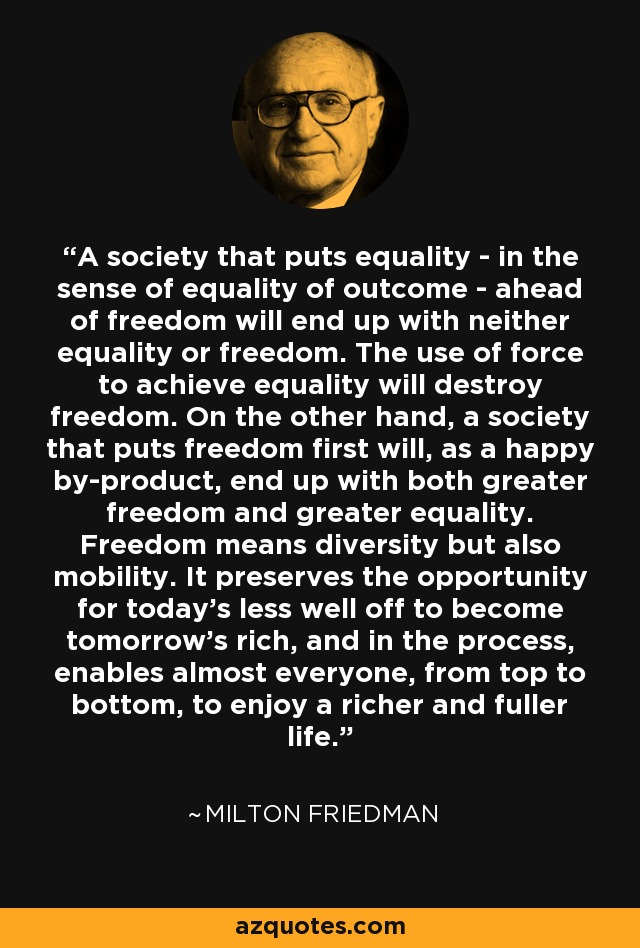
The main difference between capitalism and socialism is this: Capitalism works.


Sent from my iPhone

Wednesday, July 02, 2014

Income Inequality...Cured. Get (and stay) educated, Get (and stay) employed, Get (and stay) married


Three important "Get and Stays" and a lot of this country's problems would disappear. 
PROBLEM SOLVED. YOUR WELCOME!!! 
It even makes Bloomberg embrace conservative values. It must be that obvious. 


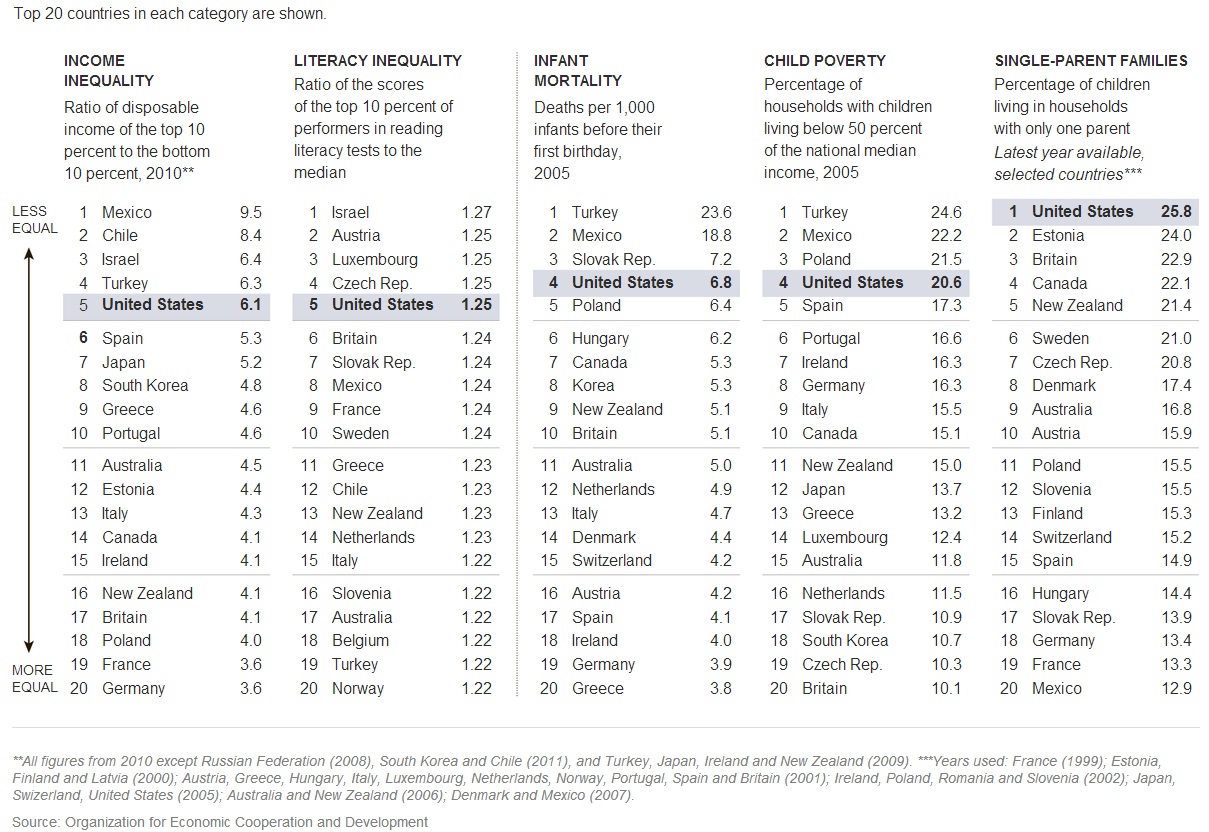
The U.S. compares very poorly to most other Western industrialized nations:
http://www.ritholtz.com/blog/wp-content/uploads/2013/07/fdafd.jpg
Washington may pay lip service to reducing inequality. But – as we will show below – bad government policy is largely responsible.
The Hard Facts of Inequality

A who's-who's of prominent economists in government and academia have all said that runaway inequality can cause financial crises.
from Carpe Diem:


Posted: 06 Dec 2013 09:03 AM PST
This week, President Obama called America's "dangerous and growing" income inequality the "defining challenge of our time,"and he plans to put the issue of income inequality at the center of his agenda during the remainder of his second term. The president is not alone in his concern about income inequality – there's been a lot of discussion in recent years on the issue, especially concerns about "increasing income inequality." That concern is demonstrated by more than 1 million search results for the term "increasing income inequality" on Google. However, there's apparently not as much attention or concern about "explaining income inequality" (there are only178,000 Google search results for that term), and that's the topic that this post will attempt to address.

Most of the discussion on income inequality focuses on the relative differences over time between low-income and high-income American households, but it's also instructive to analyze the demographic differences among income groups at a given point in time to answer the question: How are high-income households different from low-income households?

The chart above (click to enlarge) shows some key demographic characteristics of U.S. households by income quintiles for 2012, using updated data from the Census Bureau (here, here and here, and see my previous versions of this analysis for years 2009 and 2010 and 2011).
Below is a summary of some of the key demographic differences between American households in different income quintiles in 2012:

1. Mean number of earners per household. On average, there are significantly more income earners per household in the top income quintile households (2.04) than earners per household in the lowest-income households (0.45). It can also be seen that the average number of earners increases for each higher income quintile, demonstrating that one of the main factors in explaining differences in income among U.S. households is the number of earners per household. Also, the unadjusted ratio of average income for the highest to lowest quintile of 15.8 times ($181,905 to $11.490), falls to a ratio of only 3.5 times when comparing "income per earner" of the two quintiles: $89,169 for the top fifth to $25,533 for the bottom fifth.

2. Share of households with no earners. Sixty-one percent of U.S. households in the bottom fifth of Americans by income had no earners for the entire year in 2012. In contrast, only 3% of the households in the top fifth had no earners in 2012, providing more evidence of the strong relationship between household income and income earners per household.

3. Marital status of householders. Married-couple households represent a much greater share of the top income quintile (77.5%) than for the bottom income quintile (17%), and single-parent or single households represented a much greater share of the bottom 20% of households (83.0%) than for the top 20% (22.5%). Like for the average number of earners per household, the share of married-couple households also increases for each higher income quintile.

4. Age of householders. Almost 8 out of every 10 households (79.5%) in the top income quintile included individuals in their prime earning years between the ages of 35-64, compared to fewer than half (47.3%) of household members in the bottom fifth who were in that prime earning age group last year. The share of householders in the prime earning age group of 35-64 year olds increases with each higher income quintile.
Compared to members of the top income quintile of households by income, household members in the bottom income quintile were 1.6 times more likely (23.5% vs. 14.8%) to be in the youngest age group (under 35 years), and more than 5 times more likely (29.2% vs. 5.7%) to be in the oldest age group (65 years and over).

6. Work status of householders. More than four times as many top quintile households included at least one adult who was working full-time in 2012 (78.2%) compared to the bottom income quintile (only 18.2%), and more than five times as many households in the bottom quintile included adults who did not work at all (67.3%) compared to top quintile households whose family members did not work (12.5%). The share of householders working full-time increases at each higher income quintile.

7. Education of householders. Family members of households in the top fifth by income were six times more likely to have a college degree (77.2%) than members of households in the bottom income quintile (only 12.9%). In contrast, householders in the lowest income quintile were 26 times more likely than those in the top income quintile to have less than a high school degree in 2012 (26.7 % vs. 1.0%). As expected, the Census data show that there is a significantly positive relationship between education and income.

Bottom Line: Household demographics, including the average number of earners per household and the marital status, age, and education of householders are all very highly correlated with household income. Specifically, high-income households have a greater average number of income-earners than households in lower-income quintiles, and individuals in high income households are far more likely than individuals in low-income households to be well-educated, married, working full-time, and in their prime earning years. In contrast, individuals in lower-income households are far more likely than their counterparts in higher-income households to be less-educated, working part-time, either very young (under 35 years) or very old (over 65 years), and living in single-parent households.

The good news is that the key demographic factors that explain differences in household income are not fixed over our lifetimes and are largely under our control (e.g. staying in school, getting and staying married,etc.), which means that individuals and households are not destined to remain in a single income quintile forever. Fortunately, studies that track people over time indicate that individuals and households move up and down the income quintiles over their lifetimes, as the key demographic variables highlighted above change, see CD posts here, here andhere. And Thomas Sowell pointed out earlier this year in his column "Income Mobility" that:
Most working Americans who were initially in the bottom 20% of income-earners, rise out of that bottom 20%. More of them end up in the top 20% than remain in the bottom 20%. People who were initially in the bottom 20% in income have had the highest rate of increase in their incomes, while those who were initially in the top 20% have had the lowest. This is the direct opposite of the pattern found when following income brackets over time, rather than following individual people.


It's highly likely that most of today's high-income, college-educated, married individuals who are now in their peak earning years were in a lower-income quintile in their prior, single younger years, before they acquired education and job experience. It's also likely that individuals in today's top income quintiles will move back down to a lower income quintile in the future during their retirement years, which is just part of the natural lifetime cycle of moving up and down the income quintiles for most Americans. So when we hear the President and the media talk about an "income inequality crisis" in America, we should keep in mind that basic household demographics go a long way towards explaining the differences in household income in the United States. And because the key income-determining demographic variables change over a person's lifetime, income mobility and the American dream are still "alive and well" in the US.


 ---

from Carpe Diem:

Posted: 04 Feb 2014 01:22 PM PST
Income2012

In a December 2013 CD post, I featured the chart above (click to enlarge) that displays Census Bureau data of various household demographic factors by income quintile in 2012 (education, marital status, average number of earners, percent working full-time, age, etc.) that help us understand the factors that explain differences in household income.

In a recent National Review article ("The Working Rich"), Kevin Williamson refers to some similar, slightly older data (from 2011 I think) to make several important points: a) the wealthiest and highest-earning Americans are not "idle rich" but rather work very hard for their money, and b) the poor can learn some lessons from them to become more wealthy themselves. Here's an excerpt:
Rich America is working America: Wealthy households contain on average more than four times as many full-time workers as do poor households, and, surprisingly, inherited wealth constitutes a smaller share of their assets than it does for middle-class and poor households. They live modestly relative to their means and for the most part do not work on Wall Street or as corporate executives. The caricature of the rich American as a child of privilege who inherited a fortune and spends his days shuttling between mansions in a private jet is largely a product of the imagination of such would-be class warriors as Elizabeth Warren and Robert Reich, neither of whom lives in Section 8 housing, or even downwind of it.

There is a reason that money earned from work accounts for a relatively large share of the holdings of rich Americans: They work more — a lot more. While Census Bureau data document a very large gap in the prevalence of college degrees among the top 20 percent  of  households vs. the bottom 20 percent, there is an even larger and more significant gap — 60 percentage points — between full-time employment for householders in the top income group (78.2% in 2012, see chart above) vs. the bottom income group (18.2%). There is, to be sure, such a thing as the working poor, but the most salient characteristic of poor households is the lack of full-time workers in them. For the bottom income group, there is an average of 0.42 earners per household (0.45 in 2012), with 68.2 percent (67.3 percent in 2012) of householders not working at all, as opposed to 1.97 earners (2.04 in 2012) per household and only 13.3 percent (12.5 percent in 2012) not working for the highest income group. The answer to poverty turns out to be "get a job," after all — though that should be an aspiration toward which we assist the poor rather than a contemptuous dismissal of their needs.

Family matters. Not surprisingly, 78.4 percent (77.5 percent in 2012) of those highest-income families were married couples, as opposed to 17 percent (18.2 percent) for the lowest-income group. What this all means in brief is that the highest-income families are composed almost exclusively of two-earner households, the overwhelming majority of them married couples. Those who are inclined to see public policy mainly through green eyeshades may sniff at the social conservatives and their quaint worries about marriage, but there is a very strong connection between how we conduct our family lives and our economic outcomes — the very word "economy" derives from the Greek term for household administration, οἰκονομία. All the best people may roll their eyes at "tiger mom" Amy Chua's admiration for Asian-American, Nigerian-American, and Mormon domestic culture, but it is difficult to dismiss the results.
MP: As I concluded in my December post, household demographics like the average number of earners per household and the marital status, age, and education of householders are all very highly correlated with household income. Specifically, high-income households have a greater average number of income-earners than households in lower-income quintiles, and individuals in high income households are far more likely than individuals in low-income households to be well-educated, married, working full-time, and in their prime earning years. In contrast, individuals in lower-income households are far more likely than their counterparts in higher-income households to be less-educated, working part-time, either very young (under 35 years) or very old (over 65 years), and living in single-parent households.

The good news is that the key demographic factors that explain differences in household income are not fixed over our lifetimes and are largely under our control (e.g. staying in school, getting and staying married,etc.), which means that individuals and households are not destined to remain in a single income quintile forever. Fortunately, studies that track people over time indicate that individuals and households move up and down the income quintiles over their lifetimes, as the key demographic variables highlighted above change. And as Kevin points out, if the poor pay attention, they can learn from the rich and become better off themselves by investing in education, getting and staying married, and working full-time.


Is Inequality a Problem that needs Fixing?


Put me down for a "NO" on this one. 

Giants Top Minor League Prospects

  • 1. Joey Bart 6-2, 215 C Power arm and a power bat, playing a premium defensive position. Good catch and throw skills.
  • 2. Heliot Ramos 6-2, 185 OF Potential high-ceiling player the Giants have been looking for. Great bat speed, early returns were impressive.
  • 3. Chris Shaw 6-3. 230 1B Lefty power bat, limited defensively to 1B, Matt Adams comp?
  • 4. Tyler Beede 6-4, 215 RHP from Vanderbilt projects as top of the rotation starter when he works out his command/control issues. When he misses, he misses by a bunch.
  • 5. Stephen Duggar 6-1, 170 CF Another toolsy, under-achieving OF in the Gary Brown mold, hoping for better results.
  • 6. Sandro Fabian 6-0, 180 OF Dominican signee from 2014, shows some pop in his bat. Below average arm and lack of speed should push him towards LF.
  • 7. Aramis Garcia 6-2, 220 C from Florida INTL projects as a good bat behind the dish with enough defensive skill to play there long-term
  • 8. Heath Quinn 6-2, 190 OF Strong hitter, makes contact with improving approach at the plate. Returns from hamate bone injury.
  • 9. Garrett Williams 6-1, 205 LHP Former Oklahoma standout, Giants prototype, low-ceiling, high-floor prospect.
  • 10. Shaun Anderson 6-4, 225 RHP Large frame, 3.36 K/BB rate. Can start or relieve
  • 11. Jacob Gonzalez 6-3, 190 3B Good pedigree, impressive bat for HS prospect.
  • 12. Seth Corry 6-2 195 LHP Highly regard HS pick. Was mentioned as possible chip in high profile trades.
  • 13. C.J. Hinojosa 5-10, 175 SS Scrappy IF prospect in the mold of Kelby Tomlinson, just gets it done.
  • 14. Garett Cave 6-4, 200 RHP He misses a lot of bats and at times, the plate. 13 K/9 an 5 B/9. Wild thing.

2019 MLB Draft - Top HS Draft Prospects

  • 1. Bobby Witt, Jr. 6-1,185 SS Colleyville Heritage HS (TX) Oklahoma commit. Outstanding defensive SS who can hit. 6.4 speed in 60 yd. Touched 97 on mound. Son of former major leaguer. Five tool potential.
  • 2. Riley Greene 6-2, 190 OF Haggerty HS (FL) Florida commit.Best HS hitting prospect. LH bat with good eye, plate discipline and developing power.
  • 3. C.J. Abrams 6-2, 180 SS Blessed Trinity HS (GA) High-ceiling athlete. 70 speed with plus arm. Hitting needs to develop as he matures. Alabama commit.
  • 4. Reece Hinds 6-4, 210 SS Niceville HS (FL) Power bat, committed to LSU. Plus arm, solid enough bat to move to 3B down the road. 98MPH arm.
  • 5. Daniel Espino 6-3, 200 RHP Georgia Premier Academy (GA) LSU commit. Touches 98 on FB with wipe out SL.

2019 MLB Draft - Top College Draft Prospects

  • 1. Adley Rutschman C Oregon State Plus defender with great arm. Excellent receiver plus a switch hitter with some pop in the bat.
  • 2. Shea Langliers C Baylor Excelent throw and catch skills with good pop time. Quick bat, uses all fields approach with some pop.
  • 3. Zack Thompson 6-2 LHP Kentucky Missed time with an elbow issue. FB up to 95 with plenty of secondary stuff.
  • 4. Matt Wallner 6-5 OF Southern Miss Run producing bat plus mid to upper 90's FB closer. Power bat from the left side, athletic for size.
  • 5. Nick Lodolo LHP TCU Tall LHP, 95MPH FB and solid breaking stuff.