Sunday, June 15, 2014

Take me out to the Ball Game

Take Me Out to the Ball Game

This article from 2008 seems almost quaint in the current youth sport environment. It does ask what is many times posed as the big ticket debatable question, "Does involvement in sports promote character or produce characters".

This goes back to the quote from sportswriter Heywood Hale Broun:
"Sports do not build character. They reveal it."  

If that is the case, it seems like we are spending a lot of time as coaches and sports administrators attempting to jam square pegs into round holes. Maybe that is the most maddening part of the problem.

from vision.org
http://www.vision.org/visionmedia/article.aspx?id=4710

Society & Culture 
Take Me Out to the Ball Game
March 11, 2008

Early seasonal sightings in North America of the blue-beaked shortstop and the red-breasted right fielder foretell of flocks sure to follow. As winter gives way to spring, town parks and area playing fields will sprout youth sport programs—a bevy of brightly-colored, budding ball players eager to strut their stuff.  

Laden with lawn chairs, picnic baskets and pets, proud parents leave their nests to assemble and enjoy the adorable exuberance and athletic exploits of their offspring. The cheerful scene of children at play in a safe and well-supervised setting is a delight to behold and a credit to communities that care for their fledging citizens. 

For many moms and dads, going out to the ball game is a welcome diversion from daily duties, a time of wholesome family fun in hometown America. If you buy them some peanuts and cracker jacks, they won’t care if they ever go back to the harried pace and hectic regimen of routine responsibilities.


In the Big-Inning

Early in the 20th century social agencies like the Young Men’s Christian Association (YMCA) began sponsoring sports and structured recreational activities, ostensibly designed to keep boys out of trouble. 

In 1938 an oil company clerk named Carl Stotz had an idea for an organized baseball league for the boys in his hometown of Williamsport, Pennsylvania. With some help from family and friends, the first official Little League game was played on June 6, 1939.  Over the past six decades, Little League Baseball has become the world’s largest organized youth sports program with over 180,000 teams in all 50 U.S. states and 80 different countries. 

Little League Baseball describes its mission, unchanged since 1939, as being to: “provide a wholesome, healthy activity for children using the ball field as a classroom, to instill discipline, teamwork, sportsmanship and fair play, and to establish a set of values to guide them into adulthood, and hopefully responsible citizenship. These are the reasons Carl Stotz founded the program, and they are the reasons it exists today.” 

Since the middle of the 20th century, adult-organized athletic activities for youth have grown dramatically. The view that these programs convey values, and cultivate character has been generally accepted in American culture. 

A 2001 National Council of Youth Sports report indicates that 63 percent of boys and 37 percent of girls in America participate in an organized youth sports program for an average of five years. Over 38 million children participate in structured sports programs annually.


It’s Only a Game, Isn’t It?

Why do parents continue to register their kids in record numbers? Is it all fun and games?  Or is there an expected return on their investment of time and money? At a time when warnings of childhood obesity abound, the obvious benefits of additional activity and exercise are attractive. Some have fond memories of their own childhood experiences and wish the same for their kids. Others express hope that physical abilities learned through structured play with peers will foster confidence and enhance social skills, teamwork, cooperation and the ability to deal with disappointment.


But are we asking too much of sports and extracurricular activities? Is it reasonable to expect fields to function as classrooms of character? If we claim that sports can assist in building character, must we concede that if abused they can damage and destroy character? 


By nature, competitive sports involve determined effort and emotional intensity. It is this inherent pressure to push oneself to perform that attracts some parents to enroll their kids in these activities. They anticipate that the discipline demanded by competition will promote physical and mental toughness, produce character and prepare children for the rigors of life.


But does competition promote Character or produce characters?

Daniel E. Doyle, Jr. is founder and executive director of the Institute of International Sport at the University of Rhode Island. Widely-acclaimed institute initiatives include National Sportsmanship Day, The World Scholar-Athlete Games, and the Center for Sports Parenting. Doyle holds a master of arts degree from the Fletcher School of Law and Diplomacy at Tufts University. He has addressed sports ethics with student athletes for the National Collegiate Athletic Association (NCAA) on over 100 college campuses and has received two honorary doctorates for his work in sports education. 


Doyle recently discussed the relationship between sports and character with Vision. When asked if competitive sports can deliver the much-desired benefit of building character in children, he replied: “Sports can teach traits that transfer into skill for success in life, but athletic prowess alone is not a guaranteed path to good life choices.” 


In his recently released book, The Encyclopedia of Sports Parenting, the first in a three-volume series that can serve parents as a comprehensive guide for navigating the youth sports scene from novice to the NCAA, Doyle declares: “As a youngster playing sports in Worcester, Massachusetts, it was common to hear a well-meaning coach say, ‘If you’re a success on the court, you’ll be a success in life.’ This is not necessarily true!” 


“For those unable to transfer athletic excellence to other undertakings, there seemed to be a revealing common denominator: their success as young athletes had given them a false, even delusional sense of self-importance. For many, athletic success was accompanied by the passivity and even complicity of parents, coaches or teachers who permitted the young stars to take shortcuts and neglect their academic and character development.  When parents encourage balance and perspective, sports can have a wonderful impact on a child. Without such balance and perspective, sports can produce detrimental, sometimes devastating consequences.” 


Sadly, a lack of perspective causes some to perceive the young player’s rite of passage as the first encounter with the formidable forces that determine winners and losers in the game of life. To these folks this is more than mere child’s play. Their offspring’s identity, and no doubt their own, is at stake.


Cheers, Jeers, Tears and Fears!
Unfortunately, all is not fun and games in Norman Rockwell’s America. Social commentators continue to express concern about the coarsening of contemporary culture. That trend reveals itself as a lack of sportsmanship by coaches, athletes and spectators at sporting events. Although unsportsmanlike conduct is not new, it does seem that appropriate standards of behavior were less ambiguous to previous generations.  

Why do we tolerate trash-talking, taunting and baiting of opponents by young athletes? Are we unwittingly acquiescing to an adversarial “in your face” attitude? Emboldened by the cover of the crowd, some fans revel in hurling crude comments and abusive attempts at humor toward players, officials and each other. 

Ironically, some adults expect organized sports to help develop good character in their children while they themselves demonstrate insidious incivility and lack of self-control on the sidelines. Are they unaware that their crass conduct undermines the credibility of the claim that sports competition is a classroom for responsible citizenship? 

Is good sportsmanship becoming an endangered ethic of a bygone era? 

Doyle believes that balance and perspective come from constructing a values-based sports parenting philosophy. He advises parents to adopt an anchors/aspirations approach to child rearing. 

“My anchor/aspiration approach to child rearing is simple. It proposes that aspirational goals such as excellence in sports or the arts are wonderful—they ennoble our lives. But the aspirations must be fortified by two anchors—character development and training the mind—or serious problems can develop. The objective is not to suppress a child’s desire to excel but rather to support the desire by making sure that the two anchors are safely moored. Failure to demand consistent effort toward achieving proficiency in the anchor qualities is very detrimental to a youngster’s long-term development. Aspirational sports goals should never be mistaken as substitutes for, or interchangeable with, the anchor values.”


The Honorable Competitor
Can opponents clash in a competitive contest and demonstrate mutual respect while challenging one another to be and do their best? Doyle suggests that they can indeed if they are taught the true meaning of honorable competition.

“Teach your young athlete that the word competition comes from the Latin word competere, which means to strive together, not against each other. Respect is an important part of this concept. Impress upon your young athlete that the honorable competitor respects opponents and, when an opponent tries hard and plays fairly, one often ends up both respecting and admiring the opponent.” 
If we want sports and extracurricular activities to contribute to the good character of our children, then we must have a predetermined values-based parenting philosophy that we require our children adhere to both on and off the field. Doyle emphasizes, “Parents should punish their children for unsportsmanlike conduct, whether officials do or not. Parents who fail to discipline a young athlete often rationalize their failure with excuses such as the umpires are unfair or the other team plays dirty. Dads and moms must let their athlete know that misconduct will result in home discipline. Parents who ignore problems send the message that misconduct is acceptable. If you fail to actively and consistently teach your child the right values, you are, by default, leaving your child open to learning the wrong values. Harmful values include a win-at-any-cost mentality, outright cheating, arrogance, selfishness, acts of aggression and taking shortcuts to get ahead.” 

Parents seeking to promote the positive and neutralize the negative components of the contemporary competitive sports scene will benefit from the practical advice in Doyle’s The Encyclopedia of Sport Parenting

Parents seeking a code of conduct—a core set of virtues for formulating their parenting philosophy—need look no further than the Judeo-Christian ethic. Its golden rule provides a solid basis for a principled philosophy, good sportsmanship and quality of character. Do unto others as you would have them do unto you! This one brief statement promotes balance and perspective, expounds empathy, reveals the secret to graceful winning or dealing with disappointment, and champions the cause for class and character. 


TOM FITZPATRICK
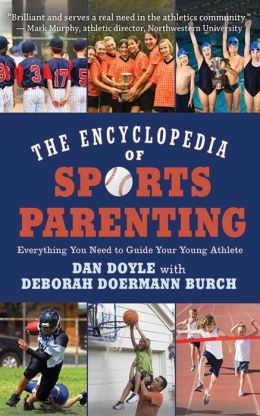

 The Encyclopedia of Sports Parenting: Everything You Need to Guide Your Young Athlete

Happy Father's Day


Contrary to the recent trend in society today, apparently you are important. So take this day to celebrate that importance and then shut up, get back to work and do your job. 

 from Wikipedia:
Father's Day[1] is a celebration honoring fathers and celebrating fatherhood, paternal bonds, and the influence of fathers in society. Many countries celebrate it on the third Sunday of June, though it is also celebrated widely on other days by many other countries. Father's Day was created to complement Mother's Day, a celebration that honors mothers and motherhood.
Funny that they include the word "complement" in there, since that is what makes the traditional form of marriage not only unique, but better than any other form out there today. Not "equal to" or "same as", but "better than" and offering something that the others cannot.

Emperical evidence demonstrates that over and over again.   So does common sense.

Fathers' Involvement Can Change Children’s Futures

from the Daily Signal:

Children with involved fathers are more likely to graduate from college—particularly among middle- and upper-income families but also among those from lower-income backgrounds, a recent study found.
 According to this new research by Brad Wilcox at the University of Virginia, the family structure that best promotes this involvement is a married, intact family. This is the case for youth from lower-educated homes as well as those from more highly educated homes.
Wilcox also found fathers are more involved with their children today than they have been in the past. The amount of time fathers spend with their children each week has increased from 4.2 hours on average in 1995 to 7.3 hours on average in 2011. The down side is that fewer teens live in intact families, particularly teens from working-class and lower-income homes.
On the other hand, their peers from college-educated homes are "triply advantaged," according to Wilcox: "They typically enjoy more economic resources, an intact family, and an involved father."
The question then is, how to keep youth connected with their fathers, or, as Wilcox puts it, how to "bridge the fatherhood divide between children from college-educated and less-educated families."
Increasing the odds that more children are raised in homes with their married mother and father is a crucial factor in the equation.
Today, more than  40 percent of children are born to unwed mothers.
Among lower- and moderately educated (high school diploma or less) households, the number is much higher. Taking this factor into account along with the high rate of divorce, 55 percent of children are expected to spend some time outside of an intact-parent family before they reach their 18th birthday.
Despite the trends, accepting the decline of marriage is not the answer. Marriage is critical to helping children succeed, as Wilcox's research and a multitude of other studies attest. Marriage is the foundation of a strong society, helping men, women and children thrive.
Some communities are taking action. In his recent book, Brigham Young University professor Alan Hawkins describes a plan for helping individuals and couples build and maintain lasting, healthy marriages. As I wrote last month in Public Discourse, Hawkins makes the case that preparing for and maintaining a healthy marriage is a lifelong endeavor. His strategy includes relationship and marriage education throughout different stages of life: from helping youth in high school learn how to build healthy relationships that will prepare them for marriage down the road, to helping couples in crisis salvage their marriage if possible.
Hawkins points to examples of schools, communities and states that have taken important steps to providing opportunities to build and strengthen marriages.
For example, he points to high schools in Alabama that have taught relationship literacy education" classes. Students who participated in these classes had more realistic attitudes about marriage and better conflict-management skills a year after participating, compared to their peers who didn't participate. More than half of the students came from low-income households.
Additionally, First Things First in Chattanooga, Tenn., runs a "community healthy marriage initiative." First Things First provides marriage education courses, operates public advertising campaigns about the importance of marriage and sponsors events for couples and families. They report that their efforts have reduced divorce rates in their community by nearly 30 percent (although a more rigorous evaluation is needed).
Finally, Utah and Oklahoma have taken the lead on marriage initiatives by providing marriage and relationship education to couples.
There are promising examples, yet far more is needed. As Hawkins points out, the United States must renew a culture of marriage if real change is to take place. Leaders at every level need to promote the culture of marriage.
A restoration of marriage in the United States will ensure more children have the opportunity to thrive, not only academically but when it comes to their physical and emotional health, as well as their own relationship success. Ultimately, it will mean providing a culture that gives Americans the greatest likelihood to succeed in achieving their dreams.


Friday, June 13, 2014

Giants Law may need TJ surgery and the 4/2 Rule


"For every four you take, two will break...." The Giants Derek Law may fall victim to this baseball organizational rule of thumb. It also helps explain why some of these guys move up and down or on and off the various prospect lists.


If Law goes down for Tommy John surgery, he may disappear from the lists for a year or so. Bad news for the Giants, as he was progressing very well. Law was described as having "elbow tightness" and many times that term is a precursor to packing your bags for a trip to the orthopedic surgeon.


from San Jose Mercury News:

Michael Morse forgets criticism, makes former team Washington Nationals pay - San Jose Mercury News:

Right-hander Derek Law (forearm tightness) had an MRI this week and will see another specialist Saturday in Arizona. The Giants had hoped Law, one of the organization's top pitching prospects, could avoid Tommy John surgery, but Bochy didn't sound encouraged Thursday.
"Obviously there's a lot of concern with what may be the next move," Bochy said.
'via Blog this'


Here is the story that explains the quote from Dodgers VP Logan White. You can never have enough pitching.


from MLB.com

http://losangeles.dodgers.mlb.com/news/article/la/pitching-remains-a-staple-of-dodgers-draft-plans?ymd=20140602&content_id=77653296


LOS ANGELES -- The sudden epidemic of Tommy John surgeries in baseball isn't so sudden to Dodgers vice president Logan White.
It's an occupational risk he considers every year at this time, when -- more often than not -- he ties his livelihood to the fragility of some kid's ulnar collateral ligament.
White said he has long subscribed to a selection theory that assigns equal weight to quantity and quality because of predictable attrition.
"You've heard me say over and over why I draft a lot of pitchers, " said White. "It's my 4/2 rule. For every four you take, two will break, probably need surgery at some point. So I draft a lot of pitchers. Some clubs will stay away from the pitchers because they worry about the injuries. I think that's wrong.
"Pitching is always the most valuable commodity. You have to draft pitching. I try to draft the player that will have the greatest impact on the Major League level for the longest time. That's the type of player I look for, and he's often a pitcher. You hope it's a [Clayton] Kershaw or a [Matt] Kemp. That's what you're shooting for."

Friday, June 06, 2014

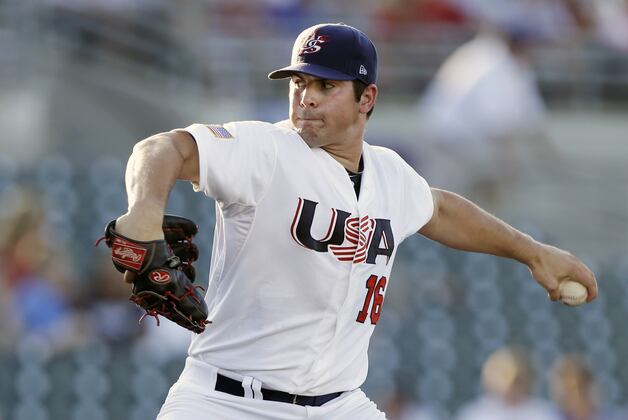
Carlos Rodon: Prospect Profile for Chicago White Sox's 1st-Round Pick | Bleacher Report

Carlos Rodon: Prospect Profile for Chicago White Sox's 1st-Round Pick

The safe pick here for the White Sox, probably broke a few hearts in the Cubs war room. The comparison in the article is to Rays David Price. If he give the WSox anywhere near that, they will be very happy.

from Bleacher Report:
Carlos Rodon: Prospect Profile for Chicago White Sox's 1st-Round Pick | Bleacher Report:
Nobody in college baseball has been better over the last three seasons than Carlos Rodon. And now, after a historically good career at N.C. State, the left-hander is finally ready to enter the professional ranks.
A 16th-round selection by the Brewers in 2011 out of high school, Rodon has been viewed as the favorite to be this year’s No. 1-overall pick basically since setting foot on campus. In 2012 the left-hander became the first freshman in conference history to win the ACC Pitcher of the Year award after posting a 1.57 ERA and 0.98 WHIP with 135 strikeouts in 114.2 innings (16 starts). His remarkable season also led to him being named Louisville Sluggers’ National Freshman of the Year.
'via Blog this'

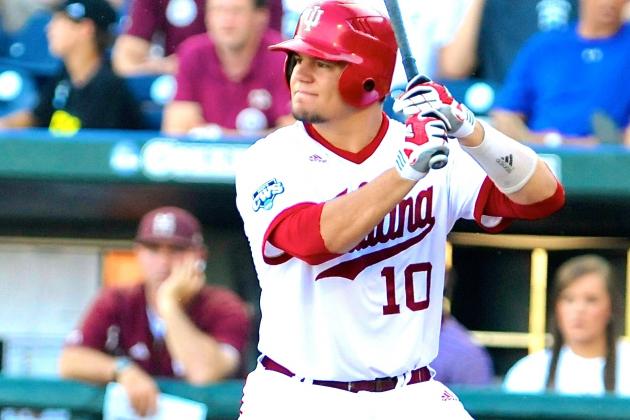
Kyle Schwarber: Prospect Profile for Chicago Cubs' 1st-Round Pick | Bleacher Report

Kyle Schwarber: Prospect Profile for Chicago Cubs' 1st-Round Pick

A bit of an eye-opener from the Cubs in the four spot. No question about the bat, but questions about whether he sticks as a C raise the question of whether the Cubs were trying to fill a need at C or a general need for more offense. If he sticks behind the dish, it's an OK pick, I probably would have gone for Kennesaw State's C Max Pentecost here. Cubs fans will love his beer league softball look and feel and his mashing of the baseball regardless of where he plays on defense.

The comp in the article is is to Mike Napoli.

from Bleacher Report:
Kyle Schwarber: Prospect Profile for Chicago Cubs' 1st-Round Pick | Bleacher Report:

Kyle Schwarber is the kind of player who would have been right at home in the MLB draft 15-20 years ago, when the focus was on finding power-hitting college bats who wouldn't add much, if any, value on defense.

The good news is Schwarber's offensive skill set, most notably his huge raw power, makes him more valuable than ever due to how scarce pop is at the college level. He's come a long way from being an undrafted high school senior, leading the Big Ten in home runs and being a first-team All-American last season.

'via Blog this'

Rays pick Casey Gillaspie


2014 First-Year Player Draft

The comp in the article is to Mark Teixeira, which may be due to the fact that he is pigeon-holed as a 1B-DH type who switch-hits. If his bat produces anything near Teixeira like production, the Rays would take that right now. These bats have to start paying off for the Rays who need the help at the major league level very quickly.

from Bleacher Report:
http://bleacherreport.com/articles/2076625-casey-gillaspie-prospect-profile-for-tampa-bay-rays-1st-round-pick?
The younger brother of Chicago White Sox corner infielder Conor Gillaspie, Casey, a switch-hitting first baseman, has done nothing but improve since arriving at Wichita State.
After going undrafted out of high school, Gillaspie made an immediate impact for the Shockers in 2012 as a freshman, batting .274/.378/.442 with 10 doubles, eight home runs and a respectable 43/34 strikeout-to-walk ratio in 59 games.
'via Blog this'

Giants roll with “Young Beedah.” Select right-hander Tyler Beede from Vanderbilt – Giants Extra


I like the pick. I would have like a collegiate bat like Bradley ZImmer as well, but Beede is a potential top of the rotation type that the Giants couldn't pass up. Concerns about his command will allow him to fit right in with Crick, et al.  This is the second time Beede has been picked in the first round, having been picked 21st overall in 2011. He considers himself an accomplished rapper, so he would fit right in with the Giants somewhat eclectic clubhouse and dugout.

from Giants Extra:
Giants roll with “Young Beedah.” Select right-hander Tyler Beede from Vanderbilt – Giants Extra: "The rough 2013 season gave the Giants a high-ish draft pick, and naturally they used it on a pitcher. Tyler Beede is the selection. A right-hander from Vanderbilt, Beede was a first-round pick of the Blue Jays in 2011 but decided not to sign. Here’s a story on the new kid, with quotes from John Barr, including this: “He’s someone who, I hate to set timetables on, has a chance of moving quickly.”"

'via Blog this'

Thursday, June 05, 2014

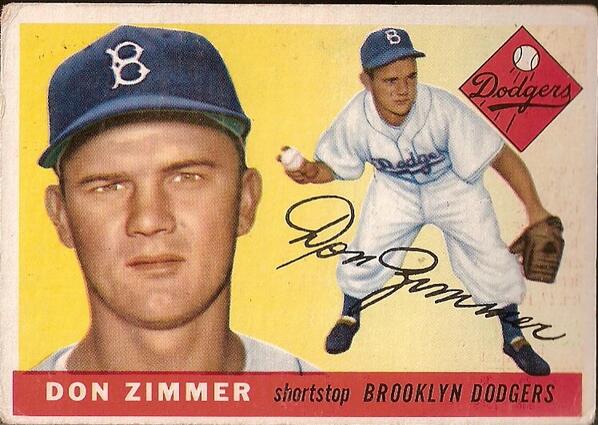
Don Zimmer dies at 83 — he lived a baseball life that could not be duplicated | Yahoo Sports

View image on Twitter

Sad news. Zim spent time with and made a significant impact on the Red Sox, the Yankees and the Rays, now three pretty big rivals. A baseball lifer, well respected and highly regarded he will be sorely missed by all those he touched. One of the quotes about Zim was "..the best baseball man I know" an indication of the powerful influence he had on the players and fellow coaches he interacted with. RIP Zim.

from Yahoo Sports:
Don Zimmer dies at 83 — he lived a baseball life that could not be duplicated | Big League Stew - Yahoo Sports:
Baseball is without Don Zimmer now. He died Wednesday at age 83. After his heart surgery in April, Zimmer remained hospitalized because of fibrosis in his lungs. His son, Tom Zimmer, told the Tampa Bay Times that his father went peacefully. "He just faded away."
In Major League Baseball, however, Zimmer will do no such thing. He'll be remembered as a treasure of the game. Commissioner Bud Selig called him one of the game's "most universally beloved figures." Jim Leyland said there's no better person in life than Zimmer. Pick someone in baseball, anyone, they're saying good things about Don Zimmer right now.
Zimmer won six World Series, a manager of the year award and was an All-Star twice. Zimmer played with Jackie Robinson and coached Derek Jeter, bookends of a baseball life that can't be duplicated.
'via Blog this'

I remember when he would come to his grandson's games in St. Petersburg, Florida and just sat in the stands and watched quietly like any other proud grandfather. Other than the occasional comment from an admirer -- "That's Don Zimmer siting over there" -- you wouldn't have even known he was there.

In an arena where alpha males throw out their chests and are all too ready to let you know who they are, what they are and where they are at every waking moment, he seemed like a very humble guy with a great perspective on baseball and life. He will be sorely missed.

Giants Top Minor League Prospects

  • 1. Joey Bart 6-2, 215 C Power arm and a power bat, playing a premium defensive position. Good catch and throw skills.
  • 2. Heliot Ramos 6-2, 185 OF Potential high-ceiling player the Giants have been looking for. Great bat speed, early returns were impressive.
  • 3. Chris Shaw 6-3. 230 1B Lefty power bat, limited defensively to 1B, Matt Adams comp?
  • 4. Tyler Beede 6-4, 215 RHP from Vanderbilt projects as top of the rotation starter when he works out his command/control issues. When he misses, he misses by a bunch.
  • 5. Stephen Duggar 6-1, 170 CF Another toolsy, under-achieving OF in the Gary Brown mold, hoping for better results.
  • 6. Sandro Fabian 6-0, 180 OF Dominican signee from 2014, shows some pop in his bat. Below average arm and lack of speed should push him towards LF.
  • 7. Aramis Garcia 6-2, 220 C from Florida INTL projects as a good bat behind the dish with enough defensive skill to play there long-term
  • 8. Heath Quinn 6-2, 190 OF Strong hitter, makes contact with improving approach at the plate. Returns from hamate bone injury.
  • 9. Garrett Williams 6-1, 205 LHP Former Oklahoma standout, Giants prototype, low-ceiling, high-floor prospect.
  • 10. Shaun Anderson 6-4, 225 RHP Large frame, 3.36 K/BB rate. Can start or relieve
  • 11. Jacob Gonzalez 6-3, 190 3B Good pedigree, impressive bat for HS prospect.
  • 12. Seth Corry 6-2 195 LHP Highly regard HS pick. Was mentioned as possible chip in high profile trades.
  • 13. C.J. Hinojosa 5-10, 175 SS Scrappy IF prospect in the mold of Kelby Tomlinson, just gets it done.
  • 14. Garett Cave 6-4, 200 RHP He misses a lot of bats and at times, the plate. 13 K/9 an 5 B/9. Wild thing.

2019 MLB Draft - Top HS Draft Prospects

  • 1. Bobby Witt, Jr. 6-1,185 SS Colleyville Heritage HS (TX) Oklahoma commit. Outstanding defensive SS who can hit. 6.4 speed in 60 yd. Touched 97 on mound. Son of former major leaguer. Five tool potential.
  • 2. Riley Greene 6-2, 190 OF Haggerty HS (FL) Florida commit.Best HS hitting prospect. LH bat with good eye, plate discipline and developing power.
  • 3. C.J. Abrams 6-2, 180 SS Blessed Trinity HS (GA) High-ceiling athlete. 70 speed with plus arm. Hitting needs to develop as he matures. Alabama commit.
  • 4. Reece Hinds 6-4, 210 SS Niceville HS (FL) Power bat, committed to LSU. Plus arm, solid enough bat to move to 3B down the road. 98MPH arm.
  • 5. Daniel Espino 6-3, 200 RHP Georgia Premier Academy (GA) LSU commit. Touches 98 on FB with wipe out SL.

2019 MLB Draft - Top College Draft Prospects

  • 1. Adley Rutschman C Oregon State Plus defender with great arm. Excellent receiver plus a switch hitter with some pop in the bat.
  • 2. Shea Langliers C Baylor Excelent throw and catch skills with good pop time. Quick bat, uses all fields approach with some pop.
  • 3. Zack Thompson 6-2 LHP Kentucky Missed time with an elbow issue. FB up to 95 with plenty of secondary stuff.
  • 4. Matt Wallner 6-5 OF Southern Miss Run producing bat plus mid to upper 90's FB closer. Power bat from the left side, athletic for size.
  • 5. Nick Lodolo LHP TCU Tall LHP, 95MPH FB and solid breaking stuff.