Friday, February 27, 2015

Angel Pagan's Healthy Comeback as Good as Big Offseason Splash for Giants | Bleacher Report

Angel Pagan's Healthy Comeback as Good as Big Offseason Splash for Giants


The key to the Giants success could be the trainer and strength and conditioning staff. More production out of Pagan and Cain could offset the loss of production from losing Sandoval and Morse.

from Bleacher Report:
Angel Pagan's Healthy Comeback as Good as Big Offseason Splash for Giants | Bleacher Report:
The San Francisco Giants' biggest offseason addition might turn out to be a guy who was there all along.

No, not Matt Cain, though if the right-hander can return to ace-level status after surgeries on his elbow and ankle it'd go a long way toward solidifying San Francisco's rotation.
'via Blog this'

Thursday, February 26, 2015

Josh Hamilton meets with MLB after drug relapse: source - NY Daily News


Josh Hamilton has been summoned to New York for a meeting with MLB officials. 


I heard the report from MLB Network this morning on Sirius that a league source, when asked if Hamilton's issue was due to PED use, reportedly said "worse, far worse".

Like fellow Angels OF Mike Trout said, "this sucks". But this is what worse, far worse and Hamilton's prior struggles lead you to conclude.

Thought and prayers go out to Josh and his loved ones. This has to be devastating news to them as well as his extended baseball family.

from NY Daily News:
Josh Hamilton meets with MLB after drug relapse: source - NY Daily News:

Josh Hamilton, the slugging outfielder who seemed destined for baseball stardom but has been repeatedly sidelined due to substance abuse, was summoned to New York to meet with MLB officials Wednesday about a disciplinary issue.

A source told The News that Hamilton — whose struggles with crack cocaine and alcohol have been well-documented — suffered a cocaine and alcohol relapse.
According to CBSSports.com, Hamilton told MLB about his relapse. His father-in-law, Michael Chadwick, reportedly said Wednesday that Hamilton has “hit a bump in the road, keep him in your prayers.”
 The Los Angeles Times reported that the Angels are preparing for a possible suspension.
'via Blog this'

Grow: Imagining an MLB concussion lawsuit | SABR


Image result for MLB concussions

Get used to the term "guardian of player safety". It could be coming to a courtroom near you and will include MLB and more importantly youth sports leagues according to the article.  Between lawyers and insurance companies, nothing brings fundamental change to a sports landscape quicker than a major court decision.

Something to keep an eye on. One thing is for sure, it will not drive the cost to participate or attend any of the sports down.

from SABR.org
Grow: Imagining an MLB concussion lawsuit | SABR:
Grow: Imagining an MLB concussion lawsuit
From SABR member Nathaniel Grow at FanGraphs on February 18, 2015:
You may have heard that football is in the midst of a bit of a concussion crisis. Not only is the National Football League facing a number of concussion-related lawsuits, but suits have been filed at the collegiate, high school, and Pop Warner levels as well. Meanwhile, both professional hockey and soccer are also facing their own concussion litigation.
Like football, hockey, and soccer, baseball is also – at times – a contact sport, and baseball players occasionally suffer concussions. In 2013, for instance, former outfielder Ryan Freel became the first professional baseball player to be diagnosed with chronic traumatic encephalopathy (CTE) – the brain disease often associated with professional football players – following a career during which he reportedly suffered nine or ten concussions.
So it is reasonable to ask whether Major League Baseball could be the next league to face a concussion-related lawsuit, and if so, how such a case would compare to those in the other sports?
Read the full article here:
http://www.fangraphs.com/blogs/imagining-an-mlb-concussion-lawsuit/

'via Blog this'


First, a bit of legal background. The pending lawsuits against the NFL and National Hockey League are based on the idea that both leagues voluntarily assumed the role of “guardian of player safety,” and therefore owed their players a legal duty of care. This duty of care, the lawsuits assert, required the leagues to not only take reasonable precautions to protect their players from injury, but also required them to inform their players of any known dangers related to their sport.

Econlib: What Every HS Junior should know before going to college

image
What Every High School Junior Should Know About Goin...
EconLog reader Meretta Marks sent me the following request:Would you consider the following topic for your EconLog blog:
Preview by Yahoo


EconLog reader Meretta Marks sent me the following request:

Would you consider the following topic for your EconLog blog:
"What every high school junior should know before thinking of going to college"
Suppose.....it's the beginning of the school year in high school.  Many members of the junior class are starting to think about planning for college, i.e. do they want to go and why, how they should start the process, what questions should they think to be asking, etc.

Here's what I'd say...

Dear Juniors,

You've spent the last eleven years of your life in school.  When you started, you were a child, and treated like a child.  Now you're almost an adult, and you're finally facing some adult choices.  One of the biggest: Should you stop school after you graduate from high school, or continue on to college?

Going to college definitely sounds better.  Almost every authority figure in your life - educators and family alike - recommend it to each and every student.  But as you may have noticed, authority figures are often untrustworthy.  Indeed, they usually bend the truth whenever honesty makes them look bad.  This doesn't mean you shouldn't go to college, but it is a reason to second-guess the party line, to seek out ugly facts parents and educators would rather ignore.  

Fortunately, you need not seek far.  Unlike most educators, I put candor above social acceptability.  Skim my writings if you don't believe me.  In all candor, then, here's what I have to say about going to college.  

1. College is a good deal for good students, a mediocre deal for mediocre students, and a poor deal for poor students.  

2. Once in a long while, a poor student morphs into good student.  But expecting any particular poor student - yourself included - to morph into a good student is wishful thinking.  

3. How do you know if you're a good, mediocre, or poor student?  Look at your past academic performance - your grades and standardized test scores.  If you're in the top 30%, you're good.  If you're in the next 20%, you're mediocre.  If you're in the bottom half, you're poor.
  
4. This 30/20/50 breakdown is relative to all American high school students.  If your high school is academically strong, the breakdown is probably more like 45/30/25.  If your high school is academically weak, it's probably more like 10/20/70.  If this baffles you, I'm afraid you're probably not a good student.

5. The main reason why college is a good deal for good students, a mediocre deal for mediocre students, and a poor deal for poor students: good students usually finish college, mediocre students usually don't, and poor students almost never do.  And most of the payoff for college comes from finishing.

6. The secondary reason why college pays better for better students: hard majors pay better than easy majors, and better students gravitate toward harder majors.

7. One bad argument against college: "What professors teach isn't relevant in the real world."  In the labor market, degrees in the most irrelevant subjects still open doors and raise pay.  Many jobs simply require a college degree in... whatever.  Thedifficulty of your major matters a lot more to employers than its relevance.

8. Completion rates at two-year colleges are well below those at four-year colleges - even for students who look the same on paper.  If you can't handle a four-year college, you probably can't handle a two-year college either.  Two-year college is not a happy medium between four-year college and no college.

9. When you decide whether to go to college, you should consider the college experience as well as the career benefits.  But the college experience is greatly overrated.  A good rule of thumb: If your studies bore you in high school, they'll probably bore you in college too.

10.  Don't go to college because you have no idea what career to pursue.  Most recent college graduates feel the same bewilderment.  In both cases, you need to dive into the labor market and try your luck.  

High school juniors, I don't want to crush your dreams.  But I'd rather crush your dreams than see you waste years of your lives and many thousands of dollars.  When teachers and parents reassure you that "Every student is a good student," that is a flowery lie.  

Suppose your 150-pound friend dreams of being a professional football player.  Would a true friend urge him on?  No, he'd warn his mid-weight friend that he is astronomically unlikely to succeed in football, and needs to consider more realistic careers.  I'm trying to play the same role for mediocre and poor students who expect to succeed in college.

Please don't get mad at me.  I am only a messenger.  If you're going to get mad at anyone, get mad at all the authority figures who give you counter-productive advice to spare your feelings - and their own.

In friendship,

Bryan Caplan
Professor of Economics
George Mason University


Econlib: The Ten Pillars of Economic Wisdom

The Ten Pillars of Economic Wisdom, David Henderson | EconLog | Library of Economics and Liberty
A few times I've referred to "The Ten Pillars of Economic Wisdom" that I teach at the start of every economics course I give.
Preview by Yahoo


A few times I've referred to "The Ten Pillars of Economic Wisdom" that I teach at the start of every economics course I give. I've usually linked to someone's restatement of them from my book, The Joy of Freedom: An Economist's Odyssey. But I've updated a few times since then. Here's the current version of them.

The Ten Pillars of Economic Wisdom
By David R. Henderson

1. TANSTAAFL: There ain't no such thing as a free lunch.
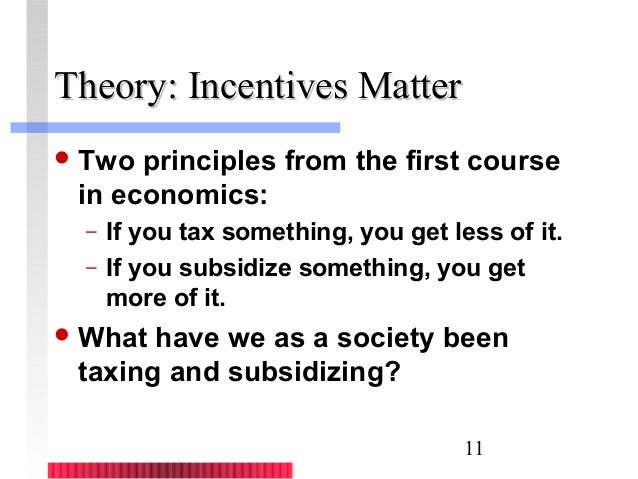
2. Incentives matter; incentives affect behavior.
3. Economic thinking is thinking on the margin.
4. The only way to create wealth is to move resources from a lower-valued to a higher-valued use. Corollary: Both sides gain from exchange.
5. Information is valuable and costly, and most information that's valuable is inherently decentralized.
6. Every action has unintended consequences; you can never do only one thing.
7. The value of a good or a service is subjective.
8. Creating jobs is not the same as creating wealth.
9. The only way to increase a nation's real income is to increase its real output.
10. Competition is a hardy weed, not a delicate flower.

Wednesday, February 25, 2015

MLB Moneyball Power Rankings and the effect of Tax Policy on Roster Construction (sexy, huh?)


Now we just need a Michael Lewis-type author to glamorize, sensationalize and personalize a Billy Beane-type CFO and we could make a complimentary sequel of books / movies / DVD's..

We can call it Bean-Counter Ball or Laffer Ball, in honor of the Laffer curve.

I'm on it!!

I'm just not sure how to glamorize a profession laden with bow-ties, excel spreadsheets and pocket protectors. ~;::::::;( )">  ¯\_( )_/¯

Wait! I know, I'll ask Mrs. TheSlav. She knows everything.....


Major League Baseball has a payroll luxury tax and an international signing limit tax. The Giants have avoided getting dinged on either of those, moving as nimbly as a Ford F-350 with a Ron Paul bumper sticker.

But until they find a way to uproot AT&T Park and haul it to Reno, the tax man will continue to make a major impact on how they build a roster.

That was the most interesting part of the general discussion around Giants GM Brian Sabean's podium as baseball managers and executives held a media availability session at the Arizona Biltmore Hotel on Monday.

The conversation began with a question about Sabean's team-building philosophy, and how he resists the compulsion to "win" the offseason or arrive at spring training with a finished roster. As we've seen in all three World Series-winning campaigns, the Giants had plenty of personnel churn along the way – Mark DeRosa, John Bowker, Bengie Molina and Aaron Rowand were in the opening-day lineup in 2010, for crying out loud – and the roster-building work is never done. Hunter Pence,

Marco Scutaro, Jake Peavy, Javier Lopez and Ramon Ramirez were all vital midseason acquisitions on teams that won it all.

Free agents are a major component of that change for every team, to some extent. That process plays out in the winter, obviously. But that's not where Sabean has made his most important acquisitions while the Giants have won World Series titles in three of the last five seasons, and there's a simple reason for that: for all the twinkle off those rings, the Giants aren't an appealing destination for players set to strike it rich on the open market."The 25-man roster is a living organism," Sabean said. "It changes every day."

"In some ways we've found … to entice a free agent to come to San Francisco, we're almost in an overpay situation," Sabean said. "I don't need to bore you with the reasons why. We all know. So why get involved with those kinds of (players) when you won't be able to tow the load money wise?"
"We're not a team that's going to overspend. We're not going to bump the luxury tax. Having said that, we're very much on a cash flow basis. We're budgeted into the future. And if you look at our future commitments, they're quite sizable."

In other words, Sabean is trying to tell you that the Giants aren't cheap. Their payroll should approach $170 million this season (below the luxury tax threshold of $189 million), which would fall somewhere between No.5 and No.9 in the major league rankings. They paved the way with gold to make sure players like Buster Posey, Matt Cain and Pence wouldn't stray off the path. Pablo Sandoval's wanderlust aside, they've been highly successful in retaining their own free agents, including Lopez, Peavy, Tim Lincecum, Jeremy Affeldt and Angel Pagan.

And when Sabean's scouts and top advisors shower near-unanimous recommendations on a free agent from the outside world, such as Jon Lester, the club takes its best, most aggressive shot.
But unless the Giants have an established relationship with that player, it's hard for them to close a deal without paying a massive premium that in most cases would threaten their future payroll flexibility. (Rowand's five-year, $60 million albatross, which was panned from the day it was announced in 2007, is the last contract beyond two years that the Giants have given to an external free agent.)

The main reason it's so hard to lure those players? You can express it with a number: 13.3.
That's the top income tax rate in California. It's more than double the top tax rate in all but a handful of states with major league franchises. For example, Sandoval will pay 5.15 percent in Massachusetts. Florida, Texas and Washington have no state income tax.

You can shield some earnings by structuring them in the form of a signing bonus. But contracts are getting bigger and bigger, which means the tax bite is, too.

"It's exponential when you get into the size of some of these numbers," Sabean said. "It makes a difference."

Sure, the Dodgers, Angels, Padres and A's are fighting the same Golden State constraint. Form 540 hasn't stopped the Southern California teams from luring some of the game's biggest free agents. Then again, do you really consider it a wise baseball decision to be paying $30 million to a 41-year-old Albert Pujols in 2021?

Add it all up and it's simple math: the Giants must have success by developing or trading for hitters and doubling down their dollars on pitchers who want to sign with them. As players like Pence, a Texas native, can attest, sometimes it's a matter of just getting a guy in the door and allowing him to experience what it's like to play in San Francisco, with sellout crowds every night, to entice him to stay.The Angels had to overpay players like Pujols and Josh Hamilton. The Giants might have had to overpay more, since there's the enduring perception among free-agent hitters that AT&T Park will take a water cannon to your slugging percentage.

Although Giants ownership is treating the $189 million luxury tax threshold as a hard cap, Sabean wouldn't rule out exceeding the international signing limits and paying the dollar-for-dollar tax on the overage – just not to the extent that the Red Sox were after pledging $31.5 million to heralded Cuban teenager Yoan Moncada. (That's a $63 million expenditure when you include the penalty.)
"We're not built for that," said Sabean, "and neither is most of baseball."

No, the Giants have to build a different way – one that requires a little improvisation at midsummer. It's worked so far. So well, in fact, that it's led to one more little tax obligation – more than $7000, by most accounts.

Those diamond-encrusted World Series rings are taxable assets, after all.


23. San Francisco Giants

Projected 2015 Wins: 84.5
Projected 2015 Payroll: $170,627,999
Projected Cost Per Win: $2,019,266
Notable Pre-Arbitration Players
  • 2B Joe Panik
Others: RP Jean Machi, RP George Kontos, OF Juan Perez, C Andrew Susac, RP Hunter Strickland, IF Matt Duffy
3 Best Values
Player2015 WARValue2015 SalaryNet Value
Buster Posey6.4$35.2 M$17.278 M+$17.922 M
Madison Bumgarner4.3$23.65 M$6.95 M+$16.7 M
Brandon Crawford2.4$13.2 M$3.175 M+$10.025 M
3 Worst Values
Player2015 WARValue2015 SalaryNet Value
Tim Lincecum0.3$1.65 M$18.0 M-$16.35 M
Matt Cain1.3$7.15 M$20.833 M-$13.683 M
Hunter Pence2.5$13.75 M$18.5 M-$4.75 M
Notes
  • A lack of pre-arbitration talent, coupled with the $18 million salary of Tim Lincecum, earns the Giants a low spot in the rankings here.
  • Matt Cain is being paid like an ace with his $20.833 million salary, and the Giants need him to pitch like one. The 1.3 zWAR may seem low, but he is a question mark coming back from ankle and elbow surgeries.
  • Hunter Pence shows up on the list of worst values, but there is no arguing how much he means to this Giants team. His numbers dropped a bit across the board last season, but he was still a 4.7 WAR player. And at 31, there's no reason he can't at least match that number in 2015.
  • Other notable players in either direction include Brandon Belt (+6.85 M) and Casey McGehee (+$6.05 M) on the positive side, and Tim Hudson (-$4.3 M) on the negative side.
There are a lot of numbers and names to digest on the pages that follow, so allow me to first offer up an explanation of what everything means.
The following slides are broken into four sections:
  • 2015 Win-Loss and Payroll Projections
At the top of each slide, you will find a projected win total, projected salary and then the projected cost per win (salary/win total).
The win-loss projections come from Vegas odds released for each team, provided here via Business Insider. The payroll projections for each team are courtesy of Roster Resource.
  • Pre-Arbitration Players
Below that is a bulleted list of key pre-arbitration players, followed by a quick list of any other players with big-league experience who fall into that category.
This part was the first big determining factor in where each team was ranked. Considering most of the players listed here will be making somewhere between $500,000 and $600,000 during the upcoming season, these are often the biggest values on the roster.
  • Top 3 Best/Worst Values
Next up, you'll find each team's three most and least valuable players for the upcoming season, based on the following three-step process.
Step 1: To start with, I took each player's projected WAR for the upcoming season. My personal preference for projections is the ZiPS projections from Dan Szymborski, which can be found in spreadsheet form here. Those projections will be referenced as zWAR throughout the piece and will always refer back to the aforementioned spreadsheet.
Step 2: Based on the FanGraphs value system, and many other outlets agree, 1.0 WAR was worth somewhere between $5-6 million in 2014. We went with the middle ground and called it $5.5 million.
So from there, each player's projected zWAR from Step 1 was multiplied by 5.5. That gave us the player's projected 2015 value in millions of dollars.
Step 3: Each player's salary for the 2015 season was then subtracted from his projected 2015 value, resulting in his 2015 net value.
The three highest and three lowest totals were then highlighted on a pair of tables. Player salaries came again from the team pages ofRoster Resource.
Formula: (2015 zWAR x 5.5) - 2015 salary = net value
It's important to note that pre-arbitration players were not considered for this section. Any player from that group who makes any sort of impact will be a bargain; that's why those players were highlighted at the beginning.



Giants Top Minor League Prospects

  • 1. Joey Bart 6-2, 215 C Power arm and a power bat, playing a premium defensive position. Good catch and throw skills.
  • 2. Heliot Ramos 6-2, 185 OF Potential high-ceiling player the Giants have been looking for. Great bat speed, early returns were impressive.
  • 3. Chris Shaw 6-3. 230 1B Lefty power bat, limited defensively to 1B, Matt Adams comp?
  • 4. Tyler Beede 6-4, 215 RHP from Vanderbilt projects as top of the rotation starter when he works out his command/control issues. When he misses, he misses by a bunch.
  • 5. Stephen Duggar 6-1, 170 CF Another toolsy, under-achieving OF in the Gary Brown mold, hoping for better results.
  • 6. Sandro Fabian 6-0, 180 OF Dominican signee from 2014, shows some pop in his bat. Below average arm and lack of speed should push him towards LF.
  • 7. Aramis Garcia 6-2, 220 C from Florida INTL projects as a good bat behind the dish with enough defensive skill to play there long-term
  • 8. Heath Quinn 6-2, 190 OF Strong hitter, makes contact with improving approach at the plate. Returns from hamate bone injury.
  • 9. Garrett Williams 6-1, 205 LHP Former Oklahoma standout, Giants prototype, low-ceiling, high-floor prospect.
  • 10. Shaun Anderson 6-4, 225 RHP Large frame, 3.36 K/BB rate. Can start or relieve
  • 11. Jacob Gonzalez 6-3, 190 3B Good pedigree, impressive bat for HS prospect.
  • 12. Seth Corry 6-2 195 LHP Highly regard HS pick. Was mentioned as possible chip in high profile trades.
  • 13. C.J. Hinojosa 5-10, 175 SS Scrappy IF prospect in the mold of Kelby Tomlinson, just gets it done.
  • 14. Garett Cave 6-4, 200 RHP He misses a lot of bats and at times, the plate. 13 K/9 an 5 B/9. Wild thing.

2019 MLB Draft - Top HS Draft Prospects

  • 1. Bobby Witt, Jr. 6-1,185 SS Colleyville Heritage HS (TX) Oklahoma commit. Outstanding defensive SS who can hit. 6.4 speed in 60 yd. Touched 97 on mound. Son of former major leaguer. Five tool potential.
  • 2. Riley Greene 6-2, 190 OF Haggerty HS (FL) Florida commit.Best HS hitting prospect. LH bat with good eye, plate discipline and developing power.
  • 3. C.J. Abrams 6-2, 180 SS Blessed Trinity HS (GA) High-ceiling athlete. 70 speed with plus arm. Hitting needs to develop as he matures. Alabama commit.
  • 4. Reece Hinds 6-4, 210 SS Niceville HS (FL) Power bat, committed to LSU. Plus arm, solid enough bat to move to 3B down the road. 98MPH arm.
  • 5. Daniel Espino 6-3, 200 RHP Georgia Premier Academy (GA) LSU commit. Touches 98 on FB with wipe out SL.

2019 MLB Draft - Top College Draft Prospects

  • 1. Adley Rutschman C Oregon State Plus defender with great arm. Excellent receiver plus a switch hitter with some pop in the bat.
  • 2. Shea Langliers C Baylor Excelent throw and catch skills with good pop time. Quick bat, uses all fields approach with some pop.
  • 3. Zack Thompson 6-2 LHP Kentucky Missed time with an elbow issue. FB up to 95 with plenty of secondary stuff.
  • 4. Matt Wallner 6-5 OF Southern Miss Run producing bat plus mid to upper 90's FB closer. Power bat from the left side, athletic for size.
  • 5. Nick Lodolo LHP TCU Tall LHP, 95MPH FB and solid breaking stuff.