Tuesday, March 03, 2015

POLITICS MATCH: MODERATE LIBERTARIAN CONSERVATIVE


Image result for MODERATE LIBERTARIAN CONSERVATIVE


PoliticsMatch

Your Political Philosophy
The below is a way of thinking about your political philosophy by dividing your PoliticsMatch answers into "personal" and "economic" questions.  It is only a theory - please take it with a grain of salt!
Personal Questions:  Liberals and libertarians agree in choosing the less-government answers, while conservatives and populists agree in choosing the more-restrictions answers.
Economic Questions:  Conservatives and libertarians agree in choosing the less-government answers, while liberals and populists agree in choosing the more-restrictions answers.
 
Your Score
You scored the following on the PoliticsMatch questions:
 
Personal Score50%
Economic Score68%

Where You Fit In
Where your Personal score meets your Economic score on the grid below is your political philosophy.  Based on the above score, you are a Moderate Libertarian Conservative .
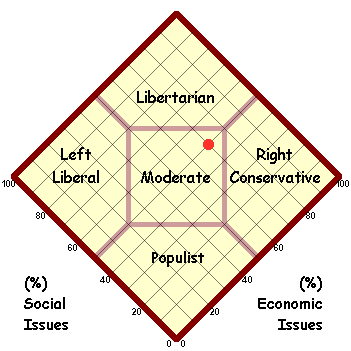
Political Map
 
Personal Score
This measures how much you believe government should intervene in people's personal lives. Personal issues include health, love, recreation, prayer and other activities that are not measured in dollars.
  • high score (above 60%) means you believe in tolerance for different people and lifestyles.
  • low score (below 40%) means you believe that your standards of morality & safety should be enforced by government. 
Economic Score
This measures how much you believe government should intervene in people's economic lives. Economic issues include retirement funding, budget allocations, and taxes
  • high score (above 60%) means you believe in personal responsibility for your financial matters, and that free-market competition is better for people than central planning by the government. 
  • low score (below 40%) means you believe that a good society is best achieved by the government redistributing wealth. You believe that government's purpose is to decide which programs are good for society, and how much should be spent on each program.
Examples
The chart below indicates how four "hard-core" political philosophers would answer the questions. From this example, you can see how you fit in with each philosophy.  Your answers are on the left.
  • A "hard-core liberal" would answer personal questions to minimize government involvement, but would answer economic questions to include government intervention.
  • A "hard-core libertarian" would answer both personal and economic questions to minimize government involvement.
  • A "hard-core conservative" would answer personal questions to include government intervention, but would answer economic questions to minimize government involvement.
  • A "hard-core populist" would answer both personal and economic questions with proposals that include government intervention.
 = Strongly Support     = Support     = No Opinion     = Oppose     = Strongly Oppose
 
Personal IssuesYouHard-core LiberalHard-core LibertarianHard-Core ConservativeHard-Core Populist
Abortion Is a Woman's Right
 
Sexual Orientation Protected By Civil Rights Law
 
Teach Family Values in Public Schools
 
Death Penalty 
 
Mandatory "Three Strikes" Sentencing Laws
 
Drug Use Is Immoral: Enforce Laws Against It
 
Allow Churches To Provide Welfare Services 
 
The Patriot Act harms civil liberties
 
Illegal immigrants earn citizenship
 
US out of Iraq and Afghanistan
 
 = Strongly Support     = Support     = No Opinion     = Oppose     = Strongly Oppose
Economic IssuesYouHard-core LiberalHard-core LibertarianHard-Core ConservativeHard-Core Populist
Require Companies To Hire More Women/Minorities 
 
More Federal Funding For Health Coverage
 
Privatize Social Security
 
Replace coal and oil with alternatives
 
Make taxation more progressive
 
Support and Expand Free Trade
 
Absolute Right To Gun Ownership
 
YouHard-core LiberalHard-core LibertarianHard-Core ConservativeHard-Core Populist
 = Strongly Support     = Support     = No Opinion     = Oppose     = Strongly Oppose
Issues Not Counted In PhilosophyYouHard-core LiberalHard-core LibertarianHard-Core ConservativeHard-Core Populist
Parents Choose Schools Via Vouchers
 
More Spending On Armed Forces
 
Stricter limits on political campaign funds
 
YouHard-core LiberalHard-core LibertarianHard-Core ConservativeHard-Core Populist
 = Strongly Support     = Support     = No Opinion     = Oppose     = Strongly Oppose
Final Notes
To ensure balance among political viewpoints, we arranged the wording of the questions so that half the time, the answer involving more government is answered by "support", and half the time by "oppose." Hence, each of the "hard core" philosophers would choose "support" for 3 or 4 of the Personal questions and for 3 or 4 of the Economic questions.

There are four questions which are not counted in your political philosophy. Those questions do not fit this theory -- for example, Democrats typically oppose unrestricted gun ownership, while a 'hard core liberal' would support it on grounds of the government not intervening in a personal issue. These omissions ensure that the theoretical definitions match with current-day politics.

Many of these statements cross over the line between personal issues and economic issues. And many people might answer what we call a "Personal" issue based on economic reasoning. But we have tried to arrange a series of questions which separates the way you think about government activities in these two broad scales.

Political Map and some content from Advocates for Self-Government.

STLFED: WEALTH INEQUALITY MAY BE A BIGGER PROBLEM IN THE US THAN INCOME INEQUALITY


But, on the other hand, not all Wealth Inequality is bad. You gotta love those two-handed economists and politicians. 

During the Clinton era, the President himself defended the burgeoning wealth and income inequality that was developing during the dot.com bubble. This according to no less an authority than Allan Greenspan in his book "The Age of Turbulence". Clinton's rationale is that this is what one would expect and was a welcome development during a period of economic growth. 

Hmmm..............

I'm pretty sure that the good folks at the Federal Reserve know of Hayek, they just don't believe Hayek. And why would they? He just makes too much common sense for them.

Mandating equal outcomes leads to unfair treatment

MARCH 03, 2015 by LEVAN GVALIA
From the fact that people are very different it follows that, if we treat them equally, the result must be inequality in their actual position, and that the only way to place them in an equal position would be to treat them differently....
We do not object to equality as such.... Our objection is against all attempts to impress upon society a deliberately chosen pattern of distribution, whether it be an order of equality or of inequality.
- FA Hayek, The Constitution of Liberty


07/29/14
Wealth Inequality May Be a Bigger Problem in the U.S. Than Income Inequality
U.S. income inequality has been a focal point of PUBLIC discussion and debate in recent years, with claims that it is severe and that the distribution is becoming increasingly unequal over time. However, wealth inequality is a much greater dilemma, according to a recent article from The Regional Economist, published by the Federal Reserve Bank of St. Louis.Income InequalityRESEARCH Director and Economist Christopher Waller and Senior Research Associate Lowell Ricketts, both with the St. Louis Fed, noted that, "Households in the top 10 percent of the income distribution have earnings so great that they raise mean income over the median for the entire population." In 2010, the median household income was about $46,000, while the mean income was close to $78,500. They also noted that some inequality in the U.S. income distribution naturally develops between age groups and that a lot of it is determined by educational attainment.Waller and Ricketts used a simple measure to see how income inequality in the U.S. compared to other countries around the world (which will be discussed on this blog Thursday) and how it compared to wealth inequality in the U.S. They used the ratio of the median income of the top 10 percent of the income distribution ($203,900) divided by the median income of the bottom 10 percent ($9,900). "The resulting ratio of 21 quantifies the substantial divide between the rich and the poor in the U.S."

Wealth InequalityWaller and Ricketts then examined U.S. wealth inequality in terms of net worth, defined as household assets less liabilities.1 In 2010, the median net worth of all households was $77,300. "Just as there was with the income statistics, there is a substantial divide between median and mean net worth. Mean net worth was $499,000, indicative of an even more top-heavy distribution than that of income."
Using income distribution, Waller and Ricketts calculated the same ratio as used above. The median net worth of the top 10 percent of the income distribution ($1.194 million) divided by the median net worth of the bottom 10 percent ($3,100) yields a wealth inequality ratio of 385, notably higher than the ratio of 21 for income inequality.
Using net worth distribution to define the population groups changes the statistics even more dramatically, as the bottom 20 percent of the distribution has a negative median net worth. The ratio of the median for the top 10 percent ($1.9 million) divided by the median for the bottom 30 percent ($700) yields a ratio of 2,714.

Not All Wealth Inequality Is BadWaller and Ricketts explained that some wealth inequality is a function of age, allowing people to maintain a stable path of consumption over their life spans. Young people have little wealth and tend to be unskilled, so they borrow money for school and their first home. In middle age, they start paying down their DEBTand accumulating wealth while entering their peak earning years. As they get older, they start spending down the wealth they accumulated. Waller and Ricketts said, "This natural life cycle of wealth accumulation hasn't changed much, and most Americans will progress along a similar path. While the process is the same for most people, at any one point in time you're going to have relative inequality: poor, middle and rich based on age alone. While this natural inequality doesn't account for the entire wealth disparity across the population, it is important to understand that some inequality isn't inherently bad." Waller and Ricketts concluded, "The labor market has changed into a system that places a greater value on EDUCATION than physical labor and rewards skilled workers with wage premiums. This system is characterized by substantial inequality, but it doesn't inherently exclude anyone from climbing the income brackets. … Wealth inequality is a much greater dilemma, but it is often unaddressed in the public debate outside of tax proposals. … Financial education initiatives could use some of the energy devoted to the fierce debate surrounding income inequality in the U.S."

Notes and References1 Household assets include both financial (such as retirement accounts, STOCKS AND BONDS) and nonfinancial (such as cars, homes and small businesses).
Additional Resources

from fee.org
http://fee.org/blog/detail/economic-equality-and-social-injustice-video


Economic Equality and Social Injustice (Video)

Mandating equal outcomes leads to unfair treatment

MARCH 03, 2015 by LEVAN GVALIA
From the fact that people are very different it follows that, if we treat them equally, the result must be inequality in their actual position, and that the only way to place them in an equal position would be to treat them differently....
We do not object to equality as such.... Our objection is against all attempts to impress upon society a deliberately chosen pattern of distribution, whether it be an order of equality or of inequality.
- FA Hayek, The Constitution of Liberty


Monday, March 02, 2015

White Sox legend Minoso passes away | whitesox.com

MLB says goodbye to Minoso


Sad news this weekend, RIP Minnie Minoso. This has been a tough winter for Chicago, first losing Mr. Cub and now losing someone who could definitely be called Mr. White Sox.

from whitesox.com
White Sox legend Minoso passes away | whitesox.com:
Minnie Minoso spent 17 years in MLB, 12 of which were with his beloved White Sox. Early Sunday morning, the seven-time All-Star and three-time Gold Glover passed away at the age of 92.

Born in Cuba, he was, in the words of Orlando Cepeda, "to Latin ballplayers what Jackie Robinson is to black ballplayers." He began his American baseball career in the Negro Leagues, where he played, fittingly, with the New York Cubans from 1946 to 194
'via Blog this'

Once again, shame on the Hall of Fame voters. And really, how many times must we say "shame on the Hall of Fame voters before we take the job away from this pitiful lot? Is this really the kind of press the Hall of Fame and Major League Baseball wants thrust upon it time and time again? It's getting a bit ridiculous and at times just indecent.

Shame on the whole sorry lot of them for their inaction.


from Yahoo Sports:
http://sports.yahoo.com/blogs/mlb-big-league-stew/taking-a-look-at-minnie-minoso-s-hall-of-fame-case-182819285.html

Minnie Minoso wanted nothing more than to be honored by his peers and recognized by the game he loved. As he stated many times, it was his final dream in life. Just to have that moment and know he truly belonged among baseball's elite.
“'My last dream is to be in Cooperstown, to be with those guys,”' Minoso said. “'I want to be there. This is my life's dream.”
It's a feeling Minoso carried with him and echoed right up until his final day. On Saturday, Minoso talked to Christina Kahrl of ESPN, and once again spoke of the heart break he felt after falling short on the Hall of Fame's Golden Era ballot this past winter.
Truly, I'm hurt. You know why? Because I've seen so many guys – and all of my respect is for them – get inducted [into Cooperstown], but my records are better. And I played more years. That's what's breaking my heart. I go to these card shows, and most guys there are Hall of Famers. Some of them got in later, but what difference should there be?
Making Minoso's disappointment even more disheartening is that it's an honor he deserved.

from Grab Some Bench:
http://grabsomebench.com/root/thoughts-analysis/minnie-minoso-hall-of-fame-worthy.html
 It is for these reasons and more that Minnie Minoso deserves the honor of being immortalized alongside the greats of the game in Cooperstown. He was a one-of-a-kind player, and those deserve to be remembered.
Minoso Quote
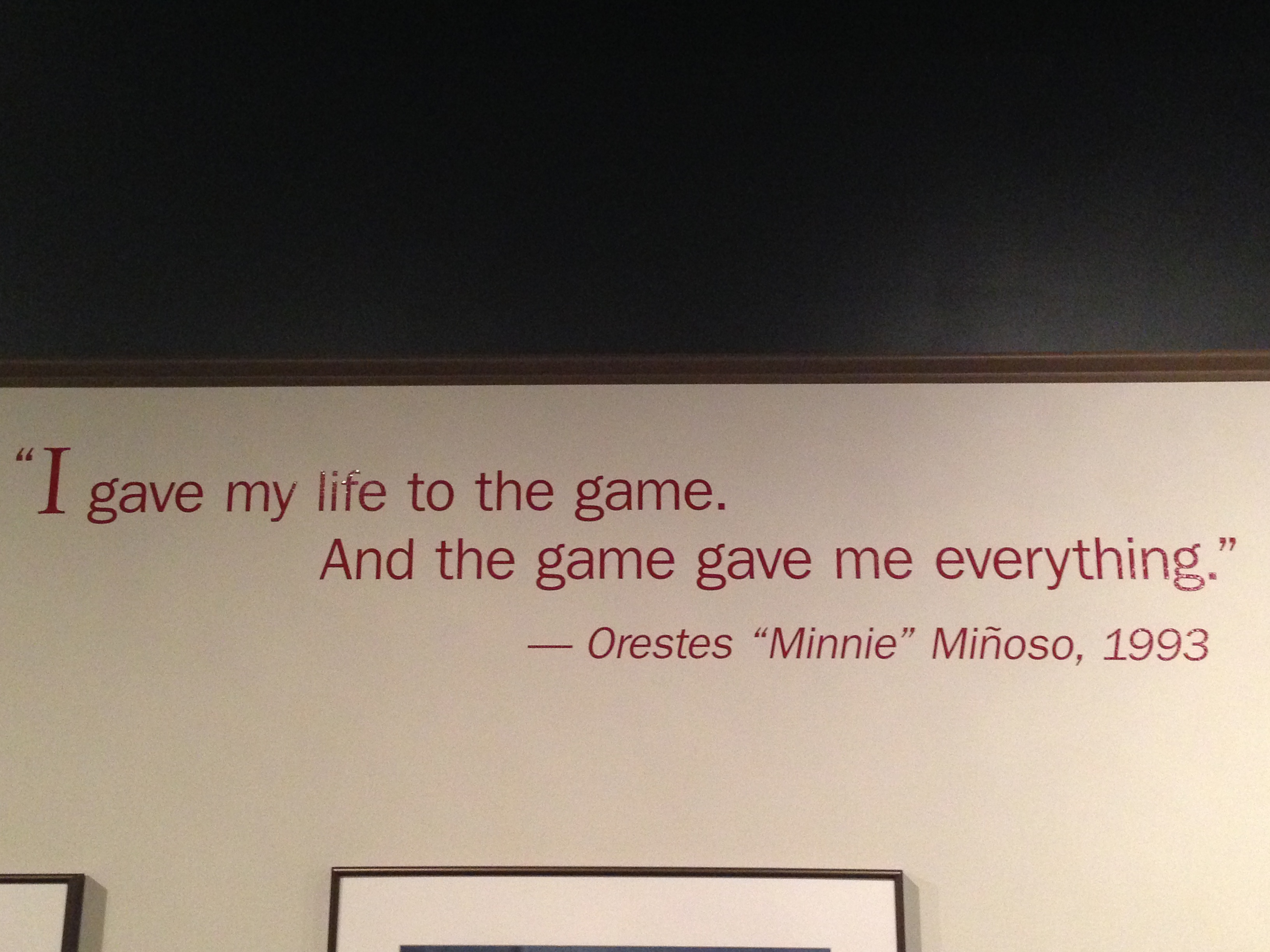
There is a quote on the wall in the third floor of the Baseball Hall of Fame from Minnie that says, “I gave my life to the game. And the game gave me everything.” I think the game owes him one last thing, and I think it’s time he got it.

Sunday, March 01, 2015

Glenn Flesig On Tommy John Incidence | MLB Trade Rumors


When looking for the magic bullet in the correlation / causation argument, a key phrase from the article sticks out in my mind.

 "since the recovery rate is so high, teams are willing to project a return to normality for prospects". 


Looking back to the 70's - 80's and even the early 90's, having Tommy John surgery was considered a Hail Mary pass for aging veterans. Since 1994-95, due to the miracle of modern medicine and advances in rehabilitation, the surgery has gone from pariah to panacea for pitchers of all ages. 

It used to be considered like a major overhaul to the pitching arm and now it's looked on as more akin to a tune-up. It has become almost an enhancement to a prospects career more than a detriment. All in one generation. 

Oh, The Times They Are A-Changin'.......... Thanks Bob.
Come writers and critics
Who prophesize with your pen
Keep your eyes wide
The chance won't come again
Don't speak too soon
For the wheel's still in spin
And there's no tellin' who
That it's namin'
For the loser now
Will be later to win
For the times they, they are a-changin'

Read more: Bob Dylan - The Times They Are A-changin' Lyrics | MetroLyrics 

from MLB Trade Rumors:
Glenn Flesig On Tommy John Incidence – MLB Trade Rumors:

Injury expert Glenn Flesig discussed the latest Tommy John surgery epidemic at the annual Sloan Sports Analytics Conference, writes Matthew Leach of MLB.com. Flesig, who holds a doctorate in biomedical engineering, is the partner of Dr. James Andrews at the American Sports Medicine Institute (ASMI). The institute aims to “improve the understanding, prevention and treatment of sports-related injuries through research and education.”
Flesig presented data on both professional and youth pitchers. At the professional level, 16% of pitchers have had Tommy  John surgery. Flesig found that once pitchers have recovered from the procedure, “they have the typical flexibility and typical mechanics. So they’re back to normal.” Of course, lost time and the potential for complications means that it’s best to avoid the issue in the first place.
Of course, UCL replacement can often impact free agency and the trade market. The increased incidence of the injury last season had some teams reaching for outside help. The Braves were able to call upon Ervin Santana on a one-year deal when Kris Medlen and Brandon Beachy both required a second procedure. Atlanta forfeited a draft pick when they signed Santana. We saw both Medlen and Beachy sign short-term, incentive-laden contracts this winter.
Since the recovery rate is so high, teams are willing to project a return to normality for prospects. Last June, the Blue Jays drafted Jeff Hoffman ninth overall. The Nationals took Erik Fedde with the 18th pick. Both pitchers had Tommy John surgery shortly before the draft.
A study of youth pitchers could reveal the way to decrease the incidence of elbow injury. Flesig offered a few convincing correlations. Youth pitchers who threw over 80 pitches in a game were four times more likely to require surgery. Those who pitched for more than eight months a year were five times more likely.
Pitching when fatigued was the biggest risk indicator. Youth who self-identified as having “often pitched” when fatigued were 36 times more likely to go under the knife. For the parents in the audience, don’t let your kid pitch too often or when fatigued.
'via Blog this'

I like that the stats community is getting interested in this and disseminating some of the knowledge down to where it belongs, at the youth level. The professionals are just that, professionals. They can do what they want and they have the best of the best out there helping them make informed decisions.

It seems like there are still organizations scattered out there that are thirsting for this type of direction and information. It appears that MLB has to get a grip on issues like this and that may require a bit of centralization. Colleges, high schools and youth leagues are going to have to be willing to give up some autonomy in exchange for some of this information. We'll see at that point who really cares about kids and who cares more about pocketbooks and bottom lines.

New commissioner Rob Manfred has made some noises about a USA Baseball type of umbrella,

Get the right information into the right hands and let's see what happens.

from Irvine Youth Sports Parents Blog:
http://irvineyouthsportsparents.com/

IYSPNMission
The mission of the Irvine Youth Sports Parents Network is to provide a forum for parents to exchange ideas and information on youth sports while promoting  the ideals of student-athlete citizenship.
Irvine is a city known for its cultural diversity, academic excellence and love of athletics. Our children are citizens first, students second and athletes third.
We believe in “sport as metaphor” – that 99.9% of our children will not go on to become professional athletes but take what they learn from athletics and pursue excellence and competition in other endeavors.
It is our hope that this organization can support the early nurturing of those dreams.

youth-sports-coach
Youth sports is a serious business.
Take a look at this piece in the Boston Globe on a proposed $150 MILLION Youth Sports Facility backed by Red Sox executive Dan Duquette and slated for construction on Cape Cod.  The growing money trend in youth sports is incredible. It’s estimated that the Travel Ball world of tournaments ALONE represents $7 billion per year and is projected to grow at 4% per year.Not only are athletic fields being constructed all over the country but so are the hotels for housing players and their families.
The benefits of youth sports have morphed from fun and development into trophies and cash.  The payoff has shifted from kids to adults.
When kids are polled about why they play sports their top three answers are:
1. To have fun
2. Be with friends
3. Do something I’m good at.
Nothing there about cash or hardware.
Clubs that get paid money to coach kids need to remember that sports doesn’t last forever.
But the values they impose do.
And the best values of sport are based on character…not cash.
IrvineYouthSportsBaseball

“We mathematically, statistically, scientifically have proven that the kids who play baseball year-round are three times more likely to end up on a surgery table by their 20th birthday that those who don’t,”
Glenn Fleisig, of the American Sports Medicine Institute, citing a 10-year study targeting teenagers who pitch more than 100 innings in a calendar year.

A lot of youth baseball parents have lost their minds.
That is the only conclusion any rational human being can come to when they are faced with the reality of this chart below indicating the exponential rise of Tommy John Surgeries for baseball pitchers.
Tommy-John-Surgery-Rise
What is it going to take before we parents realize that not only are we wasting too much of our time and money on travel ball and tournaments but we are also wasting the physical health of our children.
Isn’t that ironic?
Here we are putting our boys in a situation to enjoy their physicality and fun with friends and twisting it all up in a perfect mess of ego gratification and delusions of grandeur.
“Major League Baseball gets the blame for pitchers getting injured,” says Fleisig, “But the fact is these pitchers definitely have some damage in their arm when they get them.”
Consider the case of Jameson Taillon.  His elbow gave out recently at the age of 22 and after just 382 professional innings, all of them monitored with extreme caution by the team that handed him $6.5 million out of high school, the Pittsburgh Pirates. Taillon had been throwing more than 90 miles per hour since he was 16 and a sophomore in high school. He threw as hard as 99 mph as a senior.
According to Sports Illustrated…
Beginning in July 2008, when he was 16 years old, Taillon threw at six events sponsored by Perfect Game, one of the country’s top youth baseball services, in a 13-month period. Those events occurred in the summer, fall and winter. (In the spring, he was busy pitching for his high school team in The Woodlands, Texas.) His top velocities were meticulously recorded: 92, 93, 95, 96, 96 and 97. Every high school pitcher is known by the top velocity he “hits,” even if he gets there once, as much as his very name.
As a high school senior, Taillon hit 99. In June of that year, 2010, the Pirates selected him with the second pick of the draft, in between Washington selecting Bryce Harper and Baltimore taking Manny Machado. He was labeled as another “can’t miss” in the long line of Texas schoolboy power pitchers, including Josh Beckett and Roger Clemens.
Now he joins another long line: First-round high school pitchers who are blowing out their arms before they even accrue any major league mileage — a line that hardly existed as recently as five years ago.”
The problem is that parents and coaches are seeing results in all the private training, tools and techniques they are using to capture “increased velocity”, the buzzphrase of the moment in baseball.  The combination of year round travel ball and too many tournaments is putting a strain on young arms while the average speed of major league pitchers has increased from 90 MPH to 92 MPH.
But forget for a moment that you’re a parent of a prodigy because, like me, you’re not.
But you still have to suffer in this system and so does your boy.
The suffering comes whether he is an average player or shows a bit of promise.
If he’s average he’s going to be relegated to the worst positions on the field and he’s going to stop playing with some of his friends who are moving up to more competitive divisions.  If he’s got a little something extra, welcome to increased batting practice, throwing lessons and all kinds of private training just to keep up.
It can become stressful on everyone.
The difficulty is that you can see differences, measurable differences, in kids that put in extra time and those that don’t.  You CAN get results and that’s what gets everyone in a lather.  The reality is your really don’t know what you have until post puberty.
My wife and I struggle with this and try to remind ourselves…they’re kids.  And they deserve not be burdened with our unfulfilled ambitions but to simply experience the short-lived joy of being a kid.


Giants Top Minor League Prospects

  • 1. Joey Bart 6-2, 215 C Power arm and a power bat, playing a premium defensive position. Good catch and throw skills.
  • 2. Heliot Ramos 6-2, 185 OF Potential high-ceiling player the Giants have been looking for. Great bat speed, early returns were impressive.
  • 3. Chris Shaw 6-3. 230 1B Lefty power bat, limited defensively to 1B, Matt Adams comp?
  • 4. Tyler Beede 6-4, 215 RHP from Vanderbilt projects as top of the rotation starter when he works out his command/control issues. When he misses, he misses by a bunch.
  • 5. Stephen Duggar 6-1, 170 CF Another toolsy, under-achieving OF in the Gary Brown mold, hoping for better results.
  • 6. Sandro Fabian 6-0, 180 OF Dominican signee from 2014, shows some pop in his bat. Below average arm and lack of speed should push him towards LF.
  • 7. Aramis Garcia 6-2, 220 C from Florida INTL projects as a good bat behind the dish with enough defensive skill to play there long-term
  • 8. Heath Quinn 6-2, 190 OF Strong hitter, makes contact with improving approach at the plate. Returns from hamate bone injury.
  • 9. Garrett Williams 6-1, 205 LHP Former Oklahoma standout, Giants prototype, low-ceiling, high-floor prospect.
  • 10. Shaun Anderson 6-4, 225 RHP Large frame, 3.36 K/BB rate. Can start or relieve
  • 11. Jacob Gonzalez 6-3, 190 3B Good pedigree, impressive bat for HS prospect.
  • 12. Seth Corry 6-2 195 LHP Highly regard HS pick. Was mentioned as possible chip in high profile trades.
  • 13. C.J. Hinojosa 5-10, 175 SS Scrappy IF prospect in the mold of Kelby Tomlinson, just gets it done.
  • 14. Garett Cave 6-4, 200 RHP He misses a lot of bats and at times, the plate. 13 K/9 an 5 B/9. Wild thing.

2019 MLB Draft - Top HS Draft Prospects

  • 1. Bobby Witt, Jr. 6-1,185 SS Colleyville Heritage HS (TX) Oklahoma commit. Outstanding defensive SS who can hit. 6.4 speed in 60 yd. Touched 97 on mound. Son of former major leaguer. Five tool potential.
  • 2. Riley Greene 6-2, 190 OF Haggerty HS (FL) Florida commit.Best HS hitting prospect. LH bat with good eye, plate discipline and developing power.
  • 3. C.J. Abrams 6-2, 180 SS Blessed Trinity HS (GA) High-ceiling athlete. 70 speed with plus arm. Hitting needs to develop as he matures. Alabama commit.
  • 4. Reece Hinds 6-4, 210 SS Niceville HS (FL) Power bat, committed to LSU. Plus arm, solid enough bat to move to 3B down the road. 98MPH arm.
  • 5. Daniel Espino 6-3, 200 RHP Georgia Premier Academy (GA) LSU commit. Touches 98 on FB with wipe out SL.

2019 MLB Draft - Top College Draft Prospects

  • 1. Adley Rutschman C Oregon State Plus defender with great arm. Excellent receiver plus a switch hitter with some pop in the bat.
  • 2. Shea Langliers C Baylor Excelent throw and catch skills with good pop time. Quick bat, uses all fields approach with some pop.
  • 3. Zack Thompson 6-2 LHP Kentucky Missed time with an elbow issue. FB up to 95 with plenty of secondary stuff.
  • 4. Matt Wallner 6-5 OF Southern Miss Run producing bat plus mid to upper 90's FB closer. Power bat from the left side, athletic for size.
  • 5. Nick Lodolo LHP TCU Tall LHP, 95MPH FB and solid breaking stuff.