Showing posts with label Baseball Rules. Show all posts

Wednesday, May 02, 2018

Second opinion: 'Extra' looks at new rule | MiLB.com News


Fernando Tatis Jr., Joey Lucchesi, Erick Fedde and Blake Rutherford weigh in.


The rules make more sense for MiLB's use exclusively, from both a roster flexibility standpoint as well as the fact that minor league baseball is more about player development than Wins and Losses.

They cannot dip down a level and bring a guy up if they tax a bullpen in a 15-inning game like the big boys can.

I really don't want to be any Texas Tie-breakers deciding MLB games. It's travel ball stuff when games have to be decided quickly because another team is waiting to use the field next. In the WBC, there is the concern about using MLB assets (pitchers) before they have built up their workload.


from MiLB.com
Second opinion: 'Extra' looks at new rule | MiLB.com News:


By Benjamin Hill / MiLB.com | March 23, 2018 10:00 AM ET
On March 14, Minor League Baseball unveiled a new set of pace-of-play rules and procedures. One of them garnered a lot of attention since it marked a distinct shift from the way that the game has always been played. 
"At all levels of Minor League Baseball, extra innings will begin with a runner on second base."  
Why would extra frames begin with a runner on second? Minor League Baseball stated it aims to "reduce the number of pitchers used in extra innings and the issues created by extra-innings games, including, but not limitied to, shortages of pitchers in the days to follow, the use of position players as pitchers and the transferring of players between affiliates due to pitching shortages caused by extra-innings games."
Whatever the motivation, the new rule immediately generated an avalanche of incredulous, if not downright negative, fan-driven social media conversation. But what do those within Minor League Baseball think about it? To answer that question, MiLB.com's Sam Dykstra, Ben Hill, Josh Jackson and Tyler Maun surveyed individuals working at a number of different positions within Minor League Baseball's vast ecosystem. Their perspectives varied, but taken as a whole seem to suggest those within the game have more quickly embraced the rule than those outside of it.  

Player development staff

"I have full trust in the people in the Commissioner's Office to enforce this and see what's happening. I don't think it's something that they're going to thrust upon the country willy-nilly. The worst day of a farm director's year is the 17-inning game. You have guys that are generally on work limits. Some of these guys are the youngest players playing in what are, at times, career-altering moments. Nobody wants a position player throwing four innings. No one wants a kid stretching beyond what he's safe to do. I think people will like this. There is a fun element of strategy and explosiveness to it. For us, in terms of addressing the arm health issue, I think this is really more a player safety and arm care issue than it is pace of play." -- Jeff Graupe, Cincinnati Reds director of player development
"We had it in complex [Gulf Coast and Arizona League] baseball last year, and I didn't mind it. Now, obviously it's climbing up towards the Major Leagues. At the Major League level, I'm still fairly skeptical of this. And I'm skeptical of bringing it to the Minor Leagues, however, I'm a huge fan of executing situational baseball. We're big believers of that in this organization. We certainly believe that to be successful at the Major League level, you need to be hugely successful at scoring runs from second base. What a great opportunity to have a chance at that every single night, when it comes to extra innings. Obviously, it will add a little bit of excitement, I would like to think, for the fans that may be there. In terms of run expectancy and those types of numbers, I think this will be a test -- whether we're going to lay a bunt down here to get a guy over or we're going to take our swings and try to score him from second base. From that aspect, I'm excited to see how this plays out." -- Chris Getz, Chicago White Sox director of player development. 
"There's been times where we have needs at the Major League level the next day and we just played a 17-inning game at Triple-A. That creates real problems and problems that are unfair to the Major League team more than anything else. First and foremost, that's what we worry about and that's what's important, but from an injury standpoint, it is a saver. It's a game-saver. ... I'm not sure that I would've done it exactly the way it turned out, but I can tell you that there's going to be a lot less worrying for me to do, and that is a definite positive." -- Zach Wilson, Colorado Rockies farm director
"Clearly this is something to deal with games that go into a lot of innings and cause teams to get in some jams here and there. From a player-development standpoint, this is supposed to make that easier. We'll roll with it. ... It's not really anything we're going to spend significant time on. A runner on second with no outs, that's a situation we work on in drills anyways in terms of how to work cutoffs, relays, how to attack as pitchers. I think some of our managers are kicking around their own plans, and we'll talk some about how to approach it as an organization. But it's not something we'll have a whole big plan for." -- Dave Littlefield, Tigers vice president of player development. 
"We'll have to play within the confines of the rules and understand how to execute. From a pitching standpoint, we're going to have to work on how to handle that type of situation with runners on. We'll have to practice it here, and it'll be part of our program to work on these situations. Not just in Spring Training but as part of our fundamentals going forward." -- Mark Scialabba, Washington Nationals director of player development. 

Players

"It's going to be weird. The games are going to be shorter. They're going to take a little part of the emotion [out], but that's the new rule. I don't like it so far, but it is what it is." -- Fernando Tatis Jr., Padres infielder, No. 8 overall prospect.  
"Mixed feelings, I guess. Everyone in the Minor Leagues is there to get to the big leagues, more than to win games in the Minor Leagues. I guess I don't mind in the sense that they're trying to shorten it, so we don't get guys hurt playing 20-inning games and all the pitching gets stuck behind for the next week. ... The team can definitely tell. Some of us are thinking, 'Oh man, if I'm starting the next day, I've got to go seven or eight innings to save the bullpen.' It's one of those things you're never happy with, but it's part of the game.
[Starting with a runner on second is] going to be completely different. I did it international play when I was in college. We played that system, and it changes the game completely with bunts and how people are going to play that. You've just got to be super-aggressive and try to punch guys out. It's going to be interesting. It's really hard to say to see how it'll play out. -- Erick Fedde, RHP, Nationals No. 4 prospect. 
"End it in nine -- let's try to win it. You've just got to compete. You can't do anything about it. You can't complain." -- Joey Lucchesi, LHP, Padres No. 9 prospect. 
"[It's] going to take a little bit of the flair out of the whole extra-inning thing, but whatever's best for the game I'm all for. I guess that's their decision, and there's nothing we can really do or say about it, so it's whatever's best for baseball." -- Blake Rutherford, outfielder, White Sox No. 7 prospect. 

Minor League Baseball front-office staff

"As someone whose first-ever game working in baseball went to 21 innings, I'm very much OK with this change. Not only are the health of pitchers' arms in question, but from the front-office perspective, there are a lot of positives to increasing the pace of play in extra innings and overall -- city curfews, fireworks, weather, employee morale, fan egress, etc." -- Erin O'Donnell, Birmingham Barons vice president of marketing


"In our office, it was met with mixed emotions. Some of the most memorable times at the ballpark are the 17-inning games that seemingly come prior to a day game or at the tail end of a nine-game home stand. 
From an activation standpoint, we have immediately begun to have some good conversations with some partners about leveraging the 'Extra Innings' element with a runner starting at 'second base/ halfway home.'" -- Ryan Keur, Daytona Tortugas president
"Younger workers in the office -- and spouses and families outside the office -- are treating it with cautious optimism that maybe we'll get home earlier now. We generally understand the sentiment, especially dealing with things like seven-inning games whenever we host a doubleheader. While I've sat through a frigid April 18-inning game before, that's the exception and not the rule. Running extra promotions at that point becomes challenging, but it's often those weird, creative, off-the-cuff things like staff danceoffs and infinite t-shirt tosses that become a welcome distraction from the completely inert baseball game being played." -- Chris Rogers, Bowie Baysox promotions manager
"This certainly should end games a little earlier, which three-and-a-half hours into the seventh game of a homestand, will be nice. You go to the 10th inning of a game on a Wednesday in April. and before you know it, there's 30 fans in the seats and I've got a dozen [cleanup crew] people waiting for them to leave so they can start picking up empty popcorn boxes. When you've been at the ballpark for 14 hours and you're looking at extra innings, a guy standing on second ain't a bad look. At this level, with the idea that the player development comes before winning and losing, it makes sense." -- Philip Guiry, Charleston RiverDogs director of operations
"If a game could be played for 18 innings without any negative repercussions, that would be fine with me. The fact of the matter, unfortunately, is that there are repercussions. We're learning the proper ways to take care of a pitcher's arm health. Cutting down on extra innings to save a staff will matter in the long run. I would not mind if they did away with all extra innings entirely. Pitching arm health is too important. ... I am also in favor of an automated strike zone in the Minor Leagues, but that's neither here nor there." -- Jesse Goldberg-Strassler, Lansing Lugnuts broadcaster
Benjamin Hill is a reporter for MiLB.com and writes Ben's Biz Blog. Follow Ben on Twitter @bensbiz. Sam Dykstra, Tyler Maun and Josh Jackson all contributed to this report. This story was not subject to the approval of the National Association of Professional Baseball Leagues or its clubs.


'via Blog this'

Friday, July 10, 2015

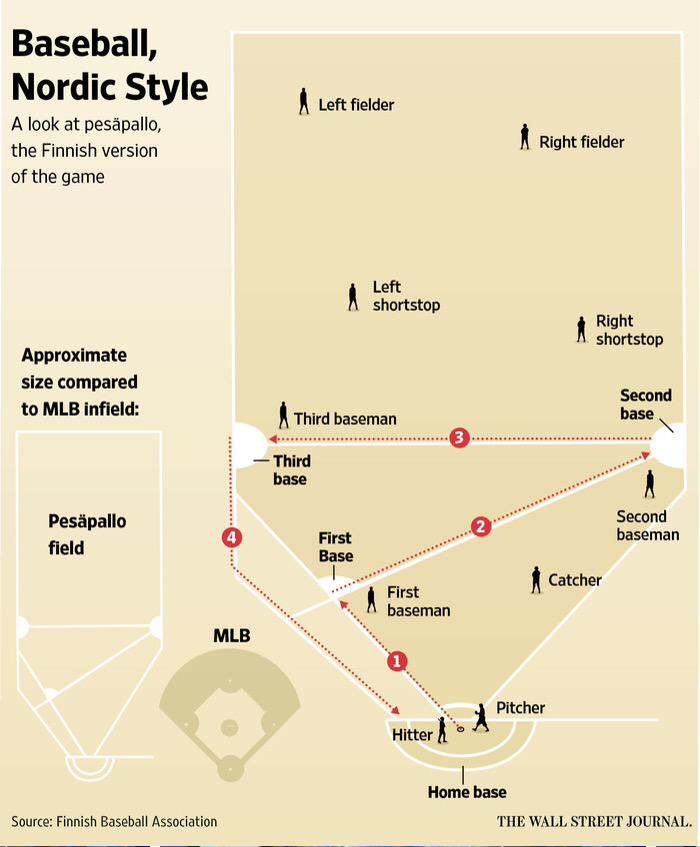
A neat way to make baseball more exciting - Baseball Nordic Style

Embedded image permalink


This might be the quote of the year about getting more excitement into baseball.
"If you dropped acid and decided to go make baseball, this is what you would end up with," said Andy Johnson, a Minnesota Twins scout based in Norway.
I guess we can count on the support of one Bill Walton to making this change then, right? Although he might hold out for some reds, Vitamin C (euphemism alert?) and cocaine for good measure.

Image result for livin on reds vitamin c and cocaine

I'm not sure I'm down with the T-Ball/coach pitch tossing of the ball to the batter. What happens to all of our pitchers? I mean, Bumgarner would hit, but we lose a lot there. Crazy Finns!!

from WSJ.com
What Finland Can Teach America About Baseball
Tired of pitchers ambling around the mound? In Finland, there is no mound. Pitchers stand beside the hitter and toss the ball vertically over the plate.
Unlike in the American game, where batted balls sometimes feel like a rarity, Finnish baseball has constant action. PHOTO: JUKKA RASIMUS

Falling asleep waiting for the next batted ball? In Finland, hitters put nearly every pitch in play, sending fielders scampering in every direction. Players aren't allowed to call for time between plays or pitches.

Seen enough late-inning pitching changes? In Finland, there are no relievers. The typical pitcher throws every inning of every game, all season long.

And those are only some of the quirks of a game that includes a zigzag base path, a rectangular outfield, trios of designated hitters called jokers and managers whose primary mode of communication resembles the feathers of a peacock.

"If you dropped acid and decided to go make baseball, this is what you would end up with," said Andy Johnson, a Minnesota Twins scout based in Norway.

https://twitter.com/sabr/status/619268173452324864

Sent from my iPhone


Friday, May 29, 2015

10 bizarre baseball rules you won't believe actually existed


from mlb.com

http://m.mlb.com/cutfour/2015/05/22/124363454/
 1. Batters had the right to request a low or high pitch from 1867 to 1887

Imagine Mike Trout walking up to the plate and telling David Price exactly where he wanted the ball. In the game's infancy, that was a reality: Prior to every at-bat, batters would request a high or low strike zone -- either from the knee to the belt or the belt to the shoulder -- and the pitcher had to put it there. Awfully demanding of you, late-19th-century batsmen.
2. Fly balls could be caught off a bounce until 1864, and foul balls until 1883
This may seem bizarre to baseball fans today, but the logic behind the one-bounce rule was actually fairly straightforward: It was a holdover from other favorite childhood games, like jacks, and in the days before gloves it allowed players to avoid catching a very hard ball with their bare hands.
As the 19th century wore on, though, support for the rule waned. After years of hilariously acrimonious debate -- at a convention in New York, one delegate even dubbed it a "boy's rule" -- the rule was officially voted out for fair balls in 1864. Foul balls, however, could still be caught on a bounce for another 20 years. 
3. Pitchers were required to throw underhand until 1883
Baseball owed much of its origin to cricket, and one of the game's first codified sets of rules -- the Knickerbocker rules, drafted in 1845 for New York's Knickerbocker baseball club --speak to those roots: "The ball must be pitched, not thrown, for the bat." "Pitched", in the traditional sense of the term: a stiff, underhanded motion, almost like bowling.
The first man to go electric, according to MLB's official historian John Thorn, was Tommy Bond: He raised his delivery just above the waist in the mid-1870s, and from there, it was only a matter of time before the overhand delivery was born, if only because this is not the face of a man you want to mess with:
Tommy Bond
But at least the Chad Bradfords of the world can rest a little bit easier tonight, knowing that, once upon a time, they were the normal ones.
4. One side of the bat was allowed to be flat from 1885 to 1893
Concerned about a lack of scoring in the National League (league-wide ERA: 2.37, so quit bragging, Kershaw), Cincinnati Red Stockings organizer Harry Wright proposed a rule change to help juice offense: Allow bats to have a flat face, much like cricket. After much hand-wringing, the NL adopted the policy in 1885, and, combined with changes to the pitching distance, runs began to increase -- until everyone soon realized that flat bats had a tendency to splinter, and the rule was rescinded in 1893.
5. Walks were scored as hits for one year, in 1887
If you read the above and thought, "Wow, that seems destined to cause all kind of record-keeping difficulties," well, you would be absolutely correct!
A staggering 11 players hit .400 that season, nine of whom wouldn't have had walks not counted as an at-bat. The statistics were even rewritten in 1968 by the Special Baseball Records Committee, with drastic consequences: Cap Anson, who hit .421 to lead the league in 1887, had 60 hits taken away, which stripped him of not only the batting title but the honor of first-ever member of the 3,000-hit club. In 2001, MLB reversed the Committee's decision, and Cap now sits proudly in the Hall of Fame with over 3,400 hits and one stellar mustache:
Cap Anson
As for the rule itself, it was deeply unpopular even at the time -- with a New York Times article even referring to walks as "phantom hits" -- and it was quickly rectified after one year.
6. Umpires in the 19th century had it made
The plight of the umpire is a difficult one: You try tracking a small white ball traveling at ridiculously high speeds, with a stadium full of people and the entire Internet ready to castigate you if you're wrong.
Being an umpire at the turn of the 20th century, though? Thatactually sounds pretty great: They were chosen from the crowd prior to first pitch -- they were often prominent members of the local community -- and rather than spend all that energy to squat behind the catcher, umpires were given easy chairs in the general vicinity of home plate. And that was just the beginning of the perks. From Ohio's Marion Star newspaper in 1916:
"The old time umpires were accorded the utmost courtesy by the players. They were given easy chairs, placed near the home plate, provided with fans on hot days and their absolute comfort was uppermost in the minds of the players. The umpire always received the choicest bits of food and the largest glass of beer."
Sign us up, please.
7. Rather than crouching, catchers would stand a few feet behind home until the early 1900s
Nowadays, catchers serve a vital defensive purpose -- from calling a game to the art of framing pitches to throwing out baserunners. In the mid-1800s, though, their responsibilities were far simpler: Just get in the way of the ball, please. Catchers were originally conceived as glorified backstops, standing a few feet behind home plate and making sure balls didn't roll past them. A couple of innovative souls began to buck this trend in the 1870s, but the crouching we're accustomed to wouldn't truly spread until the beginning of the 20th century.
8. The spitball was outlawed in 1920 -- but pitchers who had been throwing it for years were grandfathered in
Pitchers doctoring baseballs was always an ethical gray area, but it was a fairly common practice in the early days, and spit wasn't nearly the worst of it: pitchers would use mud, grease, soap, anything they could think of to make the ball dance in unpredictable ways.
Wanting to bring more offense to the game, MLB responded in 1920, outlawing the practice for good. But several famous spitballers were in the middle of their careers, and so the league came up with a compromise: a grandfather clause, allowing those who had thrown it before the rule to continue to do so. Righty Burleigh Grimes carried the "last official spitballer" mantlefor 14 more years, grossing out all of his teammates until his retirement in 1934:
Burleigh Grimes
9. It was pretty difficult to hit a walk-off homer until 1920
The batter steps to the plate in the bottom of the ninth, bases loaded, the score tied. He swings, and blasts one over the 400-foot sign in left field! The crowd roars as our hero celebrates his walkoff ... single, at least for the game's first few decades. Until 1920, hitters were only given credit for the number of bases the winning run advanced -- so, for example, a walkoff home run that scored a runner from second would only be considered a double, because that runner only advanced two bases. The only way a home run could stand as a walk-off was if the batter himself was the winning run.
Setting aside the impact this rule had on the record books, just think of the home plate celebrations baseball's earliest fans were deprived of.
10. Ground rule doubles were actually home runs as recently as 1930
Yes, really: Any ball that bounced off the ground and over the fence was ruled a home run. Rumor has it that at least one of Lou Gehrig's home runs during his 1927 home run race with Babe Ruth was actually a ground rule double.
In fact, at one point the very concept of a home run was an alien one: According to Thorn, on May 21, 1880 -- a time when few parks had ground rules stipulating that a ball clearing the wall was a home run -- a player hit a ball over the fence and into a river, and the right fielder, confused as to what to do next, actually hopped into a boat to go retrieve the thing. (He eventually gave up, unsuccessful in his pursuit. Stay forever weird, baseball.)


Strange but True Rules from MLB rule book


Tough being in umpire nowadays.

I had the uncaught third strike almost come back to bite me in the butt when I was working with a partner who was apparently not aware that a third strike had to be caught on the fly. He came flying down the line from 1B and stopped the batter-runner from trying to reach first after the catcher didn't properly catch strike three.

Luckily for us, the coach was unaware that we were wrong or just erroneously assumed we were right rather than conflicted and confused as we seemed by both having different opinions. It's gotta be tougher on the big stage where stuff happens faster and under more stress and scrutiny.  However, umpires on the lower levels have the added burden of dealing with different rules books and interpretations depending on the level and the governing body administering the rules.

10 strange-but-true rules from MLB's official rulebook
10. Runners advance one base if a pitched ball "lodges in the umpire's or catcher's mask or paraphernalia." Rule 5.09(g)
9. A designated hitter is specifically prohibited from sitting in the bullpen, unless serving as a bullpen catcher. Rule 6.10(b)(15)
8. A runner is out when they are hit by a fair batted ball, whether they are on a base or not, except when the infield fly rule is called. In that case they are not out if hit by the ball while on base, but are still out if hit by the ball off a base. Rule 7.08(f)
7. When a manager, coach or player are ejected, they are expressly permitted to take a seat in the stands, as long as they change into street clothes and are "well removed from the vincinity of his team's bench or bullpen." Rule 4.07
6. If a fielder deflects a fair ball into the stands, it counts as a home run; unless the deflection somehow manages to occur 250 feet or closer to home plate, in which case all runners only advance two bases. Rule 6.09(h)
5. If a player pinch-hits for a batter in the middle of an at-bat with two strikes, and strikes out, the at-bat and strikeout are credited to the replaced batter. Any other outcome is credited to the pinch-hitter.  Rule 10.15(b)
4. The umpire has the specific authority to, in the case of wet weather, instruct the pitcher to put the rosin bag in his pocket. Rule 8.02(a)
3. All runners, including the batter, advance three bases if a fielder intentionally touches a fair batted ball with their cap, mask or any other part of their uniform "detached from the proper place on his person." All runners advance two bases if the same thing happens on a thrown ball.Rule 7.05(b-e)
2. If there are two strikes on the batter, and a runner steals home, and the pitch hits the runner in the strike zone, the batter is out. The run does not score if there are two outs; if there are less than two outs, it does. Rule 6.05(n)
1. Pitchers are allowed to switch their throwing arm in the middle of an at-bat, but only if they have injured the other one. If one does, they do not get an opportunity to warm up with the other arm. Rule 8.01(f)
-- Dan Wohl / MLB.com

--

from wikipedia.com
http://en.m.wikipedia.org/wiki/Uncaught_third_strike

In baseball and softball, an uncaught third strike (sometimes referred to as dropped third strike) occurs when the catcherfails to cleanly catch a pitch for the third strike. A pitch is considered uncaught if the ball touches the ground before being caught (a bouncing ball), or if the ball is dropped after being grasped (see also catch). In Major League Baseball, the specific rules concerning the uncaught third strike are addressed in Rules 6.05 and 6.09 of the Official Baseball Rules.[1]

On an uncaught third strike with no runner on first base or with two outs, the batter immediately becomes a runner. The strike is called, but the umpire does not call the batter out. The umpire may also actively signal that there is "no catch" of the pitch. The batter may then attempt to reach first base and must be tagged or forced out. With two outs and the bases loaded, the catcher who fails to catch the third strike may, upon picking up the ball, step on home plate for a force-out or make a throw to any other fielder.

The purpose of the "no runner on first base or two outs" qualification is to prevent the catcher from deliberately dropping a third strike pitch and then initiating an unfair double or triple play with possible force plays at second base, third base, or home plate, in addition to putting the batter out at first base. The logic of the situation is similar to that which led to the infield fly rule.

Regardless of the outcome of an uncaught third strike, the pitcher is statistically credited with a strikeout. Because of the uncaught third strike rule, it is possible for a pitcher to register more than three strikeouts in an inning.

In Little League, in the Tee-Ball and Minor League divisions, the batter is out after the third strike regardless of whether the pitched ball is caught cleanly by the catcher. In Little League (or the Major Division), Junior, Senior, and Big League divisions, a batter may attempt to advance to first base on an uncaught third strike. Little League Major Division Softball and many other youth baseball leagues (such as the USSSA) also follow the rule.


Thursday, May 01, 2014

Baseball's Unwritten Rules - The Culture of the Game


Since we talk the Culture of the Game and the Unwritten Rules of Baseball all the time, here is a pretty good starter set for those who are newer to the game or have never played. Trust me when I say, if you have sat in enough dugouts these do's and don'ts become ingrained in your membranes.

Some of them are evolving and changing as the game changes. The A's-Astros "bunting against the IF shift" might be a recent addendum to the Do and Don't bunt situational protocol.

If you can think of some others that have caused controversy or conversation, feel free to post an addendum.  Umpires really have to be on top of these customs and mores in order to keep the peace.

from theoleballgame.com:


    The Right Way To Do Things

    1. Don't embarrass yourself, your teammates or your opponents.


    2. Never show up an umpire on balls and strikes, as a coach, pitcher or hitter.


    3. Never steal a base, or bunt, when leading by a bunch of runs. You have to get a feel for the game, and know when enough is enough. Best philosophy ~ You don't stop competing; but you do stop manufacturing runs.


    4. Never show up an opponent with a home run trot. Get out of the box, get around the bases and get back in the dugout.


      • Flipping the bat, watching the ball or taking a long time getting around the bases are all considered disrespecting your opponent.

    5. Never swing at a 3-0 pitch when your team has a comfortable lead.


    6. Never, as a batter, peek at a catcher's signals or position, from the batter's box.


    7. Keep victory celebrations under control (ACT LIKE YOU HAVE BEEN THERE BEFORE.)

    At The End Of The Day, With Baseballs' Unwritten Rules, They All Point To One Word.

    ~ RESPECT ~


    • Respect of the game.


    • Respect for the history of the game.


    • Respect of your opponents.


    • Players sacrificing personal glory, for the good of the team.


Baseballs' Unwritten Rules

Here we have the core of what keeps baseball civil, baseballs' unwritten rules. Some of the rules here are old baseball axioms on the right way to play the game. A lack of knowledge with them will detract from your game, but not create on field conflict. Others, however, will immediately evoke a negative response.

While these rules are not written down in a rule book, players at all levels are expected to know "the right way to do things". It is that failure to do things the
right way that emmanently leads to on field conflict, a problem seen with ever increasing frequency with each passing year.

Coaches of amateur and youth baseball teams have a responsibility to know, and teach, unwritten rules to their players.

There are intangibles that coaches can instill in their players. Honesty, pride, work ethic, discipline, winning and losing with dignity, never give up attitude, teamwork and respect for other individuals, to name a few.

When that player leaves you and moves forward, even if he never plays baseball again, he does have to interact with other human beings the rest of his life.

In a game in which fewer than 1% of all baseball players reach the major leagues, and approximately only 7% play in college, what is it you will have given them when their season is finished and their baseball careers are over?
When they put away the bats and balls for the last time, you will have left them with a foundation of values to build upon in all aspects for the rest of their lives. Therein lies the true legacy of baseball and coaching!

OLD BASEBALL AXIOMS


  • Never make the first or third out of an inning at third base.


  • Always run out ground balls, even routine ones.


  • Hustle on and off the field.


  • Never lose track of the count, or the number of outs.


  • Never mention a "no hitter" when a pitcher has one working.


  • Never put team or personal gear away until the last out is recorded and the game is officially over.
  • Quote From Tony Gwynn ~"There is only one way to play the game, it's the right way"~

Giants Top Minor League Prospects

  • 1. Joey Bart 6-2, 215 C Power arm and a power bat, playing a premium defensive position. Good catch and throw skills.
  • 2. Heliot Ramos 6-2, 185 OF Potential high-ceiling player the Giants have been looking for. Great bat speed, early returns were impressive.
  • 3. Chris Shaw 6-3. 230 1B Lefty power bat, limited defensively to 1B, Matt Adams comp?
  • 4. Tyler Beede 6-4, 215 RHP from Vanderbilt projects as top of the rotation starter when he works out his command/control issues. When he misses, he misses by a bunch.
  • 5. Stephen Duggar 6-1, 170 CF Another toolsy, under-achieving OF in the Gary Brown mold, hoping for better results.
  • 6. Sandro Fabian 6-0, 180 OF Dominican signee from 2014, shows some pop in his bat. Below average arm and lack of speed should push him towards LF.
  • 7. Aramis Garcia 6-2, 220 C from Florida INTL projects as a good bat behind the dish with enough defensive skill to play there long-term
  • 8. Heath Quinn 6-2, 190 OF Strong hitter, makes contact with improving approach at the plate. Returns from hamate bone injury.
  • 9. Garrett Williams 6-1, 205 LHP Former Oklahoma standout, Giants prototype, low-ceiling, high-floor prospect.
  • 10. Shaun Anderson 6-4, 225 RHP Large frame, 3.36 K/BB rate. Can start or relieve
  • 11. Jacob Gonzalez 6-3, 190 3B Good pedigree, impressive bat for HS prospect.
  • 12. Seth Corry 6-2 195 LHP Highly regard HS pick. Was mentioned as possible chip in high profile trades.
  • 13. C.J. Hinojosa 5-10, 175 SS Scrappy IF prospect in the mold of Kelby Tomlinson, just gets it done.
  • 14. Garett Cave 6-4, 200 RHP He misses a lot of bats and at times, the plate. 13 K/9 an 5 B/9. Wild thing.

2019 MLB Draft - Top HS Draft Prospects

  • 1. Bobby Witt, Jr. 6-1,185 SS Colleyville Heritage HS (TX) Oklahoma commit. Outstanding defensive SS who can hit. 6.4 speed in 60 yd. Touched 97 on mound. Son of former major leaguer. Five tool potential.
  • 2. Riley Greene 6-2, 190 OF Haggerty HS (FL) Florida commit.Best HS hitting prospect. LH bat with good eye, plate discipline and developing power.
  • 3. C.J. Abrams 6-2, 180 SS Blessed Trinity HS (GA) High-ceiling athlete. 70 speed with plus arm. Hitting needs to develop as he matures. Alabama commit.
  • 4. Reece Hinds 6-4, 210 SS Niceville HS (FL) Power bat, committed to LSU. Plus arm, solid enough bat to move to 3B down the road. 98MPH arm.
  • 5. Daniel Espino 6-3, 200 RHP Georgia Premier Academy (GA) LSU commit. Touches 98 on FB with wipe out SL.

2019 MLB Draft - Top College Draft Prospects

  • 1. Adley Rutschman C Oregon State Plus defender with great arm. Excellent receiver plus a switch hitter with some pop in the bat.
  • 2. Shea Langliers C Baylor Excelent throw and catch skills with good pop time. Quick bat, uses all fields approach with some pop.
  • 3. Zack Thompson 6-2 LHP Kentucky Missed time with an elbow issue. FB up to 95 with plenty of secondary stuff.
  • 4. Matt Wallner 6-5 OF Southern Miss Run producing bat plus mid to upper 90's FB closer. Power bat from the left side, athletic for size.
  • 5. Nick Lodolo LHP TCU Tall LHP, 95MPH FB and solid breaking stuff.