Showing posts with label STRONG MARRIAGES - STRONG FAMILIES. Show all posts

Thursday, July 16, 2015

"It Takes A Village" ( no, it doesn't )


"The problem today IS the village...." 
Hillary Clinton says it takes a village to raise a child, but the real 'village' is founded on strong parents, supported by family, friends, churches, schools and the local community. Big government isn't a village. And bureaucrats in Washington are not better able to make decisions for children than loving parents. The village must be an environment in which families are supported and strengthened. The problem today IS the village.
Cultural pollution, crime, violence, liberal government policies, sexually explicit images, unresponsive educators, and anti-faith bigotry are among the 'village forces' that work against families trying to teach their children right from wrong and trying to give them a sense of the American dream.
Sent from my iPhone

Monday, June 29, 2015

FINANCIAL RULES OF THUMB

image
Here's why renters in America feel trapped
In a recent report by the FINRA Investor Education Foundation, researchers offer a sobering peek into the homes (and finance) of renters. It's not a prett...
Preview by Yahoo


Presented as a public service.

Some financial Rules of Thumb that regular folks should know in order to negotiate their way through the Great Financial Crisis (GFC) or as it's more commonly referred to by those that want more control over you life, the greatest financial crisis since the Great Depression.

BTW: those folks fail to inform you that both events were brought to you by the same folks that we are told we have to turn to in order to get us out of the crisis ( The Federal Government and The Federal Reserve ). A paradox indeed.

If we had not jettisoned some of these "rules of thumb" as relics of a bygone era in the name of expediency (mostly politicial, combined with personal), heck we may not have had a Great Financial Crisis to begin with. WDIK? ¯\_( )_/¯

As we have illustrated before: Education, Employment, Marriage lead to higher standard of living.

THE THREE "GET AND STAYS":
Get educated and stay educated.
Get employed and stay employed.
Get married and stay married

Very easy to see here in this report. 

Source: Finra


Things aren't looking great for aspiring homeowners in the U.S.
In a recent report by the FINRA Investor Education Foundation, researchers offer a sobering peek into the homes of renters. Nearly one-quarter of renters  in a survey of 25,509 renters and homeowners combined say meeting their monthly financial commitments is "very difficult," and more than half say they wouldn't be able to come up with $2,000 to cover an emergency expense.
Homeowners, by comparison, feel much more stable. Half as many homeowners as renters say they find meeting their monthly bills "very difficult" and nearly half say they have no trouble meeting their monthly expenses, according to the report.
Because the cost of renting and buying varies so widely across the U.S., you have to take reports like these with a healthy dose of salt. In some metro areas, like San Antonio and Phoenix, it's actually much cheaper to buy a home than rent.  
But the reality is that the cost of renting across the country is on the rise, straining the budgets of many renters. In the largest 25 metro areas in the U.S., rents increased by 5.5% in 2013, eating up more than 40% of the average renter's household income, according to Trulia. Most financial experts recommend spending less than one-third of income on housing.
"Once [rent] is over 30%, that's when you start getting into the danger zone financially," says Helen Stephens, a certified financial planner in Dallas. "And the problem when you're renting is that you may be in a lease for a year, and at the end of that year your landlord has the right to raise the rent on you."
In addition to rising rents, coming up with the cash for day-to-day expenses, let alone a down payment, can be tough for renters. Renters are more likely to be saddled with debt of all kinds than homeowners, according to FINRA. More the half of renters carry credit card debt vs. 47% of homeowners. And renters are nearly twice as likely to have medical debt than homeowners, owing to the fact that fewer renters have health insurance.
Not all renters are 20-somethings eating Cup Noodles and struggling to pay off student debt, either. The average age of renters today is 41, per FINRA, and nearly half of renters say they have dependents at home.
The road from rent to mortgage 
For renters who aspire to own a home one day, the biggest hurdle they'll face is mastering cash flow — ensuring that the money coming in can not only cover their bills, but also leave them with wiggle room to save. Unfortunately, today's renters have a lot less capital to work with than existing homeowners. According to FINRA, 74% of renters earn less than $50,000 a year, vs. 60% of homeowners who earn more than $50,000.
Another challenge facing prospective homebuyers: the daunting down payment -- typically 20% of the home's purchase price. And Stephens advises her clients to build up an emergency maintenance fund of at least a few thousand dollars in case any unexpected repairs are needed once they've moved in.
As for the best place to save for a down payment, Stephens recommends a regular bank account. Banks are offering paltry interest rates on savings now, but it's a wiser option than investing it in the stock market, she says.
"I don't believe in investing money in the market that you're going to need for the short term," she says. "I know it may not earn much [interest] in a bank but it is secure and it's for a very targeted expense."
Preparing financially isn't the only step to homeownership. Buying a house is a complex, long-term endeavor that requires a lot of mental prep work. In a FINRA survey of more than 25,000 homeowners and renters, 40% of renters answered a basic question about 15-year and 30-year mortgages incorrectly, compared to just 19% of homeowners. 
"No one should buy a home if they can't understand basic finance," says Ilyce Glink, author of "100 Questions Every First-time Home Buyer Should Ask". "The quick way to bankruptcy is to buy a house you can't afford, get locked into mortgage payments, real estate tax bills, and maintenance and upkeep expenses."
Glink has written dozens of articles available for free with tips for first-time homebuyers. But even she recognizes that homeownership isn't for everyone. Sometimes, renting just makes more sense.
"Choose renting if you don't know where you're going to want to live in five years, if your employment situation isn't stable, and if you can't currently set aside 20% of your after-tax income into a savings account," she says. "You might also choose renting if you're currently dating someone and hope to be in a long-term stable relationship that involves living together because otherwise you might buy a condo that's too small for your expanding family."


Source: FINRA


===

image
30 Personal Finance Rules of Thumb
Personal finance rules of thumb. Rules of thumb. Money rules of thumb, investing rules of thumb, car buying rules of thumb, debt rules of thumb, car main...
Preview by Yahoo

So here are the "Personal Finance Rules of Thumb" that I could find, with my comments in brackets:
  1. You should spend no more than 2-3 times your household salary on a house. [I think your mortgage should be no more than 3 times your household salary as a maximum. Any equity/down payment you have should be taken into account in this Rule of Thumb]
  2. In order to retire comfortably at a normal age, your net worth should be your age times your salary, divided by ten. [I don't remember the footnotes that go with this Rule, but it is from The Millionaire Next Door. If your net worth is twice that number or more, then you are a Prodigious Accumulator of Wealth and you'll be very comfortable in an early retirement. Discuss.]
  3. Every dollar in your RRSP in your twenties corresponds to a dollar of yearly income after 65 (adjusted for inflation). Every $2 in your RRSP in your thirties corresponds to a dollar of yearly income after 65 (adjusted for inflation). Every $4 in your RRSP in your forties corresponds to a dollar of yearly income after 65 (adjusted for inflation). Every $8 in your RRSP in your fifties corresponds to a dollar of yearly income after 65 (adjusted for inflation). […Until at 65-ish, you should have around $25 in your RRSP for every dollar of income (equates to 4% withdrawal rate). I can't remember what the assumptions were. But not hard to figure out I guess…Using the rule of 72, it implies a real return of 7.2% in your RRSP. Perhaps a bit high, but not completely unreasonable.]
  4. Maximum mortgage payments should be no more than 28% of your gross monthly salary. [I think this is what the banks use.]
  5. Maximum for all debt payments should be no more than 36% of your gross monthly salary. [Again, I think this is from banks]
  6. If you negotiate a discount of prime, a variable rate mortgage will always be cheaper in the long run when compared to a fixed-rate mortgage. [I think this is true.]
  7. Pick a variable rate mortgage, but increase your payments so that they match the fixed rate payments. [This one is from Gordon Pape I think. Gives you a safety cushion if rates go up, and you're prepaying the mortgage if rates stay the same or go down.]
  8. In addition to maxing out your retirement plans, try to save at least 10 percent of your take-home pay for other goals, such as an emergency fund, college or a new home. [Makes sense, a lot of PF books have said the same thing]
  9. Generally speaking, if you've got young kids or teenagers, you'll need a life insurance policy that covers between 6 and 10 times family income and possibly more, depending on your family's expenses and how much your surviving spouse can earn. [I'm sure everyone will point out that it is not income that matters, but expenses.]
  10. To find the percentage of your portfolio that should be invested in stocks, Subtract your age from 120. This formula should help you maintain your living standard through your retirement years. [The rule used to be 100 minus your age, but people are living longer I guess!]
  11. Student loans: "Your total borrowing shouldn't exceed what you expect to make your first year out of school." [I don't know what the basis is for this rule. Should be doable in Canada, unless you take 12 years of university]
  12. Buy used and drive it for at least 10 years. [Sure, this will probably save a lot of money]
  13. If you must borrow to buy a car, follow the 20/4/10 rule." Which means: Make a 20% down payment, don't borrow for more than four years and don't agree to a monthly payment that's more than 10% of your income — or 8% if you plan to buy a home in the next few years. [I reckon no one here has heard of the 20/4/10 rule, but there you have it, plain as day. The 20/4/8 rule must be to keep your debt payments reasonable when including the mortgage payment]
  14. To compute and compare the real monthly cost to buy, insure and operate a car, double the price tag and divide by 60. [I think this rule is way off. Maybe it's more like 120. Of course, this doesn't take in to account the amount of mileage you put on the car every month]
  15. Insure yourself for catastrophic expenses, not the stuff you can cover out of pocket. [Absolutely. Why get extended insurance on a $110 bread maker? Insurance is to protect wealth, not create it]
  16. If you can't afford to buy the house using a 30-year fixed-rate mortgage, you can't afford the house. [Clearly an American Rule of Thumb. Wonder if it still applies using the standard Canadian 25-yr fixed. And is this based on the posted rate or the negotiated rate?]
  17. It will save you money if you buy the right size refrigerator-freezer for your family. You need a total of 8 cubic feet of space for two people, plus 1 foot for each additional family member. [That doesn't seem like a whole lot of space. I know family fridges are around 22 cu ft. So unless these families are meant to have 16 family members, something's amiss here. Mind you, I have a 22 cu.ft fridge and there's only a sprinkling of condiments inside. I'm sure a membership to Costco will remedy the situation.]
  18. As a rule, your collision deductible should equal one week's take-home pay. [If that's true, then I suspect most people have way too high of a collision deductible. Does anyone know how much you'd save by moving from $500 to $1000 deductible? I vaguely remember a rule of thumb about collision coverage where if you pay more in a year on collision coverage than your car is worth, pass on it. Or maybe it was 2 years. Either way, if the car is 2000 model year or newer it's going to cost $2500 minimum to fix anything.]
  19. When traveling, take twice the money and half the clothes you think you will need. [Yup]
  20. Each degree you lower your thermostat over the winter will lower your overall heating bill by three percent. [Certainly a rule of thumb as the amount of savings will vary as to the temperature difference between inside and out. Wonder if its Fahrenheit or Celsius??]
  21. The end of April is the best time to get your car serviced because it's the slowest time for auto mechanics. The mild weather makes people feel more confident about their cars, and many can't afford car repairs because they've just paid income taxes. [Hmmm, maybe…Anyone confirm this?]
  22. Always wash your car before taking it in for service. Mechanics are more likely to take advantage of you if your car looks like it needs "everything." [Find a good mechanic first and you can skip the car wash]
  23. Cars with four doors are cheaper to repair than cars with two doors, but two-door cars are stolen twice as often as four-door models. [This is probably due to a broad generalization since 2 door cars are more likely to be expensive sports cars]
  24. The highest price you should pay for a car you're buying with a car loan is one-half your annual gross income. [See the 20/4/10 rule in #6.]
  25. It pays to turn off your engine if it will be idling for more than one minute. [Definitely. And good for the environment too. I think with newer cars you can cut that time down to 10 seconds. I know in Germany, they are required by law to turn their cars off at red lights.]
  26. The best time to buy a new car is the last day of the month because the sales staff wants their monthly reports to look good and is more likely to bargain. You can increase your chances of getting a good deal by choosing the youngest salesperson on the floor. [Sounds logical. But when you combine this with the other car-themed Rules of thumb, buying a car seems VERY complicated.]
  27. The time it takes to clean off the windshield is the time it takes to warm up your engine. [Agreed. Even from -40C with no block heater, all the engine needs is 30 secs maximum. On a regular winter day, I give it about 10secs, assuming there's no snow to remove. The cab will heat up much faster if the engine is actually working, and it doesn't work too hard when sitting and idling.]
  28. When traveling under 50 mph, it is more efficient to drive with the windows open than with A/C on. Above 50mph, it is more efficient (and comfortable and quiet) to drive with the A/C on. The drag is much worse with the windows open at higher speeds. [I think this is true. Didn't Mythbusters do a show on this?]
  29. Ethanol stores about 2/3 the energy of gasoline. Therefore, a 15% ethanol blend will reduce your mileage by 5%. [I think it decreases the harmful NOx emissions, so maybe it's a wash? Probably not.]
  30. There is a good rule for what temperature to buy gasoline at (the pumps are calibrated at a given temperature, 15C usually). Buy it above that temperature and you'll get more for free, buy it below that temperature and you'll get less than the pump says (why you can sometimes fill a 60L tank with 62L). [I just made this one up. But I do recall this discussion from a course on Engineering Measurements. Something to do with the density change affecting the flow meter.]

--

image
MintLife Blog | Personal Finance News & Advice | The To...
Mintlife Learn about Mint.com or Sign Up | Log in Categories Consumer IQ Goals Investing Style Credit Housing Planning Trends Family
Preview by Yahoo
Save at least 10% of your income.

Save at least three months of living expensed in an emergency fund.
Get a life insurance policy worth at least 6 times your household income.
Use the 20/4/10 rule when buying a vehicle.
Save 20 times your gross income for a comfortable retirement.
The 4% rule says you start taking 4% out of your savings the year after you stop working. You then withdraw the same amount adjusted for inflation, which typically runs 3%, each year after that.
Put down 20% on a house and don't borrow more than two times your income.
Another general rule says your mortgage should be no more than two times your household income.
Subtract your age from 100 to determine what percentage of your portfolio should be in stocks.
Pay off highest interest rate debt first.
Max the match on your 401(k).
Don't take out more in student loans than you expect to make your first year on the job.
Taking out $120,000 in student loans to earn $35,000 per year could create a financial ball and chain that could weigh you down for more than a decade.
"Before you get your doctorate in philosophy, think about what you're going to do with it," says Adam. "It's a lot more fun to be able to pay your rent and your car note than to be living in mom's basement when you're 40."
Craig Guillot is a business and personal finance writer from New Orleans. He covers insurance, investing, real estate, retirement and debt. His work has appeared in such publications and web sites as Entrepreneur, CNNMoney.com, CNBC.com, Bankrate.com and Investor's Business Daily. He is the author of "Stuff About Money: No BS Financial Advice for Regular People."

---


The standard rule of thumb is to save at least 10% of your income. 
As a rule of thumb, I figure that inflation runs 3.5% per year.
Invest no more than 10% of your total savings in your employer's stock. 
Perhaps the granddaddy of all financial rules of thumb is the rule of 72.
To determine how long it will take an investment to double, divide 72 by the annual return. 
As a rule of thumb,tackle big expenses before small expenses.

When getting a new mortgage, the balance should be less than 2x your family annual income.
Your housing costs should be less than 28% of your gross income, and your total monthly debt payments should be less than 36%. 

Standard advice was to consider refinancing your home if interest rates dropped by 2%. Closing costs are lower today, and now it often makes sense to refinance your home when interest rates have dropped by 1% from your current mortgage. 

One common rule of thumb when purchasing a car is to buy used, or to buy new and to drive it for ten years. Either one will save you big money. 

The 20/4/10 rule of thumb for buying a car. You should pay at least 20% down, finance for no more that four years, and the payment should be less than 10% of your income. The first part of this rule prevents you from owing more than the car is worth, and the last two parts prevent you from buying more car than you can afford. 
To approximate a new vehicle's five-year cost of ownership (in monthly terms), double the price tag and divide by 60.

It almost always makes more financial sense to repair your car than to buy a new one.
Save for your own retirement before saving for your children's college education. 
They can get loans for school. You can't get loans for retirement. When you're saving, remember the following:
The standard advice is to aim to replace 80% of your pre-retirement income. I think this rule is lame because it focuses on income and not expenses. Income is irrelevant. It's what you spend that matters. Instead, I recommend a different rule of thumb:
Base your retirement needs on 100% of your pre-retirement expenses — plus 10%.
Save about 20x your gross annual income to retire.

If you expect to withdraw from your portfolio for 40 years or more, you can probably safely withdraw and spend 4% of its value every year. 

IF you get a windfall, use 1% to treat yourself. (Or maybe 2% tops.) Put the rest in a safe place and ignore it for six months. After you've had time to think about it, make your decisions. 

Strictly speaking, rules of thumb deal with numbers. Still, there are a lot of non-numeric guidelines that I think are useful to know. Here are a few:
  • Always take the employer match on the 401(k).
  • Never touch your retirement savings — except for retirement.
  • Never co-sign on a loan.
  • Avoid paying interest on anything that loses value. (Note that under normal conditions, home values appreciate slowly, so they're not included in this guideline.)
  • Don't mess with the IRS. When it comes to taxes, don't try to cheat. Pay what you owe. Claim all the deductions you deserve, but don't try to stretch things.
  • In general, save an emergency fund first; pay off high-interest debt second; and begin investing (at the same time you pay down remaining debt) last.
  • If you're not willing to pay cash for it, then it doesn't make sense to buy it on credit.


Thursday, June 04, 2015

Myths and Causes of Income Inequality | Just Facts Daily


Myths and Causes of Income Inequality
By James D. Agresti
May 22, 2015
New York Times economics analyst Eduardo Porter recently penned two columns about income inequality in which he claimed that the "job market is not working to distribute wealth" and "has lost much of its power to deliver income gains to working families" over the past four decades. As proof of this, he quoted data on "household incomes" from the U.S. and other countries.
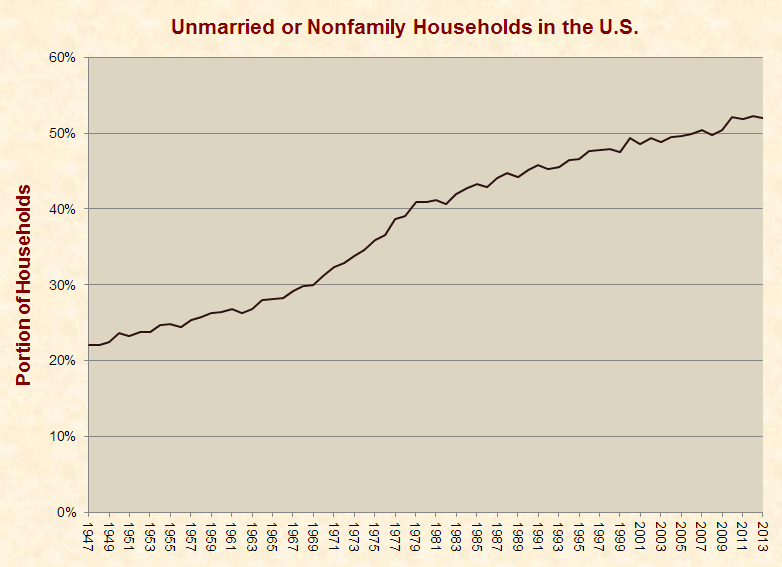
Such logic, which is common among those who claim that income inequality is at historic highs, suffers from a fatal flaw. This is because the disintegration of families has spread workers' wages over an increasing number of households during this era. As shown in the graph below, between 1967 and 2013, the portion of unmarried or nonfamily households in the U.S. rose from 29% to 52%:
unmarried_nonfamily_households_1947-2013A consequence of this marked decline in traditional family households is that household wages significantly understate job market gains. For instance, when a couple who each earns $50,000 per year gets separated or divorced, their incomes often remain the same, but their average household income drops from $100,000 to $50,000. In cases where only one spouse earns income, his or her earning power may decline due to the added responsibilities of single parenthood, and this single income may be split among two households due to alimony payments.
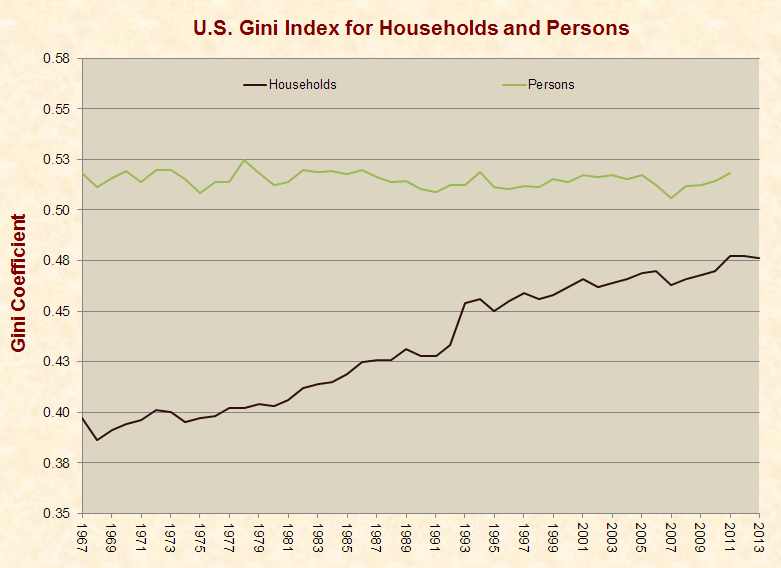
The effects of these family dynamics are evident in the Gini index, which is widely recognized by monetary institutions, economics textbooks, and academic journals as the most common measure of income inequality. Since 1967, which is as far back as the Census Bureau provides this data, the Gini index for households has consistently risen, prompting the Huffington Post (and others) to report that income inequality is at a "record high." That claim, however, is deceptive, because the Gini index for persons has been generally level throughout this period (hat tip: Political Calculations and Ivan O. Kitov):
gini_households_persons_1967-2013This stark difference between the Gini index for households and persons shows that rising household income equality has not been driven by "an inadequate job market" as Porter claims—but by the breakdown of families. Other facts relating to household structure and income underscore this reality:
  • Among children living with married parents, 35.6% have family incomes of $100,000 and above; while among children living with unmarried parents, 4.6% have family incomes of $100,000 and above.
  • Among people who are married, the poverty rate is 6%, as compared to 18% for people who are divorced, and 21% for people who have never married.
  • The poverty rate for black two-parent families is 9%, as compared to 27% for white single-mother families and 15% for white single-father families.
Liberals often argue that conservatives have mistaken the effect for the cause, and that economic hardship has spurred the decline of intact families instead of vice-versa. For example, Jeff Spross, the economics and business correspondent at The Week, has assertedthat the "primary" reason for the collapse of marriage in the U.S. is the "demise of good middle-class jobs and economic security." This notion is at stark odds with the fact that the median real income of U.S. households rose by 40% between 1979 and 2011.
A more nuanced and academic version of the argument made by Spross is that a decline in material welfare is not the cause of family breakdown but "a sense of economic despair" felt by poorer people because of the wealth gap between themselves and richer people. This theory, which is based on the Gini index for households, conflicts with the fact that the Gini index for persons has stayed flat for decades while the rates of unmarried and nonfamily households have soared. If this hypothesis had any merit, the Gini index for persons would have preceded and mirrored the decline in family cohesiveness.
Additionally, the Gini index does not capture all income and taxes, and if it did, it would likely show lower levels of inequality over the past several decades. This is evidenced by the Census Bureau's more comprehensive measures of household income, which are available from 1979 to 2003. These data account for numerous forms of income and taxes that are not included in the Bureau's standard measure of income, and the most comprehensive of these measures shows Gini figures and trends that are lower than the Bureau's standard measure.
A rational and factually coherent explanation for the decline of families is changes in ethics about extra-marital sex, divorce, and unwed child-bearing. Since Gallup began polling Americans on these issues in 2001, moral acceptance of extra-marital sex rose from 53% to 66%, divorce from 59% to 69%, and having a baby out of wedlock from 45% to 58%. These changes transpired in just the last 13 years, and much larger changes surely occurred during the sexual revolution that began in the 1940s and burgeoned in the 1960s to 1980s.
Summarizing the facts above, personal income inequality has not risen for half a century, and the rise of household income inequality stems from family disintegration driven by changing attitudes toward sex, marital fidelity, and familial responsibility.

Monday, April 06, 2015

HOW TO DESTROY AMERICA - Sounds like they have checked all the boxes


We need look no further than his Rules for Radicals (published in 1971) to see the blueprints of what is transpiring today throughout the developed world:

How To Create a Social State by Saul Alinsky
There are 8 levels of control that must be obtained before you are able to create a social state. The first is the most important.
1) Healthcare - Control healthcare and you control the people
2) Poverty - Increase the Poverty level as high as possible, poor people are easier to control and will not fight back if you are providing everything for them to live.
3) Debt - Increase the debt to an unsustainable level. That way you are able to increase taxes, and this will produce more poverty.
4) Gun Control - Remove the ability to defend themselves from the Government. That way you are able to create a police state.
5) Welfare - Take control of every aspect of their lives (Food, Housing, and Income)
6) Education - Take control of what people read and listen to - take control of what children learn in school.
7) Religion - Remove the belief in God from the Government and schools
8) Class Warfare –Divide the people into the wealthy and the poor. This will cause more discontent and it will be easier to take (Tax) the wealthy with the support of the poor.

How To Destroy America | Dick Lamm | Safehaven.com
image
How To Destroy America | Dick Lamm | Safehaven.com
First, to destroy America, turn America into a bilingual or multi-lingual and bicultural country." History shows that no nation can survive the tension, con...
Preview by Yahoo


(Editor's note: A 2004 speech on the dangers of multiculturalism in the United Stated titled "I Have a Plan to Destroy America", became famous after being frequently forwarded as an email. With the immigration debate again heating up, it is time to revisit the speech. Reprinted with permission.)

We know Dick Lamm as the former Governor of Colorado. In that context his thoughts are particularly poignant. Recently there was an immigration overpopulation conference in Washington, DC, filled to capacity by many of American's finest minds and leaders. A brilliant college professor by the name of Victor Davis Hansen talked about his latest book, Mexifornia, explaining how immigration - both legal and illegal was destroying the entire state of California. He said it would march across the country until it destroyed all vestiges of The American Dream.

Moments later, former Colorado Governor Richard D. Lamm stood up and gave a stunning speech on how to destroy America. The audience sat spellbound as he described eight methods for the destruction of the United States. He said, "If you believe that America is too smug, too self-satisfied, too rich, then let's destroy America. It is not that hard to do. No nation in history has survived the ravages of time. Arnold Toynbee observed that all great civilizations rise and fall and that 'An autopsy of history would show that all great nations commit suicide.'"

"Here is how they do it," Lamm said:

"First, to destroy America, turn America into a bilingual or multi-lingual and bicultural country." History shows that no nation can survive the tension, conflict, and antagonism of two or more competing languages and cultures. It is a blessing for an individual to be bilingual; however, it is a curse for a society to be bilingual. The historical scholar, Seymour Lipset, put it this way: 'The histories of bilingual and bi-cultural societies that do not assimilate are histories of turmoil, tension, and tragedy.' Canada, Belgium, Malaysia, and Lebanon all face crises of national existence in which minorities press for autonomy, if not independence. Pakistan and Cyprus have divided. Nigeria suppressed an ethnic rebellion. France faces difficulties with Basques, Bretons, and Corsicans."

Lamm went on: Second, to destroy America, "Invent 'multiculturalism' and encourage immigrants to maintain their culture. I would make it an article of belief that all cultures are equal. That there are no cultural differences. I would make it an article of faith that the Black and Hispanic dropout rates are due solely to prejudice and discrimination by the majority. Every other explanation is out of bounds.

Third, "We could make the United States an 'Hispanic Quebec' without much effort. The key is to celebrate diversity rather than unity. As Benjamin Schwarz said in the Atlantic Monthly recently: 'The apparent success of our own multiethnic and multicultural experiment might have been achieved not by tolerance but by hegemony. Without the dominance that once dictated ethnocentricity and what it meant to be an American, we are left with only tolerance and pluralism to hold us together.' Lamm said, "I would encourage all immigrants to keep their own language and culture. I would replace the melting pot metaphor with the salad bowl metaphor. It is important to ensure that we have various cultural subgroups living in America enforcing their differences rather than as Americans, emphasizing their similarities."

"Fourth, I would make our fastest growing demographic group the least educated. I would add a second underclass, unassimilated, undereducated, and antagonistic to our population. I would have this second underclass have a 50% dropout rate from high. school."

"My fifth point for destroying America would be to get big foundations and business to give these efforts lots of money. I would invest in ethnic identity, and I would establish the cult of 'Victimology.' I would get all minorities to think that their lack of success was the fault of the majority. I would start a grievance industry blaming all minority failure on the majority population."

"My sixth plan for America's downfall would include dual citizenship, and promote divided loyalties. I would celebrate diversity over unity. I would stress differences rather than similarities. Diverse people worldwide are mostly engaged in hating each other - that is, when they are not killing each other. A diverse, peaceful, or stable society is against most historical precedent. People undervalue the unity it takes to keep a nation together. Look at the ancient Greeks. The Greeks believed that they belonged to the same race; they possessed a common language and literature; and they worshipped the same gods. All Greece took part in the Olympic games. A common enemy, Persia, threatened their liberty. Yet all these bonds were not strong enough to overcome two factors: local patriotism and geographical conditions that nurtured political divisions. Greece fell. E. Pluribus Unum -- From many, one. In that historical reality, if we put the emphasis on the 'pluribus'. Instead of the 'Unum,' we will balkanize America as surely as Kosovo."

"Next to last, I would place all subjects off limits; make it taboo to talk about anything against the cult of 'diversity.' I would find a word similar to 'heretic' in the 16th century - that stopped discussion and paralyzed thinking. Words like 'racist' or 'xenophobe' halt discussion and debate. Having made America a bilingual/bicultural country, having established multi-culturism, having the large foundations fund the doctrine of 'Victimology,' I would next make it impossible to enforce our immigration laws. I would develop a mantra: That because immigration has been good for America, it must always be good. I would make every individual immigrant symmetric and ignore the cumulative impact of millions of them."

In the last minute of his speech, Governor Lamm wiped his brow. Profound silence followed. Finally he said, "Lastly, I would censor Victor Davis Hanson's book, Mexifornia. His book is dangerous. It exposes the plan to destroy America. If you feel America deserves to be destroyed, don't read that book."

There was no applause. A chilling fear quietly rose like an ominous cloud above every attendee at the conference. Every American in that room knew that everything Lamm enumerated was proceeding methodically, quietly, darkly, yet pervasively across the United States today. Discussion is being suppressed. Over 100 languages are ripping the foundation of our educational system and national cohesiveness. Even barbaric cultures that practice female genital mutilation are growing as we celebrate 'diversity.' American jobs are vanishing into the Third World as corporations create a Third World in America - take note of California and other states - to date, ten million illegal aliens and growing fast. It is reminiscent of George Orwell's book, 1984. In that story, three slogans are engraved in the Ministry of Truth building: "War is peace," "Freedom is slavery," and "Ignorance is strength."

Governor Lamm walked back to his seat. It dawned on everyone at the conference that the future of our great nation is deeply in trouble and worsening fast. If we don't get this immigration monster stopped quickly, it will rage like a California wildfire and destroy everything in its path, especially The American Dream. 

--


LENIN QUOTES

ECONOMICS
The best way to destroy the capitalist system is to debauch the currency. 

MARRIAGE
Destroy the family, you destroy the country.

2ND AMENDMENT
A system of licensing and registration is the perfect device to deny gun ownership to the bourgeoisie.

POLITICAL CORRECTNESS / MEDIA
We can and must write in a language which sows among the masses hate, revulsion, and scorn toward those who disagree with us.

EDUCATION
Give me four years to teach the children and the seed I have sown will never be uprooted.

OBAMACARE
Socialized medicine is the keystone to the arch of the socialist state.

COMPROMISE
We do not have time to play at “oppositions” at “conferences.” We will keep our political opponents... whether open or disguised as “nonparty,” in prison.








Giants Top Minor League Prospects

  • 1. Joey Bart 6-2, 215 C Power arm and a power bat, playing a premium defensive position. Good catch and throw skills.
  • 2. Heliot Ramos 6-2, 185 OF Potential high-ceiling player the Giants have been looking for. Great bat speed, early returns were impressive.
  • 3. Chris Shaw 6-3. 230 1B Lefty power bat, limited defensively to 1B, Matt Adams comp?
  • 4. Tyler Beede 6-4, 215 RHP from Vanderbilt projects as top of the rotation starter when he works out his command/control issues. When he misses, he misses by a bunch.
  • 5. Stephen Duggar 6-1, 170 CF Another toolsy, under-achieving OF in the Gary Brown mold, hoping for better results.
  • 6. Sandro Fabian 6-0, 180 OF Dominican signee from 2014, shows some pop in his bat. Below average arm and lack of speed should push him towards LF.
  • 7. Aramis Garcia 6-2, 220 C from Florida INTL projects as a good bat behind the dish with enough defensive skill to play there long-term
  • 8. Heath Quinn 6-2, 190 OF Strong hitter, makes contact with improving approach at the plate. Returns from hamate bone injury.
  • 9. Garrett Williams 6-1, 205 LHP Former Oklahoma standout, Giants prototype, low-ceiling, high-floor prospect.
  • 10. Shaun Anderson 6-4, 225 RHP Large frame, 3.36 K/BB rate. Can start or relieve
  • 11. Jacob Gonzalez 6-3, 190 3B Good pedigree, impressive bat for HS prospect.
  • 12. Seth Corry 6-2 195 LHP Highly regard HS pick. Was mentioned as possible chip in high profile trades.
  • 13. C.J. Hinojosa 5-10, 175 SS Scrappy IF prospect in the mold of Kelby Tomlinson, just gets it done.
  • 14. Garett Cave 6-4, 200 RHP He misses a lot of bats and at times, the plate. 13 K/9 an 5 B/9. Wild thing.

2019 MLB Draft - Top HS Draft Prospects

  • 1. Bobby Witt, Jr. 6-1,185 SS Colleyville Heritage HS (TX) Oklahoma commit. Outstanding defensive SS who can hit. 6.4 speed in 60 yd. Touched 97 on mound. Son of former major leaguer. Five tool potential.
  • 2. Riley Greene 6-2, 190 OF Haggerty HS (FL) Florida commit.Best HS hitting prospect. LH bat with good eye, plate discipline and developing power.
  • 3. C.J. Abrams 6-2, 180 SS Blessed Trinity HS (GA) High-ceiling athlete. 70 speed with plus arm. Hitting needs to develop as he matures. Alabama commit.
  • 4. Reece Hinds 6-4, 210 SS Niceville HS (FL) Power bat, committed to LSU. Plus arm, solid enough bat to move to 3B down the road. 98MPH arm.
  • 5. Daniel Espino 6-3, 200 RHP Georgia Premier Academy (GA) LSU commit. Touches 98 on FB with wipe out SL.

2019 MLB Draft - Top College Draft Prospects

  • 1. Adley Rutschman C Oregon State Plus defender with great arm. Excellent receiver plus a switch hitter with some pop in the bat.
  • 2. Shea Langliers C Baylor Excelent throw and catch skills with good pop time. Quick bat, uses all fields approach with some pop.
  • 3. Zack Thompson 6-2 LHP Kentucky Missed time with an elbow issue. FB up to 95 with plenty of secondary stuff.
  • 4. Matt Wallner 6-5 OF Southern Miss Run producing bat plus mid to upper 90's FB closer. Power bat from the left side, athletic for size.
  • 5. Nick Lodolo LHP TCU Tall LHP, 95MPH FB and solid breaking stuff.