Showing posts with label What works in Theory doesn't always work in practice. Show all posts

Saturday, April 30, 2016

Bloomberg: Humans Are Slamming Into Driverless Cars and Exposing a Key Flaw: Bloomberg News

From Bloomberg, Dec 17, 2015, 7:01:03 PM

The Law of Unintended Consequences rears its ugly head once again. Who couldn't see this coming? We're going to take "distracted driving", which I think most would believe is a bad thing, mix in a little "What works in Theory doesn't always work in Practice" and expect a good result? Amazing stuff. Hey, thanks science!! and thanks once again Yogi.

Google Self-Driving Car Project.
The self-driving car, that cutting-edge creation that's supposed to lead to a world without accidents, is achieving the exact opposite right now: The vehicles have racked up a crash rate double that of those with human drivers.
 To read the entire article, go to http://bloom.bg/1Qw8fjB
Sent from the Bloomberg iPhone application. Download the free application at http://itunes.apple.com/us/app/bloomberg/id281941097?mt=8

Sent from my iPhone

from econlib.org
 http://www.econlib.org/library/Enc/UnintendedConsequences.html

The law of unintended consequences, often cited but rarely defined, is that actions of people—and especially of government—always have effects that are unanticipated or unintended. Economists and other social scientists have heeded its power for centuries; for just as long, politicians and popular opinion have largely ignored it.

Sent from my iPhone

Begin forwarded message:

Saturday, March 05, 2016

The Simple Technology That Accidentally Ruined Baseball | The Atlantic


The pendulum swings and when it does it often goes too far in one direction before swinging back the other way. We are seeing that in baseball. This is an excellent article by The Atlantic, a non-baseball publication,  that summarizes the landscape.

QOTY candidate:

Batters are typically worse when they fall behind the count—that is, when there are more strikes than balls—because they have to defend the plate to avoid striking out. Hitters are much more successful on 2-1 counts (two balls, one strike) than on 1-2 counts. "Having a 1-1 pitch that was called a ball in 2008 suddenly get called a strike in 2013 changes the batting environment," Jon Roegele writes in an excellent paper on the rise of low strikes. Strikes hurt hitters even without strike outs by forcing batters to shift to a protect-the-plate strategy rather than a swing-for-the-fences strategy.
QOTY candidate II:

The irony is that MLB did everything that an economist or corporate guru would have advised. Baseball embraced emerging technology rather than banish it. It used analytics to improve the work of its elite employees. It used reviews to encourage exceptional performance among umpires. And the league got exactly what they wanted: a more-perfect strike zone.

But is that really baseball's highest goal? A perfect strike zone, at the expense of steadily evaporating offense?

QOTY candidate III:

Baseball has done all the right little things while perhaps ignoring the big thing: It needs hitters. It needs home runs. Sports thrive and grow when national stars thrive on national television as marketing ambassadors of the game. Today, baseball is a national pastime without a truly national star. Mike Trout, the historic and absurdly young center fielder for the league-leading Los Angeles Angels, has one-third the name recognition of Derek Jeter, a telegenic veteran that even this Yankees fan named Derek will acknowledge was never half as good as Trout.

So the league has pitched itself into a corner. Its own rules have destroyed the offensive power surge that had captured America's attention in the late-'90s and early aughts. 

Umpires, empowered and/or cowered by technology, are better than ever. As a direct result, baseball has become a grind for fans who prefer sports with scoring.
Great article

===


theatlantic.com
The Simple Technology That Accidentally Ruined Baseball - The Atlantic

The Simple Technology That Accidentally Ruined Baseball

It's not the sort of accomplishment that ESPN is likely to crow about, but Philadelphia Phillies center-fielder Ben Revere is on track to set an astonishing baseball record—a mark that says as much about the game today as Barry Bonds's 73 home runs said about the swollen biceps that defined the early 21st century. Revere is currently batting just over .313, higher than any other player in the National League. That figure would match the lowest batting title in the NL's 138-year history and the fourth lowest in baseball since 1900.

Can't anybody hit, these days?

Baseball has become too boring is one of those popular but unfalsifiable statements about sports, like Curling is stupid and Americans should watch more soccer. But if you like guys crossing the plate and balls falling beyond the outfield walls, baseball's growing tedium is a straightforward observation. Both home runs-per-game and runs-per-game are down about 20 percent from their early-2000s highs. Strikeouts are up about a fifth. In the last decade, the number of players slugging higher than .500 has collapsed from 45 to 15.

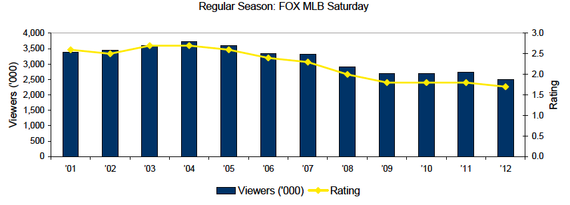
Defense wins championships, as coaches like to say, but offense wins sweeps. Fans aren't tuning in to the Era of the Pitcher. Across a range of networks including Fox's Saturday game, TBS, and ESPN, ratings have fallen by between 25 and 35 percent since baseball's collective hitting slump started in the middle of the last decade.

"Moneyball"/RBC

In short, baseball is getting quantitatively less exciting, and fewer people watch with each passing year. Why?

The obvious answer—so obvious that its obviousness seems to dispel other explanations—is the rule against steroids. In the spring of 2006, Major League Baseball implemented a new drug policy, banning more than 100 substances and threatening one-year suspensions for two-time violators and lifetime bans for three-time offenders. You might say that performance-enhancing drugs were the chemical tailwind behind the home-run bonanza.

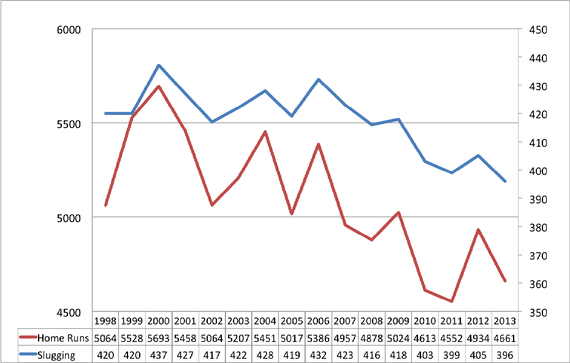
When baseball banished them, the tailwind died, and hitters' un-enhanced strength has proven inferior. Since 2006, the same year baseball introduced its drug policy, total home runs have fallen in a herky-jerky pattern. Total slugging, a more complete picture of power hitting, has eroded more steadily.

The End of Offense
League-wide home runs and slugging percentage: 1998 - 2013
baseballreference.com


Yes, steroids pumped up offenses, and yes, the rules against steroids have deflated them. But something else happened in 2006—something that baseball fans rarely talk about when they bemoan the offensive state of baseball. It wasn't something that baseball took away. It was, rather, something that baseball added.

A camera.

Umpiring the Umpires
On October 4, 2006, the Minnesota Twins hosted the Oakland Athletics in a first-round playoff game at the Metrodome. When the first pitch left Esteban Loaiza's fingers, a first-of-its-kind camera tracked the pitch's speed, break, and location, and relayed the data points to broadcasters and online viewers. By 2008, cameras with this Pitch f/x technology were installed in every stadium, capturing 95 percent of all balls and strikes, according to Hardball Times.

Rather than deem the cameras a threat to league integrity, baseball embraced them. For years, Major League Baseball had been pressuring umpires to submit to performance standards. With the introduction of Pitch f/x, MLB finally had cameras in every stadium to umpire the umpires. In 2009, the league implemented a policy called Zone Evaluation (ZE), which tracked missed calls after each game and judged umpires by their accuracy. After ZE's first year, three senior umpires were fired for their mistakes behind the plate. Those with good performance could get promotions and earn up to $400,000.

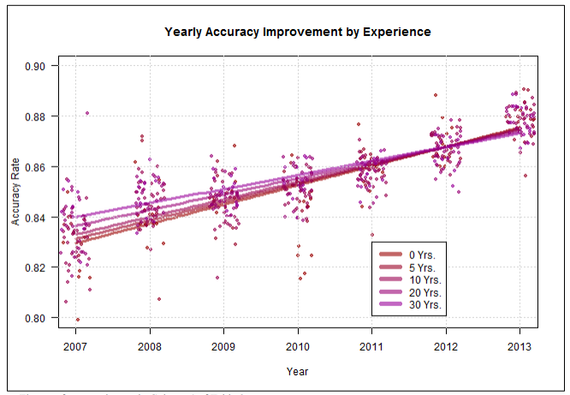
Better incentives make better workers. As economist Edward Lazear has shown, organizations become more productive when a job well done is rewarded with extra money and dumb mistakes are punished. So we shouldn't be surprised that, after the introduction of cameras, umpires have called the strike zone more consistently and more accurately each year since 2007, as Brian Mills explained in a brilliant paper.

Cameras Made Umpires More Accurate
Mills


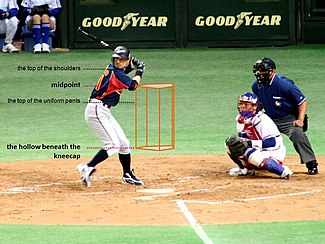
The strike zone morphed in the age of camera technology, as well. Before cameras, it turned out, umpires had been ignoring strikes around the knees. Pitches between 18 and 30 inches above the plate, which are technically in the strike zone, had been called balls for years. But the presence of cameras encouraged umpires to lower the strike zone.

As you're about to see, this swung the balance of power from the batters box to the pitching mound, shutting down baseball's thrilling home-run parade and inaugurating the Era of the Pitcher.

The New (Lower) Strike Zone
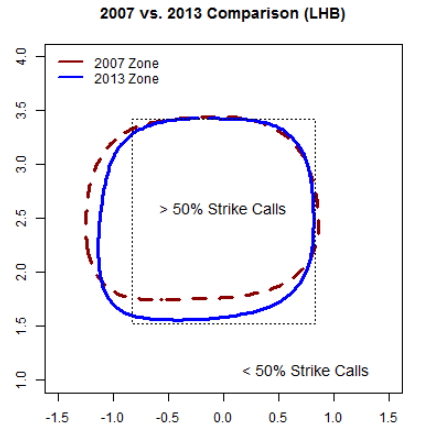
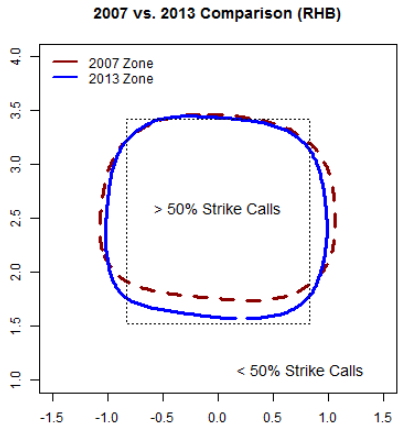
For both right- and left-handed batters, the strike zone has both narrowed and deepened. Since 2008, the strike zone has grown by about 30 square inches around a hitter's knees [see graph]. That is the equivalent of about five full baseballs placed side-by-side, according to Mills' research.

The New Strike Zone: Narrower and Lower

Since umpires opened up the basement of the strike zone, pitchers haven't just moved in. They've changed their permanent residence, painted the walls, and opened a co-op. The game of baseball has moved considerably closer to the plate in many ways ...
  • The share of pitches thrown less than 2.5 feet over the plate (i.e.: a "low" pitch) has grown every year since 2009.
  • In 2007, "low" pitches were 17 percent more common than higher pitches. By 2013, they were 43 percent more common.
  • The sinker, a fastball pitch that breaks downward, has grown from 35 percent of all pitches in 2007 to 38 percent today.
  • Hitters have swung at low pitches at a higher rate every year since 2009.
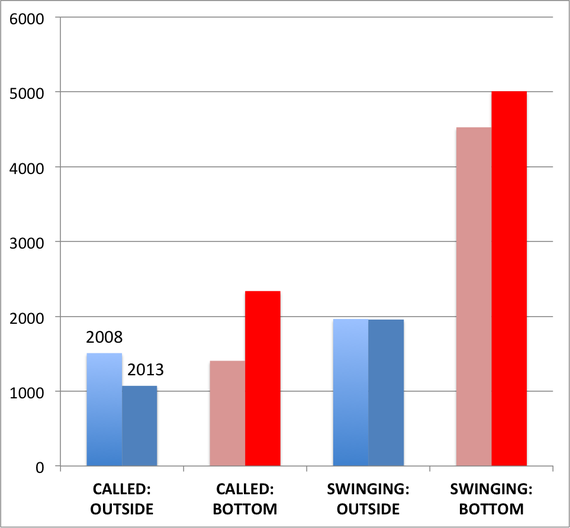
As the strikes moved down, the strikeouts went up. Swinging strikeouts are up 11 percent since 2008. Called strikeouts (on third strikes without a swing) are up 66 percent. The entire increase in strikeouts is happening on pitches between 18 and 24 inches off the ground.

The Rise in Strikeouts: It's All About Low Pitches
Y-axis: Annual strikeouts | "Bottom" = 18-24 inches above the plate
The Atlantic/Mills


To review, a lower strike zone invited more low pitches, more low strikes, and more strike outs. These variables on their own explain a good chunk of baseball's offensive drought. But let's throw in one more variable in there: hitter psychology.

Batters are typically worse when they fall behind the count—that is, when there are more strikes than balls—because they have to defend the plate to avoid striking out. Hitters are much more successful on 2-1 counts (two balls, one strike) than on 1-2 counts. "Having a 1-1 pitch that was called a ball in 2008 suddenly get called a strike in 2013 changes the batting environment," Jon Roegele writes in an excellent paper on the rise of low strikes. Strikes hurt hitters even without strike outs by forcing batters to shift to a protect-the-plate strategy rather than a swing-for-the-fences strategy.

To illustrate this point, consider the Florida Marlins' Giancarlo Stanton, the MLB-leader in home runs and RBIs. Here are his numbers on each count and after each count:
  • 1-1: 34 at-bats; .529 average; 1.176 slugging
  • 2-1: 38 at-bats; .385 average; .692 slugging
  • 1-2: 91 at-bats; .176 average; .297 slugging
     
  • After 1-1: 218 at-bats; .257 average; .459 slugging
  • After 2-1: 119 at-bats; .261 average; .445 slugging
  • After 1-2: 155 at-bats; .187 average; .297 slugging
Going from a 2-1 count to a 1-2 count has a staggering effect on Stanton's offense. On a 2-1 count, Stanton hits like Albert Pujols. On a 1-2 count, his slugging is worse than Ichiro Suzuki.
The upshot? When you add up the cumulative effects of a lower strike zone—more low pitches yielding worse hits, more strikes yielding worse counts for hitters, and more strike outs—they explain one-third of the offensive decrease over the last five years, Roegele found. Mills's research suggests that the figure is even higher: "As much as 40 percent of the decline in run scoring may be directly attributed to the increases in called strikes."

Why Baseball's Going Down
A bigger, lower strike zone might be the most important factor in baseball's offensive cold streak. That would not make it the only factor. For example:
  • In the last decade, managers have gotten smarter about defense, and many runs have potentially disappeared into the maw of improved defenders and advanced fielding.
  • The strategic deployment of hard-throwing middle relievers has blunted offensive power. The number of relief appearances since 1987 has doubled according to Joe Sheehan's newsletter, while the number of pitchers averaging a 95-mph fastball has increased from 11 to 25 since 2002.*
  • There are reports that temporary inconsistencies in baseball manufacturing in the 1990s created a bounty of "juiced balls," which traveled further than ordinary baseballs. Jay Jaffe produced interesting anecdotal evidence of the juiced-ball theory.
  • It's possible that baseball is going through a brief dry spell in home-run-hitting talent, or an extraordinary moment in pitching quality.
  • Perhaps most importantly, the harsh 2006 rules against performance-enhancing drugs offer a compelling explanation for baseball's dearth of power—although it's odd that baseball's minor leagues haven't seen a similar decline in offensive performance since their own steroid policy was implemented.  
But none of this rules out the astonishing impact that camera-technology and performance standards for umpires have had on baseball's hitters.

The irony is that MLB did everything that an economist or corporate guru would have advised. Baseball embraced emerging technology rather than banish it. It used analytics to improve the work of its elite employees. It used reviews to encourage exceptional performance among umpires. And the league got exactly what they wanted: a more-perfect strike zone.

But is that really baseball's highest goal? A perfect strike zone, at the expense of steadily evaporating offense?

Baseball has done all the right little things while perhaps ignoring the big thing: It needs hitters. It needs home runs. Sports thrive and grow when national stars thrive on national television as marketing ambassadors of the game. Today, baseball is a national pastime without a truly national star. Mike Trout, the historic and absurdly young center fielder for the league-leading Los Angeles Angels, has one-third the name recognition of Derek Jeter, a telegenic veteran that even this Yankees fan named Derek will acknowledge was never half as good as Trout.

So the league has pitched itself into a corner. Its own rules have destroyed the offensive power surge that had captured America's attention in the late-'90s and early aughts. 

Umpires, empowered and/or cowered by technology, are better than ever. As a direct result, baseball has become a grind for fans who prefer sports with scoring.


Sent from my iPhone


Why Socialism Failed | Foundation for Economic Education


 And yet, we seem to want to try it here? When it has failed miserably everywhere else?

I think back to Reagan's quote about socialism "It only works in two places. Heaven, where they don't need it. And Hell, where they already have it."

And Margaret Thatcher's "Socialism works until you run out of other people's money."

One of the biggest lies of all time. Socialism works.


Why Socialism Failed | Foundation for Economic Education

Why Socialism Failed

Socialism is the Big Lie of the twentieth century. While it promised prosperity, equality, and security, it delivered poverty, misery, and tyranny. Equality was achieved only in the sense that everyone was equal in his or her misery.
In the same way that a Ponzi scheme or chain letter initially succeeds but eventually collapses, socialism may show early signs of success. But any accomplishments quickly fade as the fundamental deficiencies of central planning emerge. It is the initial illusion of success that gives government intervention its pernicious, seductive appeal. In the long run, socialism has always proven to be a formula for tyranny and misery.
A pyramid scheme is ultimately unsustainable because it is based on faulty principles. Likewise, collectivism is unsustainable in the long run because it is a flawed theory. Socialism does not work because it is not consistent with fundamental principles of human behavior. The failure of socialism in countries around the world can be traced to one critical defect: it is a system that ignores incentives.
In a capitalist economy, incentives are of the utmost importance. Market prices, the profit-and-loss system of accounting, and private property rights provide an efficient, interrelated system of incentives to guide and direct economic behavior. Capitalism is based on the theory that incentives matter!
Under socialism, incentives either play a minimal role or are ignored totally. A centrally planned economy without market prices or profits, where property is owned by the state, is a system without an effective incentive mechanism to direct economic activity. By failing to emphasize incentives, socialism is a theory inconsistent with human nature and is therefore doomed to fail. Socialism is based on the theory that incentives don't matter!
In a radio debate several months ago with a Marxist professor from the University of Minnesota, I pointed out the obvious failures of socialism around the world in Cuba, Eastern Europe, and China. At the time of our debate, Haitian refugees were risking their lives trying to get to Florida in homemade boats. Why was it, I asked him, that people were fleeing Haiti and traveling almost 500 miles by ocean to get to the "evil capitalist empire" when they were only 50 miles from the "workers' paradise" of Cuba?
The Marxist admitted that many "socialist" countries around the world were failing. However, according to him, the reason for failure is not that socialism is deficient, but that the socialist economies are not practicing "pure" socialism. The perfect version of socialism would work; it is just the imperfect socialism that doesn't work. Marxists like to compare a theoretically perfect version of socialism with practical, imperfect capitalism which allows them to claim that socialism is superior to capitalism.
If perfection really were an available option, the choice of economic and political systems would be irrelevant. In a world with perfect beings and infinite abundance, any economic or political system–socialism, capitalism, fascism, or communism–would work perfectly.
However, the choice of economic and political institutions is crucial in an imperfect universe with imperfect beings and limited resources. In a world of scarcity it is essential for an economic system to be based on a clear incentive structure to promote economic efficiency. The real choice we face is between imperfect capitalism and imperfect socialism. Given that choice, the evidence of history overwhelmingly favors capitalism as the greatest wealth-producing economic system available.
The strength of capitalism can be attributed to an incentive structure based upon the three Ps: (1) prices determined by market forces, (2) a profit-and-loss system of accounting and (3) private property rights. The failure of socialism can be traced to its neglect of these three incentive-enhancing components.
Prices
The price system in a market economy guides economic activity so flawlessly that most people don't appreciate its importance. Market prices transmit information about relative scarcity and then efficiently coordinate economic activity. The economic content of prices provides incentives that promote economic efficiency.
For example, when the OPEC cartel restricted the supply of oil in the 1970s, oil prices rose dramatically. The higher prices for oil and gasoline transmitted valuable information to both buyers and sellers. Consumers received a strong, clear message about the scarcity of oil by the higher prices at the pump and were forced to change their behavior dramatically. People reacted to the scarcity by driving less, carpooling more, taking public transportation, and buying smaller cars. Producers reacted to the higher price by increasing their efforts at exploration for more oil. In addition, higher oil prices gave producers an incentive to explore and develop alternative fuel and energy sources.
The information transmitted by higher oil prices provided the appropriate incentive structure to both buyers and sellers. Buyers increased their effort to conserve a now more precious resource and sellers increased their effort to find more of this now scarcer resource.
The only alternative to a market price is a controlled or fixed price which always transmits misleading information about relative scarcity. Inappropriate behavior results from a controlled price because false information has been transmitted by an artificial, non-market price.
Look at what happened during the 1970s when U.S. gas prices were controlled. Long lines developed at service stations all over the country because the price for gasoline was kept artificially low by government fiat. The full impact of scarcity was not accurately conveyed. As Milton Friedman pointed out at the time, we could have eliminated the lines at the pump in one day by allowing the price to rise to clear the market.
From our experience with price controls on gasoline and the long lines at the pump and general inconvenience, we get an insight into what happens under socialism where every price in the economy is controlled. The collapse of socialism is due in part to the chaos and inefficiency that result from artificial prices. The information content of a controlled price is always distorted. This in turn distorts the incentives mechanism of prices under socialism. Administered prices are always either too high or too low, which then creates constant shortages and surpluses. Market prices are the only way to transmit information that will create the incentives to ensure economic efficiency.
Profits and Losses
Socialism also collapsed because of its failure to operate under a competitive, profit-and-loss system of accounting. A profit system is an effective monitoring mechanism which continually evaluates the economic performance of every business enterprise. The firms that are the most efficient and most successful at serving the public interest are rewarded with profits. Firms that operate inefficiently and fail to serve the public interest are penalized with losses.
By rewarding success and penalizing failure, the profit system provides a strong disciplinary mechanism which continually redirects resources away from weak, failing, and inefficient firms toward those firms which are the most efficient and successful at serving the public. A competitive profit system ensures a constant reoptimization of resources and moves the economy toward greater levels of efficiency. Unsuccessful firms cannot escape the strong discipline of the marketplace under a profit/loss system. Competition forces companies to serve the public interest or suffer the consequences.
Under central planning, there is no profit-and-loss system of accounting to accurately measure the success or failure of various programs. Without profits, there is no way to discipline firms that fail to serve the public interest and no way to reward firms that do. There is no efficient way to determine which programs should be expanded and which ones should be contracted or terminated.
Without competition, centrally planned economies do not have an effective incentive structure to coordinate economic activity. Without incentives the results are a spiraling cycle of poverty and misery. Instead of continually reallocating resources towards greater efficiency, socialism falls into a vortex of inefficiency and failure.
Private Property Rights
A third fatal defect of socialism is its blatant disregard for the role of private property rights in creating incentives that foster economic growth and development. The failure of socialism around the world is a "tragedy of commons" on a global scale.
The "tragedy of the commons" refers to the British experience of the sixteenth century when certain grazing lands were communally owned by villages and were made available for public use. The land was quickly overgrazed and eventually became worthless as villagers exploited the communally owned resource.
When assets are publicly owned, there are no incentives in place to encourage wise stewardship. While private property creates incentives for conservation and the responsible use of property, public property encourages irresponsibility and waste. If everyone owns an asset, people act as if no one owns it. And when no one owns it, no one really takes care of it. Public ownership encourages neglect and mismanagement.
Since socialism, by definition, is a system marked by the "common ownership of the means of production," the failure of socialism is a "tragedy of the commons" on a national scale. Much of the economic stagnation of socialism can be traced to the failure to establish and promote private property rights.
As Peruvian economist Hernando de Soto remarked, you can travel in rural communities around the world and you will hear dogs barking, because even dogs understand property rights. It is only statist governments that have failed to understand property rights. Socialist countries are just now starting to recognize the importance of private property as they privatize assets and property in Eastern Europe.
Incentives Matter
Without the incentives of market prices, profit-and-loss accounting, and well-defined property rights, socialist economies stagnate and wither. The economic atrophy that occurs under socialism is a direct consequence of its neglect of economic incentives.
No bounty of natural resources can ever compensate a country for its lack of an efficient system of incentives. Russia, for example, is one of the world's wealthiest countries in terms of natural resources; it has some of the world's largest reserves of oil, natural gas, diamonds, and gold. Its valuable farm land, lakes, rivers, and streams stretch across a land area that encompasses 11 time zones. Yet Russia remains poor. Natural resources are helpful, but the ultimate resources of any country are the unlimited resources of its people–human resources.
By their failure to foster, promote, and nurture the potential of their people through incentive-enhancing institutions, centrally planned economies deprive the human spirit of full development. Socialism fails because it kills and destroys the human spirit–just ask the people leaving Cuba in homemade rafts and boats.
As the former centrally planned economies move toward free markets, capitalism, and democracy, they look to the United States for guidance and support during the transition. With an unparalleled 250-year tradition of open markets and limited government, the United States is uniquely qualified to be the guiding light in the worldwide transition to freedom and liberty.
We have an obligation to continue to provide a framework of free markets and democracy for the global transition to freedom. Our responsibility to the rest of the world is to continue to fight the seductiveness of statism around the world and here at home. The seductive nature of statism continues to tempt and lure us into the Barmecidal illusion that the government can create wealth.
The temptress of socialism is constantly luring us with the offer: "give up a little of your freedom and I will give you a little more security." As the experience of this century has demonstrated, the bargain is tempting but never pays off. We end up losing both our freedom and our security.
Programs like socialized medicine, welfare, Social Security, and minimum wage laws will continue to entice us because on the surface they appear to be expedient and beneficial. Those programs, like all socialist programs, will fail in the long run regardless of initial appearances. These programs are part of the Big Lie of socialism because they ignore the important role of incentives.
Socialism will remain a constant temptation. We must be vigilant in our fight against socialism not only around the globe but also here in the United States.
The failure of socialism inspired a worldwide renaissance of freedom and liberty. For the first time in the history of the world, the day is coming very soon when a majority of the people in the world will live in free societies or societies rapidly moving toward freedom.
Capitalism will play a major role in the global revival of liberty and prosperity because it nurtures the human spirit, inspires human creativity, and promotes the spirit of enterprise. By providing a powerful system of incentives that promote thrift, hard work, and efficiency, capitalism creates wealth.
The main difference between capitalism and socialism is this: Capitalism works.


Sent from my iPhone

Friday, August 01, 2014

Your Big Doubts About the 10,000 Hour Rule Are Well-Founded | Library of Economics and Liberty


Great stuff on the Nature versus Nurture debate, the Ten Thousand Hour Rule and more from what may seem like an unlikely source, the Library of Economics and Liberty. BTW this site and this article demonstrates my theory that you can judge a site by the quality of the comments in the comments section and this site is top notch, top quality and first class all the way. Therefore, it is appropriately bookmarked and highly recommended.


Your Big Doubts About the 10,000 Hour Rule Are Well-Founded | EconLog | Library of Economics and Liberty
image
Your Big Doubts About the 10,000 Hour Rule Are Well-F...
Ericsson, Krampe, and Tesch-Romer's
Preview by Yahoo

Ericsson, Krampe, and Tesch-Romer's "The Role of Deliberate Practice in the Acquisition of Expert Performance" (PSYCHOLOGICAL Review 1993) isn't just one of the most famous articles in the history of academic PSYCHOLOGY.  Thanks to Malcolm Gladwell's Outliers, the article's bullet points are now famous around the globe.  It is from this article and related RESEARCH the Gladwell distills his "10,000 Hour Rule."

What does the 10,000 Hour Rule really say?  A few caveats aside, the Rule says that 10,000 hours of deliberate practice is both necessary and sufficient for world-class expertise.  Listen, for example, to Gladwell talk about musical expertise.
The striking thing about Ericsson's study is that he and his colleagues couldn't find any "naturals," musicians who floated effortlessly to the top while practicing a fraction of the time their peers did. Nor could they find any "grinds," people who worked harder than everyone else, yet just didn't have what it takes to break the top ranks. Their research suggests that once a musician has enough ability to get into a top MUSIC SCHOOL, the thing that distinguishes one performer from another is how hard he or she works. That's it. And what's more, the people at the very top don't work just harder or even much harder than everyone else. They work much, much harder.
This may seem like journalistic hyperbole, but it's quite close to the original RESEARCH.  Ericsson, Krampe, and Tesch-Romer:
Contrary to the popular "talent" view that asserts that differences in practice and experience cannot account for differences in expert performance, we have shown that the amount of a specific type of activity (deliberate practice) is consistently correlated with a wide range of performance including expert-level performance, when appropriate developmental differences (age) are controlled. Because of the high costs to the individuals and their environments of engaging in high levels of deliberate practice and the overlap in characteristics of deliberate practice and other known effective training situations, one can infer that high levels of deliberate practice arenecessary to attain expert level performance. Our theoretical framework can also provide a sufficient account of the major facts about the NATURE and scarcity of exceptional performance. [emphasis mine]
And:
We attribute the dramatic differences in performance between experts and amateurs-novices to similarly large differences in the recorded amounts of deliberate practice. Furthermore, we can account for stable individual differences in performance among individuals actively involved in deliberate practice with reference to the monotonic relation between accumulated amount of deliberate practice and current level of performance.
Although I've found great value in Ericsson's research, his skepticism about innate talent always struck me as crazy.  Yes, experts energetically hone their crafts.  But everywhere I look, I see Gladwell's "naturals" - people who are good despite relatively little time investment - and "grinds" - people who are mediocre despite massive time investment.  Only recently, though, did I discover a pile of researchthat confirms my big doubts about the 10,000 Hour Rule.  Highlights of the highlights:
More than 20 years ago, researchers proposed that individual differences in performance in such domains as music, sports, and games largely reflect individual differences in amount of deliberate practice, which was defined as engagement in structured activities created specifically to improve performance in a domain. This view is a frequent topic of popular science writing--but is IT SUPPORTED by empirical evidence? To answer this question, we conducted a meta-analysis covering all major domains in which deliberate practice has been investigated. We found that deliberate practice explained 26% of the variance in performance for games, 21% for music, 18% for sports, 4% for education, and less than 1% for professions. We conclude that deliberate practice is important, but not as important as has been argued.
The case of chess:
On average, deliberate practice explained 34% of the reliable variance in chess performance, leaving 66% unexplained and potentially explainable by other factors. We conclude that deliberate practice is not sufficient to account for individual differences in chess performance. The implication of this conclusion is that some people require much less deliberate practice than other people to reach an elite level of performance in chess. We illustrate this point in Fig. 2 using Gobet and Campitelli's (2007) chess SAMPLE, with the 90 players classified based on their chess ratings as "master" (≥2200, n = 16), "expert" (≥2000, n = 31), or "intermediate" (<2000, n = 43). There were large differences in mean amount of deliberate practice across the skill groups: master M = 10,530 h (SD = 7414), expert M = 5673 h (SD = 4654), and intermediate M = 3179 h (SD = 4615). However, as the SDs suggest, there were very large ranges of deliberate practice within skill groups. For example, the range for the masters was 832 to 24,284 h--a difference of nearly three orders of magnitude. Furthermore, there was overlap in distributions between skill groups. For example, of the 16 masters, 31.3% (n = 5) had less deliberate practice than the mean of the expert group, one skill level down, and 12.5% (n = 2) had less deliberate practice than the mean of the intermediate group, two skill levels down. In the other direction, of the 31 intermediates, 25.8% (n = 8) had more deliberate practice than the mean of the expert group, one skill level up, and 12.9% (n = 4) had more deliberate practice than the mean of the master group, two skill levels up.
The figure:

expert.jpg

The case of music:
On average across studies, deliberate practice explained about 30% of the reliable variance in music performance, leaving about 70% unexplained and potentially explainable by other factors. We conclude that deliberate practice is not sufficient to account for individual differences in music performance. Results of other studies provide further support for this conclusion. Simonton (1991) found a large amount of variability in the amount of time it took famous classical composers to have their first "hit," and that the interval between the first composition and the first hit correlated significantly and negatively with maximum annual output, lifetime productivity, and posthumous reputation. Composers who rose to fame quickly-the most "talented"-had the most successful careers. Furthermore, Sloboda, Davidson, Howe, and Moore (1996) noted that although students at a selective MUSIC SCHOOL ("high achievers") had accumulated more "formal practice" than students who were learning an instrument at a non-music school ("pleasure players"), there were some individuals at each skill level (grade) who did "less than 20 per cent of the mean amount of practice for that grade" and others who did "over four times as much practice than average to attain a given grade" (p. 301).
If deliberate practice doesn't explain everything, what does?  Lots of stuff.  Starting age.  IQ. PERSONALITY.  Specific cognitive skills, too.  Consider working memory:
Ericsson and colleagues have argued that measures of working memory capacity themselves reflect acquired skills (Ericsson & Delaney, 1999; Ericsson & Kintsch, 1995), but working memory capacity and deliberate practice correlated near zero in this STUDY (r = .003). There was also no evidence for a Deliberate Practice × Working Memory Capacity interaction, indicating that working memory capacity was no less important a predictor of performance for pianists with thousands of hours of deliberate practice than it was for beginners.  
Fortunately, we can salvage most of the original RESEARCH behind the 10,000 Hour Rule.  Instead of thinking of 10,000 hours of deliberate practice as a mandatory minimum for expertise, take it as a rule of thumb: On average, a world-class expert has to practice for about 10,000 hours to reach the top.  Instead of thinking of 10,000 hours as a guarantee of expertise, adopt a pluralistic and probabilistic approach: 10,000 hours combined with lots of innate talent will usuallytake you to the top.

Most importantly, though, think of deliberate practice as a general THEORY ofimprovement, not a special THEORY of expertise!  Some people learn more much easily than others.  But almost anyone can improve in almost anything.  How?  By deliberately practicing the specific skills they wish to improve.  RESEARCH on deliberate practice doesn't undermine intelligence research by showing that genius is a myth.  Instead it reinforces Transfer of Learning research by showing that learning is highly specific.

HT: GMU econ prodigy Nathaniel Bechhofer


---


Nature versus Nurture

In this article we will be exploring the age-old nature or nurture debate: which is more relevant; your genes or how you are bought up. This particular article will be concerned with inteligence.


Evolution and Genetics
Firstly, what is evolution? It is a process where the creatures that are best adapted to survive will live longer and therefore be able to reproduce more and have a greater number of offspring. Many of these offspring will have this characteristic and over the course of many generations all in that species will have this characteristic.
It can be defined briefly as: a gradual change in a species over time because of a natural selection of the best adapted to an environment.
Now we move on to a simple look at genetics. As you know, we have genes which give us different characteristics and these genes are inherited from our parents. The actualgenetic code is known as the genotype. However, you get one gene from each parent for everything, but obviously only one of these can be expressed; so how the genes actaully manifest themselves is called the phenotype.
Twin Studies
A twin study is one of the method used. There are two types of twin: dizygotic (DZ) who are regular fraternal twins; and then monozygotic (MZ) which are identical twins and so have exactly the same DNA as each other, i.e. the genotypes are identical. The table below summarizes what the various findings would mean.
twin studies
In particular it is useful to look at MZ twins (since there genetics are the same) who have been raised together or apart. This was done by Shields (1962), and found the correlation between inteligences of MZ growing up together was 0.83 and growing up apart was 0.51. This would appear to show the environment is more important, however there are some methodological issues related to this study.
A correlation shows how two things are related, but don't give a definite reason. Also, it is only recently that we can prove two twins are identical, it could be that DZ twins that looked very similar were included because they thought they were identical. And finally there is the issue of what was counted as 'seperated' in the study, some twins were included who were raised but different family members but lived near to each other, regually saw each other and went to the same school.

............

Conclusion
Very sorry to dissappoint you, but the conclusion is that both nature and nurture play an important role, however perhaps that the environment is the deciding factor.
The idea used to describe it is the Rubber Band Hypothesis. It says that the potential (length of the band) is decided by genetics. However the environment stretches this band, so that someone with a low potential could be stretched beyond someone with a high because of environmental differences. However if someone with a high and someone with a lower genetic potential had the same environment, that person with the higher genetic potential would be able to 'stretch' their intelligence to a higher level.
the rubber band hypothesis of intelligence


Giants Top Minor League Prospects

  • 1. Joey Bart 6-2, 215 C Power arm and a power bat, playing a premium defensive position. Good catch and throw skills.
  • 2. Heliot Ramos 6-2, 185 OF Potential high-ceiling player the Giants have been looking for. Great bat speed, early returns were impressive.
  • 3. Chris Shaw 6-3. 230 1B Lefty power bat, limited defensively to 1B, Matt Adams comp?
  • 4. Tyler Beede 6-4, 215 RHP from Vanderbilt projects as top of the rotation starter when he works out his command/control issues. When he misses, he misses by a bunch.
  • 5. Stephen Duggar 6-1, 170 CF Another toolsy, under-achieving OF in the Gary Brown mold, hoping for better results.
  • 6. Sandro Fabian 6-0, 180 OF Dominican signee from 2014, shows some pop in his bat. Below average arm and lack of speed should push him towards LF.
  • 7. Aramis Garcia 6-2, 220 C from Florida INTL projects as a good bat behind the dish with enough defensive skill to play there long-term
  • 8. Heath Quinn 6-2, 190 OF Strong hitter, makes contact with improving approach at the plate. Returns from hamate bone injury.
  • 9. Garrett Williams 6-1, 205 LHP Former Oklahoma standout, Giants prototype, low-ceiling, high-floor prospect.
  • 10. Shaun Anderson 6-4, 225 RHP Large frame, 3.36 K/BB rate. Can start or relieve
  • 11. Jacob Gonzalez 6-3, 190 3B Good pedigree, impressive bat for HS prospect.
  • 12. Seth Corry 6-2 195 LHP Highly regard HS pick. Was mentioned as possible chip in high profile trades.
  • 13. C.J. Hinojosa 5-10, 175 SS Scrappy IF prospect in the mold of Kelby Tomlinson, just gets it done.
  • 14. Garett Cave 6-4, 200 RHP He misses a lot of bats and at times, the plate. 13 K/9 an 5 B/9. Wild thing.

2019 MLB Draft - Top HS Draft Prospects

  • 1. Bobby Witt, Jr. 6-1,185 SS Colleyville Heritage HS (TX) Oklahoma commit. Outstanding defensive SS who can hit. 6.4 speed in 60 yd. Touched 97 on mound. Son of former major leaguer. Five tool potential.
  • 2. Riley Greene 6-2, 190 OF Haggerty HS (FL) Florida commit.Best HS hitting prospect. LH bat with good eye, plate discipline and developing power.
  • 3. C.J. Abrams 6-2, 180 SS Blessed Trinity HS (GA) High-ceiling athlete. 70 speed with plus arm. Hitting needs to develop as he matures. Alabama commit.
  • 4. Reece Hinds 6-4, 210 SS Niceville HS (FL) Power bat, committed to LSU. Plus arm, solid enough bat to move to 3B down the road. 98MPH arm.
  • 5. Daniel Espino 6-3, 200 RHP Georgia Premier Academy (GA) LSU commit. Touches 98 on FB with wipe out SL.

2019 MLB Draft - Top College Draft Prospects

  • 1. Adley Rutschman C Oregon State Plus defender with great arm. Excellent receiver plus a switch hitter with some pop in the bat.
  • 2. Shea Langliers C Baylor Excelent throw and catch skills with good pop time. Quick bat, uses all fields approach with some pop.
  • 3. Zack Thompson 6-2 LHP Kentucky Missed time with an elbow issue. FB up to 95 with plenty of secondary stuff.
  • 4. Matt Wallner 6-5 OF Southern Miss Run producing bat plus mid to upper 90's FB closer. Power bat from the left side, athletic for size.
  • 5. Nick Lodolo LHP TCU Tall LHP, 95MPH FB and solid breaking stuff.