Showing posts with label TALENT. Show all posts

Thursday, July 05, 2018

How to Identify Talent: Five Lessons from the NFL Draft - Behavioral Scientist

How to Identify Talent: Five Lessons from the NFL Draft - Behavioral Scientist


JACKSONVILLE - The Browns had a tough decision again for the franchise QB spot and this time I think they got it right with Mayfield. I think some of the other NFL GM's were trying to coax them into a mistake with leaked information about how great the other guys were, but they all had warts.  Mayfield struck me as almost a modern day, collegiate version of Jim McMahon, and that spells winner.

from behavioralscientist.org
http://behavioralscientist.org/how-to-identify-talent-five-lessons-from-the-nfl-draft/

How to Identify Talent: Five Lessons from the NFL DraftApril 23, 2018

This week the Cleveland Browns will decide which, if any, of the top quarterback prospects to acquire with the first pick in the NFL draft. There are four leading contenders, and the team has been evaluating them in detail for more than a year. They will pay the young man over $30 million, and his success or failure will drive the team's fortunes for years. No pressure. Never mind the sobering 52 percent success rate for picking between two players in the NFL draft.

Few industries invest as much into each "hire" as professional sports. I have seen this firsthand, working closely with NFL teams for more than 10 years and more recently with professional basketball and baseball teams. Their issues parallel those I see in nonsports organizations, from multinational corporations to graduate school admissions and urban nonprofits. The challenge of finding the next generation of talent is both ubiquitous and vexing. Successful track records are rare.

Yet, if there is one consistent yet underappreciated principle for making good hires, it is that process beats technology. It turns out that best practices in hiring have much in common with what psychologists have preached for decades.

More independence is often the biggest improvement an organization can easily make in their hiring process.

Why is it so hard to draft or hire well? One reason it is that it is so difficult to be consistent. A draft pick is the product of a year's work, by dozens of people, an outcome negotiated from diverse perspectives to satisfy diverse preferences. The process is overseen by owners and general managers subject to the shifting sentiment of outside forces. And the actors are constantly changing, with scouts and coaches moving between teams each year. This is hardly a recipe for consistency—and not that different from many nonsports organizations.

That is why a structured decision process is especially valuable. The best teams have philosophies and policies that firmly guide the draft process. There are few organizations capable of doing that consistently, and it's a real advantage for those who can.
There is no silver bullet. In sports or out, there is no test or technology that reliably distinguishes star from bust, despite all our advances and many promises otherwise. How should we do it then? What can we learn from how NFL teams draft? Here are five universal prescriptions.

#1: Understand Your Goal
I once worked for an NFL team that was much more successful drafting players one side of the ball than the other. One year we surveyed the staff about the kind of player they wanted to acquire at a particular position. The position was on the side they struggled with, and we discovered there was zero consensus on the type of player to pursue. Given the range of opinions, the group average was meaningless. No wonder they had trouble drafting the right guys!

To paraphrase Lewis Carroll, if you don't know where you're going, any road will get you there. An easy way to flub a hire from the beginning is to skip asking exactly what it is you're looking for. People often don't understand their decision objectives, but the most successful sports teams are clear about their goal and don't stray from the principles and attributes they've established.

#2: Keep Your Judges Apart

NFL teams have dozens of scouts and a complicated method of getting multiple looks at their prospects. Even marginal prospects are seen by more than one scout, and the top guys might be evaluated by a dozen different people. In some teams a scout will know the previous scouts' opinions before forming his or her own while other teams keep scouts blind to previous evaluations. This is a key difference.

Replicability is a referendum on your process.

People are impressionable. When they are exposed to other's opinions before forming their own, they tend to anchor on the existing view. More generally, the "wisdom of the crowd" depends on the independence of the respective opinions within the crowd. Yet that independence is easily compromised, in many ways—anchoring, of course, but also common backgrounds, training, friends, etc. You may think you're getting 5-6 opinions when effectively you're getting only 1.5!

A good hiring process explicitly pushes against these compromising factors: Don't let people talk to each other or see other's opinions before providing their own, expose the candidate to judges in different ways and at different points in time, and bring people with different perspectives into the process. More independence is often the biggest improvement an organization can easily make in their hiring process.

#3: Break the Candidate Into Parts …NFL teams break players down in minute detail. There are physical qualities: For a quarterback it includes, for example, arm strength, mobility, and release. And then there is their "makeup," or the intangibles considered critical for success. Ideally even these intangibles are broken into component parts, such as work ethic and selflessness. This decomposition means players are explicitly evaluated on many distinct dimensions.
This involves work. It's much easier to give one, global evaluation—like or dislike, hire or reject. These overarching evaluations are natural and efficient, but unfortunately, they are often biased. For a more reliable evaluation, you need to break the objective into component parts and evaluate them separately. Daniel Kahneman recognized the importance of this step years ago when designing performance evaluations for the Israeli military and has advocated for them since.

#4: … and Bring Them Back Together MechanicallyAn NFL executive once mused about what would happen if their draft board fell down (teams generally sort players by placing nametags on a physical board). After painstakingly ranking their prospects for months, would they be able to put them back up in the same order? His answer was no, and that troubled him. The logic is simple: If your hiring rankings aren't perfectly replicable, you have noise in the process; if you have noise in the process, you're more likely to take bad candidates and pass on good ones. Replicability is a referendum on your process.

The single best way to reduce noise is to aggregate opinions mechanically. This can mean finalizing a scout's opinion of a prospect by merely summing his or her component grades for an overall score. At the team level it can mean summarizing the group's collective opinion by simply averaging scouts' opinions. At the very least this approach provides a more systematic starting point for a group discussion. This sounds boring, but that's kind of the point.

Hiring is best thought of as a forecasting process, and the only way to improve forecasts is to map them against results and refine the process over time.

Letting a spreadsheet—or a model—summarize your judgment may seem like an abdication, but we've known for decades that simple linear models outperform intuitive judgment. This isn't because evaluators don't have expertise but rather because they apply their expertise inconsistently. Hiring decisions shouldn't depend on the loudest voice in the room or how many strong candidates were seen earlier that day. The best way to ensure this is to aggregate mechanically. It also happens to be a big time-saver, freeing you to focus on the issues humans handle better than machines. 

#5: Keep ScoreNFL scouts are always looking for a guy with "it"—the elusive quality that seems to distinguish those who excel in the pros from those who struggle. Eyes light up when scouts talk about a player they believe has "it." Trouble is we don't know how reliable these beliefs are. On one hand, intuition based on years of repeated exposure and pattern recognition can be quite good. On the other, unless that experience comes with clear and regular feedback it can be misleading.

Of course, the rest of us are no different than scouts in this regard. We've all been animated by the sense we've just seen the next star in our field. The trick is to capture those judgments and track them over time to learn how predictive they are. This applies to all judgments. Hiring is best thought of as a forecasting process, and the only way to improve forecasts is to map them against results and refine the process over time. By doing this, teams learn which tests matter most, which questions are more informative, and which scouts are best with each position on the field.

Many organizations don't bother keeping score, because the payoff is delayed; it can be years before enough data arrive for reliable insights. The kind of foresight and humility required is exactly what distinguishes good management.

At the moment, the defending champions in all three major professional sports—the Eagles, Astros, and Warriors—are unapologetic devotees of "Moneyball" in some form. Moneyball isn't about a model or a technology but rather a decision-making process. The tenets of that process suggest steps any organization can take to improve their hiring. They are deceptively easy. The challenge isn't understanding them; it's sticking to them amid the drama of high-pressure hires. Now, back to (ahem) the Browns.


Sent from my iPhone

Wednesday, May 10, 2017

Survival of the fittest or survival of talent | footblogball


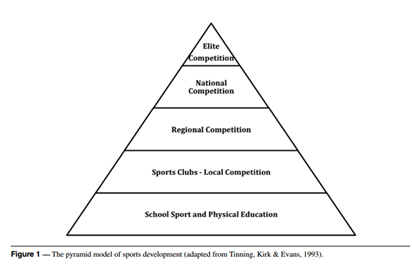
PYRAMID
Survival of the fittest or survival of talent | footblogball
Fantastic article.


Survival of the fittest or survival of talent

The optical illusion that is early talent identification and the selection philosophy of district teams

According to Darwin's theory of evolution organisms which are better adapted to their environment tend to survive longer. Does the environment we create influence the selection process and favor those that possess attributes that give them a temporary advantage while at the same time disqualifying those who at that moment in time are struggling to adapt?  Adaptive behavior is key to the survival of the human race and specific to soccer, a trait of high quality players. However if the early environment supports only temporary adapting systems ( in this case the young player) then those that are better equipt to adapt in the long run may well be lost to us forever.

Are some systems and structures just counterproductive ideologies that that are in conflict with development (learning & biopsychosocial) and the young player's natural learning process? We should of course remember that struggle is also part of the learning process. What are we doing to help players overcome those struggles that will appear during their development (non-linear)?

The Standard Model of Talent Identification
( Bailey, R.P: & Collins, D. The Standard Model of Talent Development and its

Discontents, Kinesiology Review, 2, 248-259)

In a recent paper, Bailey and Collins introduce one of the most common models used in talent identification, the Standard Model of Talent Development (SMTD)

This is a pyramid structure that is based on erroneous presumptions.
  1. Development and performance are essentially linear.
  2. Early ability that is identified as talent indicates future ability and performance.
The selection process is done at the cost of the wider group where focus is placed on those who have been identified as talented ( Bailey, R.P: & Collins, D. The Standard Model of Talent Development and its Discontents, Kinesiology Review, 2, 248-259)

Selection: Based on current performance. Identify those as talented as early as possible.

Early specialization is deemed necessary to reach elite performance level in the future.

Early performance and ability is necessary for success in the future.

De-selection: Hard to return to the system. Questionable selection criteria (often based on early physical characteristics)
PYRAMID

District team selection often begins at the age of 13/14 and is part of this pyramid. Its influence is felt years before the actual selection process. I recently spoke with a Swedish U17 youth international who said that this process can create and feed a stressful environment. Over a year before the district team selection, every day at school, at training, on social media each match or training performance was put under the microscope of analysis. "How did you play? How did I play?  As well as being physically tired you would be mentally tired as well". The player went on to say "I was lucky because I had an external support structure, family and good adult mentors that really helped me, I don't know how I would have coped otherwise". Competition, failure and struggle are of course part of the sporting experience. They don't have to be negative experiences for children. The problems occur when it is all based on adult demands and values. These adult demands and values are appearing earlier and earlier in our sporting structures. The adult and the child, do they have the same motives?

There is no convincing evidence that most sports require an early investment of training in one activity. In fact, what evidence is available suggests that across a number of eventual elite players, early specialization is negatively correlated with eventual success (Gullich, 2011).

In the paper In the paper The Standard Model of Talent Development and Its Discontents (Bailey, R.P; & Collins, D. ) It is suggested that  "the apparent success of the SMTD is ultimately an optical illusion as there is no way of knowing who might have succeeded through different systems, and who were de-selected from the system but might have (under different circumstances) gone on to achieve high performance".

The paper goes on to suggest risks associated with ill-focused of incorrectly administered pyramids.
  1. Early adult like training can lead to over-use injuries. There is a particular high risk associated with intensive training during maturation.
  2. Early intensive training can lead to psychological problems. This can lead to drop out and burnout
Development is non-linear, learning is non-linear. Therefore talent is non-linear
Judging early performance during the formative years does have its problems. This is true especially when judging and identifying something that is non-linear using what is essentially a linear model.
  1. Miss out on identifying other factors that are associated with talent ( soft skills such as decision making, communication, awareness)
  2. Often fails to recognize potential due to a focus on the performance now.
  3. Many pyramid structures based on early talent identification discriminate against those born later in the sporting calendar year.
  4. Size and strength factors that are identified early contribute to a temporary advantage resulting in short term superior performance. This all evens out after maturity. There is a risk that the player has been used for his temporary advantage (to win) and has not actually learned the game. This player will struggle when growth evens out when maturity is attained.
  5. Questionable accuracy with regard to measurement of ability, often affected by gender, ethnicity or socioeconomic background.
Are we judging biological maturation or talent?
Dutch Soccer coach Raymond Verheijen has presented data under the title "Growth spurt study in Dutch Youth Academy soccer". A 12 year study that included 36 professional clubs was carried out in Holland between the years 1997-2009. An analysis of a data base of over 10,000 players was carried out where factors such as height, weight, injuries and date of birth were taken in to consideration. The general idea was that month of birth should have no influence on talent. At the beginning of the study the Dutch schoolboy national teams were selected from August to July. Most players were born in the period August to October (43%) while only 10% of the players were born May-July. This phenomenon is often referred to as the Relative Age Effect (RAE).

Relative age effect (RAE): A bias that seems to favor a higher participation rate amongst those that are born early in the selection period).

Hancock, Adler, & Cote in a study from 2013 suggested that RAE is more than just a physical advantage. The research suggested that there are also some powerful social influences at play.
  1. Parents (Matthew effect) – The rich get richer. Those who are perceived to have ability are given preferential treatment and extra support. This in turn increases that ability which leads to more support.
  2. Coach (Pygmalion effect) – The higher the expectation placed on people the better is their performance. Those who are perceived to have ability are given more attention. Others feel neglected.
  3. Athletes (Galatea effect) – A player may see that she is able to perform better than her peers. This performance can be due to due to early maturation A players opinion about her ability and his self-expectations about her performance largely determine the performance.
During this study the Dutch FA changed the cut-off date for its national youth teams to the Jan-Dec period. The RAE adjusted accordingly. It seemed that the scouting system was primarily based on how old the player was as opposed to how talented that player is or could be. Countries with small populations have a relatively small player pool.

Focusing on winning during the early stages of development just encourages the RAE, in turn making the player pool even smaller. It becomes more about the survival of the fittest as opposed to survival of talent.

The various traits slowly appear and differentiate over time….. infancy, adolescence, and even adulthood will see the latent components undergoing various transformations (Simonton,1999,p442)

In the research paper "Swedish soccer is searching for talent but finding age" Tomas Peterson says why players are chosen in accordance with their physical development is not known "but one may assume that there is a silent agenda dictating that these players will be the most successful in the forthcoming selection steps" from club to district team to national youth team. The material and data collected "indicates that selection on the grounds of physical development is already at work in groups of 5-12 year olds and " and the effect of this process is very clear when these children reach 13 and enter an even harder selection process. It is Tomas Petersons opinion that this is counter- productive to the development "of all the football talent that exists within every yearly cohort of girls and boys. I also believe that its goes against the goals of both the sports movement and the community in general".


Many current methods of focusing on early indicators of talent are very static and linear approaches. They ignore the fact that development is individual and that differences in performance can be explained by differences in maturation. Coaches that judge early talent evaluate and focus on the contemporary level of performance where physical characteristics are fundamental factors in the talent identification process. This brings to the surface three fundamental problems that need to be addressed with early talent ID.
  1. Coaches gamble on the wrong players- (misuse of resources)
  2. Miss out on those with more long term potential
  3. Environment problem (development of a non-inclusive environment. No clear pathway back in to the system)
If we want to keep players viable over what is essentially a long, complex and sensitive development process then the aim should be to keep as many as possible as long as possible active within our sporting organization. What are we doing to help certain players overcome struggles that will appear during their development (non-linear)? What role does the environment play in creating these struggles?  We should remember that failure and struggle is also part of the learning process. Our environment should be a place where these failures and struggles can be met head on and dealt with through patience, encouragement, understanding and support.

Does the environment we create influence the selection process and favor those that possess attributes that give them a temporary advantage while at the same time disqualifying those who at that moment in time are struggling to adapt?


Sent from my iPhone

Friday, February 27, 2015

Coaches Choice: The Pygmalion Effect or the Galatea Effect?


Interesting concepts for coaches or anyone that is involved in motivating a team or a group trying to achieve a common goal. Once again from The Talent Code.

from The Talent Code:
How Great Teachers See « The Talent Code:
Talent identification is the holy grail of sports, business, parenting, and education. We dream of having the magical ability to quickly and accurately assess who is destined to succeed; to sort the contenders from the pretenders.
Funny thing is, there was once a clever scientist who figured out how to do just that.
His name was Dov Eden; he was an Israeli psychologist who worked with businesses and the military. In the early 1980s Eden published a remarkable study that showed he could predict with uncanny precision which young recruits in the Israeli military would become top performers.
It worked like this: Eden studied the mental and physical aptitudes of one thousand recruits, then selected a handful of soldiers he labeled as “high potential.” Eden informed platoon commanders that they could “expect unusual achievements” from these individuals.
Sure enough, Eden was right. Over the next 11 weeks, Eden’s group performed significantly better than their peers — 9 percent higher on expertise tests and 10 percent higher on weapons evaluation.
It looked for all the world like an impressive display of talent identification — except that it wasn’t.
Because here’s the twist: the “high-potential” soldiers weren’t really high-potential. Eden had selected them completely at random. The real power was in the act of labeling them as high-potential. In sending a simple signal — these people are special.
That signal had created a massive effect in both the mind of the instructor and the learner — a virtuous spiral between teacher and learner that led to the full expression of potential. (The phenomenon, dubbed the Pygmalion Effect, has been repeated many times, and is particularly powerful in educational settings.)
'via Blog this'


I wonder if there are significant gender differences regarding which methodology is more effective. Anecdotally, I would say that the type of motivational cues that I hear coming from 3rd base coaching boxes in softball ( from women coaches) is more of the "We believe, you believe...." type versus baseball which is more "You have to believe in yourself..."


Perhaps I could be wrong there or over-generalizing but it seems to make sense that males and females would take different approaches to achieve a result. Not that there's anything wrong with that.


Galatea effect vs. Pygmalion effect

Difference Between Galatea Effect and Pygmalion Effect

The Galatea and Pygmalion effects are the two most important self-fulfilling prophecy theories. However, there lies a fundamental difference between them. The article to come will explain the subtle differences.
The Galatea and Pygmalion effects are two important management theories based on the power of expectations. The fundamental difference between the two theories is that the Galatea effect is based on an individual's expectations about himself, whereas the Pygmalion effect is based on the premise of people's expectations of others.

In Greek mythology, the name "Galatea" is lent to a statue that is carved of ivory by Pygmalion of Cyprus. Also, Polyphemus' object of desire in Theocritus' Idylls VI and XI is named Galatea, and again it has been associated with him in the myth of Acis and Galatea in Ovid’s Metamorphoses. Though there is an association of the name with Pygmalion’s statue, the connection sprang with a post-classical writer.

Galatea Effect

The Galatea effect is a phenomenon where people's own opinions about their ability and self-worth influence their performance. The Galatea effect is self-driven. It is that part of one's motivation that depends on self-expectations and self-worth. If an employee thinks that he can perform well, chances are that he will do well. If, in that situation, he receives positive encouragement from his superiors, it will only boost his confidence and will do wonders to his performance.

Pygmalion Effect

The Pygmalion, or Rosenthal effect refers to the phenomenon in which the higher the expectations placed on people -- often students, employees, children etc., the better is their execution of work. The Pygmalion effect is a form of self-fulfilling divination. It argues that by setting higher expectations for people (who come under a leader), the leader can motivate them to perform better. It was originally studied in context with a teacher's expectations of students. It was observed that the students, who were expected to do well did perform well, while the ones who weren't expected to perform well, did not.

As is told in Greek mythology, the effect gets its name after Pygmalion, a Cypriot sculptor, who fell in love with a female statue that was carved by him. This effect, as applied to the corporate world, was first described by J. Sterling Livingston in an article in the Harvard Business Review in 1988. "The way managers treat their subordinates is subtly influenced by what they expect of them," -- said Livingston in his article. One can summarize the Pygmalion effect as follows:

⇨ Every manager, or supervisor has certain expectations for his subordinates.
⇨ They convey their expectations to them consciously and unconsciously.
⇨ The subordinates get the message of what is expected of them.
⇨ They strive to perform and live up to the expectations of their manager.

The way managers treat their subordinates influences their performance. If a negative feedback is passed on to them, their performance may actually falter. Positive Pygmalion effects have a far-reaching effect on the employees. When managers put faith in the abilities of their subordinates, their morale and self-esteem increases, and hence, their performance gets better.

Galatea Effect Vs. Pygmalion Effect

Both the effects play an important role in increasing the productivity and personal development of each individual.

⇨ The primary difference between the Pygmalion and the Galatea effects is that the Pygmalion effect is based on the expectations of others while the Galatea effect is rooted in self-expectation.

⇨ In the Pygmalion effect, subordinates work towards meeting the expectations that are set by their superiors, whether or not these expectations are verbally or non-verbally expressed. In the Galatea effect, on the other hand, an individual sets expectations for himself or herself and strives to live up to it. In short, the Galatea effect is more powerful than the Pygmalion effect.

Most preferably, people should be driven by their faith in their abilities (the Galatea effect), but the Pygamlion effect is, in its own way, a useful ally in motivating people to give their best. It may not appeal to everyone, but can be considered while coaching or leading people.

By Jyoti Babel
Published: June 7, 2013
Read more at Buzzle: http://www.buzzle.com/articles/difference-between-galatea-effect-and-pygmalion-effect.html

Thursday, September 04, 2014

Panik and Susac move from prospects to made men

Baseball America
Baseball America Prospect Report


It looks like these guys will be moving off the prospect list once and for all. They are officially "made" men.

SFMAJPanik, Joe 2B4220.3142B (7), BB (14)
SFMAJSusac, Andrew C5223.2882B (4), HR (3)

It's nice to see Susac show his stuff at the bat as I initially thought he was rushed up due to the need presented by the Sanchez concussion.  This was based entirely on my observation that Susac "only" had 836 minor league AB's  prior to his call up and the number of AB's other Giants prospects had prior to their call ups.

A cursory look at Baseball Reference data showed the following:
Posey 750 AB's (2008-10)
Sandoval 1818 AB's (2004-08)
Belt 922 PA (2010-11)
Crawford 1189 PA (2008-11)

Sandoval was an INTL signing and the other three were collegiate draftees. 

Some other blasts from the past:
Conor Gillaspie 2223 PA's - College
Nick Noonan 3000 PA's - HS
Kieschnick 2000 PA's - College
Culberson 2900 PA's - HS
Jackson Williams 2000 PA's - College
Wendell Fairley 1600 PA's - HS
Burris 920 PA's 
Freddie Lewis 2727 PA's
Schierholtz 2428 PA's
Gary Brown 2500 PA's - College

Of the recent Giants call-ups:
Joe Panik 1620 AB's
Adam Duvall 1883 AB's
Matt Duffy 942 AB's
Andrew Susac 836 AB's

It seems like for prospects, the organization would seem to know what it has somewhere around the 1,000 AB mark for college hitters and around the 1,500 - 2,000 AB's for a HS hitter. This makes sense intuitively since the HS hitters is making his first 1,000 AB's in the minors. I don't want to get pinned down to a definitive marker and get yelled at and ridiculed like Erricson and the 10,000 Hour Rule, but as a rough rule of thumb, this seems to be the line in the sand that organizations employ. This takes into consideration that some guys are rushed due to organizational need (due to injury or performance) and some guys are blocked at a certain position and their stay in the minors is, in effect, over-extended. I still feel that Gillaspie was blocked in this way with the Giants, but Oh well.

An issue for further study. Here is another story that looks into the issue somewhat as well.
--
from the Hardball Times:
The historic risk of Manny Machado’s promotion – The Hardball Times:
Machado was promoted to the majors after just 928 minor league plate appearances. There have been just six other first-round picks since 1997 who were drafted as position players out of high school and were called up to the majors with fewer than 1,200 plate appearances. Only one of these had fewer plate appearances than Machado.

Cameron Maybin (830)
Justin Upton (957)
Jason Heyward (1010)
Corey Patterson (1015)
Josh Hamilton (1148)
Joe Mauer (1177)

Hamilton had some extenuating circumstances, and was ultimately 26 years old when he made his major league debut, so let’s take him out of this discussion. With the exception of Mauer and Upton, this list is a collection of promise that has thus far gone unfulfilled, and even Upton has had hiccups in two of his five full major league seasons.
...

While minor league numbers often mean little when it comes to gauging a prospect’s potential, I’m a big proponent of allowing a player to dominate a level before moving on so that he gets a taste of what it takes to truly succeed, especially when that player has such an ability to do so. Too often, organizations are willing to play the “young for his level” card to upgrade an average performance in their own eyes.
Heyward is the most recent example of the possible pitfalls of a rushed prospect. Much like Upton and Mauer, he dominated the minor leagues, posting a .968 OPS in his final season, including a 1.057 mark in a half-season in Double-A. In his rookie season in 2010, Heyward looked like one of the few who could handle the limited developmental time, making an all-star team and finishing with an OPS+ of 131.
But the major leagues are unkind. Since then, Heyward has hit .248/.331/.433 and an OPS+ of 106, despite a nice job rebounding this season. He’s just 22, and I still believe Heyward will be a star, but his 2011 season should serve as a warning flag for those teams who believe prospects are ready without significant time in the upper minors.
'via Blog this'

And then, the only piece of expert evidence is from John Farrell, where he doesn’t really comment on the point, but implies that the gap between AAA and the majors is wider in bigger markets. Yet plenty of the prospects mentioned as under-performing were in small markets.
Here’s the concluding paragraph:
Too many at-bats in Triple-A is not going to stunt a player’s development, as seen with Andrew McCutchen. Calling up a player too soon, however, has the potential to have serious ramifications years down the road. As the 2014 rookie class clearly demonstrates, the recent trend of accelerated development clearly has not yielded the immediate success at the major league level they are designed to generate.
1. McCutchen, as the article even indicates, actually represents a bit of a departure from the prospect development of stars. Here’s another quote:
Among the notable successes in this class of prospects was Jay Bruce (405 PA), Evan Longoria (158 PA), Jacoby Ellsbury (400 PA), Andrew McCutchen (881 PA), Jason Heyward (13 PA) and Carlos Gonzalez (237 PA).
Now, it’s true, this doesn’t necessarily disprove the point that excess time in AAA can stunt growth. But that’s also not demonstrated by the article. Excess time in AAA didn’t stunt McCutchen’s growth. One data point is hardly generalizable.
2. “Calling up a player too soon, however, has the potential to have serious ramifications years down the road.” This was never really proven by the article, and is a strong, strong statement.
3. “As the 2014 rookie class clearly demonstrates, the recent trend of accelerated development clearly has not yielded the immediate success at the major league level they are designed to generate.” I would be fine with this, but there’s no real indication that there was any grand “design” in place, at least in the absence of some reasonable understanding of either the outside expectations or, more difficult to ascertain, the internal expectations. In other words, this could be true, but isn’t sufficiently proven, either.

Wednesday, June 25, 2014

10,000 Hours vs. The Sports Gene - MIT Sloan Sports Analytics Conference


I wish I could have attended this event. I'm not sure I had the requisite IQ to get in the door, but this breakout features a comparison of the recent book The Sports Gene by David Epstein (highly recommended) versus the arguments presented in The Talent Code. 

Once again, much like the Moneyball debate of "stats vs. scouts"  I think the nature vs. nurture, genetics vs. hard work is a false argument. It's not one or the other, but an elegant interplay of both sides of the argument. Enjoy. 

image
10,000 Hours vs. The Sports Gene | MIT Sloan Sports Anal...
Annual conference on sports analytics organized by the MIT Sloan School of Management.
Preview by Yahoo

Many impactful innovations in sport and beyond were created by visionaries that dared to think differently. Finding a new and radical way of approaching a traditional task – one that may even run counter to conventional wisdom – is risky but potentially "game changing" too. This panel will bring together the pioneers who have found success by challenging the status quo in their field. The discussion will focus on questions such as: What seeded the initial idea for change? Who inspired them? How did they overcome obstacles and gain buy-in to their vision? Once established, how does one continue to innovate in the face of new imitators? And, what is the next great opportunity for innovation? 

David Epstein - The Sports Gene


Tuesday, June 17, 2014

Distinction Between Skill and Ability | Human Kinetics

Click to hide.

from Human Kinetics:

Distinction Between Skill and Ability

This is an excerpt from Motor Learning and Development by Pamela Haibach, Greg Reid, and Douglas Collier.


Distinction Between Skill and Ability
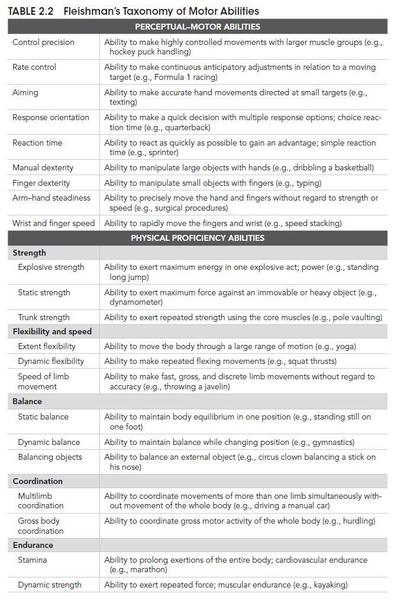
Abilities are genetically predetermined characteristics that affect movement performance such as agility, coordination, strength, and flexibility. Abilities are enduring and as such, difficult to change in adults. Abilities differ from skills in the sense that skills are learned, whereas abilities are a product of both learning and genetic factors (Fleishman, 1964). Skills are a level of proficiency on a specific motor task, while abilities are part of an individual’s traits that affect her capability to become skillful when learning a new motor task. For example, abilities that are required for a skilled race car driver include rate control, manual dexterity, stamina, control precision, and reaction time; a typist needs to have abilities in aiming and finger dexterity; a surgeon requires arm–hand steadiness and multilimb coordination; and a figure skater performing the triple axel requires abilities such as explosive strength, dynamic flexibility, gross body coordination, and multilimb coordination (refer to table 2.2 on p. 38 for the description of each motor ability).
 

Factors Affecting Abilities
An individual’s abilities are shaped by biological and physiological factors (Fleishman, 1964). The composition of an individual’s muscular tissue is certainly going to affect his physical proficiency motor abilities such as strength, endurance, and flexibility. Physiological deficits in the development of rods and cones would also limit an individual’s perceptual–motor abilities, potentially affecting reaction time. Abilities are also affected by environmental factors. For example, children who are afforded formal education will continue to develop their verbal and reasoning abilities throughout their academic years, just as children who participate in physical fitness- or sport-related programs will develop their motor abilities. The rate at which abilities develop varies across childhood and adolescence, both within individuals and across individuals. This is largely due to growth and maturation changes. The rate of development levels out between the ages of 18 and 22 years, remaining relatively stable throughout adulthood (Fleishman, 1964).

Motor Ability Hypotheses

Initial researchers in the area of motor abilities hypothesized the existence of only onegeneral motor ability (Brace, 1927). This hypothesis was based on observations of accomplished athletes who were adept at many athletic events and also able to quickly learn new and unfamiliar motor skills. It is likely that you know of athletes in your age group who fit this description. Perhaps the star quarterback from your high school, who led the basketball team to state championships and held the school batting average record, comes to mind. It may appear that there are many athletes who are capable of performing very skillfully across many different motor skills.

Research examining individuals’ performances across different activities supports the notion that every motor skill requires very specific abilities for skillful performance. This has been termed the specificity hypothesis (Henry, 1968). Henry proposed that each individual has a large number of separate and independent abilities. Fleishman (1962) developed a taxonomy to identify each ability and separated abilities into two main categories, perceptual–motor abilities and physical proficiency abilities (table 2.2). Although it is doubtful that Fleishman’s taxonomy is an exhaustive list of motor abilities, it does provide a framework to assess individual differences.

Tuesday, September 03, 2013

Giants Extra | A blog about the San Francisco Giants


This is a guy who has always put up solid minor league numbers. Petit was solid enough to be tabbed by Nate Silver's PECOTA rankings as a legitimate major league prospect. I saw Petit's name mentioned in the Index of Silver's most recent book The Signal and the Noise and read up a bit on his prior history.  The fact that he has not parlayed that success and potential at the major league may scream either AAAA player or late-bloomer as the Mercury News article suggests.

Let's hope for the Giants sake that he is finally figuring out how to get major league hitters out and win ball games.

from Mercurynews.com:
Giants Extra | A blog about the San Francisco Giants:

But the real story was Yusmeiro Petit. One good start, you say, OK, maybe it was just a fluke. A second good start, especially one that includes one walk and 10 strikeouts, and you sit up and say, “Hey, Sabes, we may have something here.” To be sure, against all odds, there seems to be some grist to this 28-year-old Venezuelan possibly being a late-bloomer.

'via Blog this'

Saturday, August 03, 2013

The Personality Theory in Coaching - The Most Significant Psychological Theories for Motivating Athletes to Peak Performance


I generally come out as either ISTJ - Inspector or INTJ - Mastermind.
Scary, isn't it? It helps to know a little bit about your own personality.


Some interesting information for coaches who want to motivate their athletes to peak performance. And who doesn't want that? It leads to W's, right? But sometimes I think as coaches, some believe that we either have this innate quality of leadership or we don't and we can't really improve much in this area.

If we don't feel we can personally motivate, we fall back on "Well, players ought to be able to motivate themselves". And that is true to an extent, but if you can't try to get better and work on your own weaknesses as a coach, how can you ask players to do the same? And the first step is to know what your weaknesses are or may be. Acknowledgement is a healthy part of the process of improving.

Similar to players, you have to learn your own strength and weaknesses, apply your own unique style to enhance your weaknesses, play to your strengths and then improve from there.

Some use the carrot, some use the stick. The really good ones probably alternate the use of both the carrot and the stick.

Good stuff.


The Personality Theory in CoachingThe Most Significant Psychological Theories for Motivating Athletes to Peak Performance:

The interaction between psychology and sport can be a very viable thing. Through the application of fundamentals and scientific theory, psychologists and coaches can motivate athletes into achieving the peak potential not only in their sport, but in other facets of their competitive lives, such as self-confidence, a strong work ethic, perseverance, and the subordination of egos and individual agendas to team goals.
     At the same time, coaches have to know when they reach the point of diminishing returns in their effort to maximize performance through the traditional exercise physiology. Most coaches subscribe to the same kind of strength and conditioning regimens, nutrition, skill development, game preparation and competitive strategy.
 Though we may not have as yet learned how to maximize our athlete’s physical development, we are fast approaching it. The next step in the growth potential will probably be achieved through the maximal application of psychological theory.
     Coaches who are bold enough to accept this premise and work at it may very well wind up with a huge competitive advantage.
     A pilot study with the St. Joseph’s University (PA) basketball team produced a feedback loop in the form of a statistical ranking of each player after every league game (Barker, 2001). The ambiguity of the roles, team hierarchy, and playing time were eliminated through this objective, quantifiable reporting system, and it was no accident that the team’s league record improved from 7-9 to 14-2.
Coaches have the opportunity to bond with their insecure athletes by responding with empathy to player problems on and off the court-making sure to be generous in bestowing pats on the back and high fives for positive efforts. It may appear simple minded, but it works. The coach should always be looking for ways to strengthen the psyches of his athletes and to identify himself as a "source of strength, care and calmness to the players (McAdam, 2001)." These are key ingredients in the ideal coach-player relationship. Coaches who invest time in cultivating trust and a secure bond with their players will be in a position to help every athlete achieve his full potential. The psychological challenge has been to identify the components needed for a positive player-coach relationship and to understand how to develop and maintain them for the mutual benefit of all team members.
How can coaches ensure positive outcomes on a more frequent basis? By providing a reward after each performance of the desired behavior.
     Where does punishment fit into this method of learning? According to Skinner, "punishing a response merely alters the person to what should not be done while providing an example of a constructive alternative. Punishment is generally a rather weak form of behavioral control (McAdam, 2001)."
     The coaching staff must assume responsibility for deciding what behaviors will be reinforced, what behaviors will be punished, and what behaviors will be ignored.
     Coaches have the opportunity to redefine the reward structure by eliminating all entitlements. Coaches who promise players a place on the team, or a certain amount of playing time, or a starting position should begin drafting their letter of resignation. They will have no rewards left for positive reinforcement.
     Only punishment will be left as a means of shaping behavior. Since the athlete has been given everything, the only way to change the environment and get his attention is by taking something away.
     Coaches must clearly define their expectations with regard to such basics behaviors as arriving on time for practice, working hard every day, and showing respect for others.
     Athletes who do these things will be given opportunity to make the team, practice every day, play in the next game and participate with the team throughout the season.
     Negative or undesirable behavior will be penalized by seating the offender on the end of the bench and having him watch rather than play the game. ("When you are ready to play, let us know.")
     Coaches have to understand, however, that anytime a player feels that he is never going to complimented for anything, he isn’t going to expect any positive reinforcement from the coach or value any of the feed back he gets from him.
     Truism: The simplest and perhaps most effective motivational tool (praise) won’t work unless it is consistently applied and there is a positive relationship between coach and player.

'via Blog this'

Giants Top Minor League Prospects

  • 1. Joey Bart 6-2, 215 C Power arm and a power bat, playing a premium defensive position. Good catch and throw skills.
  • 2. Heliot Ramos 6-2, 185 OF Potential high-ceiling player the Giants have been looking for. Great bat speed, early returns were impressive.
  • 3. Chris Shaw 6-3. 230 1B Lefty power bat, limited defensively to 1B, Matt Adams comp?
  • 4. Tyler Beede 6-4, 215 RHP from Vanderbilt projects as top of the rotation starter when he works out his command/control issues. When he misses, he misses by a bunch.
  • 5. Stephen Duggar 6-1, 170 CF Another toolsy, under-achieving OF in the Gary Brown mold, hoping for better results.
  • 6. Sandro Fabian 6-0, 180 OF Dominican signee from 2014, shows some pop in his bat. Below average arm and lack of speed should push him towards LF.
  • 7. Aramis Garcia 6-2, 220 C from Florida INTL projects as a good bat behind the dish with enough defensive skill to play there long-term
  • 8. Heath Quinn 6-2, 190 OF Strong hitter, makes contact with improving approach at the plate. Returns from hamate bone injury.
  • 9. Garrett Williams 6-1, 205 LHP Former Oklahoma standout, Giants prototype, low-ceiling, high-floor prospect.
  • 10. Shaun Anderson 6-4, 225 RHP Large frame, 3.36 K/BB rate. Can start or relieve
  • 11. Jacob Gonzalez 6-3, 190 3B Good pedigree, impressive bat for HS prospect.
  • 12. Seth Corry 6-2 195 LHP Highly regard HS pick. Was mentioned as possible chip in high profile trades.
  • 13. C.J. Hinojosa 5-10, 175 SS Scrappy IF prospect in the mold of Kelby Tomlinson, just gets it done.
  • 14. Garett Cave 6-4, 200 RHP He misses a lot of bats and at times, the plate. 13 K/9 an 5 B/9. Wild thing.

2019 MLB Draft - Top HS Draft Prospects

  • 1. Bobby Witt, Jr. 6-1,185 SS Colleyville Heritage HS (TX) Oklahoma commit. Outstanding defensive SS who can hit. 6.4 speed in 60 yd. Touched 97 on mound. Son of former major leaguer. Five tool potential.
  • 2. Riley Greene 6-2, 190 OF Haggerty HS (FL) Florida commit.Best HS hitting prospect. LH bat with good eye, plate discipline and developing power.
  • 3. C.J. Abrams 6-2, 180 SS Blessed Trinity HS (GA) High-ceiling athlete. 70 speed with plus arm. Hitting needs to develop as he matures. Alabama commit.
  • 4. Reece Hinds 6-4, 210 SS Niceville HS (FL) Power bat, committed to LSU. Plus arm, solid enough bat to move to 3B down the road. 98MPH arm.
  • 5. Daniel Espino 6-3, 200 RHP Georgia Premier Academy (GA) LSU commit. Touches 98 on FB with wipe out SL.

2019 MLB Draft - Top College Draft Prospects

  • 1. Adley Rutschman C Oregon State Plus defender with great arm. Excellent receiver plus a switch hitter with some pop in the bat.
  • 2. Shea Langliers C Baylor Excelent throw and catch skills with good pop time. Quick bat, uses all fields approach with some pop.
  • 3. Zack Thompson 6-2 LHP Kentucky Missed time with an elbow issue. FB up to 95 with plenty of secondary stuff.
  • 4. Matt Wallner 6-5 OF Southern Miss Run producing bat plus mid to upper 90's FB closer. Power bat from the left side, athletic for size.
  • 5. Nick Lodolo LHP TCU Tall LHP, 95MPH FB and solid breaking stuff.