The Slav's Baseball Blog - BASEBALL 24-7-365
The Slav's Blog about anything relating to the great game of baseball
- and other less important issues from outside the diamond.
The best baseball blog that you have never heard of.
Both are very inspirational stories demonstrating the incredible strength of the human spirit as well as how much we can accomplish even when it appears that our life challenges or circumstances are hopelessly stacked against us.
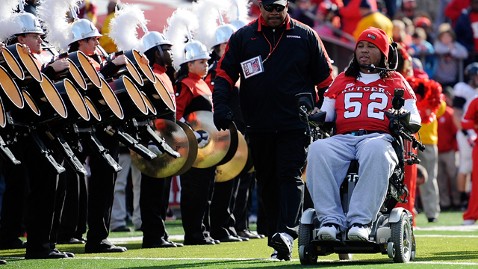
I have heard that Eric LeGrand's rehabilitation goal is to be able to go back to the spot on the field where he was hurt and get back up and walk off the field under his own power.
Let's hope that he finds the strength to do just that.
Maybe we need to appreciate the heroism of ordinary athletes more than what passes for and is accepted as "heroism" on the part of some of our more highly decorated sports heroes.
SANTA ANA, Calif. — When you tell Mater Dei alum Cory Hahn he can't do something, there's a charge that goes through his mind. A charge so strong it borders defiance.
It fuels him.
So after being told he would never function normally again after suffering a freak injury on the baseball field two years ago, it only added fuel to his fire.
Hahn, who played on the United States' first gold-winning 18U team alongside Bryce Harper of the Nationals and Manny Machado of the Orioles, was selected in the 26th round of the 2010 MLB Draft by the San Diego Padres. After already signing his Letter of Intent with Arizona State, he decided to honor his pledge to the Sun Devils.
Fresh off leading Mater Dei High School to a CIF title in 2010 and being named an All-American and Orange County's 2010 Player of the Year, Hahn was ready for the next level.
In just his third game at Arizona State, he was at first base when a double steal was called. It was the first steal attempt of his college career.
The throw was off-line as Hahn slid head first into second base. His head went into the leg of the player covering, fracturing his C-5 vertebrae.
He was left on the field motionless, paralyzed from the chest down.
“No one does inspiration better than Eric,” said Peter Wilderotter, president and CEO of the Christopher & Dana Reeve Foundation, which supports research and advocacy efforts.
“Its significance is huge,” he said. “Chris [Reeve] used to say, ‘It’s what you do after the accident that matters.’ In the 18 months since his injury, it’s been a natural culmination. He wanted a career in broadcasting and wanted to stay involved in football. What a great message for those living with spinal cord injuries and for their families and employers.”
LeGrand’s former coach Greg Schiano has supported the player since he was injured.
“This coach demonstrated that coaching doesn’t end when football season is over,” Wilderotter said of Schiano.
This articles (below) have an awful lot of Carol Dweck and Mindset: The New Psychology for Success and Angela Duckworth's True Grit in them. Perseverance and effort as the keys to success in sports as well as many other life endeavors. Football coaches verbalize it better with "It's not how many times you get knocked down, it's how many times you get back up". Of course, in football they spend a lot of time knocking each other down, so that makes sense from a coaching / motivational perspective. But think about baseball. Not a lot of time spent getting physically knocked down in baseball. Unless you're the high school version of Barry Bonds watching your moon shots leave the yard. Then maybe getting some extra dirt in your diet. But think about the mental aspect of the game or your life outside the game. How many times do we mentally or emotionally get knocked down and stay down rather than bounce right back up? Or check out and stop playing hard, so to speak, for innings or games or days or weeks on end? Oh yeah right, I'm the only one this happens to!! OK folks!! There is so much valuable wisdom for athletes, students, teachers, parents and coaches tied up in some of the quotes below that they do bear repeating. Definitely something to work on. Those life lessons from the ball field, you gotta love 'em!! Now, if we could just stop giving everyone in T-Ball a trophy, we might just have a chance to turn things around a bit.
Our youth sports culture is similar to the classroom. Kids who are divided into “A” or “B” teams at an early age are taught that their development path is set; the skills they have now are the same skills they will have in the future. It becomes a self-fulfilling cycle as the “A” teams get better coaching, play in the better leagues against better competition and the talent gap widens.
Often, parents can also, unknowingly, contribute to this cycle. As in school, when a child is told that his or her success is due to his brain not his effort, the perception begins that when they do eventually struggle with a math test or a tougher opponent, there is little they can do to improve.
Jin Li, a psychology professor at Brown University, has also been studying cultural differences in learning and teaching. One of her research projects recorded conversations between parents and children to hear the language used.
There were subtle differences between American and Asian parents when complimenting their kids. While the Americans praised with phrases like, “you’re so smart”, Asian parents focused on the struggle, “you’ve worked so hard on learning that and now you did it.”
“So the focus is on the process of persisting through it despite the challenges, not giving up, and that’s what leads to success,” Li said in the same NPR interview.
Every young athlete will face challenges as they move up the ladder from youth clubs to high school to college. Instilling them with the belief that they can improve through hard work will keep them motivated to get to the other side of the wall. Their support team of parents and coaches can help this process by rewarding the learning process.
“Think about that [kind of behavior] spread over a lifetime,” Stigler concluded. “That’s a big difference.”
Did you know that more top CEOs in United States graduated from a state college than an Ivy League University such as Harvard, Yale, or Princeton?
Shocked?
Research is showing there’s a far more important predictor of a grad’s future success than the prestige of the school or faculty or even the price of tuition. What matters far more is the graduate’s “personal drive quotient.”
Nothing beats stick-to-it-ness and hard work when it comes to boosting success-absolutely nothing. And research continues to confirm that crucial fact.
One of the most fascinating recent studies on student achievement was conducted by Harold Stevenson, a professor of psychology at the University of Michigan. Stevenson sought to answer a question many Americans ask, “Why do Asian students do better academically than American students?”
Since 1979, Stevenson’s team of researchers conducted five intensive cross-national studies analyzing students’ achievement in the United States, China, Taiwan, and Japan. Hundreds of hours observing students and interviewing their teachers, the researchers reached a conclusion: a critical key lies in what parents emphasize about their children’s learning. Here’s the difference in parenting styles:
Asian parents strongly stress the value of effort with their children. Over and again they tell their children, “Work as hard as you can, and you will be successful.” By expecting their children to work hard, and emphasizing the attitude: “there are no excuses for poor grades, you just didn’t work hard enough,” perseverance is nurtured in Asian children. And the parental expectations had a remarkable effect on their children. The researchers found on the whole, Asian children worker longer and harder than their American counterparts because they had recognized their success was based on how hard they worked.
Instead of prioritizing how much effort our kids put into their learning attempts, research found that most American parents emphasized: “So what grade did you get?” or “How many did you miss?” or “Did you win?”
The researchers also found that the effort a child put into their process is not nearly as important to the American parent as the end product of the grade or score.
Stevenson also found American parents place a greater emphasis on their children’s innate abilities. They tend to lower their academic expectations for their children if they perceive them to have lower academic abilities.
An Asian parents’ philosophy is different: any child can succeed regardless of an IQ score or handicap–success is all a matter of how hard you are willing to work.
Just think a minute of the long term effect of stressing effort could have on our children!
Our kids would learn from an early age that there’s nothing that can stop them from succeeding if they put their heart and soul into their endeavors. They would see mistakes or failures as just temporary setbacks, instead of as excuses to quit. If they just keep on trying, and use their mistakes as learning clues, they’ll ultimately achieve their goals!
Great work by Angela Duckworth demonstrating the link between perseverance and success. This trait correlates well to success across many different arenas. Who would have thunk it? Score one for the old-schoolers.
From ironshrink.com: True Grit | Iron Shrink: "But Duckworth et al. noticed that none of the Big Five predict success very accurately. Nor does intelligence, by itself. At least one study cited by the authors suggests that any single Big Five personality trait accounts for less than 2% of variance in achievement. Intelligence only accounts for up to one third of the variance in some measures of success."
Something is conspicuously absent from the Big Five. Duckworth and company wondered, as did William James a century earlier, “why do some individuals accomplish more than others of equal intelligence?” Being the intrepid researchers that they are, they began to ask around:
“Our hypothesis that grit is essential to high achievement evolved during interviews with professionals in investment banking, painting, journalism, academia, medicine, and law. Asked what quality distinguishes star performers in their respective fields, these individuals cited grit or a close synonym as often as talent. In fact, many were awed by the achievements of peers who did not at first seem as gifted as others abut whose sustained commitment to their ambitions was exceptional. Likewise, many noted with surprise that prodigiously gifted peers did not end up in the upper echelons of their fields.”
In other words, some people simply work harder than others, but that’s not all. They do it in a particular way.
Long-term goals: Grit involves more than a solid work ethic and self-discipline. Hard work by itself is not enough to secure the type of success created by long-term, sustained effort. Back in my loading dock days, I worked very hard and gained no more reward in that environment than guys who did far less. One of the secrets of grit, according to the authors, is passion for long-term goals.
“Grit entails working strenuously toward challenges, maintaining effort and interest over years despite failure, adversity, and plateaus in progress. The gritty individual approaches achievement as a marathon; his or her advantage is stamina. Whereas disappointment or boredom signals to others that it is time to change trajectory or cut losses, the gritty individual stays the course.”
Commitment: Self-control is not enough, either. In fact, it’s a poor predictor of success in long-term goals.
“An individual high in self-control but moderate in grit may, for example, effectively control his or her temper, stick to his or her diet, and resist the urge to surf the Internet at work – yet switch careers annually.”
Determination: Even the need for achievement is not enough. In fact, the need for recognition can be a hindrance in long-term success. The gritty individual stays the course even when times are tough.
“Whereas individuals high in need for achievement pursue goals that are neither too easy nor too hard, individuals high in grit deliberately set for themselves extremely long-term objectives and do not swerve from them – even in the absence of positive feedback.”
I think I can, I know I can
The gritty individual sets long term goals, does not waver from them, and is able to ride out the rough patches – even when it means tolerating punishment or foregoing reward for long periods. The authors noticed that grit was a better predictor of first summer retention at West Point then was self-control or the Admission Committee’s prediction of the cadet’s abilities. (Self-control was a better predictor of later academic performance, though.)
Among spelling bee contestants, “gritty finalists outperformed their less gritty peers at least in part because they studied longer. Specifically, weekend hours of practice mediated the relationship between grit and final round.” The pertinacious progenture were clearly more distingue and perspicacious.
If the benefits of grit aren’t obvious by now, the authors spell it out: “among relatively intelligent individuals, those who are less bright than their peers compensate by working harder and with more determination.” It’s these gritty individuals who eventually win the day and achieve their goals. More often than not, great leaps forward are achieved through sustained effort rather than a solid but meandering work ethic. Just ask Winston Churchill.
Hope for guys like me
I love the underdog. Heck, I was the underdog. As a fetus, I lacked the foresight to be born rich or good looking and, like many kids, I had a few legitimate challenges to overcome. The beauty of this study is that it sheds light on one of the great equalizers on an unfair planet. This study offers hope for guys like me.
No matter how we enter the world, perseverance and determination can carry us farther than our talents alone. Sometimes, the rewards of grit can even show up quickly, as they did among undergraduates at an elite university who “scored higher in grit [and] earned higher GPAs than their peers, despite having lower SAT scores.” While the authors did not state it outright, I suspect that sustained effort helps a person develop a level of skill that they would not otherwise possess.
Another beautiful thing about grit: it’s free, and anybody can do it. In one of the six sub-studies comprising this paper, the authors noticed that grit tends to increase automatically with age. Apparently, experience teaches us that “quitting plans, shifting goals, and starting over repeatedly are not good strategies for success.” If we tend to learn that lesson intuitively, then there is no reason a person cannot choose to plot a long-term course and stick to it.
Grit is defined as “perseverance and passion for long-term goals.” [2] Building upon biographical collections of famous leaders in history, researchers and scientists have reached similar conclusions about high achieving individuals. Specifically, those individuals who were deemed more successful and influential than their contemporary counterparts typically possessed traits above and beyond that of normal ability.[3][4][5] While ability was still critically important, these individuals also possessed “zeal” and “persistence of motive and effort.”[2] Duckworth and colleagues (2007) believe this dual-component of Grit to be a crucial differentiator from similar constructs. Grit is conceptualized as a stable trait that does not require immediate positive feedback.[2] Individuals high in Grit are able to maintain their determination and motivation over long periods of time despite experiences with failure and adversity. Their passion and commitment towards the long-term objective is the overriding factor that provides the stamina required to “stay the course” amid challenges and set-backs. Essentially, the Grittier person is focused on winning the marathon, not the sprint.
Grit is defined as perseverance and passion toward long-term goals (Duckworth et al. 2006). Gritty people tend to persevere, self-regulate and push themselves toward success. Drs. Angela Duckworth and Martin Seligman (2006) found that the correlation between self-discipline and achievement was twice as large as the correlation between IQ and achievement.
Additional research suggests that people with grit:
report experiencing more happiness than those who are less gritty, even when controlling for age and education;
earn higher GPAs than their non-gritty classmates, even with lower SATs scores;
are more likely to outperform in spelling bee contests, regardless of verbal IQ.
The article links some of Duckworth's conclusions with those of Carol Dweck (another favorite).
Fixed Mindset People Do Not Love Effort
This is a difficult message for people to embrace who believe in fixed intelligence or proclivity for success. That belief is what Dr. Carol Dweck refers to as fixed mindset. Those in a fixed mindset tend to believe that effort is a bad thing, if they have what it takes to be smart, gifted or talented by nature than they should not need much effort. This type of belief decreases the motivation to work towards long term goals.
Interestingly, according to Dweck, simply learning about fixed mindset causes changes in people’s belief systems. They are more likely to accept a growth mindset- or the belief that effort, embracing challenges and seeking out learning opportunities is a stronger predictor of success. This encourages developing a grittier perspective, contributing to wanting to put more effort and time in.
A few years ago I completed the NYC half-marathon. This was a stretch goal. I had never ran more than 4 miles in my life. It took grit to get to the race and even more to complete it. Nevertheless, afterward I felt so proud and the positive emotions were self-reinforcing.
The mantra of the Army is, “Be all that you can be.” Grit, perseverance and self-regulation towards long term goals can make that happen.
For me, this is the question that make the Jeremy Lin story so interesting and compelling. How did so many teams miss? How did he keep his confidence when so many "experts" were telling him he wasn't good enough? It's a testimony to his strength and perseverance.
"Linsanity blindsided Kobe Bryant, so much that the future Hall of Famer took weeks to properly word his frustration.
His target? The front-office talent evaluators who failed to draft Jeremy Lin, cut him from two NBA teams and sent him to the Development League four times.
"They would all be fired if I was owning a team," he said before an All-Star Game practice session in February. "I hear this stuff about how he came out of nowhere, and I think it's a load of crap. You can't play that well and just come out of nowhere. There has to be something there, and everybody missed it.""
What an inspirational story!! An early candidate for College Baseball Player of the Year.
The Collegiate Baseball story makes note of the fact that this kid and his dad studied
Barry Bonds' hitting mechanics to come up with a way to compensate for having to hit with one-arm. Lost in the fire-storm over the PED witch-hunt was the fact that Bonds is in a league with perhaps only Ted Williams as a bona-fide genius in the art of hitting a baseball. Bobby Cox witnessed Bonds' pitch recognition ability during an All-Star game and talks about it with amazement. The efficiency of Bonds' hitting mechanics are validated with this incredible story.
Obviously, this kid is not using PED's to generate power. Great story.
---
FROM GORDON COLLEGE WEBSITE:
The Gift of Adversity: Freshman Baseball Player Overcomes the Odds
Gordon College baseball player Dillon Coleman ’13 was born with only one hand, and to him that’s a gift. In fact, ask him about the challenges that he’s needed to overcome and he never mentions how difficult it is to switch from glove to bare hand fast enough to throw someone out.
He also won’t talk about the disadvantage of swinging the bat with only one hand. Instead he says, “The biggest challenge I’ve had to overcome was convincing my coaches over the years that I was good enough to play at the team’s level.”
Dillon’s love for the game—and his ability to confront adversity—came from his father, who began pitching to him when he was 3 years old. “My dad has been my greatest inspiration, encouraging me to try my hardest and convincing me that I could do anything I set my mind to.”
..........
Dillon grew up in Cromwell, Connecticut, and learned about Gordon through his church, Wethersfield Evangelical Free Church in Wethersfield, Connecticut, from some of his friends who are also Gordon students. “I was looking for a Christian college with an art program and a baseball team, so Gordon was perfect,” Dillon says. With a knack for stealing bases and an eagerness to hit the ball into the gap, Dillon approaches baseball with the same passion and determination he does with everything else. one that exceeds all expectations. And with Gordon’s first season game approaching, he is excited about what he will contribute to the team. “I want to step up my game,” he says, “and show even more people the gifts God has given me.”
MORE ON DILLON COLEMAN: The complete, in-depth story is available in the Feb. 24, 2012 issue of Collegiate Baseball. We find out how Coleman can hit the ball so far despite only having one hand and how the mechanics of Barry Bonds helped him.
WENHAM, Mass. — Dillon Coleman of Gordon College is an amazing story. Born with no left hand, this 6-foot-2, 160 pounder has overcome great odds to play college baseball.
The journey has been difficult to say the least. He was cut from his junior high baseball and basketball teams.
Coleman had his left eye fractured when he was hit by a pitch as a youngster and also was hit in his right eye on another occasion when a ball ricocheted off his bat.
Through it all, his incredibly caring family has encouraged him to keep playing the sport he loves in baseball.
And while many of his friends stopped playing baseball after Little League, junior high and then high school, this junior at Gordon College keeps playing as a starter.
Last season, one of the most amazing things in college baseball history unfolded. The left side hitting Coleman, who plays leftfield and centerfield with no left hand, did the unthinkable.
With only his front hand to guide a regulation 32 inch, 29 ounce bat through the strike zone, Coleman belted the first three home runs of his life all over an 8-day span.
Last season when record low offensive numbers were turned in by college hitters across the board with the new BBCOR regulation bats, Colman put on a power display for the ages over those magical eight days — his only home runs of 2011.
Stop for a moment to realize how difficult it would be to hit a home run 300-plus feet with only the front hand essentially being utilized during the batting stroke and little help coming from the back arm. Also consider that this trio of home runs were the first circuit clouts ever hit by anyone from his family. His dad Jeff never hit a home run in his baseball career, and neither have his two younger brothers.
As a left side batter, Coleman utilizes his front right hand, but he doesn’t have a hand on his back left arm. As he steps to the plate, he chokes up on the bat about an inch with his right fingers on the bat. The end of his other arm is a small section of bone covered by flesh which rests against the bat next to his right hand. The athletic movements his body makes to gain torque and power through the hitting zone is incredible.
1. Joey Bart 6-2, 215 C Power arm and a power bat, playing a premium defensive position. Good catch and throw skills.
2. Heliot Ramos 6-2, 185 OF Potential high-ceiling player the Giants have been looking for. Great bat speed, early returns were impressive.
3. Chris Shaw 6-3. 230 1B Lefty power bat, limited defensively to 1B, Matt Adams comp?
4. Tyler Beede 6-4, 215 RHP from Vanderbilt projects as top of the rotation starter when he works out his command/control issues. When he misses, he misses by a bunch.
5. Stephen Duggar 6-1, 170 CF Another toolsy, under-achieving OF in the Gary Brown mold, hoping for better results.
6. Sandro Fabian 6-0, 180 OF Dominican signee from 2014, shows some pop in his bat. Below average arm and lack of speed should push him towards LF.
7. Aramis Garcia 6-2, 220 C from Florida INTL projects as a good bat behind the dish with enough defensive skill to play there long-term
8. Heath Quinn 6-2, 190 OF Strong hitter, makes contact with improving approach at the plate. Returns from hamate bone injury.
9. Garrett Williams 6-1, 205 LHP Former Oklahoma standout, Giants prototype, low-ceiling, high-floor prospect.
10. Shaun Anderson 6-4, 225 RHP Large frame, 3.36 K/BB rate. Can start or relieve
11. Jacob Gonzalez 6-3, 190 3B Good pedigree, impressive bat for HS prospect.
12. Seth Corry 6-2 195 LHP Highly regard HS pick. Was mentioned as possible chip in high profile trades.
13. C.J. Hinojosa 5-10, 175 SS Scrappy IF prospect in the mold of Kelby Tomlinson, just gets it done.
14. Garett Cave 6-4, 200 RHP He misses a lot of bats and at times, the plate. 13 K/9 an 5 B/9. Wild thing.
2019 MLB Draft - Top HS Draft Prospects
1. Bobby Witt, Jr. 6-1,185 SS Colleyville Heritage HS (TX) Oklahoma commit. Outstanding defensive SS who can hit. 6.4 speed in 60 yd. Touched 97 on mound. Son of former major leaguer. Five tool potential.
2. Riley Greene 6-2, 190 OF Haggerty HS (FL) Florida commit.Best HS hitting prospect. LH bat with good eye, plate discipline and developing power.
3. C.J. Abrams 6-2, 180 SS Blessed Trinity HS (GA) High-ceiling athlete. 70 speed with plus arm. Hitting needs to develop as he matures. Alabama commit.
4. Reece Hinds 6-4, 210 SS Niceville HS (FL) Power bat, committed to LSU. Plus arm, solid enough bat to move to 3B down the road. 98MPH arm.
5. Daniel Espino 6-3, 200 RHP Georgia Premier Academy (GA) LSU commit. Touches 98 on FB with wipe out SL.
2019 MLB Draft - Top College Draft Prospects
1. Adley Rutschman C Oregon State Plus defender with great arm. Excellent receiver plus a switch hitter with some pop in the bat.
2. Shea Langliers C Baylor Excelent throw and catch skills with good pop time. Quick bat, uses all fields approach with some pop.
3. Zack Thompson 6-2 LHP Kentucky Missed time with an elbow issue. FB up to 95 with plenty of secondary stuff.
4. Matt Wallner 6-5 OF Southern Miss Run producing bat plus mid to upper 90's FB closer. Power bat from the left side, athletic for size.
5. Nick Lodolo LHP TCU Tall LHP, 95MPH FB and solid breaking stuff.