Showing posts with label Pitching Mechanics. Show all posts

Wednesday, July 25, 2018

Top 9 reasons pitchers are getting injured | Inside Pitch Magazine

Top 9 reasons pitchers are getting injured | Inside Pitch Magazine


JACKSONVILLE - I think the over-emphasis on "velocity enhancement" training programs fits in here someplace as well.

from insidepitchonline.com
https://insidepitchonline.com/top-9-reasons-pitchers-are-getting-injured/

Top 9 reasons pitchers are getting injured
article by Nunzio Signore
It's no secret that the numbers of youth injuries in baseball are staggering. Even with the implementation of pitch counts, youth injuries not only continue to rise but account for many of the injuries ball players eventually suffer later in their careers. An awful lot has been written about overuse among young pitchers that ultimately leads to injury. But I believe there are many other contributing factors that are often overlooked. Below is a summary of my top 9 leading causes of pitching injuries.

1. Previous / Lingering InjuryLet's start with what I believe to be the "numero uno." Common knowledge in the industry tells us that the #1 predictor of injury is a previous injury. A good example is an athlete who has had a lingering elbow issue from a prior year (or years) and is hoping that a shut down in the off-season has fixed the problem. This usually isn't the case with overuse injuries. Once throwing begins the symptoms return, and voila! another season on the bench. This is also a key reason why injuries are at their highest early on in the season.
2. Poor Pitching MechanicsThe question is "are we really fixing the problem or just relieving the symptoms?" Does the following scenario sound familiar?
-Pitcher's arm hurts
-He goes to Physical Therapist (PT)
-PT shuts him down for 6 weeks
-Pain goes away
-Pitcher starts throwing again
-Pitcher's arm hurts again…
Obviously if we stop throwing, the pain will go away but if it returns once throwing begins again it's generally a clear sign that something isn't right in the pitching delivery. For example, sequencing issues of the lower half can cause the athlete to overuse the arm to generate a higher velocity ceiling. This can cause pain in the anterior shoulder and medial elbow. Giving this athlete specific throwing correctives to help engage the lower half, and teaching him to create a more "hip dominant" back leg, will allow him to put more force into the ground while coming down the mound. The net result of all this will create lower half leverage in the delivery and take much of the stress off of the anterior shoulder by lowering the workload of the upper body and arm.
3. Inadequate StrengthIf quality weight room work—which is needed to maintain strength, mobility and stability—trails off, so will power on the mound. Pitchers are throwing harder at an earlier age, and many are writing checks that their bodies can't cash due to a lack of strength. Even with lower pitch counts, some young athletes are not strong enough to throw even 40 pitches let alone 60 or 70. It will likely leave an athlete vulnerable to a cavalcade of maladies including a gradual drop in velocity, control, and worst of all, injury as the season moves onward. When a young athlete gets to a certain age, strength training is no longer an option, nor is it something you should only do in the off-season.
4. Early Age OveruseThis is probably the most prevalent issue as well as the one that I believe has the biggest carryover to some of the other reasons we'll look at. We are starting to see the results of what these kids did to themselves beginning some 10 years ago. The excessive pitch counts in youth and high school baseball is starting to rear its ugly head. We all realize that baseball is part of being a kid, but we have a lifespan on our ligaments! When starting to throw at an early age (7-11), there are permanent structural changes to the growth plates in the arm, shoulder and elbow that change the kinematics of the joint. This is called humeral retroversion. While this acquired increase in external rotation allows for greater layback, it also comes with a higher risk for injuries associated with "little league elbow" such as:
-Epicondylitis and physeal plate (growth) fractures
-Osseous (bony) changes in the humeral head
-Calcification of the UCL and acromion
Many young athletes are injuring themselves as kids and don't even know it. This is why playing multiple sports and monitoring pitch counts is of the utmost importance at an early age.
5. Inadequate Rest between Outings"Fatigue is the enemy of motor learning." — Nick Winkelman
After each outing on the mound, there can be up to a 10-degree loss of glenohumeral internal rotation, losses in hip mobility and ankle stability, just to name a few. It goes without saying that if you don't perform proper maintenance and don't rest adequately between outings, you will experience a loss in total range of motion. This not only compromises movement patterns but also increases the risk of injury as well. Note: Many times, there are no warning signs of fatigue but if you know what to look for, fatigue can present itself in a variety of ways including mechanical issues on the mound (decrease in stride length, lack of trunk flexion or releasing the ball high and arm side). Here's a great chart (courtesy of Pitch Smart) to let you know where you stand:6. Lack of Mobility/StabilityWe need to help the body achieve more athletic positions in the delivery with mobility work. Mobility is "the ability to move freely into a desired position" and can be something that is lost fairly quickly. In fact, many athletes don't even realize they're losing it until they're injured. If you combine a loss of shoulder and hip mobility with the violence of the pitching movement, you can get a recipe for disaster. On the other hand, not all athletes need extensive mobility work. Those with laxity (excessive joint range of motion) need more stability to help them get into more athletic positions. For these guys some foam rolling, scapular stability work and good old-fashioned strength training may be just what the doctor ordered.
7. Insufficient Shutdown PeriodI am going to spend a minute on this one as it hits close to home. While there are many reasons why a 10-12 week shut down is paramount, I'll just list a couple big ones:
-Give "lay-back" a break – Pitchers should intentionally lose a few degrees of external rotation each off-season, this allows them to improve their stability on the anterior side of the shoulder and gain back some much-needed internal rotation.
-Allow time to get in some manual resistance cuff exercises: Manual resistance exercises are the single-best option for improving rotator cuff strength. We incorporate them when appropriate all season long in our programming. This allows us to emphasize eccentric strength. Bands are ok, but nowhere near as powerful. Cuff strength and scap stability work as well as mobility work should be included in every off-season training program.
Throwing year-round without a break works against many of these qualities we work so hard to achieve. This is especially problematic in younger populations, as they are generally weaker and skeletally immature. This is why we advocate a 10-12 week shut down annually. Sure, you'll be a bit rusty in the first few weeks but don't worry—you'll "figure it out" during the ramp-up of your throwing program.
8. Insufficient Pre-season Ramp-upSometimes too little of a good thing can be detrimental as well. Many older, more experienced players—especially the guys that already have commitments to schools—may be trying to save some bullets and start throwing a little later, and ramp up a little slower. Players go from a casual off-season progression to an excessive amount of high intensity pitches in a short amount of time. In the northeast, this is especially taxing since the season usually begins in 40-degree weather. It is a grind. If you are a high-level pitcher and you aren't familiar with Davis's Law, you should be: "Ligaments, or any soft tissue, when put under even a moderate degree of tension, if that tension is unremitting, will elongate by the addition of new material; on the contrary, when ligaments, or rather soft tissue, remain interruptedly in a loose or lax state, they will gradually shorten, as the effete material is removed, until they come to maintain the same relation to the bony structures with which they are united that they did before their shortening."
So, make sure you ramp-up properly for the spring load.
9. Poorly Designed Strength Training ProgramsThis one hits close to home as well. Most traditional baseball strength training programs either involve excessive coddling (no heavy lifting) or going to the extremes and doing the football team's workout. I read a great quote by Eric Cressey once where he stated, "baseball players can and should be pushed incredibly hard as long as the exercise selection is appropriate." I agree 100%.
Including a thorough assessment is a must to ensure individualized programming as well as coaching proper movement patterns to ensure that we're not allowing athletes to get really good at moving poorly. In addition, programming should reflect where the athlete is in their season and as always, avoiding things such as Olympic lifting (hard on the shoulders and wrists). Not placing heavy weights in unstable overhead shoulder positions will also go a long way in reducing wear and tear on the joints in the weight room.
Injuries continue to rise despite the greater focus on injury prevention. So, I have assembled below what I consider to be a Pitcher's Doctrine, I hope it's helpful:
1. Avoid early age overuse (7-14)
2. Improve overall strength
3. Improve and maintain mobility / stability year-round
4. Maintain an optimum weight level (lean muscle mass)
5. Identify and correct pitching mechanics for disconnects and stress
6. Get adequate sleep
7. Observe a minimum 10-weeks of shutdown during the year
8. Participate in a thorough pre-season ramp-up program
9. Avoid year-round baseball
10. Follow a proper nutrition program

Nunzio Signore is the owner and operator of Rockland Pitching Performance, author of the book Pitchers Arm Care, and Co-Director of the Pitching Lab. He has spoken at clinics like Be the Best and Inside Baseball as well as college exercise science majors at schools such as Springfield College, Cortland University and Montclair State. Nunzio is also a performance enhancement specialist certified through the National Academy of Sports Medicine, is certified in the Functional Movement Screen, and has done work with Cressey Sports Performance and Mike Boyle (Olympic Men's Ice Hockey, Boston Red Sox).


Sent from my iPhone

~;::::::;( )">   


Friday, July 06, 2018

Study: Half of all HS pitchers report pain in throwing arm | Coach & Athletic Director

Study: Half of all HS pitchers report pain in throwing arm
June 1, 2018 / Baseball • Sports Medicine & Nutrition
COLUMBUS, Ohio — More than half of high school baseball pitchers report experiencing pain in their throwing arms during the season. To better understand the cause of these injuries, researchers at The Ohio State University Wexner Medical Center conducted a new study to determine when and why overuse injuries are occurring.
"We found that the number of injuries peaked early — only about four weeks in — and then slowly declined until the end of the season," said James Onate, associate professor of health and rehabilitation sciences at the Jameson Crane Sports Medicine Institute. "We see a lot of kids who didn't prepare in the offseason and, when their workload goes through the roof, they're not prepared for the demand of throwing."
To accurately assess the timing and severity of their pain, 97 high school pitchers were asked to submit a weekly questionnaire via text message.
"Most of the pain reported was mild or moderate and players were actually continuing to play through it," said Mike McNally, research associate in Ohio State University's School of Health and Rehabilitation Sciences. "Part of the reason we think we're seeing a decline is because players start to get used to playing through the pain as the season goes on. So they likely still have that pain, it just doesn't affect them like it used to."
Researchers are also exploring the biomechanics behind overuse injuries. The research team developed a high-tech pitching mound that measures the amount of force being driven by the legs, trunk and arms when throwing, as well as a pre-season program to help pitchers properly prepare their bodies to avoid injuries.
"We're starting to pinpoint what's going to be the personalized approach to an individual to be able to throw, and then tweak it from there," Onate said. "The whole goal is to keep the kids safe to be able to do what they want to do."
Ohio State researchers are advocating that the high school baseball season be extended so that games postponed due to inclement weather can be spread out over several weeks. Pitchers typically throw their hardest during competition, while limiting their effort and number of pitches in practices, so playing too many games in close succession may lead to more injuries.
"Spreading out games is important in that it allows players to get some recovery time. Rainouts and postponements force kids to go from playing a few games a week to five or six games per week," McNally said. "When that happens, you have a high school kid that's essentially playing a major league schedule, which can accumulate and cause more pain and injuries."
The research team included Ajit Chaudhari from Ohio State's Wexner Medical Center, as well as Jingzhen Yang and Kevin Klingele from Nationwide Children's Hospital.


Sent from my iPhone

Monday, June 25, 2018

Using Swing Plane to Coach Hitters: a Deeper Look - Driveline Baseball


What has changed from Ted Williams' day is we now have the technology to measure the matching of the hitters swing plane to the angle of incoming pitch. That's it, folks.

from drivelinebaseball.com
https://www.drivelinebaseball.com/2018/05/using-swing-plane-coach-hitters-deeper-look/

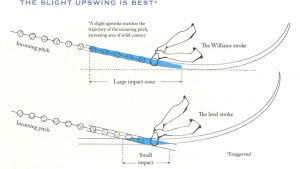
Swing plane is a commonly used, and certainly not a new, idea. Ted Williams famously discusses it in his book The Science of Hitting in 1971 and includes this awesome graphic. Swing plane is incredibly important, but the swing plane problem is much more complex than how it’s being discussed.

Same is in pitching where we now have better tools to measure a pitchers velocity than we did back in Williams day where we measured Bob Fellers fastball by running a motorcycle with a speedometer on a track next to Feller throwing a ball. Real precise measurement tool back then.

BTW, pitchers may not be throwing harder than back in the day as we need to adjust for the inadequacy of the tools being used to measure the speed which reduced the speed number by anywhere from 3-5 MPH. There are certainly more pitchers throwing harder since these days the pitching gurus are entirely focused on throwing harder whereas back in the day the "pitching guru wars" focused on how to throw more efficiently i.e.: with "perfect mechanics".  The focus has shifted.

The advancement in technology has led to a regression in the value, worth and efficiency of most modern day baseball gurus in my opinion, but only time will tell.


Wednesday, January 31, 2018

Is the "Perfect Model" always perfect and the pitching guru wars


This was the tail end of one of my exchanges with Paul Nyman @ SETPRO one of the early pioneers in the pitching guru wars. He was pretty good with advanced training methods for hitters as well.

The following is a response from Paul Nyman to a post on the internet about over and underload training:

The Slav,

Words can be very difficult medium for communication. Stress for a marathoner is different than stress for a pitcher.

Stress to me means elevating the level of activity beyond the point of normal activity.

So if a person is normally throwing a baseball at 80 mph, we must find a way to elevate the stress on his body beyond the 80 mph level.

There is both physical and mental stress.

One of the least understood training issues is the need to create explosive "intent".

Without opening a can of worms, tribe999 asked the question of what is a difference in philosophy in between "other programs" and SETPRO's.

One significant difference is my belief that we need to train the intent to throw hard as opposed to following a mechanical sequence.

The way that pitching mechanics is being taught (in general) is by "picture association".

In other words a visual and verbal representation of the pitching process is used to convey the "external" picture (information) of the pitching process.

It is then left for the person doing is picture or reading the words to "internalize" this information into a sequence (motor program) of posture and muscular actions.

The problem with this is that a lot of the important information cannot be or should I say is not being transmitted by many of these pitching programs, pitching.com being one of them.

And it is not because they are intentionally doing this. It's because they just don't know how to create a richer picture (more information that can be used to more effectively create the internal actions necessary).

In short this is a long-winded way of my saying there's a difference between a pitcher being mechanical and having good mechanics (maximizing his potemtial).

I don't subscribe to the principal that if you work on your mechanics "that velocity will come".

Your velocity will not happen unless you make it happen.

If this occurs because of a specific pitching program, that all well and good.

But is not the pitching program that develops your velocity, it is YOU the player that develops the velocity.

The pitching program is/was only a means for you to achieve that.

I guess you might say that I have a more "holistic" approach to developing pitchers.

As opposed to the cure by "prescription" approach.

Anyway, back to the question of stress.

By definition as long as the effort to throw as hard as possible is there, throwing a different weight baseball has the possibility of creating greater stress.

One of the physiological aspects of the body that I don't think is really understood as much as it should by those who wish to improve their ballistic performance i.e. throwing or swinging a baseball bat, is a fact that muscular response is not linear to the force applied.

I see this phenomenon very clearly if you measure the velocity of a player throwing different weighted baseballs.

Many players can throw a 6 ounce baseball as hard (same velocity) as a five ounce baseball. Even though the 6 ounce baseball is 20 percent heavier than a five ounce baseball. This is a great illustration (to me anyways) that this particular player(s) is not trained to their maximum throwing capabilities.

The reason I say this is because with players that I work with who I believe are throwing a very high-level in terms of their potential, there is a noticeable or significant difference in velocity of their throwing a regulation five ounce baseball as compared to a 6 ounce baseball.

The same is true with them throwing a five ounce baseball as compared to a four ounce baseball.

So therefore players inability to throw a 6 ounce baseball almost as hard as a five ounce baseball indicates that there is undeveloped potential primarily in the form of neuromuscular capabilities.

And in fact significant gains can be made in short periods of time due to neuromuscular recruitment as opposed to developing additional muscle strength.

The intent to throw hard, the intent to swing hard is every bit if not more important than the actual building a strength of the muscle itself.

And we continue to "bump heads" with the specificity principal. Especially the higher we attempt to rise in our athletic capabilities.

I believe that longer durations or lower level throwing, and we have to be very careful asked what we mean by lower level, can be beneficial because my belief that prolong stress, assuming its above a certain level, will lead to physical adaptations in the form of increased tissue size (tendons and ligaments in particular).

And we have to be very careful in what is meant by duration and intensity.

But low level throwing will not in itself develop the neural systems to be explosive.

For those people or very involved in trying to understand how the body develops athletic power, there are different classifications for this power.

As example for football the training professional is more concerned with strength-speed development.

This is different than what the baseball trainer is concerned with for a pitcher, that being speed-strength development.

As far as Coop DeRenne's program, I think is a very good and very safe program to use.

I believe the SETPRO program goes beyond what DeRenne's program started (my sales pitch for today).

As far as MLB and college coaching and training philosophy, I agree 100 percent that their primary job is to maintain a player's ability to perform everyday. As opposed to maximizing their daily performance.

When I was in Atlanta at the National Strength and Conditioning Sport Specific Training Seminar for Baseball, the head training person for the Cleveland Indians said that if a player injured himself because he was doing something that the trainer recommended and was not part of the normal training routine for that athlete then the next day he would be out looking for a new job.

Dr. Frank Fultz of the Atlanta Braves related the same story about Chipper Jones. That Chipper Jones have to come to him and that Chipper have to take total responsibility for his decisions before Dr. Fultz would designed a more aggressive training program for Chipper. This training program resulted in Chipper Jones increasing his strength significantly and going from 20 plus homeruns to 50 homeruns the next season.

I have said hundreds of times that if you expect to perform at the highest level you have to accept the risk of this expectation.

But the key point is that it is "managed" risk.

You use sound training principles, something which most baseball people haven't or won't learn about.

Training principles that former "high jumpers" knew about thirty years ago.

Principles that former major league pitchers or s should I say say someone who pitched three innings in the Major Leagues has no idea about.

Slav, I'm sorry, your post was such a good one, good questions and no sarcasm, but I couldn't resist.

Paul Nyman

Theses discussions around a set of "perfect" pitching mechanics came back to me front and center when I heard Mark Prior on MLB/Sirius say that he "cringed" when he heard the term used to describe his mechanics.

https://www.si.com/thecauldron/2016/08/03/mark-prior-chicago-cubs-no-regrets

Given what happened, I still grimace when I think about those people who said I had perfect mechanics. The Kershaws, the Greinkes, the Arrietas — even they have times when their mechanics are off, and they are the best pitchers on the planet. As a pitcher, there are just times when you feel like you can’t sync up; when your sequence is off. That’s a big part of a pitcher’s responsibility: To execute and to find that groove. I never thought my mechanics were perfect. I just thought that I had a solid delivery that suited my body. I threw the way I had been taught; the way I had since I was six years old.
This was Tom House's doing, using words more to sell than to inform, but it is what it is. If I were to apply the term "perfect" to anyone's mechanics, and I would use the word optimal, it would be Nolan Ryan, who threw 95+ from 19 years old to 45 years old at the MLB level, without much injury down time, except his blister problems early in his career, which may have been related to his National Guard duties. Next, would be Tom Seaver. 

We've come full circle in trying to change arm-slots and mechanics around some pre-conceived models, that we almost ruined guys like Jake Arieta, Clayton Kershaw, Madison Bumgarner and others, who were changed, floundered and then insisted on their own that they were going to either succeed or fail by doing it "My Way" like Sinatra.

If it ain't broke, stop trying to break it! - CS

Monday, June 19, 2017

Rediscovering the Lost Art of Long Toss | Collegiate Baseball


Rediscovering The Lost Art of Long Toss

Source: Collegiate Baseball Magazine | Published: May 1999
By Alan Jaeger

"I'll start playing long toss in January. If I can throw it 200 feet, I try to throw it 300 feet. I don't stop at 120 feet, I throw it as far as I can." - Greg Maddux, Atlanta Braves

Kerry Wood, Matt Morris, Kerry Lightenberg, Alan Benes, Paul Wilson (twice), Jason Dickson, Jeremi Gonzales, Jason Isringhausen, Bill Pulsipher, Ben McDonald, Jeff D'Amico, Jason Bere, Mike Grace, Jeff Wallace, Mike James, Roger Salked , a who's who of extremely promising pitchers struck down by a major arm injury -- and that's just the beginning.

Coincidence? I don't think so.

For every famous case, a la Kerry Wood, there are those lesser known examples where arms are breaking down before they have the opportunity to reach the Big Leagues... to sign a professional contract... to step foot on a college campus... to finish their high school careers.

In your hometowns, you will find the Dan Oppermans and Darren Kerkreits of the world. First round draft picks that you may never hear of. The Drew Pearces (Cal Berkeley) and John Phillips (UCLA) -- promising college pitchers that never got the chance to play pro ball. The Joel Zamudios (Monroe High) and Justin Dunns (St. Francis High), high school pitchers who can only hope that their careers can be preserved.

"Last year (1998), three pitchers from my team all had major arm surgery (two "Tommy Johns," one major shoulder reconstruction) on the same day." - Anonymous Member of a Division I power

The numbers are mounting and the Dr. Frank Jobe's, Dr. Lewis Yocum's, and Dr. James Andrew's of the world are getting busier. As a baseball community, it's time to WAKE UP. There's a serious flaw in our system, a weak link in our development of baseball players' arms, and it's undermining their futures.

Why?

"Without the opportunity to long toss the arm isn't able to gain the strength, length, and endurance it needs. Your arm will eventually reject you." - Seth Etherton, Cincinnati Reds, Former 1st Round Draft Choice

There are many reasons a pitcher's (baseball player's) arm breaks down, why a ligament in the elbow detaches, all or part of the rotator cuff tears, or the shoulder needs to be reconstructed.

These could be the result of poor mechanics, a lack of monitoring [a relief pitcher at a Division 1 program told me that he threw in 14 consecutive games. Later that year he had Tommy John surgery], throwing with pain on a vulnerable arm, throwing too many pitches in one particular outing, throwing too many breaking balls, not enough recovery period time between games, or throwing curves in Little League.

The good news is that most of these problems are obvious and can be corrected.

What really alarms me is a seemingly growing trend that is not so obvious, and perhaps, even more responsible for a deteriorating arm and a career threatening arm injury. And it comes in an era when our levels of instruction and technology are at a all time high. This growing trend is what I refer to as "short toss" (as opposed to "long toss"), a throwing regimen where players are advised not to throw beyond 120 feet.

The 120-Foot Phenomenon 


"You do not clone pitchers. If an individual chooses to long toss, that's fine. You don't give him a distance. Why there's a limit on 120 feet I do not know." - Leo Mazzone, Pitching Coach, Atlanta Braves

When I think in terms of a baseball player's arm being deprived of throwing beyond 120 feet, I immediately feel a tight, tense, short and rigid sensation from my shoulder to the tips of my finger, the opposite kind of qualities I would use to describe a healthy arm or a healthy muscle.

When I think of a healthy arm I think of such characteristics as stretch, loose, length, strength and endurance. Qualities that are hard to attain when we're shortening, rather than, lengthening our arms.

I'm not sure who started it or where it came from, but it seems that in recent years this 120 foot theory has taken root at every stage of the development of baseball players. It seems to have become the rule rather than the exception.

"Actually, I realize that throwing 300 feet isn't such a bad idea...in fact I used to do it myself, but the manual says to stay at 120 feet, so you must stick by it" - Head of player development for a Major League Organization to his first round pick after player pleaded with him to do a long toss program in the off-season

The idea originally behind the "short toss" was that if you keep a player at 120 feet, he'll throw the ball on a line. This theoretically will serve two purposes: 1. The player will be able to keep his shoulders level (avoid "dipping") 2. The release point will stay in similar place because there is minimal change in the arc of the ball

Some even suggest that this "short toss" will save the players' arms by reducing the amount of throws they make.

"You make a living throwing a baseball so we encourage them to throw as often as possible." - Leo Mazzone

Mechanical reasons aside, there are two other major contributing factors to the evolution of the 120-foot throw: 1. Timed throwing 2. The influence of Major League Organizations

Timed throwing occurs because coaches are often pressed for practice time and pitchers have to be at a certain station by a specific time. But, may I ask, how do you time throwing? After all, isn't the amount of time that you need to throw a personal thing? Should your arm become a casualty because the bell rings or you need to go out and shag?

Off-season training programs given out by certain Major League Organizations have contributed to the short toss phenomenon by specifically stating not to throw beyond 120 feet in the off-season (which then tends to carry over into Spring Training). They do this in order to insure that pitchers have a structured throwing program in January/February and that they come to camp under the same homogenous throwing program. But how can one regimen be good for all players? Players are unique, players have different needs. Many need a lot of time or a lot of distance to get properly conditioned.

The reality is that not throwing beyond 120 feet just so you can keep the ball on a line prevents the arm from getting stretched out, loosened up, and opened up to it's potential. It deprives the arm and muscles of much needed length, extension and stimulation. It inhibits the growth of the arm by placing boundaries and limits on the arm. And for what reason? Because coaches value keeping the ball on the line. Because coaches have a packed practice plan and Major League Organizations have to keep everyone at a distance. But what could possibly be more important than the health and longevity of a pitcher's arm?

The arguments against long tossing are that the back shoulder dips a little and the release point is slightly altered. Before we go any further, let's take a look at these two misconceptions.

Pulling Down: Reinforcing A Lower Release Point 

"The pull down phase of the long toss has actually solidified my release point on all three of my pitches, especially my curve ball." - Barry Zito, 2002 Cy Young Winner

When a player throws beyond 120 feet, granted, there does comes a point where his front shoulder must lift slightly and the release point is slightly altered. This must be done in order to get the much desired stretch and distance that the arm needs to build length, strength, endurance and health. It is unavoidable.

But the irony is that the same slight adjustments that are created by the lifting of the front shoulder and the altering of the release point are actually regained and reinforced at a lower release point as the player works his way back in from the desired distance (pull down phase). This is because when you begin to take a 250-300 foot throw into 150, 120, 90 and eventually 60 feet, the release point must get lower. This occurs because the pitcher must learn not to decelerate the arm as he gets closer and closer to his partner. In other words, he must take the arm action of his maximum throw that day (i.e. 250 feet) and pull it down into 60 feet.

A 300 foot throw at 60 feet (without decelerating the arm) will force pitchers to finish through their release point on a downward plane without trying to throw hard. Concentration skills are developed because the pitcher must learn to pick a very low focal point to pull down through (i.e. his partner's shoe), otherwise the ball will end up going a long way over his partner's head. There is no way around it.

A number of additional benefits take place when a 300 foot throw is correctly compressed into a 60 foot throw:

1. The arm can generate natural arm speed and strength because the arm is throwing through a stretch. 2. The player must learn how to lower, and ultimately accelerate, through his release point. 3. The mind must learn how to concentrate and finish through a specific focal point (accuracy). 4. The looseness and power of an arm that's been properly stretched out into a shorter throw (60 feet) takes sound mechanics, balance, rhythm and concentration, which translates into further reinforcement for a pitcher in a game situation.

"I think long toss is a great way to build your arm up, to get in shape to throw off the mound." - Greg Maddux

So the pull down phase actually helps to reinforce a lot of the same principles that are critical for a pitcher on the mound: loose arm action, maximizing arm speed and strength through a properly stretched out arm, acceleration (finish) through a lower release point, maintaining concentration, balance and composure. A far cry from the criticisms of those who discount throwing distance.

The trade-off is simple. Promote health, length, strength, acceleration, and endurance by long tossing. Promote a shorter arm, tighter muscles, minimal endurance and vulnerability to arm injuries by throwing short distances.

Realizing Your Potential 

Put a four-foot snake in a five-foot cage and its expansion is limited. Put that same snake in a twenty-five foot cage and an opportunity of growth presents itself.

My experience from working with pitchers is that if they can throw in the low to mid 80's they can easily build up to throwing a baseball 250 feet. If they throw from the mid to high 80's, they can build up to 250 to 300 feet. Pitchers who throw in the high 80's to low 90's should be able to build up to 300 feet without any problem. If we use 300 feet as a model for the potential distance a college or professional pitcher can throw, than a 120 foot throw equates to 40 % of that pitcher's potential distance.

That means his arm is only stretching to 40% of its capability. Now forgive me if I'm having a hard time with this, but how can it make any sense to suppress the arm's need to expand? I mean, why do we stretch before we play any sport? Isn't it to enhance our performance, to give us agility and flexibility, to avoid injury? So then why is it okay to stretch our arm to only 40% of its need? Would a sprinter only stretch 40% of his hamstrings before running a 100-meter race? Would a hockey goalie stretch only 40% of his groin before a game? Would a golfer enter a long drive contest after stretching just 40% of his back?

"If you don't stretch your arm out, you are more susceptible to an injury. I know that from experience." - Rudy Seanez, Boston Red Sox

The point is that a pitcher who throws a baseball 80 to 100 miles an hour without properly stretching his arm puts himself in jeopardy. It may not be obvious because 120 feet is just far enough to feel like a stretch, but it is not a real stretch. It is not the kind of stretch that the arm truly needs to open up, lengthen out and establish a base.

"Organizations, coaches, etc. discourage pitchers from throwing or put so many limitations on them as to what they can do because they feel that they will get blamed if there is a breakdown." - Leo Mazzone

Can you tell I'm frustrated? Wouldn't you be if you put a pitcher into a training program to stretch, strengthen and condition his arm, only to watch his arm regress because he's been put in a throwing program that does not allow him to exceed 120 feet? Or worse, to watch him spend a year and a half rehabilitating his arm after a major arm surgery because he wasn't given the proper time or distance that is necessary to keep his arm healthy.

I haven't seen the throwing program at every High School, Junior College and four year College. I haven't seen every Major League's off season throwing manual. But I have seen enough and heard enough over the past several years to be alarmed. If we don't make an adjustment soon, we are going to continue to see this growing trend of major arm injuries. In other words, shattered dreams and broken hearts.

"Long Toss is a very important part of conditioning and training for everyone." - Dr. Lewis Yocum, Kerlan-Jobe Orthopedic Clinic

For those coaches who subscribe to distance throwing, to some form of long toss, I can only say that you are doing your best to insure that your players are optimizing their arms and staying healthy. For those of you who have subscribed to the theory of the 120 foot toss or timed throwing, I hope that you will take this article to heart and reevaluate your throwing program.

We are, after all, all dedicated to the same thing: the well-being and success of our players.

Note: I would sincerely like to thank Atlanta Braves Pitching Coach Leo Mazzone and his pitching staff and all of those players who have contributed to this article and cause. - Alan Jaeger

Giants Top Minor League Prospects

  • 1. Joey Bart 6-2, 215 C Power arm and a power bat, playing a premium defensive position. Good catch and throw skills.
  • 2. Heliot Ramos 6-2, 185 OF Potential high-ceiling player the Giants have been looking for. Great bat speed, early returns were impressive.
  • 3. Chris Shaw 6-3. 230 1B Lefty power bat, limited defensively to 1B, Matt Adams comp?
  • 4. Tyler Beede 6-4, 215 RHP from Vanderbilt projects as top of the rotation starter when he works out his command/control issues. When he misses, he misses by a bunch.
  • 5. Stephen Duggar 6-1, 170 CF Another toolsy, under-achieving OF in the Gary Brown mold, hoping for better results.
  • 6. Sandro Fabian 6-0, 180 OF Dominican signee from 2014, shows some pop in his bat. Below average arm and lack of speed should push him towards LF.
  • 7. Aramis Garcia 6-2, 220 C from Florida INTL projects as a good bat behind the dish with enough defensive skill to play there long-term
  • 8. Heath Quinn 6-2, 190 OF Strong hitter, makes contact with improving approach at the plate. Returns from hamate bone injury.
  • 9. Garrett Williams 6-1, 205 LHP Former Oklahoma standout, Giants prototype, low-ceiling, high-floor prospect.
  • 10. Shaun Anderson 6-4, 225 RHP Large frame, 3.36 K/BB rate. Can start or relieve
  • 11. Jacob Gonzalez 6-3, 190 3B Good pedigree, impressive bat for HS prospect.
  • 12. Seth Corry 6-2 195 LHP Highly regard HS pick. Was mentioned as possible chip in high profile trades.
  • 13. C.J. Hinojosa 5-10, 175 SS Scrappy IF prospect in the mold of Kelby Tomlinson, just gets it done.
  • 14. Garett Cave 6-4, 200 RHP He misses a lot of bats and at times, the plate. 13 K/9 an 5 B/9. Wild thing.

2019 MLB Draft - Top HS Draft Prospects

  • 1. Bobby Witt, Jr. 6-1,185 SS Colleyville Heritage HS (TX) Oklahoma commit. Outstanding defensive SS who can hit. 6.4 speed in 60 yd. Touched 97 on mound. Son of former major leaguer. Five tool potential.
  • 2. Riley Greene 6-2, 190 OF Haggerty HS (FL) Florida commit.Best HS hitting prospect. LH bat with good eye, plate discipline and developing power.
  • 3. C.J. Abrams 6-2, 180 SS Blessed Trinity HS (GA) High-ceiling athlete. 70 speed with plus arm. Hitting needs to develop as he matures. Alabama commit.
  • 4. Reece Hinds 6-4, 210 SS Niceville HS (FL) Power bat, committed to LSU. Plus arm, solid enough bat to move to 3B down the road. 98MPH arm.
  • 5. Daniel Espino 6-3, 200 RHP Georgia Premier Academy (GA) LSU commit. Touches 98 on FB with wipe out SL.

2019 MLB Draft - Top College Draft Prospects

  • 1. Adley Rutschman C Oregon State Plus defender with great arm. Excellent receiver plus a switch hitter with some pop in the bat.
  • 2. Shea Langliers C Baylor Excelent throw and catch skills with good pop time. Quick bat, uses all fields approach with some pop.
  • 3. Zack Thompson 6-2 LHP Kentucky Missed time with an elbow issue. FB up to 95 with plenty of secondary stuff.
  • 4. Matt Wallner 6-5 OF Southern Miss Run producing bat plus mid to upper 90's FB closer. Power bat from the left side, athletic for size.
  • 5. Nick Lodolo LHP TCU Tall LHP, 95MPH FB and solid breaking stuff.