Showing posts with label Recovery Protocols. Show all posts

Friday, January 19, 2018

Jet lag impairs performance of major league baseball players - Northwestern Now


The Giants trainers and staff are pretty big into this type of research. The announcers have harped for years on the steps they take to make sure the teams is adequately rested for the rigors of travel ad scheduling in the current environment. They may get some help if the expansion to 32 teams results in a breakdown from the current AL/NL schema into more of a regional mix of divisions and teams based on geographical proximity. The players should welcome that. 

Jet lag impairs performance of major league baseball players - Northwestern Now:

EVANSTON - Major League Baseball (MLB) managers trying to find an edge should pay close attention to their players’ body clocks, according to a new Northwestern University study of how jet lag affects MLB players traveling across just a few time zones.


The researchers found that when people, in this case Major League Baseball players, travel in a way that misaligns their internal 24-hour clock with the natural environment and its cycle of sunlight, they suffer negative consequences.


“Jet lag does impair the performance of Major League Baseball players,” said Dr. Ravi Allada, a circadian rhythms expert who led the study. “The negative effects of jet lag we found are subtle, but they are detectable and significant. And they happen on both offense and defense and for both home and away teams, often in surprising ways.”


In a study of data spanning 20 years and including more than 40,000 games, the researchers identified these effects of jet lag on player and team performance:
  • The offense of jet-lagged home teams is much more affected than that of jet-lagged away teams. Surprisingly, in terms of offensive performance, jet lag from eastward travel had significant negative effects on home teams (after returning from a road trip) and much less of an effect on away teams.
  • Negative effects on offense are related to base running. The negative effects on the home team’s offense were related to base running, such as stolen bases, number of doubles and triples, and hitting into more double plays.
  • Both home and away teams suffer on defense, specifically by giving up more home runs. With defensive performance, strong effects of eastward jet lag were found for both home and away teams, primarily with jet-lagged pitchers allowing more home runs. “The effects are sufficiently large to erase the home field advantage,” Allada said. Besides home runs allowed, few other effects were seen on pitching or defense.
  • There is a difference between traveling east and traveling west. Most significant jet-lag effects were generally stronger for eastward than westward travel. “This is a strong argument that the effect is due to the circadian clock, not the travel itself,” Allada said.
The study, “How Jet Lag Impairs Major League Baseball Performance,” will be published the week of Jan. 23 in the journal Proceedings of the National Academy of Sciences (PNAS).
Allada and his team, Alex Song (first author) and Thomas Severini, used an unprecedented amount of MLB data (from 1992 to 2011), which gave the researchers the statistical power to identify the effects of jet lag on offensive and defensive performance metrics. The researchers considered if teams were traveling east or west; if the team was home or away; and the team itself.
They also looked at the number of hours players would be jet-lagged, based on the number of time zones traveled across, to determine which games were “jet-lag games” and which were not. (The human body clock can roughly shift about an hour each day as it synchronizes to the new environment.) If players were shifted two or three hours from their internal clocks, the researchers defined them as jet-lagged.


What does all this data analysis mean going forward? With MLB spring training less than a month away, Allada has some advice based on his research.
“If I were a baseball manager and my team was traveling across time zones — either to home or away — I would send my first starting pitcher a day or two ahead, so he could adjust his clock to the local environment,” Allada said.
Allada provides an example from the 2016 National League Championship Series illustrating the potential impact of jet lag on player performance. In game 2, Los Angeles Dodgers’ ace Clayton Kershaw shut out the Chicago Cubs, giving up only two hits, but game 6 was a different story.


“For game 6, the teams had returned to Chicago from LA, and this time the Cubs scored five runs off of Kershaw, including two home runs,” Allada said. “While it’s speculation, our research would suggest that jet lag was a contributing factor in Kershaw’s performance.”


Allada is the Edgar C. Stuntz Distinguished Professor in Neuroscience and chair of the neurobiology department in the Weinberg College of Arts and Sciences. He also is associate director of Northwestern’s Center for Sleep and Circadian Biology.


The Defense Advanced Research Projects Agency (grant D12AP00023) supported the research.


http://www.pnas.org/content/114/6/1407.full.pdf


'via Blog this'

Tuesday, December 15, 2015

Post-Pitching Recovery Protocol

Post-Pitching Recovery Protocol 
By: Ryan Faer and Matt Van Dyke
Pitching is one of the most, if not the most, high-velocity action found in the world of athletics. That being said, proper recovery from this explosive, repeated movement becomes vitally important in determining not only the timeframe of return to maximal strength and velocity for a pitcher, but also the longevity of their career. This article will emphasize the importance of implementing recovery techniques based on the physiological stressors pitchers experience during competition. It is important to note that the methods used in this article may be applied to any athletic event, however the focus will be placed on different areas of the body as needed in each individual sport.
Why Recovery Post-Pitching Matters:
As we briefly explained earlier, pitching is one of the most explosive, high-velocity movements found in athletics. Peak shoulder internal rotation reaches a velocity of 7000o/second with peak elbow extension velocity reaching 2000o/second. To put this rotational velocity in perspective, 7000o/second is the equivalent to rotating your arm in a circular motion 70,000 times per hour. This almost unimaginable feat displays the true explosive power that pitchers' shoulders must produce and endure with each pitch. Think about looking at a pitchers arm found on a baseball card and the way the pitcher's arm is "cocked" or in the "layback" position. There is clearly a tremendous amount of force being transferred through the entire kinetic chain, and it is all transferred specifically through the throwing arm. The rapid acceleration of the arm through the throwing motion must, ultimately, be stopped in a rapid fashion as well. This rapid deceleration of the arm places high eccentric stress on the arm, specifically the posterior shoulder musculature. This means the posterior shoulder muscles are violently contracting while still elongating as they attempt to decelerate the humerus during its internal rotation and extension toward home plate.
It is well understood that high eccentric stress is the leading cause of muscle damage in high-velocity movements. Taking a brief look at the physiology of a muscle contraction, the myosin head is attempting to attach to the actin in order to decelerate the arm moving at an extremely high-velocity. If the myosin heads and their actin attachment sites have not been properly trained to handle these high-stress, eccentric loads, muscle damage almost always occurs. Even with proper training, the explosive action of pitching will lead to muscle damage, just not as much. Multiple exposures to high eccentric stress, as seen in pitching, without proper recovery methods leads to a loss in range of motion, inflammation, and soreness. It is for this reason the recovery protocol for pitchers becomes an imperative piece in keeping them not only injury free, but continuously performing optimally.
Immediately Post:
Once an outing for a pitcher has concluded, they can immediately begin the recovery process. The goal of this recovery protocol immediately following pitching is to begin the process of rebuilding as rapidly as possible, thus optimally preparing the pitcher for their next competition date. The primary modes of recovery immediately post-pitching can ultimately be broken down into three segments, the first being AVOID ICE AT ALL COSTS, the second is the completion of dynamic movements of the shoulder, and the third is active recovery.
We know the first aspect of recovery goes against everything the majority of us have been taught about treating injuries. However, icing will lead to the halting and even reversal of the healing and recovery process. Simply put, a pitcher will take longer to recover if ice is used on their shoulder or elbow. The logic behind this anti-icing movement is simple and easily understood. When any tissue is damaged within the body, our ultimate goal should be to improve that tissue to its highest functioning state. In athletics, our goal is then made more difficult as we attempt to treat injuries as quickly as possible to get our athletes back on the field. We accomplish this task by removing the waste or "junk" produced by the injury via the lymphatic system and by increasing the blood flow to the injured area, which will bring the necessary nutrients to begin the rebuilding process. If the lymph system is understood, you know the only way lymph or the "junk" within the lymphatic system is cleared is by active muscle contraction in the nearby area. If we take these two basic principles of recovery and then realize that ice both leads to immobilization and decreased blood flow to the injured area, we can clearly see icing is completely ineffective and significantly hinders recovery.
If you are interested in learning more about the "anti-icing" movement, click here for a link to a video featuring Gary Reinl explaining his profoundly simple idea to maximizing recovery.
Dynamic movement of the shoulder is the second piece in our immediate recovery plan. These movements not only assist with the inflammatory process by increasing waste removal via the lymphatic system, but they also function to strengthen posterior shoulder muscles and the entire range of motion of the shoulder joint. As covered earlier, it is the posterior muscles of the shoulder that experience the highest levels of eccentric stress and potential micro-trauma. Strengthening these muscles immediately post-pitching will jump start the building process for the next outing and ultimately reduce the likelihood of chronic overuse injuries down the road. It is important to note that if there is pain experienced during these muscle actions, movement should be reduced to a pain free range of motion. This will prevent any further damage being done to these damaged muscles. The goal of causing no more harm is always in effect during training.
Active recovery is simply putting the body in motion. This can range from a dynamic warm-up to a brisk walking session, with the goal of keeping the heart rate around 100 bpm. This recovery protocol ensures all tissues receive the blood flow necessary, which carries the needed nutrients for proper regeneration. This low-intensity training also assists in the removal of any remaining metabolites within the body produced during the pitching outing. This method can be paired with the dynamic movements of the shoulder if so desired.
Day after:
The first day after a pitching outing is another opportunity for a coach to maximize a pitcher's recovery time. The training methods implemented on this day play just as vital a role in reducing needed recovery time as the methods used immediately post-pitching. Covered here will be training protocols that will hinder recovery and potentially subsequent performance. Training methods to enhance recovery also will be given.
The mentality of avoiding ice continues to be applied in this phase of recovery, just as it was during the immediately post-pitching recovery process. The reasoning for this approach is outlined above and is based on the principle of getting "garbage out and groceries in". This refers to the process of removing the "junk" or "garbage" via the lymphatic system produced by the damaged tissue, and getting the proper nutrients or "groceries" to the recovering muscles via blood flow. Once again, the reasoning for this method is expressed in a more detailed manner above.
One of the biggest, most misguided, training protocols prescribed to pitchers is the "flush run" or jogging poles. Physiologically speaking, based on the requirements of pitching, there is simply no need to "flush the system" after a pitching outing. Pitching consists of a short duration, max-effort bout, followed by 20-30 seconds of rest. This high-intensity bout is then repeated an upwards of 100 or more times, and broken into segments (innings in this case) that allow much longer rest times. Short duration, high-intensity movements, as seen in pitching primarily use the ATP-CP energy system, as long as creatine phosphate is available. This is the shortest metabolic pathway and allows the rapid use of energy, or ATP, for explosive movements. It should be noted that all energy pathways are utilized at all times, however, they function in an ever fluctuating model depending on the intensity and time requirements of the activity being performed.
As stated above, pitching primarily relies on the ATP-CP energy system when a pitcher is fully recovered, or has available stores of creatine phosphate. As more pitches are thrown during a single half-inning, the body must begin to rely on other energy pathways to meet the high-intensity demands required in pitching as creatine phosphate cannot fully recover between pitches. Anaerobic glycolysis, or the use of glycogen, is the next available energy system capable of producing high-intensity efforts and becomes utilized to a greater extent, leading to the production of lactate. The hydrogen ions produced along with lactate lead to the reduced ability of the ATP-CP energy system to produce the needed energy. The ability to clear and tolerate these hydrogen ions becomes vitally important as more pitches are thrown within a single half-inning. Once the half-inning is completed, properly trained athletes will have enough time to clear the majority of hydrogen ions prior to the start of their next inning. This will allow the body to begin to replenish ATP stores and the ATP-CP system. The fact that the body can clear these metabolites rapidly demonstrates a "flush run" is not a requirement for recovery during the next day after a pitching performance.
The training methods to increase an athlete's abilities in clearance of lactate or tolerance of high concentrations of lactate are laid out in the following article, Understanding Blood Lactate to Optimize Training and Performance.
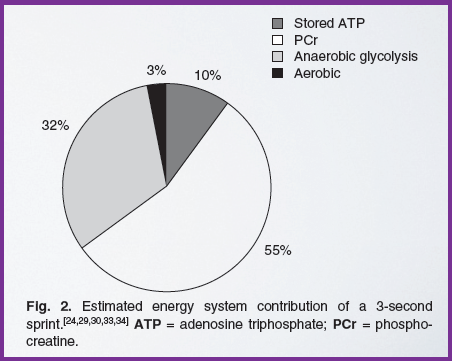
Below is a figure showing the estimated energy system contribution during a 3 second sprint, which is similar to the short burst, high-intensity movements seen in pitching. As the inning continues and more pitches are thrown, energy system contribution will shift toward the anaerobic glycolysis pathway.
Energy_Systems_in_3_sec_Sprint.png 
If simply being unnecessary isn't enough for a coach to discontinue these "recovery" methods, such as jogging poles, then it should be understood that these exercises can lead to decreased maximal power outputs, or reduced explosiveness. The first sentence of this article portrayed the importance of explosive power for pitchers, so the fact that a training method commonly used leads to decreasing the ability so vital for success should immediately lead to the training being questioned.
Explosive power, which is provided via contraction of the type II, "fast twitch", muscle fibers, provides the backbone to elite, high-level, pitchers. As coaches, it should be our goal to provide training protocols to optimize the power producing abilities of these type II fibers. Distance jogging, as seen in running poles, leads to a shift in fast twitch fibers to slower, more oxidative fibers. Once this occurs, research shows the ability to transition those fibers back to their original explosive form is virtually impossible. This means your star pitcher, whose success relies almost solely on being explosive, just trained their body to be less explosive. As coaches, we never want to facilitate the shifting of explosive type II fibers to more aerobically trained fibers. Now some of you may be questioning the walking method as an active recovery method, as discussed in the immediately post-pitching section, after reading these last few sentences. Walking as a method for active recovery will not lead to the shift of type II fibers to a more oxidative, or less explosive form. This is simply because the type II fibers responsible for maximal power are not activated during this low-intensity activity. The activity does not require their activation, thus they are not changed.
As mentioned earlier, the violent eccentric contractions of the posterior shoulder musculature can cause significant Delayed-Onset Muscle Soreness (DOMS). Also, DOMS can be experienced in the forearm from the eccentric contractions by the wrist flexors, as the wrist must rapidly decelerate during the ball release phase, and in the lower body from decelerating the entire body upon foot strike and follow-through.  To reiterate, DOMS is caused by mechanical damage to the muscle cells and the ensuing inflammatory response. This inflammation causes the cells to swell, whereby pressure receptors are activated, causing pain. It's important to understand that, although this swelling causes soreness, it is a vital part of the muscle's recovery and repair. Coaches and pitchers DO NOT want to ice the sore muscles, for exactly the reasons stated multiple times above, and they certainly do not want to take anti-inflammatory drugs, as this will impede any positive physiological adaptations your pitcher's body can incur from the eccentric muscle damage.
However, there are a few modalities that can be used to assist with the DOMS in order to achieve the goal of returning to maximal strength and physical state before the next outing. When muscle fibers are damaged, as frequently caused in pitching, they do not always repair themselves in an orderly fashion. This improper healing can lead to the formation of adhesions within the muscle, which can cause additional pain along with that already experienced due to the DOMS. If these adhesions are not continuously addressed, overall muscle functioning and power production abilities will be reduced dramatically over the course of a season, along with an increased risk of traumatic injury due to potential muscle and movement compensations. Self myofascial release techniques (SMR), through the utilization of foam rollers or a lacrosse ball, can be of assistance to reduce and potentially relieve the muscle adhesions. These SMR techniques also facilitate regeneration and recovery of the muscle tissues. Foam rolling can be used on the posterior shoulder musculature, as well as the rest of the body.
Light stretching and mobility work also can contribute to relieving the symptoms of DOMS and restore joint function after the tough eccentric bouts experienced during pitching. Over the course of the season, a pitcher tends to lose particular ranges of motion, particularly internal rotation of the shoulder along with scapular upward rotation. Mobility work along with stretching will support and keep the glenohumeral joint functioning optimally throughout the long seasons experienced in baseball.
Training in the weight room should consist of a lower body emphasis the day after a pitching outing. Dynamic movement of the lower body will continue to assist in the recovery from DOMS. If a pitcher is on a 5 day rotation, this will allow 4 days of recovery prior to their next appearance. This allows the legs to be continually trained and strengthened during the long baseball season, but also gives proper time for a full recovery to be made so their legs will be fresh for their next appearance.
For relief pitchers, much of the recovery protocol becomes variable based on their workload throughout the week. Communication between the pitching coach and the strength and conditioning coach is vital to ensure the relief pitchers receive proper training and recovery, which will vary on a weekly basis. For example, if a relief pitcher makes an appearance on Monday, throwing 50 pitches, and the pitching coach deems him "down" for the next game, this would make the next day a great opportunity to get a full-body training session in and perform some dynamic movement and recovery techniques that are needed to prepare for their next potential outing. Conversely, if a reliever throws 15 pitches on Monday and is deemed "up" for the next game, some dynamic movement would be encouraged, but a lift would be out of the question, and other recovery techniques could be performed as needed on an individual basis. Communication between player, pitching coach, and strength and conditioning coach is key in this process.
Summing it all up – Do's and Don'ts:
Clearly there are methods coaches and pitchers can utilize post-outing that can dramatically improve recovery. However, if improper protocols are used, the recovery process can actually be hindered. The recovery process should begin immediately after the pitching session has been completed in order to maximize recovery time and efficiency.  Avoiding ice at all costs, paired with dynamic movement and active recovery are the first 3 steps and should be implemented as soon as possible. The following day of recovery should continue to avoid the use of ice, avoid the use of "flush running" or jogging poles, and should include light stretching and mobility exercises along with a high-intensity lower body training session. These methods will vary slightly based on the rotation schedule of each individual pitcher and their individual needs. Remember, any coach can make an athlete tired; our goal as coaches should be to provide the proper adaptations necessary to be successful in competition. It is important, once again, to note the recovery methods outlined in this article can be applied to virtually all athletes post-competition. However, the demands of the specific posterior shoulder and locations of SMR work will vary based on the requirements of the sport. There is no doubt in our minds that as the understanding of the physiological process of pitching continues to grow, these recovery methods will become even more proficient.

Thursday, May 21, 2015

Triphasic Training: A High School Manual for Athletes and Coaches

http://www.amazon.com/Triphasic-Training-systematic-explosive-performance/dp/0985174315

I would agree with every word of this endorsement/review of Cal Dietz' Triphasic Training A High School Manual for Athletes and Coaches. It should be in every strength coaches library or reading list. The book Triphasic Training (shown above) has been in my library for quite some time and is a valuable resource. Check it out. Cal is one of the best and most successful strength coaches out there.

Expand Your Coaching Arsenal: Review and Discussion on "Triphasic Training, a High School Manual for Athletes and Coaches" | Just Fly Sports

Triphasic Training: A High School Strength and Conditioning Manual" is a free resource, available for all athletes and coaches.  If you haven't downloaded it, you are doing yourself an athletic dis-service!

After 15 years of lifting weights, learning about programs, reading books, attending conferences, and coaching athletes, I figured I had seen just about every method of barbell training.  After reading through Triphasic Training, I realized just how much farther I had to go, and was beginning to become aware of just how big the world of possibilities was for the development of strength, speed and athleticism.

The first time I put together my own Triphasic program, I found that I was able to train harder, for a longer period of time without deloading.   Lifting them seemed to "transfer" more to the key sport variables I was looking for.  The rewards were increased strength, speed, and power in all arenas. 

The method forms the base-work of many of my training programs I write for online clients, as well as much of the work I do with the swimmers I work with at the University of California, Berkeley.  It is one that is close to my heart as I work through my programming, week in and week out.

With so much information floating around the internet, and so little time to read it all, perhaps one of the most important things any coach or athlete wants to consider is the relevance, clarity and application of what they are engaging in.  Listening to a lecture about fascia for 2 hours with little real application isn't really high on the priority list of the general coaching population.  It is that concept that drives my work on Just fly Sports, as I try my best to provide easy to read, straight to the point articles that are an amalgamation of more drawn out concepts and ideas.

We are constantly taking, condensing, and re-distributing to make the overall training process easier and more manageable.

With that being said, I am taking the time today to review and discuss portions of a great, free book that represents a simple and streamlined understanding of one of the most powerful, effective training methodologies available today, the "Triphasic System".

The original "Triphasic Training" book is still one of the single greatest books on training in my library, and was the most influential works on my own training design since I read "Easy Strength" about 3 years ago.  The latest adaption of Triphaic Training is the high school strength and conditioning manual version, which in addition to being a great book by itself, has some nice concepts that you won't actually will not find in the original.

First things first: If you haven't bought Triphasic Training, or aren't sure about the exact methodology, the High School Manual offers a great primer and overview.  It is a great way to dip your toes in the water.  Not only is this version of the book a great primer for those for those who aren't already familiar with the Triphasic system, there is some great stuff in the high school manual that is not in the original book.

Some new areas that I really enjoyed were some of the following:
  • Anecdotes on the importance of the feet in transfer to athletic performance
  • Plyometric progressions
  • A method to incorporate the Olympic lifts within the scope of the triphasic method
  • Ideas for GPP construction, especially applicable for the high school level
  • Oscillatory and Isometric work as part of the GPP
  • Cal's metabolic injury prevention running circuit
  • Simple and effective, multi-level core workouts
  • An extremely thorough hip strength circuit
  • Recovery protocols for use after heavy spinal loading
  • A proposal for a new practice paradigm to optimize the order in which sport skills are performed, relative to high speed skills
The manual also has a bunch of hyperlinks that go to articles on XLathlete.com.  If you have ever been to XL athlete, but weren't quite sure where to start, going through this manual puts it together in a nice, sequential manner.   Much of the information in the book is also available via articles on XLathlete, but it is awesome to have much of it all in one document.

 Aerobic Base Injury Prevention RunningAerobic Base Injury Prevention Running

Why yes Virginia, there IS a better way to do base training than running endless laps
I'd like to use the last bit of this brief article and review to discuss a few select pieces from the book, and share my thoughts on the methodology, Triphasic method combined with Olympic lifting, and then Cal's basic undulated method of yearly training.

Triphasic Olympic Lifting:
Triphasic Olympic lifting featuring 2 week blocks of paused, isometric and reactive Olympic lifting woven into a French Contrast method.   See the sample from the book below to check out what I mean.

Lift Progression

Triphasic training applied to Olympic lifting.  Taken from Triphasic Training, A High School Strength and Conditioning Manual

Clearly, Olympic lifting is a nice way to develop power, given that it is used with the correct cues, technique and bar speed.  In the past, I have typically just performed Olympic work on its own, and then tied in the Triphasic method to my squat, deadlift, bench and pullup work.  The progression above is yet another weapon that a strength coach can use to emphasize cues and core positions, while preventing accommodation that occurs from the over-use of any given training method.
Complex training, and particularly French Contrast is also an awesome way to develop qualities of power and rate of force development.  Within the "High School Manual", Cal not only lays out a sequence that would be awesome for high schoolers, but college level athletes as well.  After all, if you are going to improve power, it isn't just about magic exercises, but more about the explosive nature by which they are performed, and the sequencing within that leads to optimal motor learning, a positive hormonal and biochemical response, as well as the potentiation effect that works its way through each successive set.  In my French Contrast adaptations in the past, I have always loved placing the Olympic lifts in this system, as the total neural and biochemical effect elicits great adaptations in power development.

A Simple, but Effective Undulated Method of Alternating Speed and Strength Blocks

Another piece of gold from this manual is the yearly sequencing of a training plan for high school athletes as shown below.  In the model highlighted in the text, Cal moves from a 4-6 week introductory, GPP block to a 4 week speed-strength block, to a 4 week strength block, and then back to a speed strength block before peaking.  This model would work great for high school, as well as many college level athletes, because, in any sport, speed is the priority, not weight room 1RM's.  Learning how to move correctly, and then do so with speed and power is far more important than the ability to increase one's maximal squat, deadlift and bench press with questionable technique throughout the year.   I have seen this "speed strength to strength" method work very well for a group of college throwers in a fall semester of training.  Get in shape, set the tone of speed, and then put strength on top of that.  So many coaches do things the other way around, which can certainly work, but few would think of what might happen if things were the other way.  Taking a look at the way that the Russians trained high jumpers as given in "Special Strength Training Manual for Coaches" would also agree with the thought of building speed before significant barbell work is implemented.

Basic Undulated Method of Yearly Training

Basic undulated Method

Basic Undulated Method of Yearly Training.  Taken from Triphasic Training, A High School Strength and Conditioning Manual

As I have said even before I read through this manual, I would rather an athlete learn to do an Isometric reactive squat, with a rapid drop, a quick and unbreakable isometric phase, and an explosive concentric, than simply to be able to handle heavy weight.  I think this provides a better fulfillment of the ideology of "movement before strength".  Doing just body weight and postural corrections early on won't prepare an athlete to build their engine nearly to the level as learning the correct posture alongside the means to put serious speed behind it.

Although the weight room can't hold a candle to sport in terms of specificity, the subtle training of correct positions, and the aggressive nature that can be taught through a biomechanically optimized strength program goes a long way in transfer, and providing an extra edge in competition.

Overall, Triphasic Training: A High School Strength and Conditioning Manual is a great all-in-one resource to get a great context on how some of Cal's work fits into the big picture.  XL Athlete is a really large site, with a ton of top-notch information.  This book is one of the best ways to put the core of that information all in one place, in a sequential book format.   I would highly recommend that you check it out.

~;::::::;( )">  ¯\_( )_/¯

Giants Top Minor League Prospects

  • 1. Joey Bart 6-2, 215 C Power arm and a power bat, playing a premium defensive position. Good catch and throw skills.
  • 2. Heliot Ramos 6-2, 185 OF Potential high-ceiling player the Giants have been looking for. Great bat speed, early returns were impressive.
  • 3. Chris Shaw 6-3. 230 1B Lefty power bat, limited defensively to 1B, Matt Adams comp?
  • 4. Tyler Beede 6-4, 215 RHP from Vanderbilt projects as top of the rotation starter when he works out his command/control issues. When he misses, he misses by a bunch.
  • 5. Stephen Duggar 6-1, 170 CF Another toolsy, under-achieving OF in the Gary Brown mold, hoping for better results.
  • 6. Sandro Fabian 6-0, 180 OF Dominican signee from 2014, shows some pop in his bat. Below average arm and lack of speed should push him towards LF.
  • 7. Aramis Garcia 6-2, 220 C from Florida INTL projects as a good bat behind the dish with enough defensive skill to play there long-term
  • 8. Heath Quinn 6-2, 190 OF Strong hitter, makes contact with improving approach at the plate. Returns from hamate bone injury.
  • 9. Garrett Williams 6-1, 205 LHP Former Oklahoma standout, Giants prototype, low-ceiling, high-floor prospect.
  • 10. Shaun Anderson 6-4, 225 RHP Large frame, 3.36 K/BB rate. Can start or relieve
  • 11. Jacob Gonzalez 6-3, 190 3B Good pedigree, impressive bat for HS prospect.
  • 12. Seth Corry 6-2 195 LHP Highly regard HS pick. Was mentioned as possible chip in high profile trades.
  • 13. C.J. Hinojosa 5-10, 175 SS Scrappy IF prospect in the mold of Kelby Tomlinson, just gets it done.
  • 14. Garett Cave 6-4, 200 RHP He misses a lot of bats and at times, the plate. 13 K/9 an 5 B/9. Wild thing.

2019 MLB Draft - Top HS Draft Prospects

  • 1. Bobby Witt, Jr. 6-1,185 SS Colleyville Heritage HS (TX) Oklahoma commit. Outstanding defensive SS who can hit. 6.4 speed in 60 yd. Touched 97 on mound. Son of former major leaguer. Five tool potential.
  • 2. Riley Greene 6-2, 190 OF Haggerty HS (FL) Florida commit.Best HS hitting prospect. LH bat with good eye, plate discipline and developing power.
  • 3. C.J. Abrams 6-2, 180 SS Blessed Trinity HS (GA) High-ceiling athlete. 70 speed with plus arm. Hitting needs to develop as he matures. Alabama commit.
  • 4. Reece Hinds 6-4, 210 SS Niceville HS (FL) Power bat, committed to LSU. Plus arm, solid enough bat to move to 3B down the road. 98MPH arm.
  • 5. Daniel Espino 6-3, 200 RHP Georgia Premier Academy (GA) LSU commit. Touches 98 on FB with wipe out SL.

2019 MLB Draft - Top College Draft Prospects

  • 1. Adley Rutschman C Oregon State Plus defender with great arm. Excellent receiver plus a switch hitter with some pop in the bat.
  • 2. Shea Langliers C Baylor Excelent throw and catch skills with good pop time. Quick bat, uses all fields approach with some pop.
  • 3. Zack Thompson 6-2 LHP Kentucky Missed time with an elbow issue. FB up to 95 with plenty of secondary stuff.
  • 4. Matt Wallner 6-5 OF Southern Miss Run producing bat plus mid to upper 90's FB closer. Power bat from the left side, athletic for size.
  • 5. Nick Lodolo LHP TCU Tall LHP, 95MPH FB and solid breaking stuff.