Showing posts with label THE PERFECT PITCHER. Show all posts

Monday, June 25, 2018

Using Swing Plane to Coach Hitters: a Deeper Look - Driveline Baseball


What has changed from Ted Williams' day is we now have the technology to measure the matching of the hitters swing plane to the angle of incoming pitch. That's it, folks.

from drivelinebaseball.com
https://www.drivelinebaseball.com/2018/05/using-swing-plane-coach-hitters-deeper-look/

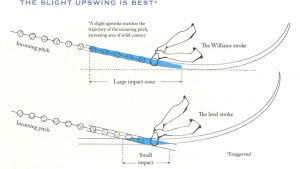
Swing plane is a commonly used, and certainly not a new, idea. Ted Williams famously discusses it in his book The Science of Hitting in 1971 and includes this awesome graphic. Swing plane is incredibly important, but the swing plane problem is much more complex than how it’s being discussed.

Same is in pitching where we now have better tools to measure a pitchers velocity than we did back in Williams day where we measured Bob Fellers fastball by running a motorcycle with a speedometer on a track next to Feller throwing a ball. Real precise measurement tool back then.

BTW, pitchers may not be throwing harder than back in the day as we need to adjust for the inadequacy of the tools being used to measure the speed which reduced the speed number by anywhere from 3-5 MPH. There are certainly more pitchers throwing harder since these days the pitching gurus are entirely focused on throwing harder whereas back in the day the "pitching guru wars" focused on how to throw more efficiently i.e.: with "perfect mechanics".  The focus has shifted.

The advancement in technology has led to a regression in the value, worth and efficiency of most modern day baseball gurus in my opinion, but only time will tell.


Wednesday, January 31, 2018

Is the "Perfect Model" always perfect and the pitching guru wars


This was the tail end of one of my exchanges with Paul Nyman @ SETPRO one of the early pioneers in the pitching guru wars. He was pretty good with advanced training methods for hitters as well.

The following is a response from Paul Nyman to a post on the internet about over and underload training:

The Slav,

Words can be very difficult medium for communication. Stress for a marathoner is different than stress for a pitcher.

Stress to me means elevating the level of activity beyond the point of normal activity.

So if a person is normally throwing a baseball at 80 mph, we must find a way to elevate the stress on his body beyond the 80 mph level.

There is both physical and mental stress.

One of the least understood training issues is the need to create explosive "intent".

Without opening a can of worms, tribe999 asked the question of what is a difference in philosophy in between "other programs" and SETPRO's.

One significant difference is my belief that we need to train the intent to throw hard as opposed to following a mechanical sequence.

The way that pitching mechanics is being taught (in general) is by "picture association".

In other words a visual and verbal representation of the pitching process is used to convey the "external" picture (information) of the pitching process.

It is then left for the person doing is picture or reading the words to "internalize" this information into a sequence (motor program) of posture and muscular actions.

The problem with this is that a lot of the important information cannot be or should I say is not being transmitted by many of these pitching programs, pitching.com being one of them.

And it is not because they are intentionally doing this. It's because they just don't know how to create a richer picture (more information that can be used to more effectively create the internal actions necessary).

In short this is a long-winded way of my saying there's a difference between a pitcher being mechanical and having good mechanics (maximizing his potemtial).

I don't subscribe to the principal that if you work on your mechanics "that velocity will come".

Your velocity will not happen unless you make it happen.

If this occurs because of a specific pitching program, that all well and good.

But is not the pitching program that develops your velocity, it is YOU the player that develops the velocity.

The pitching program is/was only a means for you to achieve that.

I guess you might say that I have a more "holistic" approach to developing pitchers.

As opposed to the cure by "prescription" approach.

Anyway, back to the question of stress.

By definition as long as the effort to throw as hard as possible is there, throwing a different weight baseball has the possibility of creating greater stress.

One of the physiological aspects of the body that I don't think is really understood as much as it should by those who wish to improve their ballistic performance i.e. throwing or swinging a baseball bat, is a fact that muscular response is not linear to the force applied.

I see this phenomenon very clearly if you measure the velocity of a player throwing different weighted baseballs.

Many players can throw a 6 ounce baseball as hard (same velocity) as a five ounce baseball. Even though the 6 ounce baseball is 20 percent heavier than a five ounce baseball. This is a great illustration (to me anyways) that this particular player(s) is not trained to their maximum throwing capabilities.

The reason I say this is because with players that I work with who I believe are throwing a very high-level in terms of their potential, there is a noticeable or significant difference in velocity of their throwing a regulation five ounce baseball as compared to a 6 ounce baseball.

The same is true with them throwing a five ounce baseball as compared to a four ounce baseball.

So therefore players inability to throw a 6 ounce baseball almost as hard as a five ounce baseball indicates that there is undeveloped potential primarily in the form of neuromuscular capabilities.

And in fact significant gains can be made in short periods of time due to neuromuscular recruitment as opposed to developing additional muscle strength.

The intent to throw hard, the intent to swing hard is every bit if not more important than the actual building a strength of the muscle itself.

And we continue to "bump heads" with the specificity principal. Especially the higher we attempt to rise in our athletic capabilities.

I believe that longer durations or lower level throwing, and we have to be very careful asked what we mean by lower level, can be beneficial because my belief that prolong stress, assuming its above a certain level, will lead to physical adaptations in the form of increased tissue size (tendons and ligaments in particular).

And we have to be very careful in what is meant by duration and intensity.

But low level throwing will not in itself develop the neural systems to be explosive.

For those people or very involved in trying to understand how the body develops athletic power, there are different classifications for this power.

As example for football the training professional is more concerned with strength-speed development.

This is different than what the baseball trainer is concerned with for a pitcher, that being speed-strength development.

As far as Coop DeRenne's program, I think is a very good and very safe program to use.

I believe the SETPRO program goes beyond what DeRenne's program started (my sales pitch for today).

As far as MLB and college coaching and training philosophy, I agree 100 percent that their primary job is to maintain a player's ability to perform everyday. As opposed to maximizing their daily performance.

When I was in Atlanta at the National Strength and Conditioning Sport Specific Training Seminar for Baseball, the head training person for the Cleveland Indians said that if a player injured himself because he was doing something that the trainer recommended and was not part of the normal training routine for that athlete then the next day he would be out looking for a new job.

Dr. Frank Fultz of the Atlanta Braves related the same story about Chipper Jones. That Chipper Jones have to come to him and that Chipper have to take total responsibility for his decisions before Dr. Fultz would designed a more aggressive training program for Chipper. This training program resulted in Chipper Jones increasing his strength significantly and going from 20 plus homeruns to 50 homeruns the next season.

I have said hundreds of times that if you expect to perform at the highest level you have to accept the risk of this expectation.

But the key point is that it is "managed" risk.

You use sound training principles, something which most baseball people haven't or won't learn about.

Training principles that former "high jumpers" knew about thirty years ago.

Principles that former major league pitchers or s should I say say someone who pitched three innings in the Major Leagues has no idea about.

Slav, I'm sorry, your post was such a good one, good questions and no sarcasm, but I couldn't resist.

Paul Nyman

Theses discussions around a set of "perfect" pitching mechanics came back to me front and center when I heard Mark Prior on MLB/Sirius say that he "cringed" when he heard the term used to describe his mechanics.

https://www.si.com/thecauldron/2016/08/03/mark-prior-chicago-cubs-no-regrets

Given what happened, I still grimace when I think about those people who said I had perfect mechanics. The Kershaws, the Greinkes, the Arrietas — even they have times when their mechanics are off, and they are the best pitchers on the planet. As a pitcher, there are just times when you feel like you can’t sync up; when your sequence is off. That’s a big part of a pitcher’s responsibility: To execute and to find that groove. I never thought my mechanics were perfect. I just thought that I had a solid delivery that suited my body. I threw the way I had been taught; the way I had since I was six years old.
This was Tom House's doing, using words more to sell than to inform, but it is what it is. If I were to apply the term "perfect" to anyone's mechanics, and I would use the word optimal, it would be Nolan Ryan, who threw 95+ from 19 years old to 45 years old at the MLB level, without much injury down time, except his blister problems early in his career, which may have been related to his National Guard duties. Next, would be Tom Seaver. 
We've come full circle in trying to change arm-slots and mechanics around some pre-conceived models, that we almost ruined guys like Jake Arieta, Clayton Kershaw, Madison Bumgarner and others, who were changed, floundered and then insisted on their own that they were going to either succeed or fail by doing it "My Way" like Sinatra.

If it ain't broke, stop trying to break it! - CS

Thursday, May 18, 2017

Why Sports Science Shows Pitching Lessons are a Dead End


Notes from Frans Bosch – Transfer of Strength Training: Implications from the CNS

Posted on March 21, 2013 by Simon Nainby
This was an important lecture for me as it introduced several concepts that prompted me to study many important aspects of skill acquisition as I mentioned in my introduction to What is good coaching?
Frans Bosch is professor of biomechanics and motor learning at Fontys University for Applied Science in the Netherlands and sprint consultant to the Welsh Rugby Union – you can read more about him here. My notes, in bullet point format, from the lecture are below:
  • The laws of motor learning should be central in designing a strength program rather than Newtonian laws
  • In order to maximise the learning result Strength exercises need:
    • Precise intention
    • Variable execution
  • Basic motor properties such as strength, endurance, flexibility, co-ordination etc don't exist
  • This is because there is no clear dividing line between properties – there should be a guaranteed transfer of that property between movement patterns but this is not the case
  • A well trained high jumper can get Maximum Voluntary Contraction to 95% executing a high jump (compared to an untrained person's level of 75%) but they couldn't do the same in a Javelin throw as it is a different movement pattern
  • If muscle is not pre-tensed in an isometric contraction prior to movement then it has slack
  • Up to 50% of a countermovement jump, for example, can be taken up with the muscle going from slack to taut
  • Resistance exercises like a barbell hang clean provide pre-tension for the muscles through the weight of the barbell providing a counterbalance
  • This results in the body becoming lazy as regards pre-tension – Frans has eliminated countermovements from lifts for his athletes for this reason
  • As a result strength cannot be considered a stand-alone bio-motor property and classic mechanics do not address motor control and is too reductionist an approach
A more in depth explanation of the concept of muscle slack is provided in this article
Frans' Rules of Specificity as the main requirement for transfer
  1. Types of muscle action must be similar to those used in competition (Inter/Intra muscular)
  2. Structure of the movement must resemble that used in competition (motion of limbs)
  3. Sensory information must resemble that present in competition
  4. Dominant energy systems used in competition must be called on
  5. Result of the movement must be the same as competition
  • 1& 2 are the usual suspects – 3 is a key factor often overlooked. Frans did not mention in his lecture but this is due to perception-action coupling which I mentioned in my blog What is good coaching? Two papers of interest on this are here and here.
  • Focussing on a movement outcome produces a better learning effect than focussing on performance of a skill
  • Frans detailed a study that split discus throwers in to 2 groups that received feedback from:
    • An elite coach – giving them Knowledge of Performance (KP – how well or poorly they executed the throw)
    • A measuring tape i.e. they were only told how far each throw went – giving Knowledge of Results (KR)
  • Those in the Knowledge of Results group attained results as good as those receiving feedback from a coach in the short term and performed better in the long term
  • KP results in an internal focus for athletes where they are thinking about where to position their limbs, sequence of movement which can result in overload (otherwise called reinvestment) and poor performance
  • KR leads to an external focus whereby the athlete is only thinking of achieving the goal
  • Therefore a Clean type movement is better than a High Pull as it has a clear outcome goal where the bar is racked on the shoulders
Frans Lecture Slide
I emailed Frans to ask about the study he mentioned and it was by Ballreich but pre-digital era and he only had a hard copy. The Wulf and Prinz Review mentioned on the slide is here.
Dynamic Systems Theory
  • There are many differences in running between an elite track sprinter and an elite rugby player such as more trunk lean and lower heel recovery height for the rugby player but how relevant are they?Attractor wells
  • Degrees of freedom – the number of parameters that may independently vary – click here for more info on this and here for a study on free(z)ing DoF
  • In the arm there are 1,000's of degrees of freedom through the various joints & muscles
  • Too many degrees of freedom can make control impossible therefore the body seeks to stabilise certain elements that then serve as attractor wells for the unstable elements (see pic on right)
  • We start with relatively unstable technique but as certain key elements stabilise they increase the depth of the well they sit in which attracts the unstable elements more easily
  • Skilled practitioners show a high variance in movement patterns that are repetitive
  • E.g a Blacksmith hitting an iron will have a different start position each time but hit the same end position each time – based on work of Bernstein (who interestingly coined the term "Biomechanics")
  • Therefore we should look to address 2 or 3 key attractors for a skill that are always the same rather than try to address every facet
  • E.g a Clean that finishes with a single leg up on to a step has the same attractors as running and the fluctuations (differences such as knee lift heights) are irrelevant
Clean Step Up
Decentralised Self Organisation
  • The body tends to be variable but the implement it is using or outcome it achieves is very precise
  • There is no hierachy of top down, brain to muscle signalling
  • The whole system is involved throughout a movement correcting errors as it develops (decentralised self organisation)
  • As the signal is filtered down through the system noise is fine tuned to remove errors
  • A squat in the gym has no pertubations whereas sport has many due to the chaotic nature
  • As a result instability in training (weights and surfaces) is very important due to the theory of differential learning
  • Aiming for perfect technique in a stable environment (e.g. back squat in a gym for a rugby player) does not improve competition performance whereas strength training that has variable performance in an unstable environment does
  • Learning a skill is not learning a perfect technique but learning how to correct errors
  • Therefore instability and variation in strength exercises are crucial for the learning effect
This lecture rattled a few cages from what I heard other delegates saying afterwards. As Ian King often says, there was an immediate over-reaction followed by a long term under-reaction on this as many came away thinking Frans was saying all strength training must be done on one leg on a upturned BOSU and therefore they would ignore what he presented.
I had my own opinion on the main point of the lecture and fortunately managed to corner Frans afterwards to clarify this. It is important to note the difference between General Preparation Means and Specific Preparation Means. This article does a good job of explaining these classifications. Once this is understood you can see that transfer is only really a consideration for Specific Preparation exercises.
Frans was not saying that all strength training must be done on unstable surfaces and every exercise must be on one leg etc. He was saying that within a program you must take in to account the fact that sport is chaotic and in order to properly prepare for this these are important considerations. He is a consultant to the Welsh Rugby Union and it is clear that their players are not waving 2.5kg dumbbells around sitting on Swiss balls all the time. They do traditional strength training as part of their General Preparation but also incorporate these methods around Specific Preparation such as speed and sport training with great success.
I think certain delegates (not all I hasten to add) missed the key messages surrounding motor learning and skill acquisition. As with most things in life, there is a blend of many factors necessary for success yet people are keen to polarise debate where this does not in fact reflect reality.
I personally found this lecture fascinating and it directed me to many interesting topics within skill acquisition which I feel are now benefitting me greatly.

Giants Top Minor League Prospects

  • 1. Joey Bart 6-2, 215 C Power arm and a power bat, playing a premium defensive position. Good catch and throw skills.
  • 2. Heliot Ramos 6-2, 185 OF Potential high-ceiling player the Giants have been looking for. Great bat speed, early returns were impressive.
  • 3. Chris Shaw 6-3. 230 1B Lefty power bat, limited defensively to 1B, Matt Adams comp?
  • 4. Tyler Beede 6-4, 215 RHP from Vanderbilt projects as top of the rotation starter when he works out his command/control issues. When he misses, he misses by a bunch.
  • 5. Stephen Duggar 6-1, 170 CF Another toolsy, under-achieving OF in the Gary Brown mold, hoping for better results.
  • 6. Sandro Fabian 6-0, 180 OF Dominican signee from 2014, shows some pop in his bat. Below average arm and lack of speed should push him towards LF.
  • 7. Aramis Garcia 6-2, 220 C from Florida INTL projects as a good bat behind the dish with enough defensive skill to play there long-term
  • 8. Heath Quinn 6-2, 190 OF Strong hitter, makes contact with improving approach at the plate. Returns from hamate bone injury.
  • 9. Garrett Williams 6-1, 205 LHP Former Oklahoma standout, Giants prototype, low-ceiling, high-floor prospect.
  • 10. Shaun Anderson 6-4, 225 RHP Large frame, 3.36 K/BB rate. Can start or relieve
  • 11. Jacob Gonzalez 6-3, 190 3B Good pedigree, impressive bat for HS prospect.
  • 12. Seth Corry 6-2 195 LHP Highly regard HS pick. Was mentioned as possible chip in high profile trades.
  • 13. C.J. Hinojosa 5-10, 175 SS Scrappy IF prospect in the mold of Kelby Tomlinson, just gets it done.
  • 14. Garett Cave 6-4, 200 RHP He misses a lot of bats and at times, the plate. 13 K/9 an 5 B/9. Wild thing.

2019 MLB Draft - Top HS Draft Prospects

  • 1. Bobby Witt, Jr. 6-1,185 SS Colleyville Heritage HS (TX) Oklahoma commit. Outstanding defensive SS who can hit. 6.4 speed in 60 yd. Touched 97 on mound. Son of former major leaguer. Five tool potential.
  • 2. Riley Greene 6-2, 190 OF Haggerty HS (FL) Florida commit.Best HS hitting prospect. LH bat with good eye, plate discipline and developing power.
  • 3. C.J. Abrams 6-2, 180 SS Blessed Trinity HS (GA) High-ceiling athlete. 70 speed with plus arm. Hitting needs to develop as he matures. Alabama commit.
  • 4. Reece Hinds 6-4, 210 SS Niceville HS (FL) Power bat, committed to LSU. Plus arm, solid enough bat to move to 3B down the road. 98MPH arm.
  • 5. Daniel Espino 6-3, 200 RHP Georgia Premier Academy (GA) LSU commit. Touches 98 on FB with wipe out SL.

2019 MLB Draft - Top College Draft Prospects

  • 1. Adley Rutschman C Oregon State Plus defender with great arm. Excellent receiver plus a switch hitter with some pop in the bat.
  • 2. Shea Langliers C Baylor Excelent throw and catch skills with good pop time. Quick bat, uses all fields approach with some pop.
  • 3. Zack Thompson 6-2 LHP Kentucky Missed time with an elbow issue. FB up to 95 with plenty of secondary stuff.
  • 4. Matt Wallner 6-5 OF Southern Miss Run producing bat plus mid to upper 90's FB closer. Power bat from the left side, athletic for size.
  • 5. Nick Lodolo LHP TCU Tall LHP, 95MPH FB and solid breaking stuff.