Showing posts with label SILVER AND GOLD. Show all posts

Tuesday, April 23, 2013

The battle for physical GLD is becoming the Cuban Missile Crisis of Finance

It will be interesting to see who blinks first. 
In hindsight, Hugo Chavez comes off smelling like a genius. He repatriated his countries gold. 
Asked for it back from the Europeans and received it. 
What does it say about the world economy when Hugo Chavez is looking like the biggest financial genius on the planet?
Now, the Germans ask for their gold back from us, the U.S. and like a degenerate gambler exposed, we tell them we'll give it back to them, in seven years. Which begs the question(s) "Where is the gold these guys gave to us to hold for for safekeeping?" Did we lose it at the track? If we have the world's largest holdings of gold on record, why should it take seven years to return Germany it's gold, which presumably is not even a part of the record amount of gold that we "hold" according to the records?
It appears as if Germany many years back, made the mistake of thinking "Hey Uncle Sam, you're reliable and safe and honest, and you live in a fairly safe neighborhood / location, but my neighborhood if rife with plunderers and thieves, how about you hold my gold until things calm down around here? Just for safekeeping? I'll come back for it when things calm down around here or I need it to pay the rent or something"
So now, Germany wants or needs it's gold back, asks us for it, and we start giving them the stiff-arm, the cold shoulder. What do you suppose they must be thinking of us over in Deutschland? What does it say about us over here?
Now the Republic of Texas wants their gold back.

The comments from the Bloomberg article are really rich. "Poor sportsmanship", "anarchistic". Really?!? 
It seems to be more an issue of poor stewardship and lack of trust. I'll leave it to others to figure out who is on  what side of those lines and who is not. But it seems like we are seeing a real-life, high stakes poker game being played out over the Golden Rule:


from Bloomberg:   
Contracts Exceed Supply

Open interest in gold futures and options traded on the Comex typically exceeds supplies held in its warehouses. If the holders of just 5 percent of those contracts opted to take delivery of the metal, there wouldn't be enough to cover the demand, Bass said.
"If you own a paper contract where they can only deliver you 10 cents on the dollar or less, you should probably convert it to physical," said Bass, who isn't related to Fort Worth's billionaire Bass family. He said holding cash wasn't a better choice because the rate of inflation exceeds money-market rates by 2.5 percent to 3 percent, eroding the value of cash.
"The call to take delivery is more of a challenge to the system and it borders on the anarchistic," said Ralph Preston, a principal at Heritage West Financial Inc., a San Diego company that specializes in futures trading. "It's like the Republicans trying to overturn President Obama over the birth certificate issue. It's poor sportsmanship."


Friday, September 02, 2011

Paul Ryan’s Question - June 11, 2010 - The New York Sun


Aside from the Bernank's imbecilic repsonse re: the price of gold, note the response when Rep. Ryan turns the questioning to the issue of jobs ie: whether or not conditions were ripe for the private sector to take the baton from the public sector (about 4:30 minutes in).

The first thing to note is the eye roll from Bernanke to Ryan's question. The second is the response, which he clearly gets wrong.

Bernanke should have been fired before this time, not rehired. If responses like this are not good enough, his dismal forecasting and problem-solving skills (which mysteriously seem to make existing problems worse) should do the trick.

Hopefully, the next President make firing this ass-clown his top priority. If he doesn't resign, have him arrested and thrown in jail.

"I don’t fully understand the movements in the gold price" and "I guess I don't buy your premise" are going to go down in economic history as two of the dumbest phrases ever uttered by a Federal Reserve chairman and this guy has them both.

I'll grant you that one was uttered before he was the chairman, however at the time he was knees and elbows deep in the crisis, along with Greenspan, but that just makes his ascension to Chairmanship that much more remarkable.

What do you have to do to lose your job in DC anyway?

Paul Ryan’s Question - June 11, 2010 - The New York Sun:

Chairman Bernanke’s testimony before the House Budget Committe this week has set the Web buzzing over the fact that he is, as the Wall Street Journal’s Jon Hilsenrath put it, “puzzled” by the surging gold price. When one gets a Fed chairman averring that he doesn't “fully understand the movements in the gold price,” it’s certainly news. But the story from the hearing that caught our ear was the emergence of the congressman who asked the headline question, Paul Ryan of Wisconsin, as a point man on what we see as the issue of the hour — fiat money.

This came 31 minutes into C-Span’s video of the hearing, when Mr. Ryan noted that on Tuesday “gold hit an all-time high,” or, as we like to put it, the value of the dollar fell to an all-time low. Mr. Ryan suggested that most people would view the development “as a vote of no confidence against fiat currencies.” What he asked the chairman was “what does that price signal tell you and what is your view of the long-term repercussions with respect to weak currency policies?” He said he supposed one could argue that we don’t have a weak dollar because everyone else is weaker, but asked about the implications for a the “strength and stability of our currency.”

“Well,” Mr. Bernanke replied, “the signal that gold is sending is in some ways very different from what other asset prices are sending. For example, the spread between nominal and inflation index bonds remains quite low, suggesting just 2% inflation over the next 10 years. Other commodity prices have fallen recently quite severely including oil prices and food prices. So gold is out there doing something different from the rest of the commodity group. I don’t fully understand the movements in the gold price, but I do think there’s a great deal of uncertainty and anxiety in financial markets right now and some people believe that holding gold will be a hedge against the fact that they view many other investments as being risky and hard to predict at this point.”

The chairman’s answer strikes us as a classic. One doesn’t go into gold because, as the be-puzzled Mr. Bernanke seems to suggest, one lacks confidence in, say, “other investments,” soybeans, say, or iron ore. One goes into gold because one lacks confidence in the fiat currencies.

This dovetails right to my feeling about the "boy-wonders" of the administrations economic team.

The jobs reports came out today and the administration hacks predictably went on the offensive. One was just on Bloomberg (Gene Sperling, I think. HARD TO KEEP TRACK OF THE RATS LEAVING THIS SINKING SHIP), defending the administrations "focus" or lack thereof on jobs. The questioner asked if the administration in hindsight made a mistake focusing on Health Care to the exclusion of jobs and the economy.

The response was predictable. Once again along the lines of We inherited this and that...we didn't realized the severity of the recession we inherited....blah, blah, blah.

HOLD ON, CHIEF!! How long have you ass-clowns been in office? At what point DID it occur to you that the economy sucked? Isn't that YOUR JOB, to recognize things as they ARE? Seems like some are still in DENIAL. I'm glad I don't have a microphone.

Mind you, the Ryan - Bernanke questioning took place in June 2010. So thankfully some were focused on jobs. Unfortunately, they were drowned out by those forces -- the Obama - Bernanke - Keynesian clowns -- who were in denial that THEIR solutions were failing to work.

They just continue to engage in finger-pointing and blame shifting. Ass-clowns of a feather seem to want to flock together in DC I guess, cause Bernanke (allegedly) is a Republican.

Remember the "Summer of Recovery'?

http://www.whitehouse.gov/the-press-office/vice-president-biden-delivers-report-president-summer-recovery-act-activity

Apparently, it was going on around the same time this questioning was occurring. Some of us obstructionist, idiots were a bit skeptical. History will tell decide who was right and who was wrong. But then again, at that point, some in DC will try to re-write history. SNAFU.

We deserve better from the Whiny, Finger-Pointing, Cry-baby in Chief and his minions.

UPDATE: for clarity, when I use the term ass-clown, I am using it in the context listed under Section 2, Article 1 of the Urban Dictionary. However, many of the other definitions fit the bill as well.

http://www.urbandictionary.com/define.php?term=ass%20clown

1. One whose stupidity and/or ineptitude exceeds the descriptive potential of both the terms ass and clown in isolation, and in so doing demands to be referred to as the conjugate of the two.

It seems as if -- given time and the right economic and monetary conditions -- the terms "Bernank" and "ass-clown" may become synonymous.


Thursday, August 25, 2011

Usury: the root of all evil | Don't Tread On Me


Usury: the root of all evil | Don't Tread On Me:

"Usury –it’s the root of all evil

Contemporary proverbs exist because of humankind’s understanding of past human-life experiences.  In China, wisdom is passed on through sayings such as ‘a single grain of rice can tip the scales’ and ‘to innovate, one must first imitate’.  The vast majority of religions and constitutions contain warnings of usury and the dangers of allowing ‘money changers’ to thrive within society.  Even gentle Jesus is alleged to have become very animated at the ‘money changers’ outside a temple.  All these past-human life experiences have given birth to the ‘money is the root of all evil’ proverb that exists throughout the English speaking world.  I propose we change those words of that particular epitaph in everyday conversation with the sheeple.  Specifically, I propose that we say, “Usury – it’s the root of all evil” whenever anyone mentions the problems we, the people, are currently enduring because of malign governments in cahoots with central banks on a GLOBAL scale."


----

Sacre bleu!!! The French were right. This partly explains to all the morons who think that this mess began with the Reagan administration. It goes back a little further than that folks.

DE GAULLE predicted the US monetary crisis in 1965


H/T to Cliff Küle's Notes blog:
http://www.cliffkule.com/

-----

"Lenin is said to have declared that the best way to destroy the Capitalist System was to debauch the currency. By a continuing process of inflation, governments can confiscate, secretly and unobserved, an important part of the wealth of their citizens. There is no subtler, no surer means of overturning the existing basis of society than to debauch the currency. The process engages all the hidden forces of economic law on the side of destruction, and does it in a manner which not one man in a million is able to diagnose." -- John Maynard Keynes;

Tuesday, August 23, 2011

Recovery Road from Andy Stanley


Andy Stanley just nails it. So many great points. It's 45 minutes long, but well worth the listen. He just makes too much sense. Maybe Ron Paul for Pres. and Andy Stanley for VP. Throw in folks like Karl Denninger for Treasury Secretary and we wouldn't be in the soup we are in, that's for sure. We would hear what we need to hear and not what we want to hear.

Can you imagine if we heard a 'speech' like this from a politician. It would be hailed as a great speech. I know it's a sermon and not a political speech, but if this is the cure for what ails us, then why do we continue to question the source?

(H/T to Karl Denninger's Market-Ticker blog http://market-ticker.org/akcs-www?post=192809 for the heads up)

My wife loves Andy as well so I'm sure it was just a matter of time before she pointed me in this direction as well. It's great to be surrounded by such great sources of information and wisdom in times of crisis.


Recovery Road
Part 1: We the People
Andy Stanley


http://www.northpoint.org/messages/recovery-road

How can a nation with this much wealth have a financial crisis? No matter who you ask - Republican or Democrat - the other side has caused our nation's problems. In this message, Andy uses a familiar Bible passage to remind us that Jesus called on us to stop pointing fingers. And start looking in the mirror. We may have more power to start the recovery than we know.

Podcast Description:


Welcome to the weekly audio podcast for North Point Community Church in Alpharetta, GA where our mission is to lead people into a growing relationship with Jesus Christ. Our desire is that this podcast will encourage you in your relationship with God. ... So how's that 401k looking these days? How 'bout your personal positivity index? Thinking about firing off an email or two to your congressional representative? Already did? Didn't hear back? If you are like most Americans, you're wondering what in the heck is going on in Washington. And you're probably wondering what in the heck you are supposed to do while you wait for somebody to fix things. Well, we've got an idea. What if we don't wait around for somebody else to fix things? What if we go ahead and start fixing it ourselves? Some of us are naïve enough to think that if we get that We the People thing cranked up, we just might be able to get this country on the road to recovery. Sound like a good idea? Then you're ready for Recovery Roadby Andy Stanley. ... Visit us at www.northpoint.org.


Discussion Questions

Moving Forward

The road to recovery begins with we, not they - with me, not you. Sure, it's easy to yell at the television, but that's not working. How will you begin today to take a long, hard look at yourself? What would Jesus have you do?

Changing Your Mind

Why do you look at the speck of sawdust in your brother's eye and pay no attention to the plank in your own eye? How can you say to your brother, "Let me take the speck out of your eye," when all the time there is a plank in your own eye? You hypocrite, first take the plank out of your own eye, and then you will see clearly to remove the speck from your brother's eye. Matthew 7: 3-5.


-----

The last time the price of Gold soared to this extent was in late 1979. Back then, Paul Volcker as Fed Chairman brought it to heel by letting go of US interest rates and watching while short-term rates soared to 20 percent plus. That “solution” today would turn every nation in the “developed” world into a giant sized Greece. The fiat money system just “celebrated” its 40th birthday. It won’t have many more. - Bill Buckler - The Privateer, 21 August 2011

Monday, August 15, 2011

The ‘Fatal Error’ of 1971 - August 15, 2011 - The New York Sun

Nixon Ends Bretton Woods International Monetary System


He was impeached for Watergate, he should have been shot for this. I AM NOT A CROOK, INDEED!! This demonstrates what happens when you allow "crisis management" ie: "never let a good crisis go to waste" dictate policy. It overrides and overruns common-sense and leads to insane policy decisions, the ramifications of which take many years / decades to play out.

The ‘Fatal Error’ of 1971 - August 15, 2011 - The New York Sun:

"In the short term, the closing of the gold window precipitated what Lewis Lehrman, writing in today’s Wall Street Journal, describes as “a decade of one of the worst inflations of American history and the most stagnant economy since the Great Depression.” The situation was righted by the combination of President Reagan’s supply-side fiscal policies and the tight money regime of Paul Volcker at the Federal Reserve. Yet there was no permanent repair of the world monetary system, no restoration of the legal checks of government over-reach.

The absence of any legal connection between the dollar and gold permitted the combination of fiscal and monetary over-reach that has, today, delivered us a dollar with a value of barely more than a 1,800th of an ounce of gold, less than a percent of the value of the constitutional dollar. It is noteworthy that the top contenders for the Republican nomination for president, Michele Bachmann, has said she’s prepared to look at a gold standard and that the close runner up, Ron Paul, has made sound money his central issue throughout his entire long career in the Congress."

-----

Jim Rickards analysis of the announcement puts things in perspective rather nicely. He also provides perhaps a silver lining (if I might mix metaphors a bit) for policy makers in dealing with the debt and how it relates to fiscal and monetary issues.

from King World News:

Rickards - KWN Special Release, US Will Revalue Gold to $7,000

http://kingworldnews.com/kingworldnews/KWN_DailyWeb/Entries/2011/8/15_Rickards_-_KWN_Special_Release%2C_US_Will_Revalue_Gold_to_%247%2C000.html

Nixon goes on the air and he interrupts Bonanza, again it would be like the President coming on with a special announcement nobody was prepared for in the middle of American Idol, he’s (Nixon is) sitting at his desk and there is an American flag in the background and he says three things:

He said first of all I am imposing national price controls because there was an inflation problem in the United States at the time. The second thing he said was I am putting a 10% surtax of imports on all imported goods coming into the United States. Then about 10 minutes into the speech, very much en passant, he said, ‘Oh by the way we are suspending the convertibility of dollars into gold’ and he immediately went into this Nixonian rant about speculators.

He acted like the wounded party, he said, ‘I refuse to let the American dollar be held hostage by speculators and we are going to make sure these speculators never do our economy harm. So we are going to make it impossible for the speculators to profit by shutting the gold window’. He made it sound like he was doing everyone a big favor.

So it was very interesting, there were three earth-shaking announcements. Can you imagine any one of those three things going on today? President Obama or any President saying he was going to impose nationwide price controls, or all Chinese goods would have a 10% surcharge. It would be cataclysmic, yet Nixon did both of those things. Plus (Nixon) took us off the gold standard, so it was quite a dramatic speech.

In a strange way he did us all a favor by making sure we (the US) held on to the gold. So I do think the United States is in a position to revalue the currency using gold to that $7,000 level. That will obviously be a huge benefit to all of the people who invested in gold because they are going to be along for the ride, along with the United States when that gold goes to $7,000.”

-----

Rickards on CNBC describing how the banks should be handled:


Sure seems like we have this debt thing under control, don't you think?


-----

from Business Week: The Nixon Shock

http://www.businessweek.com/magazine/the-nixon-shock-08042011.html

How Nixon stopped backing the dollar with gold and changed global finance, a 40-year-old decision that still echoes in Greece, Ireland, and the U.S.

Friday, June 24, 2011

Chart of the Day - The Dow - priced in gold - at post-crisis lows


Chart of the Day - The Dow - priced in gold - at post-crisis lows:

For some perspective on the long-term performance of the stock market, today's chart presents the Dow priced in another global currency – gold (i.e. the Dow / gold ratio). For example, it currently takes less than a mere eight ounces of gold to 'buy the Dow' which is considerably less than the 44.8 ounces it took back in 1999. Priced in gold, the Dow has been in a massive 11-year bear market. Recently, the Dow (priced in gold) stopped declining for long enough to break above its six-year, accelerated downtrend channel. However, shortly after the break out, the Dow (priced in gold) pulled back to post-crisis lows.

Tuesday, May 10, 2011

The more things change...


Let's review. Not sure much has changed, at least not for the better. IMO, this guys analysis of the situation was spot on back in 2009.

Quote of the Day:

"We have failed bankers giving advice to failed regulators on how to deal with failed assets. How can it result in anything but failure?" -- William K. Black

Quote of the Day - Second Place

"If cheaters prosper, cheaters will dominate. It's like Gresham's law: Bad money drives out the good. Well, bad behavior drives out good behavior, without good enforcement." -- William Black

From Barrons.com

The Lessons of the Savings-and-Loan Crisis
William Black, Associate Professor, Economics and Law, University of Missouri, Kansas City
By JACK WILLOUGHBY |
MONDAY, APRIL 13, 2009


http://online.barrons.com/article/SB123940701204709985.html#articleTabs_panel_article%3D1


Barron's: Just how serious is this credit crisis? What is at stake here for the American taxpayer?

Black: Mopping up the savings-and-loan crisis cost $150 billion; this current crisis will probably cost a multiple of that. The scale of fraud is immense. This whole bank scandal makes Teapot Dome [of the 1920s] look like some kid's doll set. Unless the current administration changes course pretty drastically, the scandal will destroy Barack Obama's presidency. The Bush administration was even worse. But they are out of town. This will destroy Obama's administration, both economically and in terms of integrity.

So you are saying Democrats as well as Republicans share the blame? No one can claim the high ground?

We have failed bankers giving advice to failed regulators on how to deal with failed assets. How can it result in anything but failure? If they are going to get any truthful investigation, the Democrats picked the wrong financial team. Tim Geithner, the current Secretary of the Treasury, and Larry Summers, chairman of the National Economic Council, were important architects of the problems. Geithner especially represents a failed regulator, having presided over the bailouts of major New York banks.

So you aren't a fan of the recently announced plan for the government to back private purchases of the toxic assets?

It is worse than a lie. Geithner has appropriated the language of his critics and of the forthright to support dishonesty. That is what's so appalling -- numbering himself among those who convey tough medicine when he is really pandering to the interests of a select group of banks who are on a first-name basis with Washington politicians.

The current law mandates prompt corrective action, which means speedy resolution of insolvencies. He is flouting the law, in naked violation, in order to pursue the kind of favoritism that the law was designed to prevent. He has introduced the concept of capital insurance, essentially turning the U.S. taxpayer into the sucker who is going to pay for everything. He chose this path because he knew Congress would never authorize a bailout based on crony capitalism.

Geithner is mistaken when he talks about making deeply unpopular moves. Such stiff resolve to put the major banks in receivership would be appreciated in every state but Connecticut and New York. His use of language like "legacy assets" -- and channeling the worst aspects of Milton Friedman -- is positively Orwellian. Extreme conservatives wrongly assume that the government can't do anything right. And they wrongly assume that the market will ultimately lead to correct actions. If cheaters prosper, cheaters will dominate. It is like Gresham's law: Bad money drives out the good. Well, bad behavior drives out good behavior, without good enforcement.


More recent analysis from David Stockman. This guys just absolutely nails it right here. So of course, he will be marginalized in some fashion by the MSM and TPTB. Just another kook, I guess.

The Case for the Gold Standard

by David Stockman
This talk was delivered at the New York Historical Society on May 8, 2011.


http://www.lewrockwell.com/orig11/stockman7.1.1.html


It took 200 years to build and perfect the classic gold standard system; then it was destroyed in about seven weeks when the Guns of August 1914 thundered across Europe;.....Fortunately, Churchill’s defense of democracy also applies to the daunting task at hand: To wit, the classic gold standard is the worst possible monetary system – except for all of the alternative inflation-generating, savings-destroying, debt-breeding, bubble-emitting and boom and bust-prone systems which have been tried in the 100 years since its demise. Hence, we offer six present day monetary vices which are curable by gold:.......the gold standard wouldn’t have allowed the US to incur nearly 40 straight years of massive current account deficits and to live high on the hog for decades by running a $7 trillion tab against its neighbors..........The gold standard tamed the demon of debt by delegating the pricing of money to the marketplace of savers and borrowers, not to an administrative board of interest rate riggers and manipulators......The gold standard was an honest regulator of Wall Street greed. Under gold, we did not seek Bernanke-style faux prosperity by levitating the Russell 2000; nor did we crucify Main Street on a cross of obscurantist theory like the Taylor Rule whereby the Fed naively gifts Wall Street with limitless zero-cost funding for leveraged speculations in commodities, currencies, derivatives and equities; nor did we punish people who invest in savings accounts out of an abundance of caution while placing a central bank "put" under those who speculate with reckless abandon........The gold standard made the world safe for fractional reserve banking. To be sure, banking – which is to say, scalping a profit from the interest spread between loans and deposits – is the world’s second oldest profession......The gold standard made the world safe for fiscal democracy because chronic budget deficits generated immediate pain. If financed from savings, deficits caused higher interest rates and squeezed-out private investment; and if financed by central bank credit, they caused a deflationary drain on gold. Nowadays, however, central banks have become monetary roach motels – places where treasury bonds go in but never come out....


Crony Capitalism Strikes Again
How the Federal Reserve is juicing speculators... again
by David Stockman
March 24,2011


http://www.lewrockwell.com/orig11/stockman6.1.1.html

Wednesday, March 09, 2011

Listen to the People


I like the concept behind the Program for Public Consultation website and some of the response they have come up with regarding issues like the budget. Very democratic, very Wisdom of Crowds oriented. You think the PTB (Powers that Be) will listen?

explanation of Wisdom of Crowds from Wikipedia:
http://en.wikipedia.org/wiki/The_Wisdom_of_Crowds

The Wisdom of Crowds: Why the Many Are Smarter Than the Few and How Collective Wisdom Shapes Business, Economies, Societies and Nations, published in 2004, is a book written by James Surowiecki about the aggregation of information in groups, resulting in decisions that, he argues, are often better than could have been made by any single member of the group. The book presents numerous case studies and anecdotes to illustrate its argument, and touches on several fields, primarily economics and psychology.

The opening anecdote relates Francis Galton's surprise that the crowd at a county fairly accurately guessed the weight of an ox when their individual guesses were averaged (the average was closer to the ox's true butchered weight than the estimates of most crowd members, and also closer than any of the separate estimates made by cattle experts).

The book relates to diverse collections of independently-deciding individuals, rather than crowd psychology as traditionally understood. Its central thesis, that a diverse collection of independently-deciding individuals is likely to make certain types of decisions and predictions better than individuals or even experts, draws many parallels with statistical sampling, but there is little overt discussion of statistics in the book.

It seems like they were able to come up with some common sense answers to the budget question without the ancillary mess that the current process leaves behind. And one thing you have to say is, it fulfills the will of the people, because it is a composite of the will of the people.

I get the part that says we have a representative form of government. But it's pretty clear that over the last couple of decades, it is the representatives themselves who are a major part of the problem. The whole listening to the people who they represent thing.

Anyway, very interesting stuff.


Program for Public Consultation

Consulting the People on Public Policy

http://www.public-consultation.org/whatis.html

What is Public Consultation?

Public consultation is a means to improve democratic governance by helping governments consult their citizenry on the key public policy issues the government faces.

Public consultations are conducted with representative samples of the citizenry. Using standard scientific methods of random sampling, a sample is chosen and subsequently weighted to reflect the population census on all major demographic variables, thus producing an accurate microcosm of the citizenry.

Standard public opinion polls using representative samples can be an effective means of consulting citizens on issues for which they have already given significant thought.

The public consultation process has the potential to go beyond the limitations of standard public opinion polls and to widen the scope of possible areas on which the public can be meaningfully questioned. This requires giving respondents key information and presenting them a wide range of arguments on the issue. The goal is for respondents to have a deliberative experience that simulates that of a policymaker.

A key feature of the public consultation process is that it is, to the extent possible, developed in conjunction with policymakers, including those representing a range of views on the issue at hand. Policymakers, as well as advocates on different sides of the issue, are invited to propose and finally approve the information and arguments that are presented to respondents.

The most common form of the consultation process is through an in-depth survey in which respondents are presented key information and the opportunity to deliberate by evaluating the full range of arguments on an issue. Finally they are asked to express their views in response to a complex menu of policy options. Ideally such a process is conducted on-line so that the respondent can take all the time they need to read and re-read the presentation of information, arguments and policy options.

In some cases respondents engage in trade-off exercises in which they are required to make graduated choices among competing priorities, just as policymakers must do. For example, respondents may be asked to construct a budget by distributing revenues among numerous spending areas and considering the option of raising or lowering the level of various types of revenue.

For especially challenging or complex issues, it may also necessary for respondents to participate in citizen assemblies in which respondents meet in person for several hours to several days. In this context they have the opportunity to be briefed in depth, to ask questions of experts, and to deliberate in discussions with other respondents before finally coming to their conclusions.

Why Public Consultation is a Good Idea
Public consultation responds to Americans' demand for greater democratic responsiveness and can help restore Americans' confidence in government.

Polls show large majorities of the public are demanding that government be more responsive to the will of the people. This is prompted by their commitment to democratic principles. It is also prompted by the growing and now widespread perception that government leaders pay little attention to the voice of the people and prioritize serving special interests over the common good. This has led to disturbingly low levels of trust in government and undermined the public's readiness to make short term sacrifices for long term goals. Symptomatic are chronic budget deficits which reflect the public's resistance to paying taxes while still demanding services, prompted by the belief that a large portion of tax money serves special interests and not the interests of the citizenry.

Public consultation is a means to give the people a stronger and clearer voice in the policy process; it is likely to increase the influence of the public and to contribute to restoring confidence in the democratic process and the decisions of government.

It may be that the public has an exaggerated belief about the role of special interests and when given the chance may actually arrive at conclusions largely similar to the ones currently being made. On the other hand, it may be that they may arrive at significantly different policy decisions. In either case, having public consultation will give the public a greater voice and will create an opportunity for a real dialogue that can move beyond the current mistrust.

Public consultation can improve policymakers' understanding of the views of their constituents.

As mentioned, government officials have limited resources for gaining information about the attitudes of their constituents as a whole. Research shows that when government officials are asked to predict how the majority of their constituents will respond to a question, they are often quite mistaken. Research also shows that policymakers tend to underestimate the willingness of the public to accept the changes necessary to address key problems. Public consultation is a means to improve policymakers' understanding of the public and is likely to help free policymakers to be more proactive in addressing challenges.

Public consultation gives policymakers a way to test new ideas.

Right now the process by which new ideas emerge is relatively slow: they must first get attention from the media and only then do they gradually gain enough currency to be adapted into proposals for public policy and then finally to be considered by the citizenry. Public consultation gives policymakers the means to quickly and easily test new ideas for addressing current challenges, giving greater efficiency to the broader creative process by which policy develops.

Public consultation is likely to be a force for greater consensus.

The world of people who are actively involved in shaping public policy tends to be highly polarized, with individuals and groups taking strong positions and fighting hard to prevail. In the world of policy advocates and also among elected officials, on a left-to-right scale, there is a u-shaped curve with clusters on the right and left and few in the middle. Among the general public, though, mapped on the same scale, you find a normal curve, with many in the middle and fewer at the extremes. Members of the public are more likely to see some validity in both sides of the issue. Thus they tend to resist choosing one value over another and try harder to find policies that balance and integrate values. In focus groups consisting of representative samples of the public, people rarely argue and spontaneously try to find common ground. Thus public consultation with representative samples is likely to be a greater force for consensus than the existing policy community. Public consultation has the potential to mediate or between the polarized forces of the policy process.

Furthermore, public consultation can help discover the potential for consensus when it is not readily apparent. For example, when an on-line survey reveals a lack of consensus, this would be a key moment for conducting an in-person meeting in which people would have the opportunity to have discussions with people holding different viewpoints. These would be conducted by facilitators trained in proven methods for finding policy consensus.

Public consultation is a way to draw on the collective intelligence and even wisdom of the society as a whole.

Research has shown that the best approach to solving problems is to integrate the views of large numbers of people who are each likely to bring unique perspectives. The integration of these perspectives effectively pools knowledge and tends to produce conclusions that reflect a greater intelligence than is found in even the smartest individual in the group. Research has also shown that when policymaking communities, often consisting of highly intelligent and informed individuals, become unresponsive to outside perspectives they can become subject to 'groupthink' which can cause them to have major blind spots and to make decisions that, in retrospect, are seen as highly unfortunate. Public consultation is likely to constantly vitalize the policy discourse by giving expression to the full spectrum of views in the population and drawing on the intelligence of the society as a whole.

Public consultation can facilitate the emergence of constructive developments in society.

Contrary to widespread assumptions, the citizenry tends to be ahead of government in responding to emerging shifts in social norms and new collective priorities. For example, historically the majority of Americans was ahead of the government in supporting racial equality. Currently most Americans believe the government is not taking enough action on climate change, with large majorities supporting all the major legislation and treaties proposed over the last decade. It appears that the distribution of forces influencing the government is more committed to the status quo than is the distribution of attitudes in the public. Public consultation, by giving the public a greater voice, is likely to be a force to promote the emergence of new constructive developments.


http://www.public-consultation.org/studies/budgetcomparisons_mar11.html

Public Proposes Federal Budget Dramatically Different Than House or White House

March 3, 2011

Full report(PDF)

American Public Shows How it Would Cut the Budget Deficit

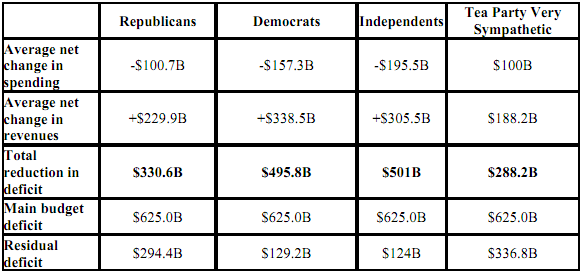
An innovative study has found that when a representative sample of the American public was presented the federal budget, they proposed changes far different from those the Obama administration or the Republican-led House have proposed.

The biggest difference in spending is that the public favored deep cuts in defense spending, while the administration and the House propose modest increases. However, the public also favored more spending on job training, education, and pollution control than did either the administration or the House. On average the public made a net reduction of $146 billion--far more than either the administration or the House called for.

While there were some partisan differences in the magnitude of spending changes, in two out of three cases average Republicans, Democrats and independents agreed on which items should be cut or increased.

The public also showed readiness to increase taxes by an average of $292 billion--again, far more than either the administration or the House.

"Clearly both the administration and the Republican-led House are out of step with the public's values and priorities in regard to the budget," comments Steven Kull, director of the Program for Public Consultation (PPC), which conducted the study. PPC is a joint program of the Center on Policy Attitudes and the School of Public Policy at the University of Maryland. Unlike in conventional polls, PPC consults with the public by presenting respondents with information on policy issues and a range of options to address them. In this case respondents were presented the discretionary budget, with descriptions of each program, and allowed to make changes.

On average, the public cut defense spending by 18%, reducing it by $109 billion. By contrast, the president's proposal increases defense spending by 4% and the House calls for increasing it 2%. For intelligence agencies the public cut 15%, while the administration says the agencies would grow, though at a slower pace.

The most dramatic differences were for job training and higher education. The public increased job training a whopping 130%, while the House cut it by a stark 47%. The administration nicked it 3%. For higher education, the House cut it 26%, the administration increased it 9% and the public increased it 92%.

Energy and the environment were also major areas of difference. The House bill cuts the Department of Energy's work on renewables and efficiency by 36%, while the administration increases it 44%. The public went even further, increasing it 110%. While the House cuts the EPA's budget by 39% and the administration cuts it by 13%, the public increased spending on pollution control by 17%.

The public cut the space program 17%, while neither the administration nor the House made significant changes. The administration made modest increases to science, as did the public (5%), but the House cut it by 12%.

The public cut spending for foreign aid that is meant to serve strategic purposes. Aid to countries "of strategic concern"--known as the Economic Support Fund--was cut a substantial 23% while military aid was cut 15%. The administration cut the Economic Support Fund 9% while the House cut it 6%, but neither made significant cuts to military aid.

For more altruistic forms of aid, on balance the public made little change--increasing humanitarian aid by 18%, cutting development assistance 14% and leaving spending on global health essentially unchanged. In the president's 2012 proposal, humanitarian assistance funding is cut 8%, while funding for global health gets an increase (11%) and so does development assistance (12%). In the House bill, humanitarian assistance is cut 17%, global health by 6% and development assistance by 18%.

The administration is calling for large scale increases to federal spending in highways (53%), air travel and roads (36%), and mass transit (109%). The House made a deep cut (27%) to mass transit. The public, meanwhile, makes modest cuts to highways (9%) and air travel and roads (7%), but leaves mass transit essentially unchanged.

For this analysis the changes the public made in the budget exercise were compared to the OMB projected budget for 2015, while those the administration made were in its 2012 budget proposal relative to the previous year. Changes by the House were based on the recently-passed changes to spending for 2011. (2011 spending is lower than 2015 projections but the distributions are very similar; thus comparisons of percentage changes are meaningful.)

Besides making changes to spending, respondents were presented a series of options for increasing revenue. On average respondents increased revenues by $292 billion. The largest portion was from income taxes: majorities increased taxes on incomes over $100,000 by 5% or more and increased them by 10% or more for incomes over $500,000. Majorities also increased corporate taxes and other excise taxes.

For the estate tax, a majority (77%) favored reverting at least to the 2009 levels, taxing estates over $3.5 million at a 45% rate. Only 15% of respondents supported the estate tax levels recently passed: taxing estates over $5 million at a 35% rate.

The Obama administration holds to its position that the Bush-era tax cuts for incomes above $250,000 should be allowed to expire, and now proposes this for after 2012. By 2015 this would generate $97.2 billion in revenues. The House leadership has so far not made any proposal to increase tax revenues and has favored making the Bush tax cuts permanent.

The public study was fielded December 18-29 with a sample of 793 respondents (margin of error plus or minus 3.5%). It was conducted using the web-enabled KnowledgePanel®, a probability-based panel designed to be representative of the U.S. population. Initially, participants are chosen scientifically by a random selection of telephone numbers and residential addresses. Persons in selected households are then invited by telephone or by mail to participate in the web-enabled KnowledgePanel®. For those who agree to participate, but do not already have Internet access, Knowledge Networks provides a laptop and ISP connection. More technical information is available at http://www.knowledgenetworks.com/ganp/reviewer-info.html.

----

Weep, you wealthy, for the miseries that are coming upon you. Your riches dissipate, and your garments become rage; your gold and silver are false, and their corrosion shall be a testimony against you, and shall eat your flesh as fire. You pursued earthly wealth with the last days of your lives. The wages of laborers, which have been fraudulently taken by you, cry out, and these cries of injustice have been heard by the Lord." - James 5:1-5
-----

"Buying physical silver is by far the greatest act of wisdom and rebellion any American can and should be doing right now. It is both a Silver Bullet to rebel against the Elite’s corrupt system and a Silver Shield to protect your family and wealth in a post- dollar world. Buying physical silver is non-violent, non-compliant resistance. Most importantly it works outside of the system and it cannot be stopped."

http://dont-tread-on.me/the-silver-bullet-and-the-silver-shield

-----

up until the last 200 years, the Gold/Silver ratio was 16:1

- 323 B.C. the ratio was 12.5:1 upon the death of Alexander the Great
- During the Roman Empire the ratio was set at 12:1
- 12th to 17th Century the ratio was around 12:1
- end of the 19th century, the universal,fixed ratio of 15:1 ended
- end of the 19th century, the bi-metallism era ended, England demonetized silver
- 1980 the last great surge in gold and silver, the ratio stood at 17:1
- 1991 silver hit its low, the ratio peaks at 100:1
- 2003 to 2007 bull market in silver drops ratio to 45:1 from 80:1
- 2008 end of the Great Recession, the ratio rises back to 80:1

Historical Recent
Low 12:1 80:1
High 100:1 45:1

Thursday, December 02, 2010

The Madness of a Lost Society


The Madness of a Lost Society


About a two and a half minutes or so in, the moderator says "this is going to hurt so many decent people who do not see this tidal wave coming."

That's why it's important. Consider yourself notified.

I can't help but think of the Chinese proverb (curse) "May you live in interesting times". I fear that we may. All that is transpiring the last couple of years and looking forward has an ominous, eerie "Through the Looking Glass" feel to it.

As always, I hope this ends well. I fear that it will not.

A gripping, in-depth SILVER interview with Writer & Economist Jeff Nielson of Bullionbullscanada.com

CONVERSATIONS 6.0 : Silver, Comex Default & QE2 - Part ONE


CONVERSATIONS 6.0 : Silver, Comex Default & QE2 - Part TWO


What to do, what to do? Put the power back in the people's hands, not the politicians. The politicians are bought and paid for by the banks and the Federal Reserve.

Do what the Dodd - Frank bill didn't do, make these guys play by the rules or pay a price.

They had their chance to do it their way and fix the problem.
They didn't do it.
It's our turn now.

Fight Back. Move your Money.

http://moveyourmoney.info/


Crash JP Morgan, Buy Silver.


Crash JP Morgan Buy Silver – Growing Economic Guerrilla War to Crash Bank With Silver Bullets
By Andrew Zarowny


http://www.rightpundits.com/?p=7681

Why do so many people want to crash J.P. Morgan-Chase Bank? Well, much of the angst stems from the office of JPM’s head of global commodities, Blythe Masters. She rose to power by pushing the creation of those nasty Credit Default Swaps. Remember them? Those CDS contracts that were used by banks like JPM and Goldman Sachs to make billions off of mortgage-back securities that were essentially worthless? They had a great deal to do with the economic Crash of 2008 and all of the misery that has since followed.


Who is behind this effort to crash J.P. Morgan-Chase? A whole lot of ‘little people’, as the head of BP would say. While not an official leader of the movement, my favorite financial guru, Max Keiser, is certainly among those advocating for this plan of assault. For years now, especially the past two, Max has been accusing the banking elite, such as JPM and Goldman Sachs, of ‘financial terrorism’. Indeed, the sudden collapse of Greece appears to be directly related to manipulation by Goldman Sachs. California, and other U.S. states, were largely enabled by banks like J.P. Morgan-Chase to run up massive deficits and become hostages, supported by the thinnest of financial threads.

Why use silver to crash J.P. Morgan? For years, JPM has been very active in manipulating commodities markets. Testimony by financial whistler-blower Andrew MacGuire points a finger directly at JPM for manipulating the silver market on the COMEX. The problem that JPM has is that they are vulnerable, as they have issued more contracts for silver futures than they have physical holdings. So, buy millions of ordinary people purchasing even small amounts of physical silver, which is in short supply, JPM will be unable to cover their positions.

While the Tea Party movement was successful in stopping the Progressives in Congress, and the White House, with their huge victories two weeks ago during the mid-term elections, there has been little done to reign-in the mega-banks of Wall Street. Obama’s financial reform bill only reinforces the bail-out system and handed more oversight authority to the Federal Reserve, another huge mistake.

Could the ‘Crash JP Morgan – Buy Silver’ movement succeed? Can a popular uprising of millions of ordinary people buying silver coins and bullion bars break one of the largest banks in the world? As world leaders wrapped up their G20 Summit and APEC meetings in Seoul and Yokohama, one thing is clear, they are not going to do much, if anything, to stop the ongoing financial chaos. Of anything, they’ll continue to fuel it. So, folks, it looks like it may be up to us to once again to roll up our sleeves and do the job ourselves. Stayed tuned as more developments follow.

Tuesday, November 16, 2010

SPEAKING WORDS OF WISDOM....


Time to Fight Back: Crash JP Morgan, Buy Silver!

http://ampedstatus.com/time-to-fight-back-crash-jp-morgan-buy-silver


Max Keiser has a plan…

Are you sick of being screwed over by Wall Street?

Now is the perfect time for us to get some revenge! A crack in the foundation has been exposed!

Buy Silver, Crash JP Morgan!

While JP Morgan has been busy illegally foreclosing upon American families, they have also been busy illegally manipulating the silver market. Whistleblowers have come forward with irrefutable evidence and RICO suits have been filed.

According to the National Inflation Association, JP Morgan is “short 30,000 silver contracts representing 150 million ounces of silver. This is one of the largest concentrated short positions in the history of all commodities, representing 31% of all open COMEX silver contracts.” This leaves JP Morgan exposed if people go out and buy physical silver in large numbers.

If we can bring the price of silver up to $50 per ounce, JP Morgan would lose $4 BILLION. Now is our chance to get some revenge! Let’s take a stand and bring down JP Morgan by buying silver!

Although I am not in any way an investment adviser, it’s seems to be a smart investment as the Federal Reserve is now committed to destroying the dollar as a matter of policy.

We are in an all out economic war. It’s time for you to start fighting back.


Expecting the world to treat you fairly because you are good, is like expecting the bull not to charge because you are a vegetarian. - Dennis Wholey


"The fundamental political question is why do people obey a government. The answer is that they tend to enslave themselves, to let themselves be governed by tyrants. Freedom from servitude comes not from violent action, but from the refusal to serve. Tyrants fall when the people withdraw their support." - ÉTIENNE DE LA BOÉTIE,1552

“Silence is better than unmeaning words.” - Pythagoras

“Everything has beauty, but not everyone sees it.” - Confucius


“Even a happy life cannot be without a measure of darkness, and the word happy would lose its meaning if it were not balanced by sadness. It is far better take things as they come along with patience and equanimity.” - Carl Jung

“The purpose of life is a life of purpose.” - Robert Byrne

“There is one quality which one must possess to win, and that is definiteness of purpose, the knowledge of what one wants, and a burning desire to possess it.” - Napoleon Hill

“When a finger points to the moon, the imbecile looks at the finger.” - Chinese Proverb

“Occasionally in life there are those moments of unutterable fulfillment which cannot be completely explained by those symbols called words. Their meanings can only be articulated by the inaudible language of the heart.” - Martin Luther King Jr.

from John Mauldin's InvestorsInsights.com Newsletter

Nearly a century ago, the great economist Ludwig von Mises observed that massive central bank easing is invariably a form of cowardice that attempts to avoid the need to restructure debt or correct fiscal deficits, avoiding wiser but more difficult choices by instead destroying the value of the currency.

Monday, November 08, 2010

Let's start listening to the 'kooks' more...the 'geniuses' got us in to this mess


The current Federal Reserve moguls returned to the scene of the crime this weekend -- Jekkyl Island, GA -- where plans for the Federal Reserve system were hatched one hundred years ago. In that time the value of the currency, which they are mandated to protect, has decreased nearly one hundred percent. As I have mentioned before, they are on pace to totally destroy the dollar -- to have it go from being worth less (two words) to worthless (one word) -- in another two or three years.

The only politician who seems to have a good grasp on what this means and what to do about it, Ron Paul.

RON PAUL CNBC INTERVIEW:


"I think the Fed will self-destruct. People will desert the dollar. I think the Chinese are hinting that already. They are not wanting our dollars as much as raw materials. This is a deeply flawed monetary system. Here we have a small group of people who can create $600 billion with the stroke of a pen... I don't know where people are coming from to think that this can work. What really astounds me me is how tolerant the people are, the people in Congress and the financial market, where did this authority come from? Now somebody outside of the government can spend trillions of dollars and not think anything about it. It doesn't work, it's a failure. And next year it will be more. Bernanke is very clear on what he is going to do - he is going to create money until he gets economic growth and there is no evidence to show that just creating money causes economic growth."


But he's the one who is branded by the major media outlets (on both sides) as a kook.

And he's the one who was branded by his fellow Republican's as a kook during the 2008 primaries.

They apparently should have been listening more closely to Mr. Paul than they did. Perhaps next time (2012), they will.

Perhaps more of the electorate will help them with their hearing and comprehension problems.

BTW, I know how he feels. I continue to burst out singing "Silver and Gold, silver and gold...." at random times throughout the day a lot more nowadays than I used to.


SILVER AND GOLD - AREN'T THEY JUST THE CUTEST THINGS??

I wonder why? Maybe because Gold crossed $1,400 today and Silver seems to be accelerating towards $30 an ounce.

It's funny that these two metals are also referred to as "honest money" but the signals that they are sending are somewhat "confusing" to the current Federal Reserve chairman.

I believe he knows exactly what kind of signal these two "honest money" markers are saying as he embarks on his quest to devalue the "dishonest money" - the dollar - that is under his stewardship. So liar, incompetent - you take your pick there Benny-boy. But history is going to put one of those labels on you, if not both, and they will stick.

Gold and Silver seem to be appreciating at a much more rapid rate than the assets (stocks, homes, commodities) that "Bubbles" Ben Bernanke seems to be trying so desperately to inflate.

I wonder why that is?

Hmmm......given the choice between "honest" and "dishonest" it confuses our intellectual genius of a Fed Chairman that people would choose honest over dishonest? WOW!!! That tells me something -- in rather unambiguous terms, no less -- about both Ben Bernanke and the monetary system that he currently oversees. Might be time for some SERIOUS reform in that area.

I suggest that the American people through their elected representatives -- help Benny with his listening and comprehension problem.

While we're at it, look at this:

Even our own Sarah Palin understands what is going on here. You go girl.

From the National Review:

Palin to Bernanke: ‘Cease and Desist’

http://www.nationalreview.com/corner/252715/palin-bernanke-cease-and-desist-robert-costa

Here are snippets from Palin’s prepared remarks obtained by National Review Online:

I’m deeply concerned about the Federal Reserve’s plans to buy up anywhere from $600 billion to as much as $1 trillion of government securities. The technical term for it is “quantitative easing.” It means our government is pumping money into the banking system by buying up treasury bonds. And where, you may ask, are we getting the money to pay for all this? We’re printing it out of thin air.

The Fed hopes doing this may buy us a little temporary economic growth by supplying banks with extra cash which they could then lend out to businesses. But it’s far from certain this will even work. After all, the problem isn’t that banks don’t have enough cash on hand – it’s that they don’t want to lend it out, because they don’t trust the current economic climate.

And if it doesn’t work, what do we do then? Print even more money? What’s the end game here? Where will all this money printing on an unprecedented scale take us? Do we have any guarantees that QE2 won’t be followed by QE3, 4, and 5, until eventually – inevitably – no one will want to buy our debt anymore? What happens if the Fed becomes not just the buyer of last resort, but the buyer of only resort?

All this pump priming will come at a serious price. And I mean that literally: everyone who ever goes out shopping for groceries knows that prices have risen significantly over the past year or so. Pump priming would push them even higher. And it’s not just groceries. Oil recently hit a six month high, at more than $87 a barrel. The weak dollar – a direct result of the Fed’s decision to dump more dollars onto the market – is pushing oil prices upwards. That’s like an extra tax on earnings. And the worst part of it: because the Obama White House refuses to open up our offshore and onshore oil reserves for exploration, most of that money will go directly to foreign regimes who don’t have America’s best interests at heart.

We shouldn’t be playing around with inflation. It’s not for nothing Reagan called it “as violent as a mugger, as frightening as an armed robber, and as deadly as a hit man.” The Fed’s pump priming addiction has got our small businesses running scared, and our allies worried. The German finance minister called the Fed’s proposals “clueless.” When Germany, a country that knows a thing or two about the dangers of inflation, warns us to think again, maybe it’s time for Chairman Bernanke to cease and desist. We don’t want temporary, artificial economic growth bought at the expense of permanently higher inflation which will erode the value of our incomes and our savings. We want a stable dollar combined with real economic reform. It’s the only way we can get our economy back on the right track.

Another kook according to the media.

Why does it seem to me -- and a growing number of people recently -- that a lot of the people that the media from both sides of the aisle seems to delight in portraying as 'out of the mainstream kooks' who have nothing to offer, are making the most sense?


VOTE THEM ALL OUT - THAT'S JUST GOOD ADVICE FOR THESE TRYING TIMES

If that doesn't work, Rinse, Lather, Repeat. Until we find some public servants who understand the meaning of the word "servant". I guess most of them understand the meaning of the word public, but I wouldn't mind them having to take a test to prove it. Maybe throw a question or two about the Constitution just to make them really squirm.

If that wasn't enough reason to like Ms. Palin here's 10 more from Doug Giles:

Why Palin Petrifies Progressives

Doug Giles

Here’s why I believe the dour democratic dames particularly dislike Palin. Check it out:

1. Palin’s hot and can rock a pair of heels, hunting boots, or any garment she dons. And you can tell she knows it and likes it. Most of the ladies on the Left, however, cannot—and we all know how jealous and petty some chicks can be when they’re aesthetically upstaged (cat fight).

2. They hate Sarah because she’s supposedly anti-intellectual. However, I’d love to see Tina Fey, Katie Couric or Joy Behag go mano a mano with her on any given topic and see who comes off looking like Snooki.

3. The feministas don’t dig SP because she’s had five kids (one of whom has Down’s Syndrome) and has never considered offing any of them in her womb.

4. She believes in the Father, the Son and the Holy Ghost, and they hate Christians.

5. She’s a conservative, and they hate conservatives.

6. She’s insanely successful, and she did it without curtsying to their wacked weltanschauung.

7. Her husband’s not some prissy, manicured metrosexual man-child but an ass kicking Alaskan.

8. She hunts and fishes. Her motto: Shoot it. Stuff it. Hang it on a wall, baby.

9. She’s unapologetic to all of the above.

10. And finally, they know that if she ever makes it to 1600 Pennsylvania Avenue that she’s going to hand the Dems their shriveled BB-sized cojones on a free market platter while the majority of the USA gives her a standing ovation.

And that, my children, is why Palin petrifies the paranormal progressives.

KEEP ON HATING, BITCHES!!!

I agree with the sentiments portrayed by this political cartoon. This woman virtually single-handedly raised the Republican Party from the grave, And we shall see how they repay her. My guess would be a knife in the back or a stick in the eye or some other such nonsense. Once they begin to believe that the people turned to them because of their own virtues.


That's why I would not mind seeing a Paul - Palin option out there in 2012. And if that means the Repubs don't win, or it siphons off votes, too bad. Maybe these kind of independent thinkers are what we need.

And if the Dems need to rehab some moderates like Evan Bayh, or one of my personal favorites from the past, Bill Bradley, then I think we would be making some real, positive change in our government.

How did guys like that get chased off the scene so rapidly? Hmmm......I wonder?


As I have said before, we are probably overdue for a Revolution in this country. Hopefully, this can be a peaceful one. Next election, let's put the 'kooks' in charge -- we can't do much worse.

Friday, October 08, 2010

END THE FED, NOW!!


THE FED'S DUAL MANDATE:

12 U.S.C. § 225a.
The Board of Governors of the Federal Reserve System and the Federal Open Market Committee shall maintain long run growth of the monetary and credit aggregates commensurate with the economy’s long run potential to increase production, so as to promote effectively the goals of maximum employment, stable prices, and moderate long-term interest rates.

HAVE THEY BEEN GOOD AT EFFECTIVELY PROMOTING MAXIMUM EMPLOYMENT? NO.

HOW ABOUT STABLE PRICES? NO AGAIN.

Could you stay in your job if you were as incompetent as these guys are? I don't think so.

These guys need to be replaced. Fired. And if they don't like it, take them off in handcuffs or chains. And bring back prisoner torture until they are tried and convicted for their thievery and economic mischief.

Because QE1 was such a rousing success, this week the Fed has let on that they are now considering a round of QE2. The hair of the dog that bit you to cure a hangover. Works every time. Fixes the hangover, does nothing for the underlying alcoholism.

Their twisted economic theory that says we should rob wealth from the poor, the elderly on fixed income, the savers to protect the bankers, Wall Street and the rich via the hidden stealth tax increase that is inflation. They are openly destroying the dollar to prop up asset prices.

But not the assets that the middle class owns, like their homes.

This is like a reversal of the Robin Hood economic theory of robbing from the rich to give to the poor. Bernanke believes the poor and the middle class should pay to protect the financial system. Just like his scum-bag acolytes like Charlie Munger and Warren Buffet.

The guys should all hang together. Literally.

Here is what the Fed has done to the value of the dollar in their 97 years at the helm. A 97% depreciation rate. At that rate, the dollar will not only be WORTH LESS (two words) in three more years, it may become WORTHLESS (one word).


The threat of QE2 was met with mixed reviews.

The best review I heard was that the Fed can print money, but they cannot figure out how to print jobs. In theory, if they were able to, they would have done so by now.

"When the Fed buys long-term government debt from the private market, it shifts interest rate risk from bondholders to taxpayers," Minneapolis Fed President Narayana Kocherlakota warned last week.

Philly Fed President, Charles Plosser agrees: "Asset purchases in our current economic environment can do little if anything to speed up the return to full employment," Plosser said in a speech last week. "Because I see little gain at this point, and some costs, I would prefer not to engage in further asset purchases at this time."

"We are following policies that unless changed will eventually lead to lots of inflation down the road," said Warren Buffett at Fortune’s Most Powerful Women Summit Tuesday. "We have started down a path you don’t want to go down."

Chicago Fed’s Charlie Evans disagrees (and he’s a voting member next year!) and said yesterday that he favors "much more [monetary] accommodation than we’ve put in place." MUCH MORE than $2Tn - take that Japan and your puny $500Bn pledge!


All the things we own, going down in value. Effectively being destroyed by these thugs.

All the things we pay for, food, fuel are going to go up in price. Commodities, the inputs for most of the things the middle class consumer needs, have skyrocketed on just the mention of another round of this failed Quantitative Easing policy.

Oil is heading back towards the $90-$100 a barrel level. Say hello to $5 / gallon gasoline.

Agricultural commodity prices have skyrocketed.

Don't worry we don't count oil and food costs in calculating CPI.

Our government is morally bankrupt as well as financially bankrupt.

The congress can no longer dip into the peoples wallet for Stimulus2 because:

a) we have elections and
b) the government is broke.


But the Federal Reserve is not elected, yet they have the future of the American economy in their hands.

Never mind what happened the last time Bernanke did this. He cranked up commodities through the same crap with the dollar and triggered the worst of the slowdown economically in terms of its impact on ordinary people, because energy and commodity prices ramped.


We keep making the same mistakes by repeating the same failed policies. Rinse, lather, repeat. The definition of insanity.

Piling more debt upon an already unsustainable amount of debt no longer works. The whole law of diminishing returns. Households know this, you can't get out of debt by paying your bills with a credit card.


Consumers are deleveraging, they are tired of being in debt. They are starting to understand those old-school phrases like "Neither a borrower nor a lender be" and "the borrower is a slave to the lender". Good for them.

They have daily experience with the inherent evils of "usury interest" whenever they open their credit card statements and are just now beginning to see why the system of "fractional reserve banking" is no longer magic. You can't create money out of thin air endlessly. The system collapses upon itself like a house of cards. Like a Ponzi scheme. They all unravel eventually once you run out of suckers and fools. And I think finally, American are tired of being played for fools.


Kevin Duffy of Bearing Asset Management described the process very well back in a 2007 article titled, 'IT'S A MAD, MAD, MAD, MAD WORLD' :

Yes, indeed it is.

Fractional reserve madness

The lure of easy money begins with the government printing press. First, the central banker buys an asset typically a government debt instrument writes a check on itself and deposits it into the banking system. Since the bank never "redeems" the check, this is equivalent to creating money out of thin air. The banker, happy to receive fresh "reserves", loans out all but a sliver. This new money ends up back with the banks, is counted again as reserves, mostly lent out, and so on and so on.

Through this process of fractional reserve banking, credit is expanded at a multiple of the initial central bank deposit. Through such a system, the creation of money and credit (the promise to pay money) looks like an upside-down pyramid - essentially a pyramid scheme on top of a counterfeiting operation.

As James Grant has counseled, the inflation process gives a finite pool of capital the illusion of an endless sea of liquidity, in effect "turning all the traffic lights green."

Such a scheme is a concoction of government privilege (or mercantilism), not laissez faire. The so-called "capitalists" are no longer efficient allocators of capital to its most productive uses, but beneficiaries of and cheerleaders for a monetary fraud in which capital is debased, taken for granted, abused. As long as they remain chummy with their friendly liquidity provider of last resort, they can act recklessly without fear of igniting an economic forest fire or if they do, without fear of having to bear the costs. And as long as the value of their collateral is constantly inflated, they never feel the need to worry about default.

Liberated from the gold standard straightjacket, the system has few restraints. For starters, the counterfeiter has an incentive not to draw attention to his racket. But the effectiveness of his ongoing propaganda campaign has weakened this deterrent. The real inflationary action, however, is in credit expansion. For example, in the last 6 years, the Federal Reserve has grown its balance sheet less than $300 billion while the nation's money supply has expanded by $4.3 trillion, or 14 times as much. In other words, the central banker can bait the hook, but lenders and borrowers still have to take the bait.

This new money is never evenly distributed, but instead gets funneled into whatever narrow area happens to capture the public's fascination. As prices and valuations soar, greater doses of credit are required to keep the game going. Either more marginal borrowers are drawn in at ever more precarious levels or greater leverage must be applied to existing borrowers. This is what ultimately doomed the housing bubble. In the end, nearly anyone who could fog a mirror was getting an invitation to join the party.

The trouble with pyramid schemes is that they're not designed to go in reverse. Eventually, the number of willing dupes is exhausted. The same people who panicked late to get into the game are just as likely to panic when the music stops. The longer the music plays, the more leveraged and unstable the inverted credit pyramid becomes. As the late economist Hyman Minsky observed, "stability is unstable."


I love these two analogies of the fallacy of QE2 from Richard Koo, the Chief Economist of Nomura Research Institute:

In describing the negligence of such monetary policy Richard Koo uses the analogy of a doctor who simply tells his patient to take more of the same medicine he originally prescribed:

“At the risk of belabouring the obvious, imagine a patient in the hospital who takes a drug prescribed by her doctor, but does not react as the doctor expected and, more importantly, does not get better. When she reports back to the doctor, he tells her to double the dosage. But this does not help either. So he orders her to take four times, eight times, and finally a hundred times the original dosage. All to no avail. Under these circumstances, any normal human being would come to the conclusion that the doctor’s original diagnosis was wrong, and that the patient suffered from a different disease. But today’s macroeconomics assumes that private sector firms are maximizing profits at all times, meaning that given a low enough interest rate, they should be willing to borrow money to invest.. In reality, however, borrowers – not lenders, as argued by academic economists – were the primary bottleneck in Japan’s Great Recession.”

Dr. Bernanke has misdiagnosed this illness one too many times. At what point does someone tell him to put the scalpel down and step away from the table before he does even greater harm?

Koo describes the failure of QE1 as a tool to promote economic recovery in the following. Mr. Koo is keenly aware of the the experience of a Quantatative Easing strategy as it has been applied in Japan for the last decade or more. It has been roundly noted as a dismal failure.

Koo goes a step further in describing the failure of QE to promote private sector recovery.

“The central bank’s implementation of QE at a time of zero interest rates was similar to a shopkeeper who, unable to sell more than 100 apples a day at $100 each, tries stocking the shelves with 1,000 apples, and when that has no effect, adds another 1,000. As long as the price remains the same, there is no reason consumer behavior should change–sales will remain stuck at about 100 even if the shopkeeper puts 3,000 apples on display. This is essentially the story of QE, which not only failed to bring about economic recovery, but also failed to stop asset prices from falling well into 2003.”

This mea culpa came from Ambrose Evans-Pritchard of the Telegraph (UK):

http://blogs.telegraph.co.uk/finance/ambroseevans-pritchard/100007777/shut-down-the-fed-part-ii/

I apologise to readers around the world for having defended the emergency stimulus policies of the US Federal Reserve, and for arguing like an imbecile naif that the Fed would not succumb to drug addiction, political abuse, and mad intoxicated debauchery, once it began taking its first shots of quantitative easing.

My pathetic assumption was that Ben Bernanke would deploy further QE only to stave off DEFLATION, not to create INFLATION. If the Federal Open Market Committee cannot see the difference, God help America.

We now learn from last week’s minutes that the Fed is willing “to provide additional accommodation if needed to … return inflation, over time, to levels consistent with its mandate.”

Ben Bernanke has not only refused to abandon his idee fixe of an “inflation target”, a key cause of the global central banking catastrophe of the last twenty years (because it can and did allow asset booms to run amok, and let credit levels reach dangerous extremes).
Worse still, he seems determined to print trillions of emergency stimulus without commensurate emergency justification to test his Princeton theories, which by the way are as old as the hills. Keynes ridiculed the “tyranny of the general price level” in the early 1930s, and quite rightly so. Bernanke is reviving a doctrine that was already shown to be bunk eighty years ago.

and this

So all those hillsmen in Idaho, with their Colt 45s and boxes of krugerrands, who sent furious emails to the Telegraph accusing me of defending a hyperinflating establishment cabal were right all along. The Fed is indeed out of control.

The sophisticates at banking conferences in London, Frankfurt, and New York who aplogized for this primitive monetary creationsim – as I did – are the ones who lost the plot.
My apologies. Mercy, for I have sinned against sound money, and therefore against sound politics.

Fed is trying to conjure away the hangover from the last binge (which Greenspan/Bernanke caused, let us not forget), as if to vindicate its prior claim that you can always clean up painlessly after asset bubbles.

Are the Chinese right? Are the Americans and the British now so decadent that they will refuse to take their punishment, opting to default on their debts by stealth?

It does seem as if the Euro is being rewarded for taking their governments and Central Bank taking the path of fiscal austerity and sound monetary policy. At least for now. I don't see how intentionally torching your currency can be the answer to what ails the American economy. And it is not worth the costs it will impose on the poor and those who saved and invested prudently. Profligate spenders and gamblers are being protected and rewarded.

So we have these Fed idiots disguised as experts, protecting their own special interest under the guise of protecting the middle class. I call BS on that one. They don't give a rats fat ass about the middle class. None of them.

And as the Obama administration continues to hemorrhage economic advisers, I can only advise the President to consider taking the term "heads are going to roll" more literally Romer, Orzag, Emmanuel (not an eco advisor) and Lawrence Summers have all beat a hasty retreat.

To be followed soon by the incompetent, criminal Secretary of Treasury Geithner. Hopefully, no later than the soon after the elections. He doesn't have the confidence of this country's business community, the international community, heck he doesn't get respect around Chinese school children. That should have told you all you needed to know about old Turbo Timmy. And he calls the Chinese currency manipulators when the Federal Reserve is doing it's own brand of manipulation.


This from the blog The Economic Collapse:

http://theeconomiccollapseblog.com/archives/federal-reserve-officials-americans-are-saving-too-much-money-so-we-need-to-purposely-generate-more-inflation-to-get-them-spending-again

Does increasing inflation as a way to stimulate the economy sound like a good idea to any of you?

These are supposed to be some of the brightest economic minds that our nation has produced.

Unfortunately, it is becoming increasingly apparent that the folks running the Federal Reserve do not have a clue about sound economic policy.

Anyone who lived through the "stagflation" days of the 1970s should know that inflation does not spur economic growth.

But now some of the most prominent Fed officials are publicly proposing that we should purposely generate more inflation so that "real interest rates" (interest rates with inflation factored in) will go down.

For example, during a recent interview the president of the Federal Reserve Bank of Chicago, Charles Evans, made the following statement....

"It seems to me if we could somehow get lower real interest rates so that the amount of excess savings that is taking place relative to investment needs is lowered, that would be one channel for stimulating the economy."

If you truly grasp what Evans is proposing here, your jaw should be dropping.

He is basically coming right out and saying, "Hey, let's go out and crank up the inflation rate so that American consumers will start recklessly spending their money again."

So are Americans really saving too much money?

Of course not.

Just take a look at the chart below.

Americans are actually still saving far, far less than they used to. As you can see from the chart, in the 1960s and 1970s Americans would usually save somewhere between 8 to 12 percent of their incomes.

Today, we are still well below that level. But we have made some progress from the reckless days of five to ten years ago when Americans were living far, far, far beyond their means and basically saving next to nothing....
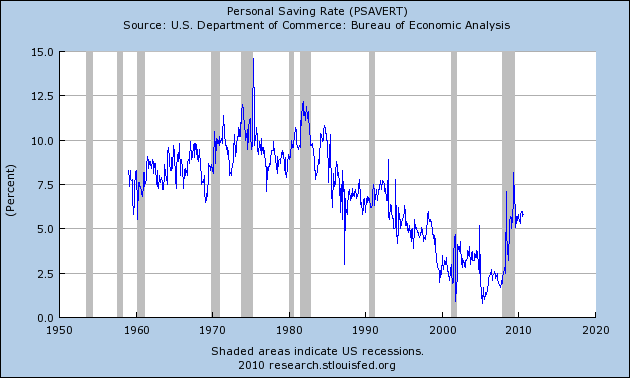


So now some top Fed officials want to undo all that. They apparently want Americans to grab their credit cards and to run out to the stores and spend wildly like they did a few years ago.

But spending recklessly is not going to repair our economy. In order to have a healthy, balanced economy you need to have a healthy personal saving rate. Encouraging Americans to spend every last nickel they have may boost economic figures in the short-term, but it will make our long-term problems even worse.

These guys need to get it together rather quickly before there's Revolution in this country.


Hopefully, it's a peaceful one.


Giants Top Minor League Prospects

  • 1. Joey Bart 6-2, 215 C Power arm and a power bat, playing a premium defensive position. Good catch and throw skills.
  • 2. Heliot Ramos 6-2, 185 OF Potential high-ceiling player the Giants have been looking for. Great bat speed, early returns were impressive.
  • 3. Chris Shaw 6-3. 230 1B Lefty power bat, limited defensively to 1B, Matt Adams comp?
  • 4. Tyler Beede 6-4, 215 RHP from Vanderbilt projects as top of the rotation starter when he works out his command/control issues. When he misses, he misses by a bunch.
  • 5. Stephen Duggar 6-1, 170 CF Another toolsy, under-achieving OF in the Gary Brown mold, hoping for better results.
  • 6. Sandro Fabian 6-0, 180 OF Dominican signee from 2014, shows some pop in his bat. Below average arm and lack of speed should push him towards LF.
  • 7. Aramis Garcia 6-2, 220 C from Florida INTL projects as a good bat behind the dish with enough defensive skill to play there long-term
  • 8. Heath Quinn 6-2, 190 OF Strong hitter, makes contact with improving approach at the plate. Returns from hamate bone injury.
  • 9. Garrett Williams 6-1, 205 LHP Former Oklahoma standout, Giants prototype, low-ceiling, high-floor prospect.
  • 10. Shaun Anderson 6-4, 225 RHP Large frame, 3.36 K/BB rate. Can start or relieve
  • 11. Jacob Gonzalez 6-3, 190 3B Good pedigree, impressive bat for HS prospect.
  • 12. Seth Corry 6-2 195 LHP Highly regard HS pick. Was mentioned as possible chip in high profile trades.
  • 13. C.J. Hinojosa 5-10, 175 SS Scrappy IF prospect in the mold of Kelby Tomlinson, just gets it done.
  • 14. Garett Cave 6-4, 200 RHP He misses a lot of bats and at times, the plate. 13 K/9 an 5 B/9. Wild thing.

2019 MLB Draft - Top HS Draft Prospects

  • 1. Bobby Witt, Jr. 6-1,185 SS Colleyville Heritage HS (TX) Oklahoma commit. Outstanding defensive SS who can hit. 6.4 speed in 60 yd. Touched 97 on mound. Son of former major leaguer. Five tool potential.
  • 2. Riley Greene 6-2, 190 OF Haggerty HS (FL) Florida commit.Best HS hitting prospect. LH bat with good eye, plate discipline and developing power.
  • 3. C.J. Abrams 6-2, 180 SS Blessed Trinity HS (GA) High-ceiling athlete. 70 speed with plus arm. Hitting needs to develop as he matures. Alabama commit.
  • 4. Reece Hinds 6-4, 210 SS Niceville HS (FL) Power bat, committed to LSU. Plus arm, solid enough bat to move to 3B down the road. 98MPH arm.
  • 5. Daniel Espino 6-3, 200 RHP Georgia Premier Academy (GA) LSU commit. Touches 98 on FB with wipe out SL.

2019 MLB Draft - Top College Draft Prospects

  • 1. Adley Rutschman C Oregon State Plus defender with great arm. Excellent receiver plus a switch hitter with some pop in the bat.
  • 2. Shea Langliers C Baylor Excelent throw and catch skills with good pop time. Quick bat, uses all fields approach with some pop.
  • 3. Zack Thompson 6-2 LHP Kentucky Missed time with an elbow issue. FB up to 95 with plenty of secondary stuff.
  • 4. Matt Wallner 6-5 OF Southern Miss Run producing bat plus mid to upper 90's FB closer. Power bat from the left side, athletic for size.
  • 5. Nick Lodolo LHP TCU Tall LHP, 95MPH FB and solid breaking stuff.