Showing posts with label EARLY PHYSICAL MATURERS. Show all posts

Wednesday, May 10, 2017

Survival of the fittest or survival of talent | footblogball


PYRAMID
Survival of the fittest or survival of talent | footblogball
Fantastic article.


Survival of the fittest or survival of talent

The optical illusion that is early talent identification and the selection philosophy of district teams

According to Darwin's theory of evolution organisms which are better adapted to their environment tend to survive longer. Does the environment we create influence the selection process and favor those that possess attributes that give them a temporary advantage while at the same time disqualifying those who at that moment in time are struggling to adapt?  Adaptive behavior is key to the survival of the human race and specific to soccer, a trait of high quality players. However if the early environment supports only temporary adapting systems ( in this case the young player) then those that are better equipt to adapt in the long run may well be lost to us forever.

Are some systems and structures just counterproductive ideologies that that are in conflict with development (learning & biopsychosocial) and the young player's natural learning process? We should of course remember that struggle is also part of the learning process. What are we doing to help players overcome those struggles that will appear during their development (non-linear)?

The Standard Model of Talent Identification
( Bailey, R.P: & Collins, D. The Standard Model of Talent Development and its

Discontents, Kinesiology Review, 2, 248-259)

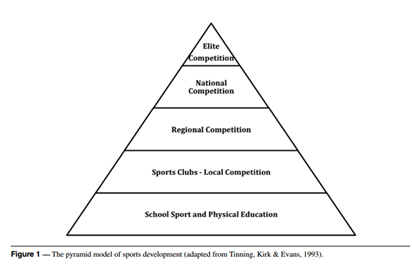
In a recent paper, Bailey and Collins introduce one of the most common models used in talent identification, the Standard Model of Talent Development (SMTD)

This is a pyramid structure that is based on erroneous presumptions.
  1. Development and performance are essentially linear.
  2. Early ability that is identified as talent indicates future ability and performance.
The selection process is done at the cost of the wider group where focus is placed on those who have been identified as talented ( Bailey, R.P: & Collins, D. The Standard Model of Talent Development and its Discontents, Kinesiology Review, 2, 248-259)

Selection: Based on current performance. Identify those as talented as early as possible.

Early specialization is deemed necessary to reach elite performance level in the future.

Early performance and ability is necessary for success in the future.

De-selection: Hard to return to the system. Questionable selection criteria (often based on early physical characteristics)
PYRAMID

District team selection often begins at the age of 13/14 and is part of this pyramid. Its influence is felt years before the actual selection process. I recently spoke with a Swedish U17 youth international who said that this process can create and feed a stressful environment. Over a year before the district team selection, every day at school, at training, on social media each match or training performance was put under the microscope of analysis. "How did you play? How did I play?  As well as being physically tired you would be mentally tired as well". The player went on to say "I was lucky because I had an external support structure, family and good adult mentors that really helped me, I don't know how I would have coped otherwise". Competition, failure and struggle are of course part of the sporting experience. They don't have to be negative experiences for children. The problems occur when it is all based on adult demands and values. These adult demands and values are appearing earlier and earlier in our sporting structures. The adult and the child, do they have the same motives?

There is no convincing evidence that most sports require an early investment of training in one activity. In fact, what evidence is available suggests that across a number of eventual elite players, early specialization is negatively correlated with eventual success (Gullich, 2011).

In the paper In the paper The Standard Model of Talent Development and Its Discontents (Bailey, R.P; & Collins, D. ) It is suggested that  "the apparent success of the SMTD is ultimately an optical illusion as there is no way of knowing who might have succeeded through different systems, and who were de-selected from the system but might have (under different circumstances) gone on to achieve high performance".

The paper goes on to suggest risks associated with ill-focused of incorrectly administered pyramids.
  1. Early adult like training can lead to over-use injuries. There is a particular high risk associated with intensive training during maturation.
  2. Early intensive training can lead to psychological problems. This can lead to drop out and burnout
Development is non-linear, learning is non-linear. Therefore talent is non-linear
Judging early performance during the formative years does have its problems. This is true especially when judging and identifying something that is non-linear using what is essentially a linear model.
  1. Miss out on identifying other factors that are associated with talent ( soft skills such as decision making, communication, awareness)
  2. Often fails to recognize potential due to a focus on the performance now.
  3. Many pyramid structures based on early talent identification discriminate against those born later in the sporting calendar year.
  4. Size and strength factors that are identified early contribute to a temporary advantage resulting in short term superior performance. This all evens out after maturity. There is a risk that the player has been used for his temporary advantage (to win) and has not actually learned the game. This player will struggle when growth evens out when maturity is attained.
  5. Questionable accuracy with regard to measurement of ability, often affected by gender, ethnicity or socioeconomic background.
Are we judging biological maturation or talent?
Dutch Soccer coach Raymond Verheijen has presented data under the title "Growth spurt study in Dutch Youth Academy soccer". A 12 year study that included 36 professional clubs was carried out in Holland between the years 1997-2009. An analysis of a data base of over 10,000 players was carried out where factors such as height, weight, injuries and date of birth were taken in to consideration. The general idea was that month of birth should have no influence on talent. At the beginning of the study the Dutch schoolboy national teams were selected from August to July. Most players were born in the period August to October (43%) while only 10% of the players were born May-July. This phenomenon is often referred to as the Relative Age Effect (RAE).

Relative age effect (RAE): A bias that seems to favor a higher participation rate amongst those that are born early in the selection period).

Hancock, Adler, & Cote in a study from 2013 suggested that RAE is more than just a physical advantage. The research suggested that there are also some powerful social influences at play.
  1. Parents (Matthew effect) – The rich get richer. Those who are perceived to have ability are given preferential treatment and extra support. This in turn increases that ability which leads to more support.
  2. Coach (Pygmalion effect) – The higher the expectation placed on people the better is their performance. Those who are perceived to have ability are given more attention. Others feel neglected.
  3. Athletes (Galatea effect) – A player may see that she is able to perform better than her peers. This performance can be due to due to early maturation A players opinion about her ability and his self-expectations about her performance largely determine the performance.
During this study the Dutch FA changed the cut-off date for its national youth teams to the Jan-Dec period. The RAE adjusted accordingly. It seemed that the scouting system was primarily based on how old the player was as opposed to how talented that player is or could be. Countries with small populations have a relatively small player pool.

Focusing on winning during the early stages of development just encourages the RAE, in turn making the player pool even smaller. It becomes more about the survival of the fittest as opposed to survival of talent.

The various traits slowly appear and differentiate over time….. infancy, adolescence, and even adulthood will see the latent components undergoing various transformations (Simonton,1999,p442)

In the research paper "Swedish soccer is searching for talent but finding age" Tomas Peterson says why players are chosen in accordance with their physical development is not known "but one may assume that there is a silent agenda dictating that these players will be the most successful in the forthcoming selection steps" from club to district team to national youth team. The material and data collected "indicates that selection on the grounds of physical development is already at work in groups of 5-12 year olds and " and the effect of this process is very clear when these children reach 13 and enter an even harder selection process. It is Tomas Petersons opinion that this is counter- productive to the development "of all the football talent that exists within every yearly cohort of girls and boys. I also believe that its goes against the goals of both the sports movement and the community in general".


Many current methods of focusing on early indicators of talent are very static and linear approaches. They ignore the fact that development is individual and that differences in performance can be explained by differences in maturation. Coaches that judge early talent evaluate and focus on the contemporary level of performance where physical characteristics are fundamental factors in the talent identification process. This brings to the surface three fundamental problems that need to be addressed with early talent ID.
  1. Coaches gamble on the wrong players- (misuse of resources)
  2. Miss out on those with more long term potential
  3. Environment problem (development of a non-inclusive environment. No clear pathway back in to the system)
If we want to keep players viable over what is essentially a long, complex and sensitive development process then the aim should be to keep as many as possible as long as possible active within our sporting organization. What are we doing to help certain players overcome struggles that will appear during their development (non-linear)? What role does the environment play in creating these struggles?  We should remember that failure and struggle is also part of the learning process. Our environment should be a place where these failures and struggles can be met head on and dealt with through patience, encouragement, understanding and support.

Does the environment we create influence the selection process and favor those that possess attributes that give them a temporary advantage while at the same time disqualifying those who at that moment in time are struggling to adapt?


Sent from my iPhone

Wednesday, August 26, 2009

Little League World Series is flirtin' with disaster, y'all


OK, I promised myself that this year I would not say anything negative about the Little League World Series. But I lied. I love the event, it still represents a slice of Americana, but there are some things I cannot watch much longer without venting.

First, the obligatory messages that you see EVERY broadcast, bar none. This wasn't quite so annoying when there was only ONE broadcast per year, but now that the LLWS looks more like March Madness, these messages have got to be scaled back somewhat.

1) The umpires are volunteers, they pay their own way here.
This message is usually delivered immediately after a retched safe/out call or a ball/strike call that Ray Charles would not miss. I'd pay some of these guys one-way ticket back home. Listen, these guys are supposed to be the creme de la creme of Little League umpires. It's not too much to ask that they appear to know what they are doing. Do your Leslie Nielsen, strikeout looking, punch out dance on the THIRD strike fellas. And this is after repeatedly looking at the indicator to check the count. It's not that hard to keep track in your head guys.

And if the field is 2/3 the size of a major league field, why do we need the same amount of umpires to cover it? Seems like four would be plenty. Most of these guys have probably rarely worked with ONE partner, much less FIVE others. And a one week or two week crash course is not going to get these guys up to speed in time.

2) The major leaguers are watching the LLWS in clubhouses across the country.
This is a bit of a tip of the cap and some needed good PR for ESPN's other corporate partner--Major League Baseball. I doubt too many guys are watching too strenuously when 75% of the time, they are playing at the same time. Oh, exception noted for the Cubs and White Sox, who are mandated by their coaches to watch the games in order to pick up base-running tips to improve their game.

3) The must play rule is the greatest thing since sliced bread.
No, it's not. It gives an advantage to the teams/leagues that carry less players on the roster. Unless they are mandating and enforcing that everyone actually has the same roster size coming into the game, there is an inequity that is being ignored.

4) The pitch count is the second greatest thing since sliced bread.
No, it's not. Unless you are also going to mandate that these kids do not throw curve-ball after curve-ball--ad nauseum--to say nothing of the slop-slider these kids twist off. I can't get through a single game without severe pain and inflammation in my elbow. And I'm just watching these kids throw.

To have the pitch count rule in place without doing anything to address breaking balls--I don't think you've made the world a much safer place for youth pitchers nationwide. And the continually mounting pitching injury statistics bear that out.

5) Which dovetails rather nicely into my next rant. Pitcher safety.
Having pitch counts will not be a salve to the wound that Little League Baseball and youth baseball in general will suffer when one of these pitchers takes a come backer to the face or head on national TV. To say nothing of the damage done if one of these calendar year 13 year-olds delivers a pitch to a late 11-early 12 year old batter.

The CA team's lineup last night went back-to-back with the 6-foot, 170 pound "Little" Leaguer and another good sized kid with a "Major" League swing. If he connected he could easily take out the 3B or pitcher with a rocket line drive.

One of the CA batters, after swinging at a third strike in the dirt that got past the catcher, TOOK OFF FOR FIRST BASE!! Do you know why he might have done that??? My guess is because he plays in a league or a travel team where they are ALLOWED to take off on a dropped third strike by rule. Granted, PONY does that and some 12 year-old travel leagues do, but my guess is that a lot of these 13 year-olds have played on the bigger field before.

We all marveled at Danny Almonte a couple of years ago until we learned that he was too good (too old) to be true. But was he such a phenom that LL or ESPN figured that people enjoyed watching the level of competence a 13-14 year old could provide and tried to increase the numbers by backing up the birth date eligibility to allow for it to happen more frequently?

We used to joke about kids who were big enough to have driven the team bus, but some of these kids look like they could actually LIFT the team bus.

It's all fun and games until someone gets hurt guys.

There is a lot of chatter about birth dates and it's effect on advancement and development throughout the major sports as well as other important elements of kids lives, such as education. And while the data is difficult to dismiss outright, I think a larger factor I see at work in these games is what Dr. Mike Marshall used to refer to as the LLWS being a Tournament of Accelerated Maturers.

If I remember right, we vacated a world championship won by the Philippines some years back after it was discovered that the team was stacked with 15-16 year-old kids. While that team was advanced physically, they were not that much bigger than a "normal" 12 year-old. And granted, there is a great range of size at this level, but the 14-15 year-olds would have more repetitions and greater overall skill development which that would deliver. It's a game of repetition and as a former colleague used to tell me "Charlie, you cannot teach BIG."

I hope these guys don't have such a party on the ratings bonanza (read money) that has accrued to both LL and ESPN from this expansion. Expanding the number of teams that play to promote the game is one thing, but expanding the talent pool to shoehorn borderline HS players into a kiddie pool is not pretty. To say nothing about how it endangers the safety of the players on the "short" end of the gene pool.

And I hope some poor kid never sacrifices his health and safety before the adults realize they have pushed the envelope too far.

P.S. - One more suggestion guys. The teams from "Saudi Arabia" and "Germany" that are in reality U.S. military base teams probably do nothing to promote the game internationally. The Middle East team should truly represent the Middle East, not the U.S. Same with the European representative.

If Little League isn't big enough in these countries that they are not able to field a team capable of getting out of their local pool maybe they should be handicapped as in golf and bowling and allowed to pull players from a wider radius than in the U.S. Maybe base it on population density or something and adjust it annually until these guys catch up.

And if you miss one year on the formula and one of these teams actually wins the title one year, so what. I MEAN, SO WHAT!!! Wouldn't that do more to promote the sport internationally at this level than almost anything else Little League can do? I mean some of these countries must be growing weary of being cannon fodder for the U.S.A. to trample over all the time.

Or throw all the team in the Final Four or Final Eight or whatever into one pool and play single-elimination from there. It's not really a "level playing field" when the International field is stacked with two or three championship caliber talent and only one team gets through to play a U.S. team that had to stretch to maybe win one game to get to the finale. The American team year after year seems to be able to set up it's pitching to win the tournament, while the World teams have to play hard every game just to get to the Final.

I would still watch a Japan-Curacao WS final.

Just a thought.
Giants Top Minor League Prospects

  • 1. Joey Bart 6-2, 215 C Power arm and a power bat, playing a premium defensive position. Good catch and throw skills.
  • 2. Heliot Ramos 6-2, 185 OF Potential high-ceiling player the Giants have been looking for. Great bat speed, early returns were impressive.
  • 3. Chris Shaw 6-3. 230 1B Lefty power bat, limited defensively to 1B, Matt Adams comp?
  • 4. Tyler Beede 6-4, 215 RHP from Vanderbilt projects as top of the rotation starter when he works out his command/control issues. When he misses, he misses by a bunch.
  • 5. Stephen Duggar 6-1, 170 CF Another toolsy, under-achieving OF in the Gary Brown mold, hoping for better results.
  • 6. Sandro Fabian 6-0, 180 OF Dominican signee from 2014, shows some pop in his bat. Below average arm and lack of speed should push him towards LF.
  • 7. Aramis Garcia 6-2, 220 C from Florida INTL projects as a good bat behind the dish with enough defensive skill to play there long-term
  • 8. Heath Quinn 6-2, 190 OF Strong hitter, makes contact with improving approach at the plate. Returns from hamate bone injury.
  • 9. Garrett Williams 6-1, 205 LHP Former Oklahoma standout, Giants prototype, low-ceiling, high-floor prospect.
  • 10. Shaun Anderson 6-4, 225 RHP Large frame, 3.36 K/BB rate. Can start or relieve
  • 11. Jacob Gonzalez 6-3, 190 3B Good pedigree, impressive bat for HS prospect.
  • 12. Seth Corry 6-2 195 LHP Highly regard HS pick. Was mentioned as possible chip in high profile trades.
  • 13. C.J. Hinojosa 5-10, 175 SS Scrappy IF prospect in the mold of Kelby Tomlinson, just gets it done.
  • 14. Garett Cave 6-4, 200 RHP He misses a lot of bats and at times, the plate. 13 K/9 an 5 B/9. Wild thing.

2019 MLB Draft - Top HS Draft Prospects

  • 1. Bobby Witt, Jr. 6-1,185 SS Colleyville Heritage HS (TX) Oklahoma commit. Outstanding defensive SS who can hit. 6.4 speed in 60 yd. Touched 97 on mound. Son of former major leaguer. Five tool potential.
  • 2. Riley Greene 6-2, 190 OF Haggerty HS (FL) Florida commit.Best HS hitting prospect. LH bat with good eye, plate discipline and developing power.
  • 3. C.J. Abrams 6-2, 180 SS Blessed Trinity HS (GA) High-ceiling athlete. 70 speed with plus arm. Hitting needs to develop as he matures. Alabama commit.
  • 4. Reece Hinds 6-4, 210 SS Niceville HS (FL) Power bat, committed to LSU. Plus arm, solid enough bat to move to 3B down the road. 98MPH arm.
  • 5. Daniel Espino 6-3, 200 RHP Georgia Premier Academy (GA) LSU commit. Touches 98 on FB with wipe out SL.

2019 MLB Draft - Top College Draft Prospects

  • 1. Adley Rutschman C Oregon State Plus defender with great arm. Excellent receiver plus a switch hitter with some pop in the bat.
  • 2. Shea Langliers C Baylor Excelent throw and catch skills with good pop time. Quick bat, uses all fields approach with some pop.
  • 3. Zack Thompson 6-2 LHP Kentucky Missed time with an elbow issue. FB up to 95 with plenty of secondary stuff.
  • 4. Matt Wallner 6-5 OF Southern Miss Run producing bat plus mid to upper 90's FB closer. Power bat from the left side, athletic for size.
  • 5. Nick Lodolo LHP TCU Tall LHP, 95MPH FB and solid breaking stuff.