Showing posts with label CULTURE OF THE GAME. Show all posts

Saturday, August 18, 2018

Does Absence of Athletic Trainers Constitute Negligence? - Athletic Business

Does Absence of Athletic Trainers Constitute Negligence? - Athletic Business


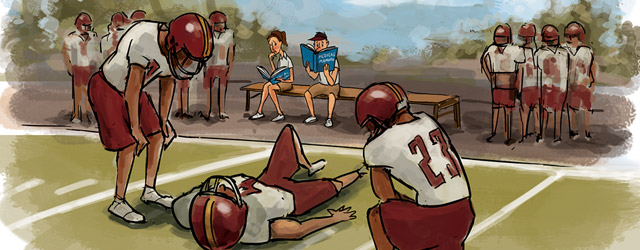
[Illustration by Arnel Reynon]

JACKSONVILLE - It seems like with what we know about the risks inherent in participation in football that this a really silly question to ask. Of course it does. Schools and programs at every level are weighing the economics versus the risks and shamefully are trying to save nickels and dimes while risking the long-term health of kids. 

The fact that the justice system is not stepping in makes the story even more reprehensible. And then we wonder why stories like the loss of life at the University of Maryland's football program happens to say nothing of the overall "toxic culture" that was mentioned there and elsewhere. You can make the argument that all of the toxic stories we hear about in college athletics recently including Michigan State and Penn State earlier, emanate from a system that values nickels and dimes over the health (physical, mental, emotional) of kids. 

Kids are not a commodity. We have to stop treating them as cogs in a machine.

from athleticbusiness.com
https://www.athleticbusiness.com/athlete-safety/does-absence-of-athletic-trainers-constitute-negligence.html

Does Absence of Athletic Trainers Constitute Negligence?


Intercollegiate football is an exciting but violent sport. A school can employ qualified coaches and medical personnel, and use injury waivers to protect itself from liability. However, failure to meet industry standards for student-athlete care will likely bring litigation in the event a player sues over treatment of injuries suffered on the field. This is evident in the ongoing case of Feleccia v. Lackawanna College, 156 A. 3d 1200 – Pa: Superior Court 2017.

The injuries On March 29, 2010, Augustus (Gus) Feleccia and Justin T. Resch participated in a tackling drill during the first day of spring football practice at Lackawanna Junior College in Pennsylvania. Both players were injured during a variation of the Oklahoma drill, during which an offensive player is isolated against a defensive player in a confined space. The offensive player tries to run past the defensive player without being tackled.
The Oklahoma drill is recognized as one of the most violent practice drills, especially the variation used by Lackawanna. This drill emphasizes proper pad level and ball security for the offensive player, and proper block shedding and tackling technique for the defensive player, but often results in a vicious collision.
While involved in this drill, Resch attempted a tackle with his head down and suffered a T-7 vertebral fracture. Normally the football program would have two certified athletic trainers assigned to its practices. However, this session had two non-certified "first responders" instead. Resch was evaluated by a Lackawanna first responder, then was transported by ambulance to a hospital.
The tackling drill continued. Feleccia suffered a "stinger" to his right shoulder during his first tackling attempt. A second Lackawanna first responder told him that he could return to practice once he began feeling better. Feleccia returned, made a tackle with his right shoulder, then suffered a brachial plexus avulsion on his right side.
After the players sued, the trial court entered a summary judgment in favor of the college. This ruling was supported by the fact that the players had signed injury waivers and assumed the risk of injury by participating in the violent sport of football. On appeal, the players asked the court to rule on two issues:
1. Is a Pennsylvania college required to have qualified medical personnel present at intercollegiate athletics events to satisfy a duty of care to the college's student-athletes?
2. Is an exculpatory clause releasing "any and all liability" signed in connection with participation in intercollegiate football enforceable as to negligence?

The issues First, the plaintiffs asked if the college is required to have certified medical personnel at practices. Led by athletic director Kim Mecca, Lackawanna hired Kaitlin Coyne and Alexis Bonisese in August 2009 to serve as certified athletic trainers.
At the time each was hired, neither Coyne nor Bonisese was licensed or credentialed as an athletic trainer. Mecca designated the two as first responders, but they were assigned job responsibilities typically granted to athletic trainers. Moreover, neither Coyne nor Bonisese had earned their athletic training credentials by the time of the athletes' injuries, yet court testimony revealed that Coyne, Bonisese and the football coaching staff represented the first responders as athletic trainers. In addition to being inexperienced and without credentials, the court heard testimony from a former professor and an internship supervisor that expressed concern regarding both Coyne and Bonisese's ability and potential work performance.
The college argued that there is no law in Pennsylvania or standard in the National Junior College Athletic Association requiring that certified athletic trainers be present at practices. The college also contends it did not have sufficient funds to hire qualified athletic trainers. In fact, Lackawanna Junior College president Dr. Ray Angeli said he was unwilling to pay an athletic director a salary higher than that of a first-year professor, but an athletic department budget analysis showed the funds were available.
Next, the plaintiffs questioned the validity of the waiver. To be valid, a waiver must not violate public policy, must be between persons relating entirely to their own private affairs, and each party must be a free bargaining agent. In common terms, a waiver is scrutinized based on its context and its content. The context refers to font size and where the waiver appears — a court may choose not to accept a waiver written in very small type and hidden within a large contract. The content refers to the language itself. The waiver should contain clear language that is easily understood by the participant.
Prior to spring football tryouts, both Feleccia and Resch signed the "Lackawanna College Waiver and Hold Harmless Agreement." Among its provisions, the signer relinquishes the right to sue "for any and all liability." The plaintiffs argued that the language is not clear that Lackawanna's negligent acts are included in the waiver.
Although Resch testified that he understood that the Oklahoma drill might be used during practices, the plaintiffs argued that the requirement to participate in the drill does not include the use of the non-certified first responders. The college still had the duty to use qualified personnel to assess and treat foreseeable injuries to meet a reasonable standard of student-athlete protection, according to the plaintiffs.
Lastly, the plaintiffs argued that the assumption of risk theory does not cover the acts in this case. Generally, the assumption of risk doctrine protects a defendant when a plaintiff encounters a known or obvious danger but voluntarily engages in the activity anyway. The plaintiffs argued that while they may assume the general risks of playing football, they were unaware of Lackawanna's failure to provide qualified athletic trainers. This act could not be considered a known or obvious danger of participating in football.
At the trial court, the defense argued that the assumption of risk doctrine eliminated any duty for the college. The plaintiffs are experienced football players (Feleccia had been playing since age 10, Resch since age six) and acknowledge that football is an inherently dangerous sport in which injuries occur. Neither player testified that they were forced to participate or coerced into participating in the Oklahoma drill.

The outcome The trial court entered a summary judgment for the defense. A summary judgment is appropriate only when the record clearly demonstrates that there are no genuine issues of material fact and the moving party is entitled to judgment as a matter of law.
The appellate court rejected that finding and stated that "colleges are expected to put a priority on the health and safety of their students, especially student-athletes engaged in dangerous sports." The summary judgment was overruled, and the case was remanded back to a trial court for a number of reasons.
Although courts generally accept a waiver for an inherently dangerous activity such as football, this specific waiver was rejected. First, the waiver did not state in clear and unambiguous terms that it would excuse Lackawanna's own negligent behavior.
Next, the waiver cannot be used as a shield against claims of recklessness or gross negligence. The Restatement (Second) of Torts (1965) states that recklessness is an unreasonable act that involves a risk of harm to others that is substantially more than negligent behavior. Thus recklessness is more similar to intentional conduct — which is not absolved via a waiver — than ordinary negligence.
Finally, the court stated the college's hiring and use of Coyne and Bonisese as athletic trainers fell below the applicable standard of care. This conduct should be considered gross negligence or recklessness.
Ultimately this court held that the college owed the players, who had engaged in school-sponsored and supervised intercollegiate athletics, a duty of care. This duty requires qualified medical personnel to assess injuries and adequately provide medical treatment when appropriate.
This case demonstrates that colleges owe a duty of care to student-athletes in terms of their safety and protection. Although a valid waiver may offer a school some protection, a court will also analyze the school's behavior and may determine that behavior to be more than simple negligence and thus allow the case to be heard at trial.

This article originally appeared in the July|August 2018 issue of Athletic Business with the title "Absence of actual athletic trainers may constitute negligence." Athletic Business is a free magazine for professionals in the athletic, fitness and recreation industry. Click here to subscribe.

Sent from my iPhone

Tuesday, June 12, 2018

ABUSIVE SPORTS PARENTS: Plane Fly-Over Banner a New Low in Parental Behavior - Ask Coach Wolff

ABUSIVE SPORTS PARENTS: Plane Fly-Over Banner a New Low in Parental Behavior - Ask Coach Wolff

Image result for parents fly banner from plane coach fired

Look!! Up in the sky, it's a bird, it's a plane!! No, it's just Johnny and Billy's parents doing stupid $pit again!!

Nothing should amaze us anymore, and yet it does. It seems like sports parents are having a competition to out-do each other in terms of stupid stunts or abhorrent behavior.

from askcoachwolff.com
http://www.askcoachwolff.com/2018/05/27/abusive-sports-parents-plane-fly-over-banner-a-new-low-in-parental-behavior/

ABUSIVE SPORTS PARENTS: Plane Fly-Over Banner a New Low in Parental Behavior

Chances are that you heard about this absolutely bizarre incident that took place last week at a HS baseball playoff game. It was first reported on all sorts of twitter feeds, and a number of you made sure I was aware of it.

In short, at Briarcliff HS in Westchester County (NY), right before the start of a game between Briarcliff and Irvington HS, a small plane flew overhead for several minutes with a banner trailing behind it that read: "Fire Schrader and Kowalcyck"….

As you might have surmised, John Schrader is the head coach, and Walter Kowalcyck is the assistant coach at Briarcliff.

Now, this act of renting a plane to publicly and blatantly urge that HS coaches be fired is, if nothing else, deeply embarrassing to the people who live in that community. That is, instead of the focus being on how the team is having a great season, one parent has selfishly pushed all of that off to the side in order to make his or her point known.

And that, of course, is just not right. Especially if you don't have the COURAGE to step forward and identify yourself – and to explain WHY you felt compelled to do this.
The hard reality is that this is just another progressive step in the increasingly acrimonious friction between sports parents and coaches. And even worse, there's no sense that this kind of alienation is going to decrease.

In short, as we know,  from the parent's perspective, THESE DAYS…it's all about MY KID….not the team…MY KID comes first.

WHO IS THE REAL VICTIM?

That's the sad irony here. Certainly in the small town of Briarcliff, word will soon get out as to who did this. And while that parent will be vilified for sure, the real victim here is the son who's presumably on the team. Of course, it's possible that he's a senior and graduating soon, or perhaps he was cut from the team, or maybe transferred to a different school. We won't really know the underlying reason until the parent steps up.

But regardless, in the end, it's the boy who clearly had some sort of relationship to the team who will be ostracized. Of course, he may be totally innocent in what his parent did, but in the end, that probably won't make any difference.

According to various media reports, the LI-based aviation company which owns the plane, it was a woman – presumably a sports parent – who paid $1250 to have the banner flown over the HS field for 15 minutes.

What is even more amazing is that the aviation company said that they get requests like this routinely. (But if that is true, how come we haven't heard about other similar incidents?)

In any event, at the time of the fly-over, Briarcliff was actually having a terrific season at 19-3 and easily defeated Irvington HS on that day.

That being said, we all know that even when a team is having a highly successful year, there are still usually parents who are disgruntled…that is, they feel that their kid is not getting enough playing time, or is not playing the right position, or they feel the staff is only playing favorites, or whatever reason – and they point to the coaches as the reason why.

Now, the aftermath is that people in Briarcliff are saying that this embarrassing experience has actually brought the team and coaching staff closer together. I sure hope so.

In fact, in the next playoff game for Briarcliff, another plane flew overhead with another  banner – but this one was encouraging the team and the Briarcliff coaches. That banner was signed by the school superintendent who clearly supported the coaching staff.

This entire incident begs the question: what can HS coaches do to defend themselves against unruly parents?

COACHES WHO FILE LAWSUITS

Now, I ask that because  I read where a HS coach in upstate NY fought back against a bunch of parents who basically got him fired by writing nasty letters to the school board. And that coach went to court to fight back; he sued those parents for defamation, and won.

In short, a long-time coach named Mark Storm in a small public school district outside Rochester was let go after 30 years coaching basketball, baseball, and other sports. As mentioned, some parents had sent a letter to the local school board saying that the coach was a bully… that he broke promises to his players… and that he was verbally abusive and had a drinking problem.

Confronted with this parental list of complaints, the local school board decided to let the veteran coach go.

But for Coach Storm, this was the last straw. He was angry at all of these complaints, and especially the false accusation that he had an alcohol problem.

So Storm fought back. He filed a defamation lawsuit against those parents. And last month, he agreed to a $50,000 settlement –he had asked for $150,000. But certainly his point was made. The parents who wrote the nasty letter now have to pay him.

This is not the first time a coach used the legal system. Back In 2005, a HS baseball coach in California won $700,000 in a slander case when a parent accused the coach of ruining his kid's chances of becoming a college or pro player. (That kid, by the way, eventually tried out as a walk-on at the Univ. of San Diego and was cut.)

Now….I'm not necessarily advocating that coaches start to hire lawyers…..but I do think we're at a point where we can certainly understand why HS coaches feel that they have a right to defend themselves.

Sure, getting a lawyer takes time, effort and money to file a lawsuit, but I do sense this may be where we are headed. I sure hope not.


Sent from my iPhone

Wednesday, June 06, 2018

Mariners’ Robinson Cano among latest in long line of Dominican players to violate MLB drug policy | The Seattle Times

Mariners' Robinson Cano among latest in long line of Dominican players to violate MLB drug policy | The Seattle Times
Image result for buscones beisbol
https://www.theplayerstribune.com/en-us/articles/jose-bautista-prospecs-beisbol-dominicano

The details in the article below (and the one above by Jose Bautista) are extremely disturbing and it goes to a topic that we've touched on here many times in the past: MLB's complicity in creating and maintaining this culture of dependency on the game itself and the siren song of PED dependency in order to make it here and leave the homeland.

They took a swing at fixing it in 2009 and the article gives an account from someone knowledgeable and on the ground that says it has only become worse. Not good MLB.

Players are coming from some of the most impoverished countries in this hemisphere, body types are changing literally overnight without a corresponding increase in economic development and we're to believe that these countries -- Cuba, Dominican Republic, Venezuela -- are all of a sudden able to develop young players to play baseball at rates higher than produced within the United States and Puerto Rico?

This may play a large role in the declining numbers of African America, white and Puerto Rican players currently in MLB. The demographics have changed too dramatically and in too short of a time period without the sort of infrastructure and economic development to explain other than to add in an element of rule-bending.

Combine this with the advantage of not being tethered to a draft and you a have a toxic brew that allows for MLB to take advantage of poor families and young kids in these countries based on economic desperation and love of baseball.

And that is shameful! What a horrible combination to be associated with.

According to Baseball Reference:

Buscone

buscone is a term used in the Dominican Republic to refer to people who peddle young baseball players to scouts for teams from Major League Baseball. The word comes from the verb "buscar" which means to look for, to search; it traces its roots to "thief" in old Spanish pirate tales. Buscones identify promising players, train them (primarily in areas like running and hitting for power that impress scouts, rather than in actual game mechanics), and then pocket a share of the signing bonus, often about a quarter. Buscones are often criticized by MLB sources, including some scouts, but are considered part of the business of baseball in the Dominican Republic.
A "thief", one who "peddles young baseball players to scouts for teams from Major League Baseball." Nice!!

It's time to seriously reform the practice. The ends of the lucky 3% no longer justifies the means of the other 97% who are not so lucky.

El Ciclo _ by Jose Bautista
But what those kids don’t get is an education. MLB has made major strides in the last 10 years in building facilities in my country, but every year, hundreds of prospects fizzle out of baseball and head back into the real world with nothing to show for the thousands of hours they’ve devoted to this game.
The statistics are eye-opening. Less than half of those signed to academy contracts in the Dominican make it to America to play rookie ball. Only 25 percent make it to Class A. Only about 3 percent will ever take an at-bat in the Major Leagues.
This is the proposition presented to many Dominican families: Have your child give up school at age 12 for a 3 percent chance to play in the Majors. And they do it happily and willingly. Because there is no other choice. Can you imagine walking into a sixth grade PTA meeting and presenting that choice to American parents?
I can already hear the people on Twitter shouting, “So what? I’d beg for the opportunity to do that for free.”
And those people are totally right. Those kids feel the same way. In my 30 years playing baseball, I have never heard a single guy say, “You know what? That was unfair. Somebody forced me into this life. This isn’t what I wanted to do.”
It’s their only way out.
---

from seattletimes.com
https://www.seattletimes.com/sports/mariners/mariners-robinson-cano-among-latest-in-long-line-of-dominican-players-to-violate-mlb-drug-policy/

Mariners' Robinson Cano among latest in long line of Dominican players to violate MLB drug policy

Robinson Cano and Dominican catcher Welington Castillo of the White Sox this month became the 56th and 57th MLB roster players suspended since PED testing was implemented. Of those, 40 percent were born in the Dominican Republic despite only about 10 percent of MLB players hailing from that country in a given season.

A darkened Santo Domingo parking lot isn't the safest place in the Dominican Republic to meet sources for stories.

But this source wanted the isolated location, because he was one of the biggest known suppliers of performance-enhancing drugs to Dominican baseball minor-leaguers playing in that country and the United States. He still hoped to play ball for a U.S. college, had a cousin in the major leagues and was taking a risk by talking, but he wanted people to know why Dominican major- and minor-leaguers were getting caught using PEDs at a disproportionately high rate.

The year was 2005, when Major League Baseball's fledgling PED testing program in the majors and minors was showing signs of a serious Dominican problem. A weeklong quest for answers through Dominican baseball's underbelly – including the shadowy world of unregulated, independent trainers known as "buscones" that develop the country's teenage baseball talent amid a scarcity of high-school leagues – led us to the dealer and his explanation for why PED usage was practically mandatory for the nation's youth.

"All the (U.S.) scouts want players who are 16 or 17 to throw over 90 miles per hour," he said. "In the U.S., even when you're 20, the scouts only ask for 86 or 87. That's why so many young players make the decision to use the stuff."

With hitters, he added, scouts wanted muscular sluggers with grown-man strength. And in the Dominican, where your career often is effectively over if you haven't signed a professional contract by age 18, players can't always wait for natural growth.

So, some buscones – who pull players as young as 12 from school and work them around the clock to sell to MLB scouts starting at age 16 – beef up their prospects on steroids, testosterone and even farm-animal drugs meant for horses and cows.

This was the free-for-all Dominican system that Mariners second baseman Robinson Cano, suspended 80 games last week after testing positive for a PED masking agent, competed within as a teenager. The same goes for Mariners teammate Nelson Cruz, who is two years older than Cano and was suspended 50 games with Texas in 2013 after being linked to the PED-supplying Biogenesis clinic in Miami.

When they see they're competing for these contracts against players all taking drugs, they feel the need to take drugs themselves," - Arturo Marcano

MLB has attempted reforms, introducing suspensions for PED usage in 2008 for pros in the rookie-level Dominican Summer League and some top amateurs. But Arturo Marcano, a lawyer, ESPN commentator and author of books on baseball's globalization and the exploitation of players in the Dominican Republic and his native Venezuela, says little has changed.

"If anything, it's gotten much worse,'' Marcano said last week, adding that a proliferation of private Dominican academies run by offshore U.S. investors, official player agents and buscones has created intense competition for younger players. Marcano said teams are "pre-signing" players to unofficial deals by 14 and 15 until they're eligible for official contracts at 16 years, six months of age.

"When they see they're competing for these contracts against players all taking drugs, they feel the need to take drugs themselves," Marcano said. "Sometimes the buscones and the player agents are forcing them to take drugs. And when they start taking PEDs at 12 and 13, it's hard to get them to ever stop.''

Cano and Dominican catcher Welington Castillo of the Chicago White Sox this month became the 56th and 57th MLB roster players suspended since PED testing was implemented. Of those, 23  – 40 percent – were born in the Dominican Republic despite only about 10 percent of MLB players hailing from that country in any given season.

And that's not counting former Mariners star Alex Rodriguez and Royals infielder Adalberto Mondesi (currently in the minor leagues), who both were suspended and are dual U.S.-Dominican citizens with close ties to the Caribbean country.

Players from Venezuela grow up under a similar system and are funneled through MLB academies in the Dominican, as are prospects from Central America and other Caribbean countries. Five Venezuelans, three Cubans, one Panamanian and one Nicaraguan have been nabbed for PEDs since 2005, which, combined with the Dominicans, accounts for 58 percent of all suspensions despite comprising less than a quarter of the MLB population.
Of 14 players suspended in the 2013 Biogenesis scandal, 11 once played in the Dominican Summer League.  The past five MLB players suspended since the start of 2017 hail from the Dominican as well.
Marcano said the late 1990s, when Cano and Cruz were amateur players, was still a "Wild West" for Dominican baseball, with MLB a decade away from suspending for PED usage there.
Cano didn't need the buscones, because his father Jose had pitched for the Houston Astros in 1989 and was independently training him. As a Dominican high-school player, Cano had been slow, with a skinny upper body and was passed over by several teams before the New York Yankees signed him for a much smaller bonus than his dad was seeking.

These days Cano's dad, who is not registered player agent, runs a private academy in the Dominican that has partnered with U.S. investors on developing Dominican teens.

As for Cruz, a basketball player and late baseball bloomer, he didn't need a buscon either after being discovered somewhat accidentally by a New York Mets scout watching a pickup game.

Cruz at 17 was thrust into the Mets' academy and struggled for three years in a Dominican Summer League rife with PEDs as a byproduct of the buscones system. Only 2 percent of Dominicans signed to pro contracts make it to MLB, and the academy players are in cutthroat competition just to make the U.S. minor leagues.
Cano skipped the MLB academy system and at 18 went straight to rookie ball in the U.S. But he'd return home each offseason and later played winter ball in the Dominican, competing alongside players purchasing myriad PEDs at local pharmacies without prescription.
Both Cano and Cruz say they've never taken PEDs to boost performance. Cano says the masking agent was prescribed for an undisclosed health condition, and Cruz said he made a "mistake" seeking treatment from Biogenesis for an ailment that caused him to lose 40 pounds.
Cano was 15 and Cruz 17 in 1998, when Dominican star Sammy Sosa chased Mark McGwire for the season home-run record.
Dominican teens wanting to emulate Sosa – who hailed from Cano's hometown of San Pedro de Macoris – were given catch-all advice by buscones, scouts and coaches: "You can't walk your way off the island."
They know that I used, and they want to know what I took." - Pedro Soto, former amateur pitcher

In other words, only free-swinging power-hitters need apply.
Once inside MLB teams' Dominican academies, even players that previously avoided PEDs felt pressure to keep up. Not getting promoted meant returning into impoverished Dominican life with relatively no education.

During our 2005 visit, a few years after Cano and Cruz had left for the U.S., a former amateur pitcher named Pedro Soto – identified by buscones as a PED supplier — estimated in an interview that 90 percent of Dominican players used such drugs by their late teens.
Soto, then 22, acknowledged that he had counseled amateur players about PEDs and supplied pro prospects in MLB-run academies.
"They know that I used, and they want to know what I took," Soto said.

It wasn't until 2009, after embarrassing disclosures about MLB team officials colluding with buscones, that commissioner Bud Selig dispatched executive Sandy Alderson to the Dominican as an emissary. Alderson reported in September 2009 that "corrupt buscones" were primarily responsible for the PED pipeline and added that MLB teams had avoided confronting them – fearing they'd be denied access to top prospects.
Marcano said subsequent MLB drug testing of Dominican amateurs, introduced in 2010, screens only a fraction of prospects signed annually into pro academies.

"The biggest problem is still at the amateur level," he said.
MLB has tried educating Dominican players about PEDs and testing. But they see players earning millions – Cano signed a $240 million, 10-year contract with the Mariners in 2013, and Cruz signed a $57 million, four-year deal with Seattle in 2014 – and figure it's worth using all the way to the majors and even after making it.

Manny Ramirez appeared Hall of Fame bound before he was suspended in 2009 and 2011. Before being suspended, Ramirez had won a World Series and had nothing more to prove.

Studies by the World Health Organization, Yale University and the National Institute on Drug Abuse, among others, have found long-term PED usage can create either physical or psychological dependence on them. Dominican players weaned on PEDs at 14 and now in their 30s in MLB will have been playing baseball on them the majority of their lifetimes.

Marcano said some Dominican players in MLB feel pressured to keep earning more money to support large families back home.

Or, they feel pressured, just like American players, to perform for big contracts. Rodriguez said he took PEDs to help him live up to his $250 million contract signed in Texas after leaving Seattle.

Some might continue using PEDs because they're chasing a record. Others, just to stay in a game they love.

But the myriad reasons some Dominican players will use PEDs for 20 years or more all have one underlying commonality. It's best explained by that PED pusher we talked to during that 2005 parking lot meeting: "They're afraid that if they stop, they won't be good anymore.''


Sent from my iPhone

Wednesday, May 02, 2018

Second opinion: 'Extra' looks at new rule | MiLB.com News


Fernando Tatis Jr., Joey LucchesiErick Fedde and Blake Rutherford weigh in.


The rules make more sense for MiLB's use exclusively, from both a roster flexibility standpoint as well as the fact that minor league baseball is more about player development than Wins and Losses.

They cannot dip down a level and bring a guy up if they tax a bullpen in a 15-inning game like the big boys can.

I really don't want to be any Texas Tie-breakers deciding MLB games. It's travel ball stuff when games have to be decided quickly because another team is waiting to use the field next. In the WBC, there is the concern about using MLB assets (pitchers) before they have built up their workload.


from MiLB.com
Second opinion: 'Extra' looks at new rule | MiLB.com News:


By Benjamin Hill / MiLB.com | March 23, 2018 10:00 AM ET
On March 14, Minor League Baseball unveiled a new set of pace-of-play rules and procedures. One of them garnered a lot of attention since it marked a distinct shift from the way that the game has always been played. 
"At all levels of Minor League Baseball, extra innings will begin with a runner on second base."  
Why would extra frames begin with a runner on second? Minor League Baseball stated it aims to "reduce the number of pitchers used in extra innings and the issues created by extra-innings games, including, but not limitied to, shortages of pitchers in the days to follow, the use of position players as pitchers and the transferring of players between affiliates due to pitching shortages caused by extra-innings games."
Whatever the motivation, the new rule immediately generated an avalanche of incredulous, if not downright negative, fan-driven social media conversation. But what do those within Minor League Baseball think about it? To answer that question, MiLB.com's Sam Dykstra, Ben Hill, Josh Jackson and Tyler Maun surveyed individuals working at a number of different positions within Minor League Baseball's vast ecosystem. Their perspectives varied, but taken as a whole seem to suggest those within the game have more quickly embraced the rule than those outside of it.  

Player development staff

"I have full trust in the people in the Commissioner's Office to enforce this and see what's happening. I don't think it's something that they're going to thrust upon the country willy-nilly. The worst day of a farm director's year is the 17-inning game. You have guys that are generally on work limits. Some of these guys are the youngest players playing in what are, at times, career-altering moments. Nobody wants a position player throwing four innings. No one wants a kid stretching beyond what he's safe to do. I think people will like this. There is a fun element of strategy and explosiveness to it. For us, in terms of addressing the arm health issue, I think this is really more a player safety and arm care issue than it is pace of play." -- Jeff Graupe, Cincinnati Reds director of player development
"We had it in complex [Gulf Coast and Arizona League] baseball last year, and I didn't mind it. Now, obviously it's climbing up towards the Major Leagues. At the Major League level, I'm still fairly skeptical of this. And I'm skeptical of bringing it to the Minor Leagues, however, I'm a huge fan of executing situational baseball. We're big believers of that in this organization. We certainly believe that to be successful at the Major League level, you need to be hugely successful at scoring runs from second base. What a great opportunity to have a chance at that every single night, when it comes to extra innings. Obviously, it will add a little bit of excitement, I would like to think, for the fans that may be there. In terms of run expectancy and those types of numbers, I think this will be a test -- whether we're going to lay a bunt down here to get a guy over or we're going to take our swings and try to score him from second base. From that aspect, I'm excited to see how this plays out." -- Chris Getz, Chicago White Sox director of player development
"There's been times where we have needs at the Major League level the next day and we just played a 17-inning game at Triple-A. That creates real problems and problems that are unfair to the Major League team more than anything else. First and foremost, that's what we worry about and that's what's important, but from an injury standpoint, it is a saver. It's a game-saver. ... I'm not sure that I would've done it exactly the way it turned out, but I can tell you that there's going to be a lot less worrying for me to do, and that is a definite positive." -- Zach Wilson, Colorado Rockies farm director
"Clearly this is something to deal with games that go into a lot of innings and cause teams to get in some jams here and there. From a player-development standpoint, this is supposed to make that easier. We'll roll with it. ... It's not really anything we're going to spend significant time on. A runner on second with no outs, that's a situation we work on in drills anyways in terms of how to work cutoffs, relays, how to attack as pitchers. I think some of our managers are kicking around their own plans, and we'll talk some about how to approach it as an organization. But it's not something we'll have a whole big plan for." -- Dave Littlefield, Tigers vice president of player development
"We'll have to play within the confines of the rules and understand how to execute. From a pitching standpoint, we're going to have to work on how to handle that type of situation with runners on. We'll have to practice it here, and it'll be part of our program to work on these situations. Not just in Spring Training but as part of our fundamentals going forward." -- Mark Scialabba, Washington Nationals director of player development

Players

"It's going to be weird. The games are going to be shorter. They're going to take a little part of the emotion [out], but that's the new rule. I don't like it so far, but it is what it is." -- Fernando Tatis Jr., Padres infielder, No. 8 overall prospect.  
"Mixed feelings, I guess. Everyone in the Minor Leagues is there to get to the big leagues, more than to win games in the Minor Leagues. I guess I don't mind in the sense that they're trying to shorten it, so we don't get guys hurt playing 20-inning games and all the pitching gets stuck behind for the next week. ... The team can definitely tell. Some of us are thinking, 'Oh man, if I'm starting the next day, I've got to go seven or eight innings to save the bullpen.' It's one of those things you're never happy with, but it's part of the game.
[Starting with a runner on second is] going to be completely different. I did it international play when I was in college. We played that system, and it changes the game completely with bunts and how people are going to play that. You've just got to be super-aggressive and try to punch guys out. It's going to be interesting. It's really hard to say to see how it'll play out. -- Erick Fedde, RHP, Nationals No. 4 prospect. 
"End it in nine -- let's try to win it. You've just got to compete. You can't do anything about it. You can't complain." -- Joey Lucchesi, LHP, Padres No. 9 prospect. 
"[It's] going to take a little bit of the flair out of the whole extra-inning thing, but whatever's best for the game I'm all for. I guess that's their decision, and there's nothing we can really do or say about it, so it's whatever's best for baseball." -- Blake Rutherford, outfielder, White Sox No. 7 prospect. 

Minor League Baseball front-office staff

"As someone whose first-ever game working in baseball went to 21 innings, I'm very much OK with this change. Not only are the health of pitchers' arms in question, but from the front-office perspective, there are a lot of positives to increasing the pace of play in extra innings and overall -- city curfews, fireworks, weather, employee morale, fan egress, etc." -- Erin O'Donnell, Birmingham Barons vice president of marketing


"In our office, it was met with mixed emotions. Some of the most memorable times at the ballpark are the 17-inning games that seemingly come prior to a day game or at the tail end of a nine-game home stand. 
From an activation standpoint, we have immediately begun to have some good conversations with some partners about leveraging the 'Extra Innings' element with a runner starting at 'second base/ halfway home.'" -- Ryan Keur, Daytona Tortugas president
"Younger workers in the office -- and spouses and families outside the office -- are treating it with cautious optimism that maybe we'll get home earlier now. We generally understand the sentiment, especially dealing with things like seven-inning games whenever we host a doubleheader. While I've sat through a frigid April 18-inning game before, that's the exception and not the rule. Running extra promotions at that point becomes challenging, but it's often those weird, creative, off-the-cuff things like staff danceoffs and infinite t-shirt tosses that become a welcome distraction from the completely inert baseball game being played." -- Chris Rogers, Bowie Baysox promotions manager
"This certainly should end games a little earlier, which three-and-a-half hours into the seventh game of a homestand, will be nice. You go to the 10th inning of a game on a Wednesday in April. and before you know it, there's 30 fans in the seats and I've got a dozen [cleanup crew] people waiting for them to leave so they can start picking up empty popcorn boxes. When you've been at the ballpark for 14 hours and you're looking at extra innings, a guy standing on second ain't a bad look. At this level, with the idea that the player development comes before winning and losing, it makes sense." -- Philip Guiry, Charleston RiverDogs director of operations
"If a game could be played for 18 innings without any negative repercussions, that would be fine with me. The fact of the matter, unfortunately, is that there are repercussions. We're learning the proper ways to take care of a pitcher's arm health. Cutting down on extra innings to save a staff will matter in the long run. I would not mind if they did away with all extra innings entirely. Pitching arm health is too important. ... I am also in favor of an automated strike zone in the Minor Leagues, but that's neither here nor there." -- Jesse Goldberg-Strassler, Lansing Lugnuts broadcaster
Benjamin Hill is a reporter for MiLB.com and writes Ben's Biz Blog. Follow Ben on Twitter @bensbiz. Sam Dykstra, Tyler Maun and Josh Jackson all contributed to this report. This story was not subject to the approval of the National Association of Professional Baseball Leagues or its clubs.


'via Blog this'

Thursday, March 22, 2018

Land of the Free – The Baseball Seams Company


Land of the Free – The Baseball Seams Company:

"Land of the Free
Nathan Rueckert Posted on July 03 2017

July 4, 1982.  Ronald Reagan was president, “Don’t You Want Me” by The Human League was the number one song in America, and nearly 66,000 baseball fans watched a giant firework display at Mile High Stadium in Denver setting the highest attendance record in MINOR league history.

This year things are a little different, Donald Trump is president and Justin Bieber holds the number 1 & 2 songs in America.  But still, millions of Americans will fill baseball stadiums across the country, take their hats off for the National Anthem, and silence themselves until the singer finishes with “the land of the free, and the home… of the... brave.”

These days it’s hard to find that kind of silence.  We are bound to our jobs, never-ending to-do lists, and can’t get away from our smart devices.  We are hardly free, hardly home. Even though we are more connected than ever through technology, we are hardly ever truly together.

Baseball is that way for us to come together.  It can be a quiet afternoon playing catch while “catching” up with your dad, or a loud stadium screaming as the home team rounds third base with two outs on the board.  In those moments, it doesn’t matter who is sitting next to us, whether we agree with their political views, or what’s struggles we may be facing ourselves… in those moments we are living in the land of the free.

No doubt we will continue to look to our phones to connect us, express our opinions, and argue about “fake news.”  But this Fourth of July we need to find each other more than ever.  My advice: This year if you want to really celebrate freedom… find baseball, find togetherness, find freedom.

July 4, 2017. (Insert memory here)"

'via Blog this'

Tuesday, May 23, 2017

Close Call Sports & Umpire Ejection Fantasy League: Dangerous Precedent - GHSA Overturns Judgment Call

Close Call Sports & Umpire Ejection Fantasy League: Dangerous Precedent - GHSA Overturns Judgment Call


This is a very disturbing development since now that you have precedent, you have encouraged legal do-gooders nationwide to step in and do the same thing. Similar to the economics rule that says when you subsidize something, you get more of it, in law once you establish a precedent, it gives birth to copy cat cases nationwide.

Ridiculous stuff. Thanks Georgia, and thanks MLB because in my opinion this is the unintended consequence of instant replay.

And soon, one of these days, these same do-gooders will be calling for instant replay in HS baseball games, subsidized by John and Jane Taxpayer. Because the law of unintended consequences never stops there when government bureaucrats and lawyers are involved. It takes the stupid unintended consequences and tries to "fix" it thereby giving birth to more stupid unintended consequences. And billable hours for the lawyers BTW.

So buckle your seat belts folks we're in for a really perilous, slippery slope kind of journey in the world of youth sports.

Don't say I didn't warn you.

http://www.closecallsports.com/2017/05/dangerous-precedent-ghsa-overturns.html?m=1

Dangerous Precedent - GHSA Overturns Judgment Call

In a decision contradicting years of legal precedent & NFHS rules, GHSA reversed an umpire's judgment call as the result of a post-game protest filed by the losing team.

Last week, we reported the curious case of Lee County vs Johns Creek High School and the Georgia playoff game that hinged on a single appeal play ruling in the bottom of the last inning of regulation.

To recapitulate, with two outs and the bases loaded in the bottom of the 7th, a Johns Creek batter received a fourth ball and walk to force the apparent winning run. After a protest from defensive Lee County's head coach that Johns Creek baserunner R2 failed to touch third base, the umpires ruled the runner out on appeal, pursuant to NFHS Rule 9-1-1, and cancelled the run pursuant to 9-1-1 Note 2.

Lee County went on to win the ballgame, and Johns Creek protested that it should have won instead due to an umpires' error.

Upon receiving Johns Creek's initial protest, GHSA Executive Director Gary Phillips on Thursday ruled the umpires' decision was one of judgment and, therefore, not protestable; the ruling must stand.

Board of Trustees President Glenn White.
GHSA counsel Alan Connell disagreed and granted Johns Creek not a protest, but an "appeal."

On Friday, a GHSA Appeals Board heard the appeal and, like Phillips, declined to uphold it.

On Monday, the GHSA Board of Trustees elected to overturn the umpires' call—based on the rationale that the Board of Trustees felt that the judgment call had been incorrect.

POLITICAL SIDEBAR: The GHSA has been dealing with organizational issues, even prior to the Johns Creek & Lee County baseball incident. In February, GHSA Board of Trustees President and Model High School Principal Glenn White voted to recommended that Executive Director Phillips resign; Phillips accordingly agreed to retire at the end of the 2016-17 school year. Meanwhile, Georgia House Bill 415 and Senate Bill 2013 proposed that the state replace the GHSA with a new statewide governing body.

Georgia State Representative John Meadows in February "said he gets more complaints about the GHSA – from schools, referees, coaches and parents – than about everything else put together, 'and basically I'm sick of it.' He added, 'I don't think they know what their job is.'"

Clearly not.

Contrary to decades of legal precedent, Trustees President White made it clear that the Trustees sustained the appeal and overturned the on-field officials' call based on a matter of judgment—not on an issue of rule interpretation:
It swayed me to believe that the wrong call was made and that it was not in the best interest of students to support that call. The bottom line is what's right and what's wrong, and I thought it was right for Johns Creek to go back to Lee County and play a third game. 
If it's the second inning of a baseball game or second quarter of a football game, you've got plenty of time to overcome a bad call,'' White said. ''This situation is a different. It's a semifinal state playoff game in baseball, and it's the end of the game. I just see that differently. That had lot to do with swaying my opinion. 
It's just not practical to review every missed call and every kid that was (called) safe but was actually out. We have set a precedent, so we need to get ready because there will probably be other people coming to see us.
This is odd, as GHSA Bylaw 2.92(e) states, "The National Federation prohibits the use of video tape to review an official's decision."

As for the legality of overturning an umpire's on-field judgment call after-the-fact, the Courts have routinely ruled, for approximately 35 years, that such practice is not legally tenable:

> 1981: Georgia High School Association vs Waddell: The Georgia Supreme Court ruled that it does not possess authority to review the decision of a high school sports official. In what was, at the time, a landmark decision to establish long-term precedent, the Supreme Court held, "We go now further and hold that courts for equality in this state are without authority to review decisions of football referees because those decisions do not present judicial controversies."

> December 2005: Brown vs. OSSAA. Referees ejected player Tucker Brown for fighting at the end of a game, resulting in an automatic two-game suspension, pursuant to state association rules. Brown's mother sued the OSSAA seeking an injunction to allow Tucker to play. In an Oklahoma Supreme Court decision, the Court opined, "It is not within our province to act as 'super referees' to alter or overturn the referee's determinations. Neither may we, because a referee does not make a call, do so for the official -- we may not 'call the game' or construe the official's failure to see every infraction as arbitrary."

> December 2005: Haverstraw Stony-Point Central School District vs NYSPHSAA. The District and high school wrestler Frank Rodriguez filed a lawsuit against the state after a referee's assessment of a two-point penalty against Rodriguez cost him his state title match. A judge refused to entertain the District's lawsuit, writing that, "To establish a precedent of reviewing and potentially reversing a referee's judgment call from the distant ivory tower of a judge's chambers would cause unending confusion in the interscholastic athletic system."

> December 2015: Oklahoma City School District vs OSSAA. The District, on behalf of Douglass High School, filed a lawsuit against OSSAA claiming that an on-field official's judgment call caused its team to lose a game, and that OSSAA failed to allow it to replay the game so as to remedy the situation. In ruling for the OSSAA, Judge Bernard Jones wrote that "what transpired during and to some degree after the disputed quarterfinal could be considered by many as a tragedy. More tragic, however, would be for this Court to assert itself in this matter...There is neither statute nor case law allowing this Court discretion to order the replaying of a high school football game."

> November 2016: Fenwick High School vs. IHSA. Fenwick filed a lawsuit after the IHSA failed to reverse an on-field ruling. The judge ruled in favor of the IHSA, writing that it is not the court's responsibility or jurisdiction to overturn an on-field referee's call, even though Fenwick suffered irreparable harm as the result of an official's failure to properly apply a rule.


Perhaps Judge Jones wrote it best, "this slippery slope of solving athletic contests in court instead of on campus will inevitably usher in a new era of robed referees and meritless litigation due to disagreement with or disdain for decisions of gaming officials—an unintended consequence which hurts both the court system and the citizens it is designed to protect."

Thus, GHSAA Board of Trustees President and robed referee White's decision runs in direct contravention to not only years of legal precedent as specified above, but the NFHS baseball rulebook itself. Although, as we wrote, the NFHS vs GHSA allowance of protests is legally ambiguous (NFHS requires a clearly delineated protest procedure, GHSA doesn't specify one in its Bylaws), let us assume for the purpose of discussion that protests are authorized.

Rule 10-4 states, "Any umpire's decision which involves judgment, such as whether a hit is fair or foul, whether a pitch is a strike or a ball, or whether a runner is safe or out, is final." Rule 10-5 states, "The use of videotape or equipment by game officials for the purpose of making calls or rendering decisions is prohibited."

Rule 4-5 states, "It is optional on the part of a state association as to whether protests are permitted. When allowed, protests are permitted regarding rules one through nine only."

Thus, a protest concerning the umpires' conduct (the Johns Creek complaint alleged "inappropriate conduct" on the part of the umpires)—such as a judgment call delineated by 10-4, or any other conduct related to Umpiring Rule 10—is prohibited by Rule 4-5.

Johns Creek's original protest cited Official Baseball Rule 5.08(b), as opposed to the High School rule 9-1-1, regarding runner responsibility to touch bases on a game-winning walk (OBR requires just the batter and runner from third to touch their respective bases; NFHS requires all runners to touch up).

As for the question of the appeal's validity, while OBR requires all appeals to be live ball in nature, NFHS authorizes dead ball appeals. At the end of the game, appeals may be filed at any time until the umpires leave the playing field (umpires remained on the field throughout the process).

Conclusion: GHSA Board of Trustees President Glenn White "thought it was right" to overturn an on-field official's judgment call because he felt "that it was not in the best interest of students to support [the on-field] call," which he deemed a "wrong call."

In an odd reversal of fates, Official Baseball Rule 7.04 states, "No protest shall ever be permitted on judgment decisions by the umpire," whereas NFHS Rule 4-5 does not explicitly state this (though it certainly implies it by saying that protests shall only be permitted regarding rules one through nine only), leaving it up to the state to delineate the protest procedure. The GHSA Constitution and Bylaws, however, fail to prescribe such a process for baseball protests.


Sent from my iPhone

Monday, May 15, 2017

Elite travel baseball and basketball teams make for a youth sports industrial complex

Elite travel baseball and basketball teams make for a youth sports industrial complex

Keown: Down with the youth sports industrial complex!

Your kid is good, right? Really good? You don't want to brag, but he can do some things on the field that other kids his age won't even try. You played a little ball yourself, and you know the difference.
Make no mistake: There's someone out there for you. He's putting together a team, and he's got a pipeline to the best tournaments. He knows people. He'll have tryouts and he'll tell you what you want to hear. It's expensive, sure, but who can put a price on your kid's future? If he's got a chance to be the best, he needs to play with and against the best, right?

Judging by the direction we're taking preteen youth sports, it appears we have completely lost our minds. Gone crazy -- collectively and individually. It's become something of a hobby for me to read the local sports coverage of the three or four sub-20,000 circulation papers in my area, and I am here to report that the center cannot hold.

The days of simply playing ball with your friends is over. It's a different world out there for the preteen athlete, with "Elite" and "Select" commonly turning up in the names of our youth sports teams and leagues. We're having tryouts for 10-and-under traveling baseball teams, and we've got 10-and-under basketball teams traveling the country playing against other fourth-graders at God knows what cost to the parents' bank accounts and the kids' psyches. All in the name of … what? Trophies?

Exposure? A leg up on a college scholarship? The egos of the parents?

The exploits of these kids, which almost always include tournament championships, national rankings from some little-known organization and perspective-free quotes from the coaches, are dutifully and breathlessly reported. If you didn't know any better, you'd think the 9- and 10-year-olds in my neck of the woods are the most remarkable 9- and 10-year-olds anywhere. But then you could probably say the same about yours. You just have to know where to look.

I found a great nugget the other day: a notice for a 10-and-under baseball team that's having tryouts for its extensive fall tournament schedule. The notice included the following sentence: "The team needs competitive youngsters who are looking to play baseball at the next level."

Let's parse that for a moment. Someone needs to explain to me what the "next level" is for a kid who's 10 or younger. I dare you to define it. Is it 11-and-under? Maybe 12-and-under? And if so, are there really 10-year-olds who are striving to play baseball at the 12-and-under level? Wouldn't it just happen naturally -- you know, with age?

If you think that, you're behind the times. This is the age of the special child. This is the age of the parent who believes his or her kid playing Little League for the neighborhood team is beneath them both. (Despite the talent you see at the Little League World Series, make no mistake: Little League has suffered enormously at the hands of the folks who peddle dreams to the parents of the preteen set. Local independent teams -- most of them touting the supposed benefits of year-round play -- skim top players out of neighborhood Little Leagues.) This is the age of the youth-sports industrial complex, where men make a living putting on tournaments for 7-year-olds, and parents subject their children to tryouts and pay good money for the right to enter into it.

There are palaces built just for the purpose of housing these tournaments. Big League Dreams is a chain of West Coast baseball complexes with multiple diamonds that attempts to replicate different big league ballparks. There's a bunch of 10-year-olds playing in Fenway, the 12s in Yankee Stadium and the 13s in Wrigley Field. (You haven't really lived until you've seen Wrigley's ivy-covered wall painted onto slabs of plywood. There are times you have to pinch yourself.) The fields are spokes that extend from the hub -- an air-conditioned restaurant and bar, where parents can sit inside and watch games away from the infernal heat.

They go through every player's backpack as he enters -- and yes, there's an entrance fee -- to make sure he isn't trying to smuggle in any outside food or drink. PowerBars and Gatorades are confiscated.

There are buzzwords in this business, sure to coax the gullible parent. The big three terms are "elite," "select," and "travel ball." Oh, the power of those words. Waving the prospect of "travel ball" under the nose of the ambitious father of a talented 9-year-old is like wafting a steak under the nose of a sleeping dog. After all, the more you travel and the farther you go to play a sport, the better you must be at that sport, right?

"Travel ball," in this world, is meant as a synonym for "better ball." Parents say, "Oh, he plays travel ball," as a means of separating their kids from the riffraff who don't see fit to spend thousands of dollars to travel all over the place with their 9-year-olds. And if it's "year-round travel ball" -- a red flag across the orthopedic medical community for the dangers of repetitive overuse -- all the better.

It's a status symbol, one promoted by parents and justified by the guys who collect tournament fees, and it's the main reason baseball in this country is widely becoming the province of wealthy suburbia.
Another nugget: A 10-and-under AAU basketball team from my Northern California town got the lead story in the sports section about a week ago. They've won six of seven tournaments, we're told, and they aren't stopping there. The coach is quoted as saying, "I am looking to go to North Carolina and Houston. And there may be a New York tournament."

In the bylined story -- and yes, I remember the days when I had to cover Little League and adult softball (gack) for a local paper -- we are treated to thumbnail descriptions of the team's two best players before we're left with the following walk-off quote from our coach: "Some parents claim they're the best team in [the county]. I must agree with them."

These are 9- and 10-year-olds, which raises a question: What the hell are we doing?

Here's one thing we're doing: We're creating a class of kids who are being labeled with terms such as "elite" and "competitive" and "best of the best." They're being worshipped by their parents and coaches, who keep statistics to post online and send photographs to the local paper. It's organized insanity.

And this is just something to think about, but if there are countless elite and select teams where I live, how elite and select can they be?

We went through a culture shift in American education in which self-esteem became a major focus. Slower kids became "challenged" or "special" as a means of eliminating pejoratives. A lot of good came of it; kids who were branded with demeaning terms found strength in their differences.

Well, the pendulum has sure swung, hasn't it? We're nearing the point in youth sports where we need to stop the "elite" and "select" madness because we're raising a generation with too much self-esteem. They can't handle failure because they've been conditioned to believe they're too good to fail. They're being placed on teams that identify them as better than their peers on the whim of either a parent/coach or a businessman/coach.

Parents line up to have their kids try out for under-10 fall baseball teams, where tiny kids compete for the right to have their arms trashed by pitching in four different games over two days of a weekend tournament put on by a for-profit organization that gives teams 10 minutes between games to warm up.

There is the allure of better coaching (sometimes true), better gear (nearly always true) and better competition (debatable). Still, is there anything dumber than holding tryouts for 9-year-olds? We're not talking about Little League tryouts, which don't include cuts and are intended to place kids at the appropriate level for their ability. No, we're talking about putting 9- and 10-year-olds through an extensive tryout to keep some and cut others.

And then, five years down the line when Little Johnny decides to trade his bat and glove for a skateboard and a piercing, his parents can scream and yell about the travel ball coach who ruined baseball for their son by taking their money and not playing him. It's an over generalization, sure, but the whole operation has a way of surgically extracting the fun out of a sport at an age when fun is all it should be.

Here's what the dream-peddlers don't tell you: Anyone who has spent more than five innings watching 10-year-olds play baseball -- or one half of a basketball game -- knows that athletic ability in a kid that young is directly related to physical maturity. The kid with hair under his arms in sixth grade is going to hit the baseball farther than the prepubescent kid who can't get out of the dugout without tripping over his own feet. It's really not that hard.

When I played youth baseball -- it was called "Fly League" where I grew up -- everyone knew the legend of Buddy Wall. He was the 5-foot-10 guy from the other side of town who struck everyone out, hit mammoth homers and bench-pressed 225 at 12 years old. He was a couple of years older than me, and I lost track of him after Fly League days. Then, when I was 16 and showed up for the first day of practice for a local 16- to 19-year-old team, the coach had all the players introduce themselves. One guy, 5-10 with a full beard, said, "My name's Buddy Wall."

Giants Top Minor League Prospects

  • 1. Joey Bart 6-2, 215 C Power arm and a power bat, playing a premium defensive position. Good catch and throw skills.
  • 2. Heliot Ramos 6-2, 185 OF Potential high-ceiling player the Giants have been looking for. Great bat speed, early returns were impressive.
  • 3. Chris Shaw 6-3. 230 1B Lefty power bat, limited defensively to 1B, Matt Adams comp?
  • 4. Tyler Beede 6-4, 215 RHP from Vanderbilt projects as top of the rotation starter when he works out his command/control issues. When he misses, he misses by a bunch.
  • 5. Stephen Duggar 6-1, 170 CF Another toolsy, under-achieving OF in the Gary Brown mold, hoping for better results.
  • 6. Sandro Fabian 6-0, 180 OF Dominican signee from 2014, shows some pop in his bat. Below average arm and lack of speed should push him towards LF.
  • 7. Aramis Garcia 6-2, 220 C from Florida INTL projects as a good bat behind the dish with enough defensive skill to play there long-term
  • 8. Heath Quinn 6-2, 190 OF Strong hitter, makes contact with improving approach at the plate. Returns from hamate bone injury.
  • 9. Garrett Williams 6-1, 205 LHP Former Oklahoma standout, Giants prototype, low-ceiling, high-floor prospect.
  • 10. Shaun Anderson 6-4, 225 RHP Large frame, 3.36 K/BB rate. Can start or relieve
  • 11. Jacob Gonzalez 6-3, 190 3B Good pedigree, impressive bat for HS prospect.
  • 12. Seth Corry 6-2 195 LHP Highly regard HS pick. Was mentioned as possible chip in high profile trades.
  • 13. C.J. Hinojosa 5-10, 175 SS Scrappy IF prospect in the mold of Kelby Tomlinson, just gets it done.
  • 14. Garett Cave 6-4, 200 RHP He misses a lot of bats and at times, the plate. 13 K/9 an 5 B/9. Wild thing.

2019 MLB Draft - Top HS Draft Prospects

  • 1. Bobby Witt, Jr. 6-1,185 SS Colleyville Heritage HS (TX) Oklahoma commit. Outstanding defensive SS who can hit. 6.4 speed in 60 yd. Touched 97 on mound. Son of former major leaguer. Five tool potential.
  • 2. Riley Greene 6-2, 190 OF Haggerty HS (FL) Florida commit.Best HS hitting prospect. LH bat with good eye, plate discipline and developing power.
  • 3. C.J. Abrams 6-2, 180 SS Blessed Trinity HS (GA) High-ceiling athlete. 70 speed with plus arm. Hitting needs to develop as he matures. Alabama commit.
  • 4. Reece Hinds 6-4, 210 SS Niceville HS (FL) Power bat, committed to LSU. Plus arm, solid enough bat to move to 3B down the road. 98MPH arm.
  • 5. Daniel Espino 6-3, 200 RHP Georgia Premier Academy (GA) LSU commit. Touches 98 on FB with wipe out SL.

2019 MLB Draft - Top College Draft Prospects

  • 1. Adley Rutschman C Oregon State Plus defender with great arm. Excellent receiver plus a switch hitter with some pop in the bat.
  • 2. Shea Langliers C Baylor Excelent throw and catch skills with good pop time. Quick bat, uses all fields approach with some pop.
  • 3. Zack Thompson 6-2 LHP Kentucky Missed time with an elbow issue. FB up to 95 with plenty of secondary stuff.
  • 4. Matt Wallner 6-5 OF Southern Miss Run producing bat plus mid to upper 90's FB closer. Power bat from the left side, athletic for size.
  • 5. Nick Lodolo LHP TCU Tall LHP, 95MPH FB and solid breaking stuff.