Showing posts with label Baker Mayfield. Show all posts

Thursday, July 05, 2018

Top 5 QB Prospects: Performance by Throw Location - ACTA Sports

Top 5 QB Prospects: Performance by Throw Location - ACTA Sports


JACKSONVILLE - I heard about this type of analysis (on Wharton Moneyball podcast) being the deciding factor in the Browns decision to select Baker Mayfield over the other candidates for the #1 selection in the NFL Draft. The analysis indicated that Mayfield was simply better at hitting open receivers and that is the top predictor for success at the NFL level for collegiate QB's. The logic was something like, if they can't do the simplest task of an NFL QB how can you expect them to do the more difficult tasks? Also, the ability to hit wide open receivers doesn't improve in the NFL, so it's a WYSIWYG stat. 

Time will tell the tale and fitting into a systems can hide QB weaknesses and shortcomings to some degree. It almost looks like Lamar Jackson might be the next best prospect, but we shall see. 

from actasports.com
http://actasports.com/statoftheweektop-5-qb-prospects-performance-by-throw-location/

Top 5 QB Prospects: Performance by Throw LocationPosted by

Here at Sports Info Solutions, we track the direction and throw depth of every throw made at the FBS level, as well whether the ball was catchable or not. A huge conversation this draft season has been about the top five quarterback prospects and how well their true accuracy was represented by their Completion Percentage. Our On-Target Percentage statistic (simply catchable throws divided by all throws) captures a player's ball placement ability much better than Completion Percentage, as it isolates a quarterback's accuracy from his target's ability to catch the ball.

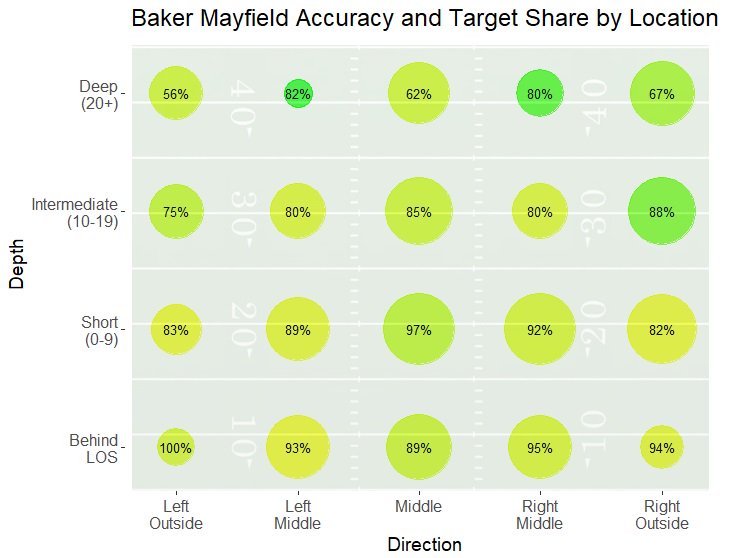
On that note, we have visualized each of the top five quarterback prospects' accuracy and Target Share (percent of total attempts) by location of their throw. The size of the circle represents the Target Share, the color represents their On-Target Percentage relative to FBS average for that location (red = bad, yellow = average, green = good), and the number in the circle is their observed On-Target Percentage. We've included both 2016 and 2017 for these players to increase their sample sizes. Baker Mayfield
In summary: Was consistently accurate all over the field.Baker Mayfield has had above average to elite accuracy almost everywhere on the field. Directionally, he most frequently threw passes between the hashes and to the right sideline outside the numbers.

From a throw depth perspective, he ranked in the top two (amongst these five QBs) in throws behind the line of scrimmage and in deep and intermediate areas. However, he threw by far the fewest passes in the 0-to-9 yard range of any QB in this group at 33% (which was seven percentage points less than any other QB).

When comparing his accuracy to FBS average, he had four of the five biggest differences in this group in On-Target Percentage: Deep Right Middle (+32%), Deep Left Middle (+31%), Intermediate Right Outside (+27%), and Deep Right Outside (+18%). Sam Darnold
In summary: Could stick a deep throw to the right sideline at an elite level.Sam Darnold presented more of a mixed bag. Directionally, he slightly favored his right, especially outside the numbers.

His accuracy was most impressive compared to FBS average in the Deep Middle (+17%) and Deep Right Outside (+15%), but he attempted three times as many throws (52 attempts vs. 17) to that Deep Right Outside area. Josh Rosen
In summary: Majority of throws were short, potential West Coast Offense fit.Josh Rosen absolutely loved throwing in that bread basket right in front of him in the short middle—he had a higher percentage of his attempts here than any other of these QBs had in any area (13%).

Likewise, this conservative throw distribution (whether by scheme or a bad offensive line) showed up again in his deep throw percentage, which ranked last by a considerable margin. By direction, nearly two-thirds of his throws were between the numbers.

His accuracy didn't really stand out in any area other than the Intermediate Left Outside (+14%); this was his only area which he placed in the top 20 (of the 100 depth and direction combinations) in terms of the difference between his On-Target Percentage and the FBS average. Lamar Jackson
In summary: Threw short the most, deep middle sweet spot.Jackson did have the highest percentage of throws to the short area (46%), but he had the second fewest percentage of throws behind the LOS (13%) and lowest in the intermediate area (23%).

Jackson really loved the Deep Middle—his Target Share in this area (6%) was highest of any prospects in any deep section, and his On-Target Percentage was elite (8% above FBS Average) on a big sample. However, his two most accurate areas compared to FBS average were interestingly both to the left and outside the numbers—specifically the Short Left Outside (+13%) and Intermediate Left Outside (+12%). Josh Allen
In summary: Works sideline and deep the most.And finally, we have Josh Allen, an inaccurate QB whose arm strength and mobility still entice teams to think about his potential. To be fair, Allen's throw locations were often to some of the hardest places to complete passes on the field, as his 51% Target Share outside the numbers was 12% more than the next QB (Darnold, 39%).

Correspondingly, he was averse to throwing in the middle and left middle areas, ranking last in both. He also led in the percentage of his throws that were deep (22%) and intermediate (27%), while having the least amount of easy throws behind the LOS.

While his accuracy generally was below average, he did excel in the Deep Right Middle compared to FBS average (+19%, which ranked fourth overall among these 100 combinations). However, that was on only 19 attempts, so sample size beware.

After diving deep into accuracy by ball location, a lot of the narratives from this draft season actually hold up pretty well. Allen was, in fact, asked to make harder throws than everyone else.

But even after controlling for the difficulty of throws, there is no QB who even came close to Mayfield in terms of being consistently accurate no matter where he threw the ball.


Sent from my iPhone

How to Identify Talent: Five Lessons from the NFL Draft - Behavioral Scientist

How to Identify Talent: Five Lessons from the NFL Draft - Behavioral Scientist


JACKSONVILLE - The Browns had a tough decision again for the franchise QB spot and this time I think they got it right with Mayfield. I think some of the other NFL GM's were trying to coax them into a mistake with leaked information about how great the other guys were, but they all had warts.  Mayfield struck me as almost a modern day, collegiate version of Jim McMahon, and that spells winner.

from behavioralscientist.org
http://behavioralscientist.org/how-to-identify-talent-five-lessons-from-the-nfl-draft/

How to Identify Talent: Five Lessons from the NFL DraftApril 23, 2018

This week the Cleveland Browns will decide which, if any, of the top quarterback prospects to acquire with the first pick in the NFL draft. There are four leading contenders, and the team has been evaluating them in detail for more than a year. They will pay the young man over $30 million, and his success or failure will drive the team's fortunes for years. No pressure. Never mind the sobering 52 percent success rate for picking between two players in the NFL draft.

Few industries invest as much into each "hire" as professional sports. I have seen this firsthand, working closely with NFL teams for more than 10 years and more recently with professional basketball and baseball teams. Their issues parallel those I see in nonsports organizations, from multinational corporations to graduate school admissions and urban nonprofits. The challenge of finding the next generation of talent is both ubiquitous and vexing. Successful track records are rare.

Yet, if there is one consistent yet underappreciated principle for making good hires, it is that process beats technology. It turns out that best practices in hiring have much in common with what psychologists have preached for decades.

More independence is often the biggest improvement an organization can easily make in their hiring process.

Why is it so hard to draft or hire well? One reason it is that it is so difficult to be consistent. A draft pick is the product of a year's work, by dozens of people, an outcome negotiated from diverse perspectives to satisfy diverse preferences. The process is overseen by owners and general managers subject to the shifting sentiment of outside forces. And the actors are constantly changing, with scouts and coaches moving between teams each year. This is hardly a recipe for consistency—and not that different from many nonsports organizations.

That is why a structured decision process is especially valuable. The best teams have philosophies and policies that firmly guide the draft process. There are few organizations capable of doing that consistently, and it's a real advantage for those who can.
There is no silver bullet. In sports or out, there is no test or technology that reliably distinguishes star from bust, despite all our advances and many promises otherwise. How should we do it then? What can we learn from how NFL teams draft? Here are five universal prescriptions.

#1: Understand Your Goal
I once worked for an NFL team that was much more successful drafting players one side of the ball than the other. One year we surveyed the staff about the kind of player they wanted to acquire at a particular position. The position was on the side they struggled with, and we discovered there was zero consensus on the type of player to pursue. Given the range of opinions, the group average was meaningless. No wonder they had trouble drafting the right guys!

To paraphrase Lewis Carroll, if you don't know where you're going, any road will get you there. An easy way to flub a hire from the beginning is to skip asking exactly what it is you're looking for. People often don't understand their decision objectives, but the most successful sports teams are clear about their goal and don't stray from the principles and attributes they've established.

#2: Keep Your Judges Apart

NFL teams have dozens of scouts and a complicated method of getting multiple looks at their prospects. Even marginal prospects are seen by more than one scout, and the top guys might be evaluated by a dozen different people. In some teams a scout will know the previous scouts' opinions before forming his or her own while other teams keep scouts blind to previous evaluations. This is a key difference.

Replicability is a referendum on your process.

People are impressionable. When they are exposed to other's opinions before forming their own, they tend to anchor on the existing view. More generally, the "wisdom of the crowd" depends on the independence of the respective opinions within the crowd. Yet that independence is easily compromised, in many ways—anchoring, of course, but also common backgrounds, training, friends, etc. You may think you're getting 5-6 opinions when effectively you're getting only 1.5!

A good hiring process explicitly pushes against these compromising factors: Don't let people talk to each other or see other's opinions before providing their own, expose the candidate to judges in different ways and at different points in time, and bring people with different perspectives into the process. More independence is often the biggest improvement an organization can easily make in their hiring process.

#3: Break the Candidate Into Parts …NFL teams break players down in minute detail. There are physical qualities: For a quarterback it includes, for example, arm strength, mobility, and release. And then there is their "makeup," or the intangibles considered critical for success. Ideally even these intangibles are broken into component parts, such as work ethic and selflessness. This decomposition means players are explicitly evaluated on many distinct dimensions.
This involves work. It's much easier to give one, global evaluation—like or dislike, hire or reject. These overarching evaluations are natural and efficient, but unfortunately, they are often biased. For a more reliable evaluation, you need to break the objective into component parts and evaluate them separately. Daniel Kahneman recognized the importance of this step years ago when designing performance evaluations for the Israeli military and has advocated for them since.

#4: … and Bring Them Back Together MechanicallyAn NFL executive once mused about what would happen if their draft board fell down (teams generally sort players by placing nametags on a physical board). After painstakingly ranking their prospects for months, would they be able to put them back up in the same order? His answer was no, and that troubled him. The logic is simple: If your hiring rankings aren't perfectly replicable, you have noise in the process; if you have noise in the process, you're more likely to take bad candidates and pass on good ones. Replicability is a referendum on your process.

The single best way to reduce noise is to aggregate opinions mechanically. This can mean finalizing a scout's opinion of a prospect by merely summing his or her component grades for an overall score. At the team level it can mean summarizing the group's collective opinion by simply averaging scouts' opinions. At the very least this approach provides a more systematic starting point for a group discussion. This sounds boring, but that's kind of the point.

Hiring is best thought of as a forecasting process, and the only way to improve forecasts is to map them against results and refine the process over time.

Letting a spreadsheet—or a model—summarize your judgment may seem like an abdication, but we've known for decades that simple linear models outperform intuitive judgment. This isn't because evaluators don't have expertise but rather because they apply their expertise inconsistently. Hiring decisions shouldn't depend on the loudest voice in the room or how many strong candidates were seen earlier that day. The best way to ensure this is to aggregate mechanically. It also happens to be a big time-saver, freeing you to focus on the issues humans handle better than machines. 

#5: Keep ScoreNFL scouts are always looking for a guy with "it"—the elusive quality that seems to distinguish those who excel in the pros from those who struggle. Eyes light up when scouts talk about a player they believe has "it." Trouble is we don't know how reliable these beliefs are. On one hand, intuition based on years of repeated exposure and pattern recognition can be quite good. On the other, unless that experience comes with clear and regular feedback it can be misleading.

Of course, the rest of us are no different than scouts in this regard. We've all been animated by the sense we've just seen the next star in our field. The trick is to capture those judgments and track them over time to learn how predictive they are. This applies to all judgments. Hiring is best thought of as a forecasting process, and the only way to improve forecasts is to map them against results and refine the process over time. By doing this, teams learn which tests matter most, which questions are more informative, and which scouts are best with each position on the field.

Many organizations don't bother keeping score, because the payoff is delayed; it can be years before enough data arrive for reliable insights. The kind of foresight and humility required is exactly what distinguishes good management.

At the moment, the defending champions in all three major professional sports—the Eagles, Astros, and Warriors—are unapologetic devotees of "Moneyball" in some form. Moneyball isn't about a model or a technology but rather a decision-making process. The tenets of that process suggest steps any organization can take to improve their hiring. They are deceptively easy. The challenge isn't understanding them; it's sticking to them amid the drama of high-pressure hires. Now, back to (ahem) the Browns.


Sent from my iPhone

Giants Top Minor League Prospects

  • 1. Joey Bart 6-2, 215 C Power arm and a power bat, playing a premium defensive position. Good catch and throw skills.
  • 2. Heliot Ramos 6-2, 185 OF Potential high-ceiling player the Giants have been looking for. Great bat speed, early returns were impressive.
  • 3. Chris Shaw 6-3. 230 1B Lefty power bat, limited defensively to 1B, Matt Adams comp?
  • 4. Tyler Beede 6-4, 215 RHP from Vanderbilt projects as top of the rotation starter when he works out his command/control issues. When he misses, he misses by a bunch.
  • 5. Stephen Duggar 6-1, 170 CF Another toolsy, under-achieving OF in the Gary Brown mold, hoping for better results.
  • 6. Sandro Fabian 6-0, 180 OF Dominican signee from 2014, shows some pop in his bat. Below average arm and lack of speed should push him towards LF.
  • 7. Aramis Garcia 6-2, 220 C from Florida INTL projects as a good bat behind the dish with enough defensive skill to play there long-term
  • 8. Heath Quinn 6-2, 190 OF Strong hitter, makes contact with improving approach at the plate. Returns from hamate bone injury.
  • 9. Garrett Williams 6-1, 205 LHP Former Oklahoma standout, Giants prototype, low-ceiling, high-floor prospect.
  • 10. Shaun Anderson 6-4, 225 RHP Large frame, 3.36 K/BB rate. Can start or relieve
  • 11. Jacob Gonzalez 6-3, 190 3B Good pedigree, impressive bat for HS prospect.
  • 12. Seth Corry 6-2 195 LHP Highly regard HS pick. Was mentioned as possible chip in high profile trades.
  • 13. C.J. Hinojosa 5-10, 175 SS Scrappy IF prospect in the mold of Kelby Tomlinson, just gets it done.
  • 14. Garett Cave 6-4, 200 RHP He misses a lot of bats and at times, the plate. 13 K/9 an 5 B/9. Wild thing.

2019 MLB Draft - Top HS Draft Prospects

  • 1. Bobby Witt, Jr. 6-1,185 SS Colleyville Heritage HS (TX) Oklahoma commit. Outstanding defensive SS who can hit. 6.4 speed in 60 yd. Touched 97 on mound. Son of former major leaguer. Five tool potential.
  • 2. Riley Greene 6-2, 190 OF Haggerty HS (FL) Florida commit.Best HS hitting prospect. LH bat with good eye, plate discipline and developing power.
  • 3. C.J. Abrams 6-2, 180 SS Blessed Trinity HS (GA) High-ceiling athlete. 70 speed with plus arm. Hitting needs to develop as he matures. Alabama commit.
  • 4. Reece Hinds 6-4, 210 SS Niceville HS (FL) Power bat, committed to LSU. Plus arm, solid enough bat to move to 3B down the road. 98MPH arm.
  • 5. Daniel Espino 6-3, 200 RHP Georgia Premier Academy (GA) LSU commit. Touches 98 on FB with wipe out SL.

2019 MLB Draft - Top College Draft Prospects

  • 1. Adley Rutschman C Oregon State Plus defender with great arm. Excellent receiver plus a switch hitter with some pop in the bat.
  • 2. Shea Langliers C Baylor Excelent throw and catch skills with good pop time. Quick bat, uses all fields approach with some pop.
  • 3. Zack Thompson 6-2 LHP Kentucky Missed time with an elbow issue. FB up to 95 with plenty of secondary stuff.
  • 4. Matt Wallner 6-5 OF Southern Miss Run producing bat plus mid to upper 90's FB closer. Power bat from the left side, athletic for size.
  • 5. Nick Lodolo LHP TCU Tall LHP, 95MPH FB and solid breaking stuff.