Showing posts with label Hitting Mechanics. Show all posts

Friday, June 08, 2018

Launch Angle vs. Exit Angle | Inside Pitch Magazine

Launch Angle vs. Exit Angle | Inside Pitch Magazine


The Precise Point Hitting Mat is a tool hitters can use to practice optimal exit angle based on pitch location.

I get that everyone is blinded by recency bias, I still trust Ted Williams and Mike Epstein for that matter, for being pioneers in the "launch angle" revolution. 


Image result for ted williams launch angleImage result for ted williams launch angle


from insidepitchonline.com
https://insidepitchonline.com/exitangle/

Launch Angle vs. Exit Angle


by Rob Ledington, Head Baseball Coach, Lynn Camp (KY) HSOver the past few years, there's been a great deal of discussion regarding the value of launch angles and offensive production, particularly as it relates to home runs, extra base hits, and runs batted in. The increased attention most likely contributed to the single-season home run record set by Major League Baseball this past season. However, does this information alone suggest that every hitter should increase their launch angle? The obvious answer is no.

A physical player with power and below average speed would obviously benefit from hitting home runs or balls in the gap for increased offensive productivity. These types of players are those who can most benefit from working on developing a higher launch angle. On the other hand, a smaller player with little power and superior speed would benefit from a lower launch angle, with their goal focused on producing line drives and hard ground balls. Even a 'swinging bunt' from smaller 'speed' guys is much more beneficial than most anything hit in the air. A buy-in to this approach can greatly increase offensive productivity by providing more opportunities to get on base, utilize their speed and ultimately, score more runs, which is what the offensive game of baseball is all about.
Exit angles, however, have equal value for all hitters regardless of size, speed, and/or desired launch angle. All hitters strive to hit the ball "squarely" thus maximizing exit velocity, and in some instances carry (travel in the air), while guarding against weakly hit fly balls and ground balls. What are exit angles? How do you determine the proper exit angle for each pitch location?

Exit angles are defined as the direction the ball goes after it is put in play. More simply put, the optimal exit angle is dependent on the lead foot, the bat and the ball creating a 90-degree angle at the point of contact. When this occurs, exit velocity is maximized for the ground ball, the line drive, and the fly ball because this contact will not create sidespin. Additionally, a fly ball will travel farther in the air when combined with the proper launch angle and backspin rotation. A high launch angle with a tardy swing (less than square) will create a high fade (in golf terms), or sidespin much like a sinker (in pitching terms), producing less exit velocity and carry. Conversely, an early swing at a high launch angle will create hook spin (in golf terms), or cutter/slider spin (in baseball terms) producing less exit velocity and carry. Therefore, only the ball struck at the optimal launch angle combined with the optimal exit angle will produce maximum exit velocity and distance in the air. It should be noted that is it entirely possible to hit a ball hard without "square contact."

It is common knowledge that a four-seam fastball (with backspin) has more velocity and carry than a sinker, a cutter, or a slider. Similarly, a drive down the middle of the fairway with backspin will travel farther in the air than a fade or a hook. Thus, to maximize exit velocity and distance in the air, the launch angle and the exit angle must work together, with the exit angle having greater importance of the two. This is especially for the smaller player, unless they enjoy jogging to second base and back to the dugout!

Since the invention of the game, baseball coaches have taught their players to hit the pitch thrown down the middle of the plate back through the middle of the diamond. Ironically when this happens "square contact" occurs as it relates to the lead foot, the bat, and the ball at the point of contact. Once this central contact point has been established, it becomes possible to determine every other point of square contact, both on the inside and outside parts of the plate. For example, if the pitch is outside, coaches will say things like, "let it get deeper" or "let it travel." When the pitch is inside, you are likely to hear "hit that out in front of the plate" or "get your foot down and swing earlier." These statements are painfully obvious to everyone, but without an understanding of specifically what needs to happen to yield optimal results, making these adjustments can be a challenge.

The general rule when it comes to handling pitches closer to the edges of the plate is to allow the pitch one ball's width outside of center to travel precisely one ball's width deep of the center pitch location, or behind the lead foot. If the pitch is two balls outside, two balls deep or behind the lead foot, and finally three balls outside, three balls deep or behind the lead foot.

The same concept would apply to pitches inside of the center contact position. One ball's width in, one ball's depth in front of the lead foot, two balls in, two balls in front of the lead foot, and finally three balls in, three balls in front of the lead foot. If this occurs, the batter will create "square contact" for each pitch location, resulting in optimal or maximum contact for each pitch.

With this understanding of what 'square contact' means as it relates to pitch location, creating a feel for the best exit angle on a pitch-to-pitch basis becomes much easier. It is even possible to practice these angles: for example, if a pitch is one ball's width inside of center, the optimal exit angle is 10 degrees for a baseball and 13 degrees for a softball (angle variance attributed to the difference in diameter of the balls). Each pitch location inside and outside of center will have precise and varying exit angles that can provide players and coaches with the opportunity to set up precise targets to aim for off the tee, during soft toss, and even during live batting practice.

Providing visual targets can help your team buy in to the concept of becoming a more complete offensive player. It also gives them instant feedback, which is something that this current generation of players is finding more and more desirable.


Sent from my iPhone

Friday, December 29, 2017

Is The ‘Old School’ Method of Teaching Hitting Outdated?


Hi Charles

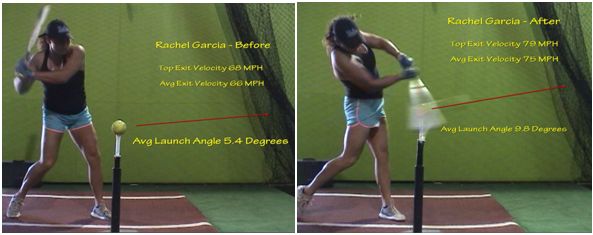
Rachel Garcia Swing Test Experiment
Recently, Rachel Garcia, an elite collegiate softball player (National Freshman of the year at UCLA) went through a simple before and after hitting analysis that I took a small part of and thought it might help to answer our question about 'Old School' teaching methods. 

Rachel added 11 MPH in Tee Exit Velocity (Tee measures 'Raw' Power - no pitch influences), from 68 MPH to 79 MPH and increased her average Launch Angle from 5.4 degrees to 9.8 degrees in one 30 minute session.  In fact, her average Exit Velocity in her 'after' round was 5 MPH higher than her top speed in the first round.  The two most important metrics in hitting, Exit Velocity and Launch Angle, both increased significantly and immediately.  An elite athlete, seemingly already firing on all cylinders, adding 14% to her Exit Velocity.  How is this possible?  

Elite performance and 'swing efficiency' are not the same things and it is possible to hit very well with slight swing inefficiencies.  We tend to look at elite players and just assume the reason they are elite is that their swing movements are perfect.  While she already had a good swing, there were some key mechanical movements that could become more efficient and thus the immediate increase. 
​​​​​​​


Tomorrow look for a year end special on the Hitting Is A Guess - Time Training and all hitting  programs combined............. 
GuessWorks, 41303 27th Street West, Palmdale, CA 93551, USA

Unsubscribe | Change Subscriber Options


Tuesday, December 12, 2017

Study analyzes visual tracking strategies in baseball - UPI.com


http://perceptionaction.com/softfocus/

from upi.com

Study analyzes visual tracking strategies in baseball

Aug. 4 (UPI) -- Researchers from Ohio State University's College of Optometry have found that batters change their visual tracking strategies depending on whether they swing or not.
The study, published in the August edition of Optometry and Vision Science, measured horizontal eye and head movements in two collegiate baseball players who were up to bat with a pitching machine.
Researchers found that patterns of head and eye movements are slightly different when batters are swinging compared to "taking" a pitch, meaning not swinging at a pitch.
The study tracked head movements in the baseball players by using an inertial sensor mounted on the players' helmets. Eye movements were tracked using a video eye tracker, both showed differences in tracking when swinging compared to not swinging at pitches.
The two batters followed a similar visual strategy in swinging and taking a pitch, however, when not swinging, they mainly moved their heads, not their eyes, toward the ball the majority of time the ball was in the air.
When the ball was about 150 milliseconds from arriving, the batters shifted their eyes ahead of the ball when it crossed the plate. 
"Large eye movements only occurred late in the pitch trajectory," the researchers said in a news release.
Conversely, when the batters were swinging at the ball, they followed a different visual strategy with head movements toward the ball being substantially larger than eye movements. The batters focused their eye on the ball up until about 50 milliseconds before it crossed the plate.
Researchers believe their findings support previous research that placing the gaze ahead of the ball is the optimal learning strategy and tracking the ball is the optimal hitting strategy.

Sent from my iPhone

Tuesday, June 20, 2017

Hitting and the Power of Suggestion | FanGraphs Baseball

Hitting and the Power of Suggestion | FanGraphs Baseball
swingsquickslot

Good stuff from Fan Graphs. It illustrates why whether it's hitting (as in this article)  or. pitching verbal cues results may vary from player to player. So say good bye to the cookie-cutter, one-size-fits-all approach and maybe soon the perfect pitching/hitting mechanics model. You'll have success with some players, but lose others but for want of a better verbal cue.

from the article: 
This fact, that there's no universal instruction for baseball development may be frustrating, but if you think about the difference from body to body, it makes sense. 

Ochart himself had some thoughts along these lines. "Coaching, in many aspects, is approached as an art more than a science because the same verbal cue to a group of athletes can cause unique movement adaptations within the group," he told me in an email. "Learning what an athlete feels has always been a critical part of coaching movement, and technology is helping us figure out exactly what's happening and bridging the critical gap between 'feel' and 'do.'"

from FanGraphs.com http://www.fangraphs.com/blogs/hitting-and-the-power-of-suggestion/?utm_source=Driveline+Baseball+Newsletter&utm_campaign=6ef49e1d1a-Sunday_Thunder_Nuggets_12_18&utm_medium=email&utm_term=0_d541cdd9d2-6ef49e1d1a-311453553&mc_cid=6ef49e1d1a&mc_eid=48e9d48f3e

Hitting and the Power of Suggestion

I was drinking a beer with Kevin Youkilis — or rather, I was drinking one of his new brewery's beers, and he was drinking water — and we were talking about the state of the game. I think I mentioned something about chopping wood — how young players are coached (badly?) to hit down on the ball, and how that leads to a lot of swing and miss as players have to try to swing to a point in space — and he stopped me. "Nobody ever swings out to a specific point in space when they're told to chop wood or swing down on the ball," Youkilis said. "What actually happens is that they end up quicker to the ball." My mind was blown.

Youkilis pointed out that he spent his whole career with that philosophy, and though one player's strikeout rate (18.7%) and power (.197 isolated slugging percentage) don't prove anything, it was an eye opener for me. He basically was saying that the power of suggestion might actually have some value, even if the content of that suggestion was technically wrong. And once I thought about it, I realized I'd heard a few smart hitters — including Mark Trumbo — tell me something similar before, but I hadn't been listening right.

In any case, this is one of those testable situations with today's tools of the trade. I asked Jason Ochart of Driveline Baseball if he could create two situations and chart the outcomes using the data collection devices for which Driveline is famous on the pitching end.

In the first situation, Ochart told his hitter to be "quick to the ball." This is maybe not exactly the same thing as telling them to chop wood, but I didn't complain. I don't want him to tell his hitters something he doesn't want to tell them, and what he did tell them still permits us to (attempt to) answer our question: is it possible to change a hitter's swing metrics just by changing what you say to him?

In the second situation, Ochart gave his hitter the advice followed enthusiastically by modern hitters: "Get your hands to the slot first, and then swing." A fundamentally different coaching statement.

The results were different, too. In very interesting ways.

First, a table. Ochart used his Diamond Kinetics app to measure the player's swing by hand speed and distance in the zone. This player is a major-league baseball player.

Swing Stats for One Hitter, Two Conditions

Condition Hand Speed Distance in Zone
Quick to Ball 24 mph 23 inches
Hands to Slot 21 mph 28 inches

SOURCE: Diamond Kinetics / Driveline Baseball

Major league hitter told to be "quick to the ball' or "get hands to slot first" in two conditions.

For this hitter, the cue had an interesting result. Being quick to the ball was better for his bat speed, and bat speed begets power. However, he was in the zone for a shorter period, meaning that his swing was steeper and he was more likely to miss the ball. He wasn't giving his hands as much chance to get to the ball.

Here's what the two swings looked like, mapped by that Diamond Kinetics app. "Quick to the ball" is the green swing and "hands to slot" is in orange.


It looks like the "quick to the ball" cue compelled the batter to get his hands down to the slot faster! That might have cost him some time in the zone, though. And that missing time comes early on in the swing, when the brain may still have time to alter the path of the bat some.

The orange swing looks like it's better for a steeper launch angle, though, and that's something that the league's hitters have been seeking to do more over the last year-plus. Thanks to Bill Petti, we can see that baseball's hitter are hitting fewer balls in the 0 to -20 degree angles that produce poor outcomes. Maybe this is from more "hands to slot" coaching happening around the league, and maybe that coaching is due to analysis based on these Statcast stats.

launch_angle_fre_yr_consec-2

Now it's time for a step back. We can't universalize this small finding to all players, not in a direct manner. What we can probably take from this is that coaching matters, and that each of these conditions is probably better for a specific swing. In other words, there are maybe powerful guys with good launch angle who could benefit from being told to be "quick to the ball." And maybe there other are guys with decent power but who need to lift the ball more; perhaps they'd benefit from being told to get the "hands to the slot" first.

This fact, that there's no universal instruction for baseball development may be frustrating, but if you think about the difference from body to body, it makes sense.
Ochart himself had some thoughts along these lines. "Coaching, in many aspects, is approached as an art more than a science because the same verbal cue to a group of athletes can cause unique movement adaptations within the group," he told me in an email. "Learning what an athlete feels has always been a critical part of coaching movement, and technology is helping us figure out exactly what's happening and bridging the critical gap between 'feel' and 'do.'"

And that's probably the perfect way to sum this up. Yes, it's probably not great to tell people to swing down on the ball. But if you take the kernel from that coaching, and tell them to be quick to the ball, you'll probably be saying the right thing to at least one type of hitter. Figuring out which type of hitter needs to hear which coaching is the next step.


Sent from my iPhone

Wednesday, May 04, 2016

Evolution of Mets phenom Michael Conforto's 'perfect swing' - NY DailyNews

Evolution of Mets phenom Michael Conforto's 'perfect swing' - NY Daily News


I cringe when I read this label being put on a guy. It's like we're looking to anoint the hitting version of Mark "Perfect Mechanics" Prior. Whatever happened to Mike Prior anyway? And if Conforto has such "perfect" mechanics, shouldn't they allow him to hit LHP's a little better? 

Just asking and I like Conforto and he has a "great" swing. Great, not perfect.


Evolution of Mets phenom Michael Conforto's 'perfect swing'

Michael Conforto swung and the scout sitting in the stands at MCU Park, home of the Brooklyn Cyclones, marveled as the ball soared over the right-field fence, despite the stiff wind blowing in off the ocean.
"It was a perfect swing," the scout recalls. "It was like you were watching a movie. I thought to myself, 'That's the nicest swing I've ever seen at a ballpark.'
"You know how many swings I see every year?"
The scout, a longtime veteran who works for an organization other than the Mets, is going back to 2014 for the anecdote, not long after the Mets had drafted Conforto 10th overall and sent him to their short-season Class A team on Coney Island. Conforto was just 21 years old at the time.
But his gorgeous swing, the one that now makes pitchers quake on the mound and Keith Hernandez swoon in the Mets' broadcast booth, began evolving long before.
MCCARRON: BARTOLO COLON CONTINUES TO IMPRESS WITH METS
Conforto, the Mets' No. 3 hitter, has been hearing about the beauty of his cut since he played in the Redmond North Little League in the Seattle suburbs. It's been tweaked, upgraded and streamlined since then by "a lot of great coaches," Conforto says.
And, of course, by Conforto's own natural ability and his feel for keeping what works for him and discarding the rest. Mix in the knowledge of situational hitting and patient approach he learned under Pat Casey at Oregon State and you have a hitter who started Monday seventh in the National League in both hitting (.342) and slugging percentage (.633).
The evolution hasn't stopped, either – Mets' hitting coach Kevin Long helped him with a key stride change last year while Conforto was struggling that's helped Conforto surge into the No. 3 slot in the Met lineup.
"If you were going to build a hitter and had to put a body and a mind together, Michael is as close as you can get to intertwining them into an ideal," Casey says.
***


Michael Conforto has had scouts gushing over his swing since he was drafted by the Mets.
Matt Slocum/AP

Michael Conforto has had scouts gushing over his swing since he was drafted by the Mets.

Long is watching a video clip of a Conforto swing from earlier this season, a home run to center off Cleveland's Cody Anderson on April 15.
Conforto's head barely moves as he tracks the pitch and wallops it. At one point, watching the clip, Long chuckles and mutters, "Ohhhh," marveling at what he's seeing.
Conforto's stride doesn't go forward because he picks his front foot – his right foot – up and puts it down in nearly the same place. He generates remarkable torque with his legs and hips – both Long and Casey rave about the strength of Conforto's lower body.
"You see a guy who stays very balanced and centered throughout his swing," Long says. "His head doesn't move. This is what makes him special. Everyone sees the pretty swing, but, mechanically, this is as sound as it gets.
"It's Yoenis Cespedes from the left side of the plate. Yoenis has no movement, either."
It's not easy to keep your head from moving when a man standing 60 feet, six inches away can throw 95 miles per hour or more, Long says. Asked to name a couple, Long says Minnesota's Joe Mauer, the owner of three batting titles, and the electric Cespedes.
CONFORTO'S CAREER OFF TO BETTER START THAN HARPER'S

"If your head moves toward the pitcher, it speeds everything up," Conforto says. "If it moves to the side, it will skew your vision."
Conforto stays so still it enhances his strike-zone discipline. "There's no jumping," Long says. "So if you want to throw him an off-speed pitch, OK, so be it. Take your chances.
"You want to throw him a fastball? OK, go ahead, try to do it."
Most hitters, Long explains, "gain distance" with their strides during their swings. But going forward just "makes hitting harder," the coach says.
With such supreme body control, Conforto is now in a perfect position to, as Long puts it in hitting jargon, have "his lower half synch up with his hands. His back foot starts to turn, his back knee starts to drive down and through and his hips get through and then the barrel (of the bat) flies through (the hitting zone).
"And then the extension he gets is incredible. He gets that as well as anybody you'll ever see."
LUPICA: MICHAEL CONFORTO IS TURNING HEADS


No more than 7 images from any single MLB game, workout, activity or event may be used (including online and on apps) while that game, activity or event is in progress.
David Maxwell/Getty Images

Conforto moves up to the No. 3 spot in the Mets lineup after making adjustments with hitting coach Kevin Long.

Mere weeks into Conforto's tenure in the majors last year, though, he needed some work. His average sagged as opponents figured out the touted kid's weakness: Pitch him inside.
"He was just getting exposed inside," Long recalls. On video, it became apparent to the Mets that Conforto had moved off the plate – Conforto estimates it was about three and a half inches, perhaps to try to overcome his struggles with inside offerings. But the change in position changed his stride, too, and all of a sudden he was striding toward the plate.
"When you're doing that, it makes it tough for you to get to the inside pitch – there's no path for your hands," Conforto says. Long suggested that Conforto move his back foot closer to the plate. That would force his stride toward the pitcher, even if it ended up as merely an up-and-down movement.
"Once we made that adjustment, it really freed up a little space for me to use my hips and get my hands in and still not give up anything out over the plate. I was hitting well going the other way, but once pitchers found out they could come in on me, that was where the problem was. That's the whole thing of coming up into the big leagues – they find your weakness quickly."
***
Conforto's never minded the work, say those who know him. He's a swing junkie who likes to watch video of other hitters, something he did often over the winter at the batting cages run by Ray and Cody Atkinson in Kirkland, Wash., where he hits during the off-season.
Some other swings he admires? "I really like Carlos Gonzalez's swing," Conforto says. "I loved Ken Griffey Jr. growing up. I always wanted to swing like him. I think Bryce Harper's swing is incredible, just how it's so powerful but at the same time he can square balls up so consistently. I think that's incredible. The way his lower half works is amazing as well. Michael Brantley – I like how simple his is.
"When you look at that stuff, you kind of realize that there's no one way to do it. It's what feels right for you, not a cookie-cutter thing. Look at Hunter Pence."
FOLLOW THE DAILY NEWS SPORTS ON FACEBOOK. "LIKE" US HERE.


Conforto hits his fourth home run in a 3-for-4 day on Saturday.
Frank Franklin II/AP

Conforto hits his fourth home run in a 3-for-4 day on Saturday.

Every day, Conforto does a routine that includes swinging one-armed with a short bat to "keep him on top of the baseball," Long says. Then regular flip drills and then he takes swings with simulated counts and situations. Then he watches video of the opposing starter and relievers.
"He prepares without overloading himself," Long says.
He's got further work to do, too, which he knows. Entering Monday, Conforto was hitting just .188 against lefties this year, with no extra-base hits.
In fact, Conforto has never had a regular-season extra-base hit against a left-hander, though he did homer off Royals' lefty Danny Duffy in the World Series.
But the Mets are giving him more chances against lefties lately and he's got plenty of raw material to work with – that marvelous mix of torque and mechanical precision that is his swing.
As the scout puts it, "A beautiful swing like that doesn't come along very often."
Tags:
michael conforto ,
kevin long ,
new york mets ,
mlb


Sent from my iPhone

Wednesday, August 05, 2015

Looking back on Barry Bonds : ESPN The Magazine


EDITOR'S NOTE: This article appeared in the August 8, 2004 issue of ESPN The Magazine.
Looking back:


Hitting coach Jeff Pentland would tell other major leaguers, You don't want what Barry has, meaning they weren't equipped for the challenge of greatness. Pentland, who was Bonds' hitting coach at Arizona State and a lifelong friend, was amazed at how well Bonds coped with his own success. In that kind of spotlight, the more you accomplish, the more that's expected of you, the more you have at stake. Even the smallest failures become


enormous. Almost anyone would shrivel from that kind of pressure, Pentland believed, once they
understood it. Bonds embraced it.
He was obsessed with correcting flaws. A couple of months into his major league career, Bonds phoned Pentland and explained that pitchers were jamming him with fastballs.
"What do I need to do?" Bonds asked. "Barry, you're the smartest player I ever had," Pentland responded. "You'll
figure it out."
In time, Bonds moved closer to the plate, shortened his stride – "Just be slow with your feet," he once explained –and became the best hitter of inside fastballs Pentland had ever seen. And the best breaking-ball hitter. And the most disciplined, period.
Swinging a bat is the most basic instinct for ballplayers. They've been doing it since they were toddlers, and after years upon years of backyard games and BP and organized competition, the yearning to swing the bat is ingrained. A player walks past a new box of bats, and invariably he reaches in and pulls one out, hefts it, takes a
half-swing, checks out how it feels. It's a blind date with wood, and the ballplayer is looking to hook up. It's what they do. It's who they are.
So other players watched Bonds abstain, refuse to swing at anything out of the strike zone, and they were awestruck. He drew fewer than 100 walks in each of his first five seasons, but late in his
career, he was spitting at outside pitches. Bonds wouldn't see a strike for four or five at-bats – hell, for two or three days – and yet, when a pitcher tried enticing him with a fastball just off the
corner, he held back. He had the most potent swing in the game, more reason to swing than any of his peers, and yet he had conquered that most basic instinct. He was the pope of plate discipline.
....


You had to see him every day to understand. Everybody has bad days in BP. Bonds never did, carving line drives to left when he wanted, always smashing the ball squarely with his bat, forever precise, his concentration unrivaled. "The great players are able to slow the game down," said A's pitcher Tim Hudson, who allowed six hits in Bonds' first 14 career at-bats against him, including two homers. "He's been able to slow it down a little more than most. He's like the big kid in elementary school who was way better than everybody else."
Virtually all hitters identify pitches by the rotation of the ball after it leaves the pitcher's hand. If they see spin, the ball's face turned into a whirlpool of seams, they know the pitcher has thrown a curve or a slider. Otherwise, it's probably a fastball or a changeup. But Hall of Famer Tony Gwynn, who studied his rivals, maintained that Bonds could identify pitches before they were released. As a pitcher's hand reached its apex, Gwynn explained, Bonds could detect in an instant whether the pitcher held the ball with his palm and fingers straight up and down (a fastball), or if he gripped it from the side (a breaking ball). A flap of fingers sticking up from behind the ball meant changeup.
In practical terms, this meant Bonds had a huge advantage on other hitters, who had to wait until the ball was four or five feet into its journey toward the plate – an eternity, by comparison. "They always said it looked like he knew a breaking ball was coming," Gwynn said then. "Well, he did."
That wasn't exactly news to his teammate, pitcher Jason Schmidt. When Bonds hit his record 73 homers in 2001, Schmidt said, "They would throw him a breaking ball, and he was like a statue. He wouldn't even move. I've never seen anything like that. He knew it was a ball even before it left the guy's hand. He didn't offer. He didn't check-swing. You don't see hitters do that."
But by the time Bonds turned 40, Schmidt was used to seeing him do the impossible. Somebody broke out a deck of cards in spring training, and Bonds eyeballed the deck as it was shuffled, then predicted the identity of the bottom card. Four times in a row. You had to see it to understand.
Sam Holman lugged a bag of bats over to Bonds in the spring of 1999, bats made out of maple rather than ash. Bonds had heard about Holman and his bats from former teammate Joe Carter, and after Bonds launched homer after homer with the maple in BP, he sat with the former stagehand and asked precise questions about why the
bats seemed harder. Holman sent him a dozen bats a week. Bonds would phone
whenever he wanted to make tenth-of-an-ounce adjustments.
Bonds had asked for just such an
incrementally lighter alteration in the summer of 2001, when he was stalking Mark McGwire's single-season home run record of 70. Holman watched on TV as Bonds bounced a couple of long drives against outfield fences, and knew he'd be getting a call. Sure enough: "Dude, there's something wrong," Bonds said. He and Holman agreed to ratchet up the weight by one-tenth of an ounce, and Bonds blew McGwire away. "Barry and I both know," Holman said, "that the record could be 76 or 77. He did the work for that."
'via Blog this'

Friday, February 27, 2015

Barry Bonds' swing: makes him the most feared hitter in the game


A Giant Amongst Legends [Archive] - Baseball Fever
After searching thru this section of the board I was unable to find a thread that celebrated and looked back in depth at the career of Barry Lamar Bonds. It is at this point I decided to start my own. Bonds is at most the greatest player who ever lived, and at the least th...
Preview by Yahoo
  
image
Preview by Yahoo

Barry Bonds' swing: makes him the most feared hitter in the game
Baseball Digest, Sept, 2003 by Chuck Johnson

COMPACT, QUICK, SELECTIVE, smooth, explosive and sweet are some of the adjectives that describe the bat swing of Barry Bonds. But ask the San Francisco Giants' slugger about it, and that subject is off-limits.

Like a gourmet chef with a secret recipe, Bonds is wary of giving away anything about how he keeps his bat cooking. The five-time National League MVP says he has never talked publicly about his swing and won't until after his career is over.

Bonds' swing isn't unique, says Hall of Fame-bound Tony Gwynn. What separates him from the pack, Gwynn says, is his ability to consistently get his hands and body in optimum position to hit almost any PITCH fair.

"He can discuss it, and he can describe it anyway he wants to," Gwynn says. "But good hitters have been doing this for years. You read Ted Williams' book, Charlie Lau, Rod Carew, Dusty Baker. I've read them all, and everybody talks about the same thing. You've got to get in a position so that your hands can work so your body can work.

"And that's what Barry Bonds does," Gwynn says. "He gets in position, he lets his hands go and, in letting his hands go, his body goes where it's supposed to go."


Gwynn was the consummate contact hitter during his 20 years in the majors, eight times the National League batting champion. The former San Diego Padres right fielder says the same swing principles APPLY to great home run and contact hitters.

"Once you make contact, it's whatever you are," Gwynn says. "Whatever type of hitter you are, that's what's going to come out. I'm not sitting here saying you're going to do the same things Barry Bonds does. But if you get to the proper position, whatever it is you do, you'll do it better.

"The key is to do it consistently every time, and he's the only one in the game who consistently does it. Ask any pitcher in major league baseball, 'Can you get in on him?' because he's right on top of the plate. The answer is no because he takes the knob of the bat to the ball and keeps his hands inside of the ball. When you try to bust him in, he pulls his hands inside the ball and that's why he doesn't pull the ball foul. He keeps it fair. He takes the knob first and pulls it through the zone. Everybody else wants to get the barrel head there, and they hook it foul."

Gwynn says the problem with trying to teach hitters the proper swing is they focus on the end result: Bonds' record 73 homers in 2001 and his 600-plus career home runs.

"They see the pose and they see how far the ball goes, instead of concentrating on seeing the actual mechanics."


Anatomy of a swing
Barry Bonds has 600-plus lifetime homers, a .430 on-base percentage with more than 1,230 extra-base hits. Here, eight-time National League batting champion Tony Gwynn analyzes his swing.

1. The thing that separates him from most other guys is his ability to do the same thing every time. The thing I've always noticed is that when he comes up, he gives a couple of bat pumps, and then he sets up the same way.

2. He's starting to get his timing mechanism down. There's a cocking of the bat as he lifts his front foot. His head is still. During the start of his swing, Bonds' head stays in the same position with little, if any, movement. The only motion is that his hands are starting to drop and he's starting to get cocked to get into position.

3. He's taken his hands, and he's raised them. He's taken them back to get into the hitting position, and the head has stayed exactly still. The bottom half of his body has moved, his hands have moved, but his head is still the same. After you get 1, 2 and 3 out of the way, here's where you separate the men from the boys.

4. As he's starting to bring the bat through the zone, he takes the bottom hand--the knob-of-the-bat hand--and starts to pull it through the zone. There isn't much arch in it when he starts to pull it through. It's not a downward pull. It's a pull right across his body. The more you can keep your hands inside the baseball, the better hitter you're going to be.

5. People have said you can't pull the bat through the zone on a flat plane and generate any pop. Well, I give you Barry Bonds, because that's exactly what he does. Every time. The top hand is going along for the ride. The palm is up. It's not going over the top.

6. His swing is flat through the zone. People talk about dropping the barrel of the bat on the ball. A lot of guys try to force the lower body through the zone. But all you have to do is get in a good position, take the bottom hand and pull it through the zone on a level plane, and the rest of it goes where it's supposed to go.


Bonds' swing: Spectacularly consistent
By Chuck Johnson, USA TODAY
By Lenny Ignelzi, AP
Barry Bonds' consistent swing has produced 594 career home runs.
Compact, quick, selective, smooth, explosive and sweet are some of the adjectives that describe the bat swing of Barry Bonds. But ask the San Francisco Giants' slugger about it, and that subject is off-limits. Like a gourmet chef with a secret recipe, Bonds is wary of giving away anything about how he keeps his bat cooking. The four-time National League MVP says he has never talked publicly about his swing and won't until after his career is over.


<br/><a href="http://oi29.tinypic.com/256fbkg.jpg" target="_blank">View Raw Image</a>


I'll add something positive about Bonds. He appears to have the highest WARP3 of any hitter in history:

Bonds - 236.4
Ruth - 227.8
Mays - 220.1
Aaron - 217.6
Wagner - 203.0
Cobb - 194.3
Musial - 191.5

Of the top 7, let's see their WARP3 numbers age 35 and after:

Bonds - 80.7 (34% of total WARP3)
Ruth - 49.7 (22%) 
Mays - 55.2 (25%)
Aaron - 47.3 (21%)
Wagner - 79.3 (39%)
Cobb - 40.9 (21%)
Musial - 43.2 (23%)

Looks like everyone put up similar impacts as they got older except for Wagner and Bonds.

Giants Top Minor League Prospects

  • 1. Joey Bart 6-2, 215 C Power arm and a power bat, playing a premium defensive position. Good catch and throw skills.
  • 2. Heliot Ramos 6-2, 185 OF Potential high-ceiling player the Giants have been looking for. Great bat speed, early returns were impressive.
  • 3. Chris Shaw 6-3. 230 1B Lefty power bat, limited defensively to 1B, Matt Adams comp?
  • 4. Tyler Beede 6-4, 215 RHP from Vanderbilt projects as top of the rotation starter when he works out his command/control issues. When he misses, he misses by a bunch.
  • 5. Stephen Duggar 6-1, 170 CF Another toolsy, under-achieving OF in the Gary Brown mold, hoping for better results.
  • 6. Sandro Fabian 6-0, 180 OF Dominican signee from 2014, shows some pop in his bat. Below average arm and lack of speed should push him towards LF.
  • 7. Aramis Garcia 6-2, 220 C from Florida INTL projects as a good bat behind the dish with enough defensive skill to play there long-term
  • 8. Heath Quinn 6-2, 190 OF Strong hitter, makes contact with improving approach at the plate. Returns from hamate bone injury.
  • 9. Garrett Williams 6-1, 205 LHP Former Oklahoma standout, Giants prototype, low-ceiling, high-floor prospect.
  • 10. Shaun Anderson 6-4, 225 RHP Large frame, 3.36 K/BB rate. Can start or relieve
  • 11. Jacob Gonzalez 6-3, 190 3B Good pedigree, impressive bat for HS prospect.
  • 12. Seth Corry 6-2 195 LHP Highly regard HS pick. Was mentioned as possible chip in high profile trades.
  • 13. C.J. Hinojosa 5-10, 175 SS Scrappy IF prospect in the mold of Kelby Tomlinson, just gets it done.
  • 14. Garett Cave 6-4, 200 RHP He misses a lot of bats and at times, the plate. 13 K/9 an 5 B/9. Wild thing.

2019 MLB Draft - Top HS Draft Prospects

  • 1. Bobby Witt, Jr. 6-1,185 SS Colleyville Heritage HS (TX) Oklahoma commit. Outstanding defensive SS who can hit. 6.4 speed in 60 yd. Touched 97 on mound. Son of former major leaguer. Five tool potential.
  • 2. Riley Greene 6-2, 190 OF Haggerty HS (FL) Florida commit.Best HS hitting prospect. LH bat with good eye, plate discipline and developing power.
  • 3. C.J. Abrams 6-2, 180 SS Blessed Trinity HS (GA) High-ceiling athlete. 70 speed with plus arm. Hitting needs to develop as he matures. Alabama commit.
  • 4. Reece Hinds 6-4, 210 SS Niceville HS (FL) Power bat, committed to LSU. Plus arm, solid enough bat to move to 3B down the road. 98MPH arm.
  • 5. Daniel Espino 6-3, 200 RHP Georgia Premier Academy (GA) LSU commit. Touches 98 on FB with wipe out SL.

2019 MLB Draft - Top College Draft Prospects

  • 1. Adley Rutschman C Oregon State Plus defender with great arm. Excellent receiver plus a switch hitter with some pop in the bat.
  • 2. Shea Langliers C Baylor Excelent throw and catch skills with good pop time. Quick bat, uses all fields approach with some pop.
  • 3. Zack Thompson 6-2 LHP Kentucky Missed time with an elbow issue. FB up to 95 with plenty of secondary stuff.
  • 4. Matt Wallner 6-5 OF Southern Miss Run producing bat plus mid to upper 90's FB closer. Power bat from the left side, athletic for size.
  • 5. Nick Lodolo LHP TCU Tall LHP, 95MPH FB and solid breaking stuff.