Chasing the 'Holy Grail' of Baseball Performance
Inside the wide-ranging search—led by economists and psychologists—for the elixir that turns good squads into great ones
In the final regular-season game for the 1977 Los Angeles Dodgers, Dusty Baker hit a home run, giving him 30 for the season and making him the fourth Dodger to reach that milestone that year, a Major League Baseball record. As Baker rounded third, a rookie who had recently entered the game, Glenn Burke, approached the plate from the on-deck circle and, seized by joy, raised his hand high above his head. Baker was taken aback by the gesture and, in a mix of celebration and confusion, decided to smack Burke's hand. Their high five was clumsy, but then again it had every right to be: Reportedly, it was the first one ever.
Baseball has always been a strange mix of social and solo. In American fashion, the game stresses the collective, but demands that you play for yourself. Despite all the intimacy of the sport's language—crowding the plate, touching base—its play is quite lonely. Other sports require a tacit harmony between players—setting a pick for a teammate, blocking for someone 10 yards behind. In contrast, a baseball hitter stands in the solitary confinement of the batter's box, facing a pitcher on the desert island of the mound. The players on the defense align themselves, except for the occasional shift, to be as far from one another as the limits of the ability to recuperate lost space permit. Defensive errors are unfailingly—and officially—attributed to individual players. The rule book, irrespective of out-of-play butt slaps and handshakes, does not sanction contact.
And yet somehow, despite this loneliness—or perhaps because of it—the sport is now at the center of an intensifying search for the nebulous, nearly mythical quality of team chemistry. In the popular conception, almost all great teams are alike in possessing it. But what exactly the quality is, and just how strongly it governs success, remains unclear. The '77 Dodgers possessed some of it, but apparently not enough: After storming into the World Series, they lost to a feuding New York Yankees squad that had been cynically described as "the best team money could buy."
In 2014, Harvard Business Review deemed chemistry the "Holy Grail" of performance analytics, the statistical discipline that first swept the sport wholesale some 20 years ago. The choice of image was telling; the Grail, of course, remains elusive. Nonetheless, a number of research groups are now taking a bet that they can pin down chemistry, through advanced math or anthropological forays into the clubhouse. Some researchers, believing that team chemistry may emerge from literal chemistry, are collecting and analyzing biometrics: testosterone levels, hormonal states.
Whatever the approach, much of the research is led by outsiders—economists and organizational-development scholars who seek to use baseball, as it is frequently used, to better understand the American workforce. Because individual success or failure is so easy to isolate in baseball, the sport itself is also easy to study; individual performance can be related clearly to team success. "Moneyball" is already used to explain changes in everything from company hiring to restaurant operations. Now, it is hoped, solving baseball chemistry might advance corporate teamwork where Myers-Briggs tests and other methods have failed.
"Baseball is a team game," Pete Rose, the former player and manager, once said. "But nine men who reach their individual goals make a nice team." Surely that's too simple. A good team helps those men reach their individual goals, and harnesses them to something larger. The question is how.
In its typical invocation, chemistry is a cop-out—an after-the-fact explanation of why a team won, especially against the odds. It lets us avoid uncomfortable truths: that baseball, like the workforce, is not always a meritocracy; that mediocre teams can capitalize on luck to beat very good ones; that the sport can be cosmically unjust. In the postgame twilight, chemistry coalesces as a narrative—the "It's not you, it's me" of baseball heartbreak. It rings hollow, but is not provably false.
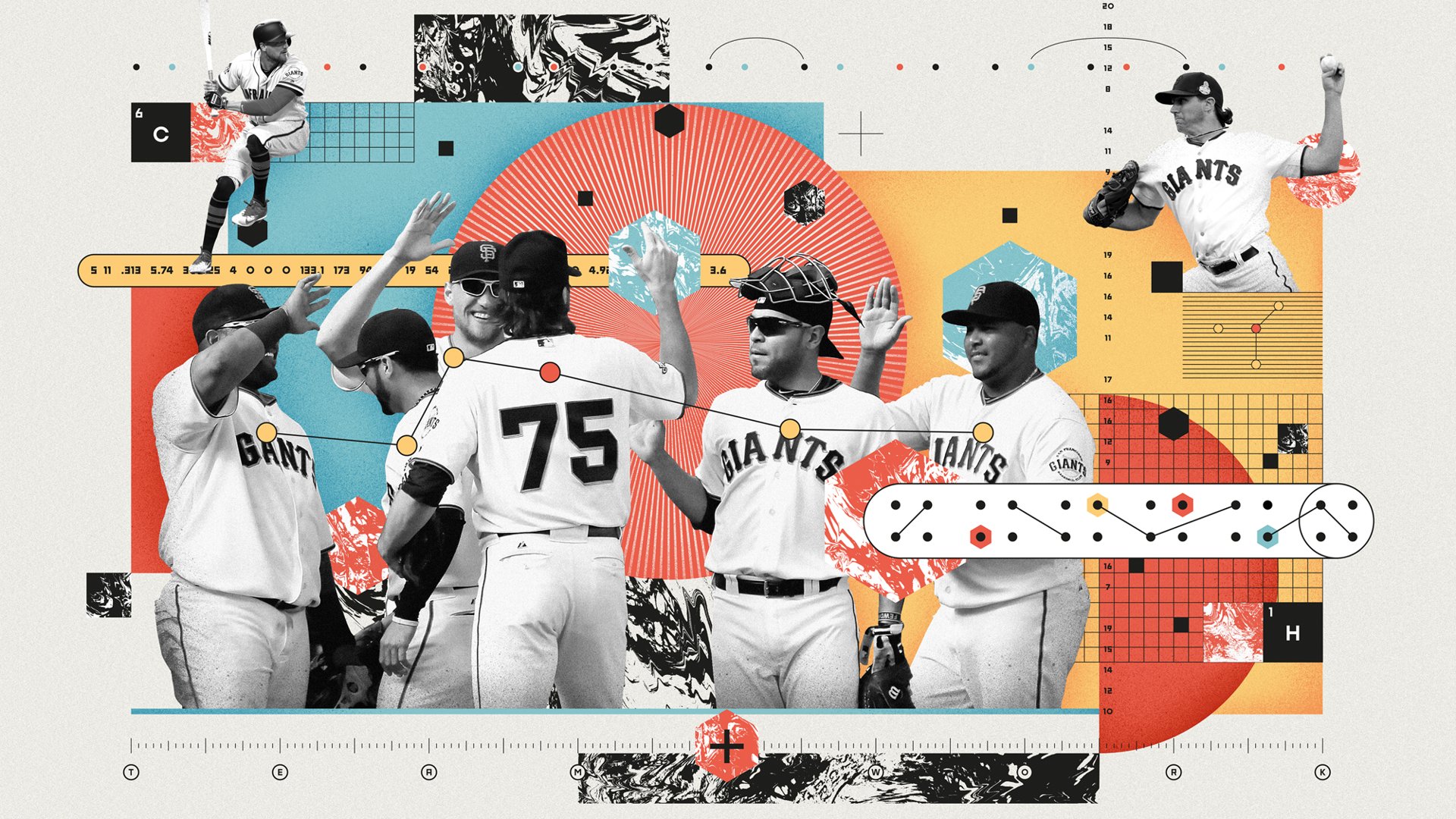
The 2012 San Francisco Giants were widely lauded by sports buffs and journalists alike for their extraordinary chemistry, following their improbable World Series victory. The team made it through the three rounds of the playoffs, as the underdog each time, and twice fought back from a two-game deficit, on the brink of elimination.
Barry Zito, then a declining Giants pitcher who miraculously outdueled opposing pitcher and reigning American League MVP Justin Verlander in a game that had been billed as "one of the great mismatches of World Series history," told me recently about the team's postseason turning point, which he offered as proof of its chemistry. It was a speech, he said, made early in the playoffs by Hunter Pence, a mid-season acquisition. The team was down two games to none in its opening-round, best-of-five playoff series, and would have to win the next three games straight—all on the road. Pence spoke up after the team's manager, Bruce Bochy, concluded his pregame talk. No one had expected remarks from a player, let alone a newish one. And no one expected such intensity: Pence made feverish eye contact, and allegedly spoke with the passion of a revivalist preacher about the need for the team to reawaken.
It seems to have worked. The Giants, of course, did win that night, and they won the next two games as well, and then they won the next two series to become the champs. You could argue that Pence's motivational speech, and its taken-to-heart reception, proves the team had a superior clubhouse atmosphere.
Alternatively, you could note that the Giants didn't play particularly well in the game right after the speech—they got just one hit in the first nine innings. Grant Brisbee, who used to run McCovey Chronicles, a Giants blog, says that luck almost certainly gave them the win. With two outs in the top of the 10th inning and two runners on base, Joaquin Arias, a scrap-heap pickup who had entered the game earlier to pinch-hit, knocked a ground ball toward Scott Rolen, the Cincinnati Reds' third baseman. Rolen is the fifth-best defender ever at third base according to one analytics site, Fangraphs, and in the top 20 of all time by traditional stats such as fielding percentage. And yet, as the ball approached Rolen, it took an in-between hop and bobbled off his mitt. Buster Posey scored on the error, giving the Giants a lead they wouldn't relinquish. One lucky bounce might have been responsible for San Francisco's championship.
That's not to say the team lacked chemistry. (Though the Giants missed the playoffs altogether in 2013, they made another improbable run to the championship in 2014; they'd also won in 2010.) But chemistry has a way of getting entangled with concurrent explanations. "It's a lot easier for us to process a narrative," Brisbee told me, "rather than 'This guy was standing two inches to his left, and that changed the whole postseason.' "
There is no I in team, but there is in statistics. Baseball, like no other sport, has stats that make a special snowflake out of every player. During the moneyball era of the early 2000s, these stats proliferated, and their relative importance was hotly debated, as analysts tried to find clearer links between individual performance and team success. But for the most part, to the analytics community of that era, chemistry was not worth investigating. Some thought it couldn't be measured or, worse, was total "bullshit," as the analyst Rob Neyer once put it. Billy Beane, the Oakland Athletics' general manager who became synonymous with the moneyball revolution, believed that chemistry existed, but that it was brought about by winning, not the other way around.
Still, front offices did consider chemistry, as any hiring body would. Zito, who played for the Athletics before he joined the Giants, told me that Beane "had a good grip of how signings would affect the clubhouse." The team, Zito said, was highly compatible, and would often gather for dinners.
Meanwhile, as the moneyball movement grew, its acolytes began to think they might be missing something. Performance analytics do not predict team success with anything close to certainty. pecota, one of the top stats-based projection systems, was off by an average of nine wins per team in its best season, according to Neil Paine of FiveThirtyEight. Luck and injuries play a large part in statistics falling short. Even so, researchers and writers are coming to think, there's ample space for chemistry to play a role.
Two economists at the Federal Reserve Bank of Chicago and one from Indiana University recently attempted to locate team chemistry by finding places where existing performance metrics fall short. In a paper titled "In Search of David Ross," presented at the 2017 MIT Sloan Sports Analytics Conference, R. Andrew Butters, Scott A. Brave, and Kevin Roberts looked at teams whose win/loss record differed greatly from what would be predicted by the sum of individual performance.
Studying more than 15 seasons' worth of data, they identified the specific players who were on teams that repeatedly overperformed. These players, the economists hypothesized, create chemistry—they have shown repeated ability to elevate their team above the sum of its parts.
David Ross, the paper's namesake, is "the epitome of where advanced metrics and player intangibles are at odds," the authors wrote. Ross is a retired journeyman who played only one full season as a starter during his 15-year career, which ended in 2016. He nevertheless won championships as a backup catcher with both the Boston Red Sox and the Chicago Cubs, and wrote a memoir, with Don Yaeger, a sports journalist, called Teammate. Wherever he went, as the economists confirmed, teams seemed to play better than their individual player statistics suggested they should have.
I spoke with Ross during Major League Baseball's Winter Meetings in December. He was advising the Cubs, and had some time on his hands. (The meetings, typically a frenzy of free-agent signings, were off to a plodding start; the only news was that the canonical team-chemistry guy, the ex-Yankee and now Miami Marlins co-owner Derek Jeter, was spatting with his team's star players.) In a general sense, Ross told me, chemistry isn't hard to sniff out—"It's like walking into a bar and getting a vibe." But what specifically it's made of, and how it can be measured, is a harder question.
Ross said that chemistry is "definitely something that can be learned." The foreword to his memoir, written by Theo Epstein, the Cubs' president of baseball operations and a former Red Sox general manager, explicitly notes that when Epstein was interested in acquiring Ross in August 2008 for the Red Sox, he heard reports that the catcher was "not a good teammate" in Cincinnati. Ross attributes this old reputation to a time, early in his career, when he barged into the team manager's office to complain that he wasn't starting.
In the book, Ross writes about learning to better communicate with players over time, and highlights one moment in 2016 when the Cubs' rookie catcher, Willson Contreras, signaled for an off-speed pitch to try to fool a hitter ahead in the count, instead of directing the pitcher to pitch around him to face a better matchup. Ross noticed the mistake from the bench as he read the sign from Contreras, but he waited a few innings before addressing it. If you call out mistakes immediately after the fact, he notes, you catch people at their most defensive, and if you address every one of them, you can lose goodwill.
The analysis by the economists echoes some of what Ross told me. They found that players do seem to "learn" to create chemistry—intangible contributions to team success tend to rise with age and, for the most part, only become appreciable in players' mid-to-late 30s, which is very late in a player's career. (Good-chemistry players may also just stick around the league longer.) In many cases, the economists found, stars make the largest intangible contributions, just as they make the largest tangible ones—Mike Trout, the best current player by performance metrics, is also the best by raw chemistry rating. By contrast, many "clubhouse cancers"—players who worsen a team's chemistry—began their career with seeming star potential, but never really panned out.
Perhaps the stars are better able to influence a clubhouse by dint of their on-field prowess (or, critics of the Fed paper may note, perhaps they simply cover for other players' poor performance on the field); maybe the never-turned-into-stars leak toxic embitterment. This is speculation. The Fed economists weren't studying clubhouse behavior, nor were they seeking to understand the particular alchemy by which chemistry is created. Other analysts, however, are doing just that. Which brings us back to the high five.
Last year, according to Wall Street Journal reports, a research group was granted access to the San Francisco Giants' minor-league affiliate in San Jose, where it installed cameras with the goal of monitoring associations between dugout interactions—high fives, back pats—and team success. A similar effort is under way in the major leagues, where Dacher Keltner and Hooria Jazaieri, psychologists at UC Berkeley, are conducting research with the goal of finding associations between the supposed subtle physical tells of chemistry and team success.
The entire approach might seem absurd. Can a high five or fist bump really create—or even stand in for—camaraderie, in all its complexity? Then again, as Barry Zito told me, "guys that don't respect each other won't go out of their way to congratulate each other after a big moment." And a celebratory touch can demonstrate a deeper level of acceptance and intimacy. Notably, Glenn Burke, the rookie who offered a raised hand to Dusty Baker after the latter's historic home run, was out of the closet to his teammates by the time of that game back in 1977, the first openly gay player in American professional sports. That moment of contact, in retrospect, helps undercut regressive but still prevalent assumptions about baseball's culture.
Research is still in progress, but David Ross told me he's dubious. He said chemistry is "definitely not about high fives and rah-rah stuff; it's about respect." Nonetheless, his book seems to place a high premium on the gesture. Ross recounts barking at the Atlanta Braves' first-string catcher, Brian McCann, after McCann once forgot to offer him a high five, as was their usual custom, when Ross returned to the dugout after a half inning of defensive work. He also writes about creating a new high five to celebrate home runs, which he calls the "cock bump"—the two players square up to each other and thrust, bumping their cups. And he has strong praise for other ritualistic acts, most notably the naked dance his Cubs teammate Anthony Rizzo did, to the musical accompaniment of the theme from Rocky, before each of the final three games of the 2016 World Series. It kept the team loose, he said, despite being on the brink of elimination—and the Cubs miraculously won all three.

Russell Carleton, a writer for Baseball Prospectus, has found evidence that chemistry can be cultivated in the long term through careful organizational management—one analysis of his, for example, reveals that having less roster turnover from year to year helps a team slug more home runs. But he also notes that undignified rituals, like Rizzo's dance, can go a long way to creating cohesion more spontaneously. A child psychologist by training, Carleton has been a consultant to three Major League Baseball teams. In 2015, when Ben Lindbergh and Sam Miller—baseball geeks and former editors at Baseball Prospectus—were given control of the Sonoma Stompers, a team 10 levels below the majors, they turned to Carleton for guidance on creating chemistry, a skill outside their wheelhouse. In their book, The Only Rule Is It Has to Work, they detail Carleton's advice: Corporate icebreakers are fine, but also have a water-balloon fight—or any other activity that would be welcome at a 12-year-old's birthday party. (Notably, childish spectacles—holding buffoonish dress-up days, bringing bear cubs to practice—are a core team-building activity deployed by Joe Maddon, the Cubs' manager, to keep his players energized.) As Carleton likes to say: "The first rule of child psychology is that it applies throughout all of life."
So does high-school psychology, according to other researchers who are looking, essentially, at the isolation of individual players and the development of cliques on different teams. Katerina Bezrukova, a professor at the University at Buffalo School of Management, looked at the demographic breakdowns of all 30 MLB teams over five seasons, analyzing age, race, nationality, tenure, and salary, on the theory that while diversity was necessary for success, teams with players who were isolated—those without any or many demographic peers—would develop "faultlines," or breaks in chemistry that might be exposed and exacerbated when the team struggled. Her model shows that these fault lines could be mitigated if players in the underrepresented group happened to be clustered together in similar roles (Latino players sitting together in the bull pen as relief pitchers, for example). Over the course of a season, she found, a team with fewer fault lines will win more games, all else being equal.
Bezrukova's work has been criticized for being demographically reductive. Its conclusions are uncomfortably similar to the thought processes of general managers who balked at integration before Branch Rickey signed Jackie Robinson, for instance. But players seem to agree that being isolated makes the game tougher to play. Johnny Cueto, a pitcher on the 2017 Giants, which finished the season 64–98, has spoken about feeling alone as the squad's only Dominican pitcher for most of the season: "When I was with Kansas City, it was a team, I think; it was a very happy bunch because we had a lot of players" from the Dominican Republic. "But here, it's different."
In 2014, ESPN the Magazine used a model designed by Bezrukova and Chester Spell, a Rutgers University business professor, in its preseason MLB predictions, selecting both the Giants and the Royals—the eventual World Series participants—as two of the strongest teams on the chemistry metric. This remains, to date, the strongest evidence that chemistry research can have predictive value.
Whatever insights into chemistry the study of baseball eventually enables, their application to the game may be tricky. Understanding chemistry is an interesting philosophical problem; creating it is a practical one. Research has no value if players (or, for that matter, other types of workers) won't buy into its conclusions. "Twenty-something hypercompetitive males aren't always well known for being in touch with their feelings," Carleton told me. The study of chemistry has been hampered by that fact.
Even so, the turn of the analytics crowd toward intangibles might be welcome in some quarters. Many players have been resistant to much of the new analytics, charging that they suck all the joy and humanity from the game. When the 2017 Washington Nationals, a team highly regarded by the analytics crowd, clinched a postseason berth last September, the outfielder Jayson Werth touted the team's superior chemistry, claiming that it was something the "people upstairs who read books and do math, bullshit like that," could not understand.
As it happened, neither the analysts nor Werth had the team right: For the fourth time in four recent playoff appearances—on account of something unmeasurable, or just by dumb luck—the Nationals were eliminated in the first round as the higher seed.
This article appears in the July/August 2018 print edition with the headline "Finding the Formula for Team Chemistry."
Sent from my iPhone


