The Slav's Baseball Blog - BASEBALL 24-7-365
The Slav's Blog about anything relating to the great game of baseball
- and other less important issues from outside the diamond.
The best baseball blog that you have never heard of.
Both are very inspirational stories demonstrating the incredible strength of the human spirit as well as how much we can accomplish even when it appears that our life challenges or circumstances are hopelessly stacked against us.
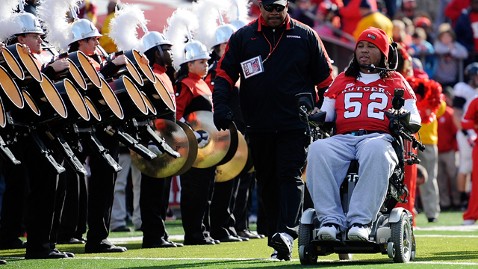
I have heard that Eric LeGrand's rehabilitation goal is to be able to go back to the spot on the field where he was hurt and get back up and walk off the field under his own power.
Let's hope that he finds the strength to do just that.
Maybe we need to appreciate the heroism of ordinary athletes more than what passes for and is accepted as "heroism" on the part of some of our more highly decorated sports heroes.
SANTA ANA, Calif. — When you tell Mater Dei alum Cory Hahn he can't do something, there's a charge that goes through his mind. A charge so strong it borders defiance.
It fuels him.
So after being told he would never function normally again after suffering a freak injury on the baseball field two years ago, it only added fuel to his fire.
Hahn, who played on the United States' first gold-winning 18U team alongside Bryce Harper of the Nationals and Manny Machado of the Orioles, was selected in the 26th round of the 2010 MLB Draft by the San Diego Padres. After already signing his Letter of Intent with Arizona State, he decided to honor his pledge to the Sun Devils.
Fresh off leading Mater Dei High School to a CIF title in 2010 and being named an All-American and Orange County's 2010 Player of the Year, Hahn was ready for the next level.
In just his third game at Arizona State, he was at first base when a double steal was called. It was the first steal attempt of his college career.
The throw was off-line as Hahn slid head first into second base. His head went into the leg of the player covering, fracturing his C-5 vertebrae.
He was left on the field motionless, paralyzed from the chest down.
“No one does inspiration better than Eric,” said Peter Wilderotter, president and CEO of the Christopher & Dana Reeve Foundation, which supports research and advocacy efforts.
“Its significance is huge,” he said. “Chris [Reeve] used to say, ‘It’s what you do after the accident that matters.’ In the 18 months since his injury, it’s been a natural culmination. He wanted a career in broadcasting and wanted to stay involved in football. What a great message for those living with spinal cord injuries and for their families and employers.”
LeGrand’s former coach Greg Schiano has supported the player since he was injured.
“This coach demonstrated that coaching doesn’t end when football season is over,” Wilderotter said of Schiano.
One of the great pleasures of being involved in coaching sports is being exposed to and sharing some of the awesome stories of hope and change that are at the core of teaching and coaching. I read this one from the blog Hoop Thoughts by LSU Lady Tigers basketball coach Bob Starkey. Starkey relates the story shared with him by former LSU mens basketball coach Dale Brown, titled "The Last Day of School" by Roy Exum.
It's quite an awesome Christmas story and a pleasure for me to pass along. The second one, from the same author, Roy Exum, documents some of the years top stories of what I refer to as "The Banality of Heroism".
Merry Christmas to all. Enjoy and God Bless.
Roy Exum: My Most Famous Story by Roy Exum
posted December 18, 2010
Roy Exum
If you’ll bang out the two words, “roy exum” on the website Google’s search line, it will show that there are over 63,300 items now available. That doesn’t mean I am famous - not by any stretch, but only that I’ve been around a long time. And the most prominent of all the stories I’ve ever written that pops up on Google, or any of the other search engines, is one entitled, “The Last Day of School.”
Every Christmas I have people from all around the country write to me and ask about the story. I explain all I did was write down a story, as best I could remember and in my own words, that I once heard the noted psychologist, Tony Campolo, tell at a breakfast meeting.
Actually, the story first appeared about 30 years ago in the old Chattanooga News-Free Press, if that tells you how long it’s been afloat.
Since then, it has been included in text books, church sermons, educational seminars and “Soup for the Soul.” One website posted it with another person’s byline and pirated my version almost verbatim, but I didn’t care.
I will always believe it is one of the greatest Christmas stories ever told, not written, and law, I’ve seen it appear all over the world in all sorts of strange languages. (When I see it in Japanese and Chinese symbols, it is kind of a kick.)
So today, in something that has become a Holiday tradition for an old guy, please bear with me as I once again present...The Last Day of School.
* * *
When Tony Campolo was in Chattanooga last week to speak at the annual "Gathering of Men" breakfast, the noted sociologist told a story that begs to be repeated, especially on this day. It seems that there was a lady named Jean Thompson, and when she stood in front of her fifth-grade class on the very first day of school in the fall, she told the children a lie.
Like most teachers, she looked at her pupils and said that she loved them all the same, that she would treat them all alike. And that was impossible because there in front of her, slumped in his seat on the third row, was a boy named Teddy Stoddard.
Mrs. Thompson had watched Teddy the year before and noticed he didn't play well with the other children, that his clothes were unkempt and that he constantly needed a bath. Add to it the fact Teddy was unpleasant.
It got to the point during the first few months that she would actually take delight in marking his papers with a broad red pen, making bold X's and then marking the "F" at the top of the paper biggest of all.
Because Teddy was a sullen little boy, nobody else seemed to enjoy him either. Now at the school where Mrs. Thompson taught, she was required to review each child's records, and because of things, put Teddy's off until the last. But, when she opened his file, she was in for a surprise.
His first grade teacher wrote, "Teddy is a bright, inquisitive child with a ready laugh. He does work neatly and has good manners...he is a joy to be around."
His second-grade teacher wrote, "Teddy is an excellent student and is well-liked by his classmates - but he is troubled because his mother has a terminal illness and life at home must be a struggle."
His third grade teacher wrote, "Teddy continues to work hard, but his mother's death has been hard on him. He tries to do his best, but his father doesn't show much interest and his home life will soon affect him if some steps aren't taken."
Teddy's fourth grade teacher wrote, "Teddy is withdrawn and doesn't show much interest in school. He doesn't have many friends and sometimes sleeps in class. He is tardy and could become a problem."
By now Mrs. Thompson realized the problem, but Christmas was coming fast. It was all she could do, with the school play and all, until the day before the holidays began and she was suddenly forced to focus on Teddy Stoddard on that last day before the vacation would begin.
Her children brought her presents, all in gay ribbon and bright paper, except for Teddy's, which was clumsily wrapped in the heavy, brown paper of a scissored grocery bag. Mrs. Thompson took pains to open it in the middle of the other presents and some of the children started to laugh when she found a rhinestone bracelet, with some of the stones missing, and a bottle that was one-quarter full of cologne. She stifled the laughter when she exclaimed how pretty the bracelet was, putting it on, and she dabbed some of the perfume behind the other wrist.
At the end of the day, as the other children joyously raced from the room, Teddy Stoddard stayed behind, just long enough to say, "Mrs. Thompson, today you smelled just like my mom used to."
As soon as Teddy left, Mrs. Thompson knelt at her desk and there, after the last day of school before Christmas, she cried for at least an hour. On that very day, she quit teaching reading and writing and speaking. Instead, she began to teach children. And Jean Thompson paid particular attention to one they all called Teddy.
As she worked with him, his mind seemed to come alive. The more she encouraged him, the faster he responded, and, on days that there would be an important test, Mrs. Thompson would remember that cologne. By the end of the year he had become one of the smartest children in the class, and well, he had also become the "pet" of the teacher who had once vowed to love all of her children exactly the same.
A year later she found a note under her door, from Teddy, telling her that of all the teachers he'd had in elementary school, she was his favorite.
Six years went by before she got another note from Teddy. And then he wrote that he had finished high school, third in his class, and she was still his favorite teacher of all time.
Four years after that, she got another letter, saying that while things had been tough at times, that he'd stayed in school, had stuck with it, and would graduate from college with the highest of honors. He assured Mrs. Thompson she was still his favorite teacher.
Then four more years passed and yet another letter came. This time he explained that after he got his bachelor's degree, he decided to go a little further. The letter explained that she was still his favorite teacher, but that now his name was a little longer. And the letter was signed, "Theodore F. Stoddard, M.D."
The story doesn't end there. You see, there was yet another letter that spring. Teddy said that, well, he'd met this girl and was to be married. He explained that his father had died a couple of years ago and he was wondering, well, if Mrs. Thompson might agree to sit in the pew usually reserved for the mother of the groom.
You'll have to decide yourself whether or not she wore that bracelet, the one with several rhinestones missing. But I bet on that special day, Jean Thompson smelled just like, well, just like she smelled many years before on the last day of school before the Christmas Holidays began.
...and the second story.
Roy Exum: They Walk Among Us by Roy Exum
posted December 23, 2010
Quick! Bang the Christmas drum and shake the tinsel from our brass horns. The Carnegie Hero Fund
Commission has just announced the names of 21 more people who walk among us who have been lauded for "extraordinary acts of civilian heroism."
This latest announcement brings into focus a total of 85 brave souls who, just this year, have been saluted by the fund established in 1904 by the famed steel baron Andrew Carnegie, whose ears were first perked when he heard inspiring rescue stories from a mine disaster that killed 181 people.
Are you ready for this? Carnegie was something of a hero himself because since the Hero Commission's inception, $32.9 million has been awarded to 9,412 people in the form of grants, scholarship aid and, sadly in some case, death benefits.
But it's like "The Duke," John Wayne once said,
"Courage is being scared to death...and saddling up anyway."
The Carnegie Awards are about common folk who immediately responded, ignoring loss of life and limb, in order to save another's life.
Greater love has no one than this, that he lay down his life for his friends. - John 15:13
I wanted to get into the story of Josh Hamilton and how great it was during the World Series, but of course, the Rangers did not cooperate by exiting early so I had to wait for another opportunity.
Winning the American League MVP award seems like a good enough second opportunity.
It is, in almost every way that I can see, a story of redemption.
Just like the Michael Vick story.
Just like your story.
Just like my story.
In many ways, it is in fact intertwined with "The Greatest Story Ever Told".
It's a story we should never tire of hearing about.
Regardless of who the story is about.
A British evangelist by the name of Leonard Ravenhill once said:
"The wonder of the grace of God is that God can take an unholy man out of an unholy world, make that man holy, then put him back into that unholy world and keep him holy in it."
That is the story of both Michael Vick and Josh Hamilton. Period. End of story.
Both are practical demonstrations of the gospel of the grace of God!
The frustration that comes from those who lie in wait for a relapse, so they can sit in judgement -- like God among men -- and say "gotcha", miss the point.
The point is made poignantly by Mr. Ravenhill in a sermon titled 'It is Finished' made shortly before his death in 1994.
In it Ravenhill refers to the phrase 'It is Finished' as the 'three most important words in history'. Further, he refers to these words as 'The Greatest Words Ever Uttered, By the Greatest Man That Ever Lived'.
Those are pretty bold statements. Let's see how he backs them up.
Again, going down that road the people mocked Him - that's what the Bible says. "They that passed by reviled Him wagging their heads." What a bunch of dumb, blind, senseless folk. If Caesar comes down the road they bow the knee and say, "Hail, Caesar."
If the priest comes, they stand in awe. But, you see, He not only was, He IS. In this mad, insane, world in which we live, HE STILL IS DISPISED AND REJECTED OF MEN.
We shouldn't put our tongue in our cheek and say this in a whisper. We ought to shout this from the house top. To a world that is groping in darkness we ought to proclaim with a trumpet voice, "It is FINISHED,
you can't buy salvation,
you can't crawl on your knees through the holy city,
you can't go on a pilgrimage,
you can't offer your righteousness,
there is nothing you can do, but bow in humility and confess and accept it."
So it really is a simple process -- this redemption thing.
Have faith, be humble, repent or confess of what you did wrong and and turn away from it.
Seems to me like that is the process that both guys have gone through and are continuing to go through daily. It's between them and God at this point. Not for us mere mortals to come between.
We all should have our own problems to work on don't we?
In his book "The People of the Lie" author M. Scott Peck walks through some of the issues. And they are a bundle of paradoxes.
I started reading this book (highly recommend it to all) when the Vick issue initially came to a boil and I am fortunate that within our church family and community groups we hear about and examine these issues routinely.
I don't pretend to have total understanding of all the issues, however, in the process of examining, I feel like I am coming to a better understanding than I had before. For that, I am very grateful.
In the Introduction of the book -- titled "Handle with Care" -- Peck makes some rather bold declarative statements about evil, recognizing it and dealing with it.
The first thing he says is:
- This is a dangerous book
- evil people are easy to hate
- remember Saint Augustine's advice to hate the sin but love the sinner
- Remember when you recognize an evil person that truly, "There but for the grace of God go I"
- We cannot begin to hope to heal human evil until we are able to look at it directly
- judgments need to be made about people
- such judgments cannot be made safely unless we begin by judging and healing ourselves.
He concludes by saying the "battle to heal human evil always begins at home. And self-purification will always be our greatest weapon."
He goes on, in the last chapter titled "The Danger and the Hope" to talk about
The Danger of Making Moral Judgement:
Even atheists and agnostics believe in Christ's words: "Judge not, that ye be not judged.".....
If we examine the matter closely, however, we will see that it is both impossible and itself evil to totally refrain from making moral judgments. And attitude of "I'm OK; you're OK" may have a certain place in facilitating our social relationships, but only a place.
Was Hitler OK? Lieutenant Calley? Jim Jones?...
What kind of father would I be if I discovered my son cheating, lying or stealing and failed to criticize him? What should I tell a friend who is planning suicide or a pateint who is selling heroin? "You're OK"? There is a such a thing as an excess of sympathy, an excess of tolerance, an excess of permissiveness.
The fact of the matter is that we cannot lead decent lives without making judgments in general and moral judgments in particular....
You and I go through our day making decisions that are judgments, most of which have moral overtones. We cannot escape from judging.
The sentence "Judge not, that ye be not judged" is usually quoted out of context. Christ did not enjoin us to refrain from ever judging. What he went on to say in the next four verses is that we should judge ourselves before we judge others-not that we shouldn't judge at all.
"Thou hypocrite." he said, "first cast out the beam out of thine own eye; and then shalt thou see clearly to cast out the mote out of thy brother's eye."
Recognizing the potential for evil in moral judgments, he instructed us not to always avoid making them but to purify ourselves before doing so. Which is where the evil fail. It is the self-criticism they avoid.
The Dangers in Perspective:
The major threats to our survival no longer stem from nature without but from our own nature within. It is our carelessness, our hostilities, our selfishness and pride and willful ignorance that endanger the world. Unless we can now tame and transmute the potential for evil in the human soul, we shall be lost.
And how can we do this unless we are willing to look at our own evil with the same thoroughness, detached discernment, and rigorous methodology to which we subjected the external world?
The Solution?
Peck touches on the need to recognize the concept of Banality of Evil -- noted by Hannah Ahrendt in her book about former Nazi Adolph Eichmann -- and it's close link to the deception -- in many cases the self-deception -- of The People of the Lie. Peck notes in conclusion in the final chapter
A Methodology of Love:
...we are all in combat against evil.
...if our passion is great enough, we may even be willing to blow ourselves up in the process of "stomping out" evil.
But we run up against the old problem that the end does not justify the means.
If we kill those who are evil, we will become evil ourselves; we will be killers. If we attempt to deal with evil by destroying it, we will end up destroying ourselves, spiritually if not physically.
What to do then?....we must begin by giving up the simple notion that we can effectively conquer evil by destroying it.
Are we to throw up our hands - to regard the problem of evil as being inherently insoluble? Hardly. That would be meaningless. It is in the struggle between good and evil that life has its meaning - and in the hope that goodness can succeed. That hope is our answer: goodness can succeed. Evil can be defeated by goodness. When we translate this we realize what we dimly have always known: Evil can be conquered only by love.
It sounds so simple, so obvious. Then why don't we practice what we preach more? The problem is that although a simple concept in theory, it is difficult to put into practice. Peck calls it a "paradox" and a "dynamic balance of opposites" or a tightrope walk between making easy versus difficult choices.
He compares it to the paradox parents face raising a child. If a parent rejects all misbehavior, that is unloving. But to tolerate all misbehavior is equally unloving. A parent walks a fine line between tolerance and intolerance. Sometimes strict in the use of the rod, sometimes flexible. Peck notes that "an almost godlike compassion is required" or the patience of a saint at the very least.
It is not an easy thing to embrace ugliness with the sole motive of hope that in some unknown way a transformation into beauty might occur thereby. But the myth of kissed frogs turning into princes remains.
Peck states that the first task of love is self-purification. A difficult first step indeed. Many of us do not like to take a long, hard look in the mirror. We deceive ourselves. But the benefits are as follows:
When one has purified oneself, by the grace of God, to the point at which one can truly love one's enemies, a beautiful thing happens. It is as if the boundaries of the soul become so clean as to be transparent, and a unique light then shines forth from the individual.
Who wouldn't want that? Peck admits that the results of this approach are not perfect. The "effect of this light varies". Some are encouraged by it and change the course of their behavior (as Vick and Hamilton appear to have done) but even in failure there can be success.
...those who hate the light will attack it. Yet it is as if their evil actions are taken into the light and consumed. The malignant energy is thereby wasted, contained and neutralized. The process may be painful to the bearer of the light, occasionally even fatal. This does not, however, signify the success of evil. Rather, it backfires. As I said in The Road Less Traveled, "It was evil that raised Christ to the cross, thereby enabling us to see him from afar."
BEAUTIFUL!!!Timeless themes really. Good will conquer evil. The Truth will set you free. Love never fails.
In further explaining how this methodology of love allows good to conquer evil Peck quotes the words of an old priest who dealt with the issue on the front lines everyday.
"There are dozens of ways to deal with evil and several ways to conquer it. All of them are facets of the truth that the only ultimate way to conquer evil is to let it be smothered within a willing, living human being. When it is absorbed there like blood in a sponge or a spear into one's heart, it loses its power and goes no further."
The willing sacrifice of another is required to absorb the evil. Peck asks the question of whether this absorption of evil corrupts the good person. What would then be gained by this seemingly meaningless trade-off?
He admits that he does not know exactly how this process occurs, but he believes that it does. The victim becomes the victor.
He quotes C.S. Lewis: "When a willing victim who had committed no treachery was killed in a traitor's stead, the Table would crack and Death itself would start working backwards."
....I know that good people can deliberately allow themselves to be pierced by the evil of others - to be broken thereby yet somehow not broken - to even be killed in some sense and yet still survive and not succumb. Whenever this happens there is a slight shift in the balance of power in the world.
Amen to that.
And that's why I continue to find these stories to be remarkable and timelessly beautiful to observe.
Dedicated to the men, women and children
who lost their lives; those brave people who gave their lives
And the Heroes that responded to the emergency
11 September 2001
THIS is what our nation is responding to.
Please remember that in the difficult times ahead.
Photos courtesy of: AP, CNN, NY Newsday, NY Daily News,
John O'Sullivan, Colin Walsh, USCG, Families of Victims, Family, Friends & Personal
SEPTEMBER 11TH JOIN US AT GROUND ZERO FOR RALLY OF REMEMBRANCE
YES TO FREEDOM, NO TO GROUND ZERO MOSQUE
The weather will be exactly like 9 years ago.
Rally of Remembrance: No to Ground Zero Mosque
September 11, 3pm Park Pace and West Broadway, Ground Zero
Dedicated to the men, women and children who lost their lives; those brave people who gave their lives. And the Heroes who responded to the emergency
11 September 2001
This morning, as we begin to observe the terrible day of September 11, 2001, let us not fall into mere rote actions and unthinking memorial. We cannot forget that this is not some long past, historical situation that we can comfortably relegate to remembrance on a single day of the year, the rest of our days to go on as if it is but a distant memory. We must keep at the forefront of our minds that we are still in extent danger of another 9/11 at any time and it is only because of the hard and dangerous work that our men and women in uniform are doing every single day that keeps the next towering inferno from our TV screens. The inhuman enemy that caused those Towers to fall, those planes to tumble from the sky, are still out there planning anew. 9/11 is fresh still. Let us remember with a keen pang of loss and rage lest we complacently imagine we are back to a 9/10 world when we are not.
Servant Leadership is based on core values and actions that arise from a desire to serve others. Robert Greenleaf first coined the term as it relates to business, "The servant-leader is servant first…It begins with the natural feeling that one wants to serve, to serve first... [D]o those served grow as persons; do they, while being served, become healthier, wiser, freer, more autonomous, more likely themselves to become servants?"
One of the great debates regarding participation in sports is framed around the question of whether it DEVELOPS character or simply REVEALS the underlying character of the participants. A person's character can be revealed or developed by a number of different people or experiences both within and outside of the sports community.
One of the thing that is generally agreed upon is the need for positive role models within the activity. Whether these role models are family members, friends or teachers/coaches. Are coaches, administrators, officials in youth sports providing this positive environment?
Is the overall environment provided by parents, coaches, administrators and officials
within these activities conducive to a beneficial experience for participants?
Is the competitive environment a positive one for development of both sports skills and skills that will serve participants throughout their lives?
The Citizen through Sports Alliance website listed below graded these areas and provided some interesting results.
------ Concept of Service Leadership
The Citizenship Through Sports Alliance is the largest coalition of professional and amateur athletics organizations in the United States, focused on character in sport. CTSA promotes fair play at all levels - youth leagues to professional sport - to reinforce the value of sport as a test of character. Since 1997, CTSA has been building a sports culture that encourages respect for self, respect for others, and respect for the game.
Because winning has the ability to supercede the values of good conduct, there has been an appreciable decomposition in sportsmanship; the CTSA strives to transcend modern society's obsession with winning at any cost. By elevating athletes to think beyond superficial success, and integrating the values of discipline, loyalty, teamwork, and character, the CTSA believes that a new sports culture can emerge in this new century.
For the first time ever, CTSA convened a panel of youth sports experts from across the
country to evaluate youth sports in the United States and articulate its successes and
failures. The panel evaluated only community-based youth sports programs, focusing
on those that serve children ages 6 to 14. To do so, panel members relied on their own
experiences as youth sports leaders, authors, sociologists, sports psychologists, coaches
and parents, as well as on current research and academic literature.
The group graded the following areas of review:
Child-Centered Philosophy
Coaching
Health and Safety
Officiating
Parental Behaviors/Involvement
It is interesting to note that the areas of Parental Behavior/Involvement and providing a Child-Centered Philosophy received a D.
Coaching received a C-.
Health and Safety received a C+.
Officiating received a B-.
One thing that jumped out at me and the first thing that I thought of was the famous Bobby Knight quote regarding officials. Knight said, "the problem with you referees is you don't care who wins the game". EXACTLY RIGHT.
Notice that the grades given in each category are higher the further you get from being emotionally attached to WINNING and LOSING.
THE PANEL'S CONCLUSIONS:
A loss of child-centered focus with less emphasis on the child's experience and more emphasis on adult-centered motives such as winning.
Over-invested parents with unrealistic expectations behave in a way that fails to promote the development of their own child and others.
An increased emphasis on early sports specialization and a hyper-competitive environment increased by travel team participation at earlier and earlier ages--leading to burnout and overuse injuries.
Loss of the voice of the child who participates for reasons different from parents and coaches interests--fun, friends, fitness and skill development.
It is interesting to note as well that this ties in to many experts conclusion that as athletes advance further up the ladder--from youth leagues to high school, college and the professional ranks--the less concern there is for character development and ethical behavior exhibited by the athletes.
The areas the panel found to be unacceptable within each category were as follows:
Parental Behavior/Involvement: 1) parents behave appropriately at games and show respect for officials, coaches and participants. 2) parental behavior..reflects an understanding of their role as parents and positive supporters--not as unofficial coaches.
Child Centered Philosophy: 1) youth sports leaders, parents and coaches put the goals of children..first. 2) youth sports leaders set expectations and hold parents, coaches and themselves accountable for sportsmanship, civility and commitment to a child-centered philosophy.
Coaching: 1) coaches focus on effort, skill development, positive reinforcement and fun. (AHEAD OF WINNING)
The areas of Health and Safety and Officiating received no unacceptable areas graded, which is great news. As far as areas needing improvement--promoting healthy habits, background checks, and emphasis on health and safety of participants were listed for Health and Safety and officials were called on to provide better training in rules, techniques and safety and adequate pool of trained officials for games and tournaments.
As someone who has participated in all these areas under review at one time or another I can tell you that if the sportsmanship area was improved the pool of officials would not have the turnover it does.
But it goes back to the Bobby Knight quote, if the overarching concern on winning and losing were magically removed tomorrow, we would have a better sports environment. To some that seems like it's an unrealistic goal, but the reality is if coaches and administrators adopted a more SERVANT-LEADERSHIP approach to their jobs, the environment would in fact improve.
Officials and administrators are their to serve, not to profit from the games.
Coaches are their to serve their athletes, not to profit in some manner from them.
The two programs listed below attempt to provide this type of climate to all participants in sports from the youth to collegiate level. Both take a servant-leadership or service-learning approach. Along with my other favorite organization CharacterCounts.org are taking steps to improve the climate in youth sports today and hopefully we will see improvement in spite of some of the recent trends.
The pros are on their own. In that arena, winning and losing is important.
--------- Concept of Servant Leadership
Winning With Character is a non-profit organization providing character, ethics, and leadership training to high school and college athletic programs.
The Servant Sport Leadership Program has been developed by the Winning With Character Foundation and the University of Idaho Center for ETHICS* to help coaches and teams develop a sense of unity built upon a foundation of character. The ground work of this program lies in effective leadership approaches modeled by coaches and key players.
--------
The Know Greater Heroes program has an element of the "Banality of Heroism" concept coined by Stanford professor Phillip Zimbardo. It takes a service learning approach to show kids, one at a time, that they "can" make a difference in the life of others and they can "get" more sometimes when they "give" first. Great program.
Throughout time and in every culture, HEROES with character have been revered in tales, written about in literature, viewed on the big screen, and looked to as role-models. Never in the history of the world, has there been a more profound need for heroes – men and women educated in integrity and empowered to tackle society’s most pressing issues - in every community, home, school, and boardroom. Introducing KNOW GREATER HEROES.
Know Greater Heroes addresses this problem. It provides and cultivates the grounds in which heroes can grow. THE MISSION is to empower communities with an engaging program that awakens the hero within each of us, thereby assisting all to succeed brilliantly through life's challenges.
-----
SERVICE - Be devoted to one another in brotherly love; honor one another above yourselves - Romans 12:10
Just as the Son of Man did not come to be served, but to serve, and to give his life as a ransom for many - Matthew 20:28
Kaleb Eulls is a 6 foot 4, 255 pound, do-everything, ambidextrous QB and DE for Yazoo County HS in Mississippi. Did I mention he also handles the punting duties as well as kickoffs and extra points?
He received scholarship offers from football powerhouses like Florida, LSU and Georgia. He committed this summer to play for Mississippi State. He has the kind of ability that makes the recruiting message boards light up and the antennae on Mel Kiper and Todd McShay's future stars list begins to do a little shimmy-shake.
Did I mention that he is also a great student? So what must this already well-recognized and honored football "hero" do to garner national attention?
Was that the type of highlight film you expected? The voice coming from the back of the bus saying "I've got the gun" was from Kaleb. Probably the most important "forced fumble and recovery" he will ever make.
Doesn't the title of the story just say it all? Kaleb Eulls' heroic action a decade in the making
Although on the surface, this seems like the prototypical man bites dog story--people just don't make this type of heroic action normally, do they?--if we look to the world of academia, maybe that perception doesn't have to be so.
Philip Zimbardo, a Stanford professor, coined the term "Banality of Heroism" to describe the phenomenon in his book "The Lucifer Effect: Understanding How Good People Turn Evil".
In the book Zimbardo illustrates through his shocking Stanford Prison Experiment how easy it is for "normal" people to commit heinous acts when put in a unique cauldron of circumstances. This highlighted the "Banality of Evil" concept described by Hannah Arendt in her work titled "Eichmann in Jerusalem: A Report on the Banality of Evil"
Although much of the Lucifer Effect text revolves around the negatives of human behavior, salvation comes in the final chapter (16) where I flip the coin and celebrate what is best in humanity-- those among us who move from passive observers to take heroic action. In celebrating heroism, I challenge the traditional view of heroes as extraordinary people, as super-special agents of noble deeds. In doing so, I distinguish between those rare people whose whole lives are centered around sacrifice for the good of society or for the well being of their fellows, chronic heroes, and those ordinary folks who are moved to an heroic deed in a specific situation at a particular time.
Their heroic deeds are always special, but these heroes are just plain folks, ordinary citizens, who “do what they had to do” when moved to action by some call to service. Typically, they say, “It was nothing special;” “I did what anyone would do in that situation.” And some add, “and what everyone ought to do.” I refer to this phenomenon as “the banality of heroism.” Doing so, obviously trades off of its similar opposite in the phrase coined by Hannah Arendt, “the banality of evil,” that she used to describe why modern criminals, like Nazi Adolph Eichmann were so frightening precisely because they are “terrifyingly normal.”
We also want to believe that there is something IN some people that drives them toward evil, while there is something different IN others that drives them toward good. It is an obvious notion but there is no hard evidence to support that dispositional view of evil and good, certainly not the inner determinants of heroism. There may be, but I need to see reliable data before I am convinced. Till then, I am proposing we focus on situational determinants of evil and good, trying to understand what about certain behavioral settings pushes some of us to become perpetrators of evil, others to look the other way in the presence of evil doers, tacitly condoning their actions and thus being guilty of the evil of inaction, while others act heroically on behalf of those in need or righting injustice. Some situations can inflame the “hostile imagination,” propelling good people to do bad deeds, while something in that same setting can inspire the “heroic imagination” propelling ordinary people toward actions that their culture at a given time determines is “heroic.” I argue in Lucifer and recent essays, that follow here, it is vital for every society to have its institutions teach heroism, building into such teachings the importance of mentally rehearsing taking heroic action—thus to be ready to act when called to service for a moral cause or just to help a victim in distress.
Historical inquiry and behavioral science have demonstrated the "banality of evil" -- that is, under certain conditions and social pressures, ordinary people can commit acts that would otherwise be unthinkable.
But because evil is so fascinating, we have been obsessed with focusing upon and analyzing evildoers. Perhaps because of the tragic experiences of the Second World War, we have neglected to consider the flip side of the banality of evil: Is it also possible that heroic acts are something that anyone can perform, given the right mind-set and conditions? Could there also be a "banality of heroism"?
The banality of heroism concept suggests that we are all potential heroes waiting for a moment in life to perform a heroic deed. The decision to act heroically is a choice that many of us will be called upon to make at some point in time. By conceiving of heroism as a universal attribute of human nature, not as a rare feature of the few "heroic elect," heroism becomes something that seems in the range of possibilities for every person, perhaps inspiring more of us to answer that call.
It's clear that we will always have this battle of "good" vs. "evil". It illustrates the importance of having a solid base of character development so that we understand when the proper time and place to stand up and say "NO!!" arises, whether it's confronting a teen with a gun or an authority figure asking to do that which you know is wrong, you will have the strength to act heroically.
Too often we are almost comforted by the fact that perceived "evil-doers" are "not like us". We don't want to hear that we may all be capable of perpetrating similar crimes if we were put in similar settings. The works of Zimbardo and the famous Milgrim experiments at Harvard clearly demonstrates the fallacy of clinging to those inconvenient truths.
By the same token, we are too often led to believe that these heroic actions are anomalies as well. We couldn't do that, COULD WE? Well, why the heck not?
The quote from Kaleb's high school coach wraps it up best:
“I’m very proud of him,” Eulls’ football coach Matt Williams said. “He doesn’t have to score any more touchdowns or make any sacks, he is probably the greatest kid I’ll ever be a part of.”
1. Joey Bart 6-2, 215 C Power arm and a power bat, playing a premium defensive position. Good catch and throw skills.
2. Heliot Ramos 6-2, 185 OF Potential high-ceiling player the Giants have been looking for. Great bat speed, early returns were impressive.
3. Chris Shaw 6-3. 230 1B Lefty power bat, limited defensively to 1B, Matt Adams comp?
4. Tyler Beede 6-4, 215 RHP from Vanderbilt projects as top of the rotation starter when he works out his command/control issues. When he misses, he misses by a bunch.
5. Stephen Duggar 6-1, 170 CF Another toolsy, under-achieving OF in the Gary Brown mold, hoping for better results.
6. Sandro Fabian 6-0, 180 OF Dominican signee from 2014, shows some pop in his bat. Below average arm and lack of speed should push him towards LF.
7. Aramis Garcia 6-2, 220 C from Florida INTL projects as a good bat behind the dish with enough defensive skill to play there long-term
8. Heath Quinn 6-2, 190 OF Strong hitter, makes contact with improving approach at the plate. Returns from hamate bone injury.
9. Garrett Williams 6-1, 205 LHP Former Oklahoma standout, Giants prototype, low-ceiling, high-floor prospect.
10. Shaun Anderson 6-4, 225 RHP Large frame, 3.36 K/BB rate. Can start or relieve
11. Jacob Gonzalez 6-3, 190 3B Good pedigree, impressive bat for HS prospect.
12. Seth Corry 6-2 195 LHP Highly regard HS pick. Was mentioned as possible chip in high profile trades.
13. C.J. Hinojosa 5-10, 175 SS Scrappy IF prospect in the mold of Kelby Tomlinson, just gets it done.
14. Garett Cave 6-4, 200 RHP He misses a lot of bats and at times, the plate. 13 K/9 an 5 B/9. Wild thing.
2019 MLB Draft - Top HS Draft Prospects
1. Bobby Witt, Jr. 6-1,185 SS Colleyville Heritage HS (TX) Oklahoma commit. Outstanding defensive SS who can hit. 6.4 speed in 60 yd. Touched 97 on mound. Son of former major leaguer. Five tool potential.
2. Riley Greene 6-2, 190 OF Haggerty HS (FL) Florida commit.Best HS hitting prospect. LH bat with good eye, plate discipline and developing power.
3. C.J. Abrams 6-2, 180 SS Blessed Trinity HS (GA) High-ceiling athlete. 70 speed with plus arm. Hitting needs to develop as he matures. Alabama commit.
4. Reece Hinds 6-4, 210 SS Niceville HS (FL) Power bat, committed to LSU. Plus arm, solid enough bat to move to 3B down the road. 98MPH arm.
5. Daniel Espino 6-3, 200 RHP Georgia Premier Academy (GA) LSU commit. Touches 98 on FB with wipe out SL.
2019 MLB Draft - Top College Draft Prospects
1. Adley Rutschman C Oregon State Plus defender with great arm. Excellent receiver plus a switch hitter with some pop in the bat.
2. Shea Langliers C Baylor Excelent throw and catch skills with good pop time. Quick bat, uses all fields approach with some pop.
3. Zack Thompson 6-2 LHP Kentucky Missed time with an elbow issue. FB up to 95 with plenty of secondary stuff.
4. Matt Wallner 6-5 OF Southern Miss Run producing bat plus mid to upper 90's FB closer. Power bat from the left side, athletic for size.
5. Nick Lodolo LHP TCU Tall LHP, 95MPH FB and solid breaking stuff.