Showing posts with label PSYCHOLOGY TODAY. Show all posts

Thursday, August 02, 2018

The Best Players Rarely Make the Best Coaches | Psychology Today

The Best Players Rarely Make the Best Coaches | Psychology TodayImage result for the best players rarely make the best coaches

JACKSONVILLE - At the youth level, I can tell you that parents "believe" that the best players make the best coaches and throw a lot of money at what seems to be a low-ROI investment.

from psychologytoday.com
https://www.psychologytoday.com/us/blog/choke/201008/the-best-players-rarely-make-the-best-coaches

The Best Players Rarely Make the Best Coaches

Why those who do can't teach

The 92nd P.G.A Championship ended yesterday with the usual fanfare and excitement that this last major of the year typically garners. But, what this tournament may be most remembered for was the younger generation of golfers - most who had not yet won a major - that sat atop the leaderboard throughout the final days at Whistling Straits.

Seasoned players like Padraig Harrington missed the cut and, although we saw some amazing shots, Tiger Woods was never really in contention. With younger players climbing the superstar ranks, you might wonder if it is time for some of the older generation to think about retirement. But, what does a golfer do after his career on the tour is over? There is of course a long list of options. You might be interested to know, however, that sport science research suggests that coaching should NOT be one of them - especially if a player wants to keep his game at a high level.
As it happens, the best players don't make the best coaches in sports. According to Canadian gold-medal hockey player Therese Brisson, "Recently retired hockey players who played at high levels rarely make the ideal coaches for youth hockey. They know what to do, but they can't communicate how they do it!" She says that given the choice between a skilled hockey player and an experienced physical education teacher to help at the youth hockey camps she now runs, she will always take the teacher. "Teaching skating skills is one of those problem areas," Brisson says. "How exactly do you skate faster?" Being able to communicate this type of information comes from coaching experience, not from playing experience.
This sentiment applies in golf too. Take a recent study conducted by psychologists Mike Anderson and Kristin Flegal.1 The researchers asked expert golfers and beginners to take some short putts on a fairly flat, straight green. The golfers then spent several minutes describing the putts they had just taken or they worked on an unrelated task, instead. Afterwards, all the golfers were asked to perform the putts again. After spending time describing their past putts, the expert golfers needed twice as many attempts to sink their putts as experts who had not put their performances into words. Beginning golfers' performances were not affected by describing putts. These less skilled players even improved a little bit when asked to recount what they had just done.


As I have blogged about in the past, for well-learned activities like taking a free throw, hitting a simple putt, or playing a cadence that you have performed a thousand times in the past, thinking too much about the step-by-step processes of what you are doing can be detrimental. But, it's not just that trying to describe your performance can disrupt it. Skilled performers often have trouble putting their actions into words in the first place. That's why those who perform at the highest levels should think twice about teaching their skills to others. When a scratch golfer in my lab, for instance, was asked to describe a putt he just took, he replied, "I don't know, I don't think while I putt." When your performance flows largely outside of your conscious awareness, your memories of what you've done are just not that good. This makes it hard to teach what you know to someone else. Just think about the type of description you might get from Michael Jordan if he were asked how he dunks a basketball. He might invoke the Nike motto and say that he "just does it," not because he doesn't want to give away his flying secrets, but because he may not know what he does.

As you get better and better at what you do, your ability to communicate your understanding or to help others learn that skill often gets worse and worse. This communication can even screw you up. Just think about golfer Ralph Guldahl, who won the US Open in both 1937 and 1938 and then the Masters in 1939. He was, at the time, one of the best players in the world. Then he wrote, "Groove Your Golf" - a how to guide for the beginning player. Guldahl never won another championship again.
__
1Flegal, K. E., & Anderson, M. C. (2008). Overthinking skilled motor performance: Or why those who teach can't do. Psychonomic Bulletin & Review, 15, 927-932


Sent from my iPhone

Tuesday, June 12, 2018

Genetic disorder knocks out prejudice | Psychology Today

Image result for no more prejudice


This leaves us all with somewhat of a societal dilemma; to be prejudice free, but perhaps an over-abundance of faith/acceptance in total strangers.

That would be a tough sell for parents of children.

Sure kid, that person offering a lollipop if you get in his car probably has your best interests at heart. It's tough being a parent these days. I believe we refer to this in economics as a trade-off.

from Psychology Today:
Genetic disorder knocks out prejudice | Psychology Today:

Genetic disorder knocks out prejudice.

Posted Apr 28, 2010
To someone with Williams syndrome, every face looks like a friend - even snarling, angry faces that signal most people to steer clear. Williams is a rare genetic disorder, whose most striking feature is a deficit in social fear. New research suggests that Williams may also confer a strange "deficit" in prejudice.
Andreia Santos and colleagues tested 20 children with Williams between the ages of 7-16, and 20 children without Williams of the same age range (presumably they were all White, though the article does not specify). The test was simple, showing pairs of people side by side. Half of the pairs differed by gender, the other half by race. For the test of racial prejudice, the children were told simple stories that included good or bad traits, like kind, pretty, smart, and bad, ugly, and stupid. Then they were asked to pick which person in the pair the story was about. The children without Williams showed strong evidence of racial bias, selecting the White person most of the time for good traits, and the Black person most of the time for bad traits. But the children with Williams did not show any evidence of bias. They picked the White and Black characters at the same rate as chance.
If this were the only comparison the researchers made it would be tempting to think that the Williams children just didn't understand the test. After all, people with Williams syndrome typically have some cognitive disabilities. But the researchers also did a gender stereotyping version of the test. It worked the same as the race test, but included stereotypical sex roles instead of good and bad traits. Williams children had no trouble guessing that the house cleaner was probably the woman, and the mechanic was probably the man, and they did so at the same rate as the control children. They understood the test, and they showed the gender stereotypes that are typical of children their age.
So, what should we make of this lack of racial bias? First, the thing we should most definitely NOT conclude is that there is a "gene for racism," or that people are "hard wired" for anything of the sort. We know from other research that although very young infants can distinguish between men and women, it takes a few years of development before they can even tell the difference between people of different races. They might learn race biases early - some studies show racial bias as young as 3-5 years old - but they have to learn it. This study is a good reminder that genes don't code for specific behaviors or beliefs. Genes make people more or less sensitive to aspects of their environment.
Santos and colleagues argue that Williams syndrome makes kids insensitive to social fear. The interesting thing about Williams kids - and a scary thing for their parents - is that they will have complete trust in complete strangers. They are famously friendly, and love to talk. A story on NPR this week described a little girl with Williams, who charmed teachers and staff by ending all her conversations with "I love you." The girl's mother found it less charming, because she would have the same kind of "I love you" conversations with the salesman at Circuit city, the grocery store clerk, anybody.
Still, Williams children are not totally fearless. They are just as afraid of non-social threats like spiders and bees as other children. The fascinating thing about this disorder is how remarkably specific it is. It's this specificity that offers a new perspective on how racial prejudice works in America today. At bottom, this research is important because it suggests that social fear is at the root of racial prejudice.
This race-fear link is consistent with my own research showing that healthy White adults are more likely to mistake a harmless object like a cell phone or wallet for a gun if it belongs to a Black man. And research by Kurt Hugenberg showing that when people view facial expressions of emotion, the darker the skin color of the face, the more likely people are to think the face looks angry.
The most interesting unanswered question for me is what kind of fear makes the difference between developing or not developing racial prejudice? Is it a particular fear of Black people, based on stereotypes, as dangerous or criminal? Or is it the more general fear of uncertain and awkward interactions with people who look different? Join the conversation by commenting below.


'via Blog this'

Tuesday, April 19, 2016

Physical Activity Is the No. 1 Way to Keep Your Brain Young | Psychology Today

University of Tsukuba, used with permission


from Psychology Today:
https://www.psychologytoday.com/blog/the-athletes-way/201510/physical-activity-is-the-no-1-way-keep-your-brain-young

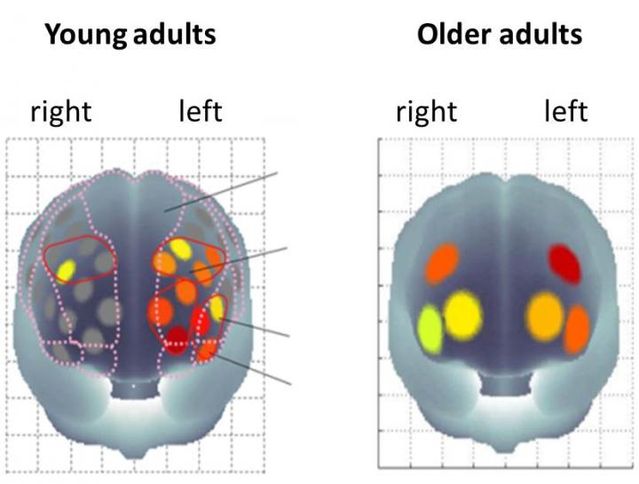
Stroop-interference-related cortical activation patterns are shown.
Source: University of Tsukuba, used with permission
Every day, my inbox seems to be flooded with new findings that physical exercise improves brain health and cognitive function. Yesterday, my mother, along with about a dozen other people, forwarded me a New York Times article from the Sunday Review, "Can You Get Smarter?(link is external)" by op-ed writer, Richard A. Friedman. My mom summed up the article in her email saying, "Did you see this? Exercise!! :-)"
I've been writing about the link between physical fitness and mental fitness for over a decade. Since the beginning, I've also stated my belief that maintaining close-knit human bonds is second only to exercise in terms of our lifelong physical and psychological well-being, which is something Friedman also speaks about in his article. 
Many of the findings that I published 10 years ago in The Athlete's Way: Sweat and the Biology of Bliss(link is external) were mentioned by Friedman in his recent NYT article such as, the idea that mindset is never fixed because of neuroplasticity and that the neurogenesis of new neurons caused by a protein called brain-derived neurotrophic factor (BDNF) is triggered through aerobic exercise. As Friedman explains,
"Intriguingly, exercise in humans and animals increases the level of a protein called brain-derived neurotrophic factor(link is external), or BDNF, in the blood and brain. BDNF promotes the growth and formation of new neurons, and it may be responsible, in part, for a remarkable effect of exercise on the brain: an increase in size of the hippocampus that is linked with improved memory.
Conversely, adverse experiences like major depression can lower BDNF levels and are associated with hippocampal shrinkage, a phenomenon that helps explain some of the cognitive impairments that are a hallmark of depression. Aside from making people feel better, antidepressants can block the depression-induced drop in BDNF, so these drugs are, in a sense, neuroprotective."

White Matter and Gray Matter Work Together to Optimize Brain Function

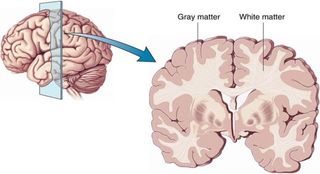
Something that I did not write about a decade ago—but which has come to light in recent years—is that exercise seems to optimize both gray matter brain volumes and white matter integrity.
MS blogspot/Labeled for reuse.
Source: MS blogspot/Labeled for reuse.
Gray matter(link is external) houses the neurons in specific brain regions. White matter(link is external)facilitates the communication between various brain regions. Gray and white matter work together to optimize brain function. The fact that physical activity benefits both gray and white matter is the primary reason that exercise is the No. 1 way to keep your brain young.
Recently, researchers at the Beckman Institute(link is external) at the University of Illinois at Urbana-Champaign, led by Art Kramer(link is external) identified that older adults who regularly engage in moderate to vigorous physical activity tend to have better brain function and greater white matter integrity than their less-fit peers. They also have increased cognitive flexibility.
Cognitive flexibility is a person's ability to switch between modes of thought and to simultaneously think about multiple concepts. I wrote about these findings in an August 2015 Psychology Today blog post, "Why Does Physical Activity Improve Cognitive Flexibility?"
Previously, other studies by Kramer and his colleagues have found white matter improvement linked to physical activity in various age groups. In 2014, Chaddock-Heyman et al found that higher levels of aerobic fitness in children is associated with improved white matter integrity. The team identified that exercise improves the microstructures of white matter in the brain. White matter integrity is linked to faster neural conduction between brain regions and superior cognitive performance.
In two separate 2014 studies—released within the same month—the Beckman researchers reported that physical activity improved the white matter integrity of physically fit children aged 9 to 10 and also in "low-fit" participants aged 60 to 78. I wrote about these findings in a Psychology Today blog post, "Why Is Physical Activity So Good for Your Brain?"

Active Body, Younger Brain

A new study by researchers in Japan led by Dr. Hideaki Soya(link is external), a professor of exercise biochemistry, from the University of Tsukuba and his colleagues shows, for the first time, a direct relationship between brain activity, brain function, and physical fitness in a group of older men.
The October 2015 study, "The Association Between Aerobic Fitness and Cognitive Function in Older Men Mediated by Frontal Lateralization(link is external)," was published in the journalNeuroImage. The researchers found that fitter men performed better mentally than their less-fit peers. The researchers believe the improved cognitive function was the result of using parts of their brains in the same way as people of a younger age.
According to Soya et al, when someone is young, he or she primarily uses the left side of the prefrontal cortex for mental tasks involving short-term memory, understanding the meaning of words and the ability to recognize previously encountered events, objects, or people. However, as we get older, people tend to also use parts of their prefrontal cortex on the right side of the cerebrum(link is external) (Latin for "brain") during these tasks. Both hemispheres of the prefrontal cortex are believed to play a role in our executive function, memory,intelligence, language, and vision.
The researchers said that for tasks involving the temporary storage and manipulation of memory, long-term memories, and inhibitory control—younger adults typically favor the right side of the prefrontal cortex, while older adults engage both hemispheres.
In a press release the researchers said, "This phenomenon has been coined HAROLD (hemispheric asymmetry reduction in older adults) and reflects the reorganization of the brain as compensation for reduced brain capacity and efficiency due to age-related structural and physiological decline."
Wikimedia/Creative Commons
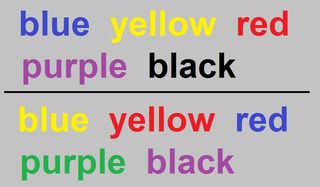
Example of the Stroop test. 
Source: Wikimedia/Creative Commons
For this study, men aged 64-75 years underwent an exercise test to measure their aerobic fitness. The men, whose physical fitness levels varied greatly, then performed a Stroop test to measure their selective attention, executive function, and reaction time. The Stroop test involves reading the word for a color, such as "blue, green, red," but asking the subject to name the color of the word rather than read the word itself.
When the color of the letters doesn't match the word, it takes the brain longer to react, as you can see by taking the Stroop test above. The length of someone's reaction time is used as a measurement of brain function. During this experiment, the brain activity in the prefrontal cortex was measured throughout the Stroop test using a unique neuroimaging technique called Functional Near Infrared Spectroscopy (fNIRS).
This brain imaging technique measures blood oxygen concentration in surface blood vessels using a set of wearable probes in a cap that is placed on the head. Active brain cells require fresh oxygenated blood which dislodges the deoxygenated blood from that region. fNIRS technically measures the changes in color between oxygenated blood (red) and deoxygenated blood (blue). This provides a measurement of brain activity.
The results showed that during the Stroop test older adults typically used both sides of the prefrontal cortex actively, with no difference between right and left, verifying the HAROLD phenomenon amongst this group of men. However, when the association between aerobic fitness and Stroop reaction time was analyzed, the men who were aerobically fit had shorter reaction times.
The researchers were able to identify that higher aerobic fitness is associated with higher left prefrontal cortex activity. Based on these findings, the researchers conclude that more aerobically fit older men can perform better mentally than less-fit older men because they're able to use specific brain regions more fluidly when necessary.
In fact, the fitter older men were using parts of their brains in the same way as they would have when they were younger, the researchers found. These results suggest that higher aerobic fitness is associated with cognitive function via lateralized frontal activation in older adults.
In a press release, Professor Soya concluded, "One possible explanation suggested by the research is that the volume and integrity of the white matter in the part of brain that links the two sides declines with age. There is some evidence to support the theory that fitter adults are able to better maintain this white matter than less fit adults, but further study is needed to confirm this theory."

Conclusion: Physical Activity, Brain Connectivity, and Superfluidity

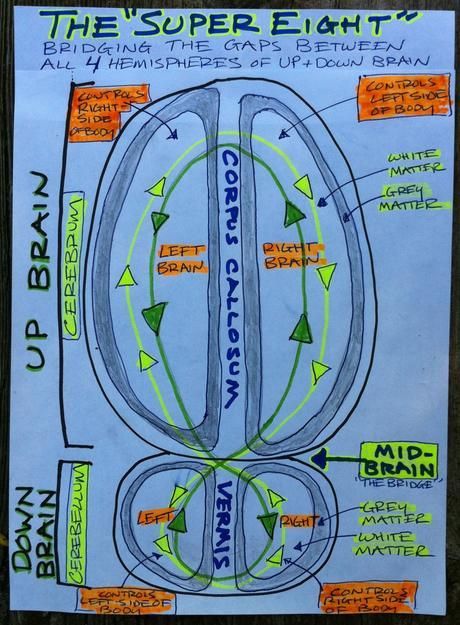
Based on decades of research, I've developed an original hypothesis that physical activity optimizes the structure, function, and connectivity of both hemispheres of the cerebrum and both hemispheres of the cerebellum(link is external) (Latin for "little brain").
To date, most research has focused primarily on the lateralization and connectivity between the left and right hemispheres of the cerebrum across the corpus callosum. But in recent months, there has been a groundswell of research that examines the role of the cerebellum in cognitive function and the creative process. 
Below is a rudimentary sketch that I drew a few years ago to illustrate my concept of superfluidity and brain connectivity between all four hemispheres:
Illustration and photo by Christopher Bergland
Optimizing the structure, function, and connectivity of all four brain hemispheres is the key to superfluidity.
Source: Illustration and photo by Christopher Bergland
I have a hunch that creating a state of superfluidity, which is the highest tier of flow, occurs when there is "zero friction, entropy, or viscosity" between all four brain hemispheres. I believe that the optimization of gray and white matter in the cerebrum and the cerebellum is the key to cognitive flexibility, creativity, and peak performance. This is still an educated guess. That said, I am constantly searching for new clues to prove my hypothesis. Stay tuned!
If you'd like to  read more on this topic, check out my Psychology Today blog posts,
© 2015 Christopher Bergland. All rights reserved.

Sent from my iPhone

Giants Top Minor League Prospects

  • 1. Joey Bart 6-2, 215 C Power arm and a power bat, playing a premium defensive position. Good catch and throw skills.
  • 2. Heliot Ramos 6-2, 185 OF Potential high-ceiling player the Giants have been looking for. Great bat speed, early returns were impressive.
  • 3. Chris Shaw 6-3. 230 1B Lefty power bat, limited defensively to 1B, Matt Adams comp?
  • 4. Tyler Beede 6-4, 215 RHP from Vanderbilt projects as top of the rotation starter when he works out his command/control issues. When he misses, he misses by a bunch.
  • 5. Stephen Duggar 6-1, 170 CF Another toolsy, under-achieving OF in the Gary Brown mold, hoping for better results.
  • 6. Sandro Fabian 6-0, 180 OF Dominican signee from 2014, shows some pop in his bat. Below average arm and lack of speed should push him towards LF.
  • 7. Aramis Garcia 6-2, 220 C from Florida INTL projects as a good bat behind the dish with enough defensive skill to play there long-term
  • 8. Heath Quinn 6-2, 190 OF Strong hitter, makes contact with improving approach at the plate. Returns from hamate bone injury.
  • 9. Garrett Williams 6-1, 205 LHP Former Oklahoma standout, Giants prototype, low-ceiling, high-floor prospect.
  • 10. Shaun Anderson 6-4, 225 RHP Large frame, 3.36 K/BB rate. Can start or relieve
  • 11. Jacob Gonzalez 6-3, 190 3B Good pedigree, impressive bat for HS prospect.
  • 12. Seth Corry 6-2 195 LHP Highly regard HS pick. Was mentioned as possible chip in high profile trades.
  • 13. C.J. Hinojosa 5-10, 175 SS Scrappy IF prospect in the mold of Kelby Tomlinson, just gets it done.
  • 14. Garett Cave 6-4, 200 RHP He misses a lot of bats and at times, the plate. 13 K/9 an 5 B/9. Wild thing.

2019 MLB Draft - Top HS Draft Prospects

  • 1. Bobby Witt, Jr. 6-1,185 SS Colleyville Heritage HS (TX) Oklahoma commit. Outstanding defensive SS who can hit. 6.4 speed in 60 yd. Touched 97 on mound. Son of former major leaguer. Five tool potential.
  • 2. Riley Greene 6-2, 190 OF Haggerty HS (FL) Florida commit.Best HS hitting prospect. LH bat with good eye, plate discipline and developing power.
  • 3. C.J. Abrams 6-2, 180 SS Blessed Trinity HS (GA) High-ceiling athlete. 70 speed with plus arm. Hitting needs to develop as he matures. Alabama commit.
  • 4. Reece Hinds 6-4, 210 SS Niceville HS (FL) Power bat, committed to LSU. Plus arm, solid enough bat to move to 3B down the road. 98MPH arm.
  • 5. Daniel Espino 6-3, 200 RHP Georgia Premier Academy (GA) LSU commit. Touches 98 on FB with wipe out SL.

2019 MLB Draft - Top College Draft Prospects

  • 1. Adley Rutschman C Oregon State Plus defender with great arm. Excellent receiver plus a switch hitter with some pop in the bat.
  • 2. Shea Langliers C Baylor Excelent throw and catch skills with good pop time. Quick bat, uses all fields approach with some pop.
  • 3. Zack Thompson 6-2 LHP Kentucky Missed time with an elbow issue. FB up to 95 with plenty of secondary stuff.
  • 4. Matt Wallner 6-5 OF Southern Miss Run producing bat plus mid to upper 90's FB closer. Power bat from the left side, athletic for size.
  • 5. Nick Lodolo LHP TCU Tall LHP, 95MPH FB and solid breaking stuff.