Showing posts with label SPORT SPECIALIZATION. Show all posts

Wednesday, June 21, 2017

The Perils of Single-Sport Participation | Changing the Game Project


Patience is a good word. Easy to say, hard to do. You are talking about parents and their children and you can't false them for being passionate about their kids. They just can't allow themselves to be blinded by that passion. It lead to bad relationships.

from the article:

To be an elite level player at a college or professional sport, you need a degree of exceptional athleticism. And the best medically, scientifically and psychologically recommended way to develop such all around athleticism is ample free play and multiple sport participation as a child.
The Perils of Single-Sport Participation
 For the last few days, my email and social media accounts have been lit up by a simple image first shared with me on Twitter by @ohiovarsity. It is amazing because the image portrays something that is widely known among experts, widely discussed in coaching circles, and has certainly been written about by me and others many times. Yet this excellent blog article on a high school sports site got over half a million shares in the first 3 days it was out because this image touched a nerve
Why? Well, here is the image:

Ohio St recruits

The question I was asked over and over this week was "What do you think of this?"

My answer, over and over was, "Amen, agreed, hopefully now people will start paying attention."

If it takes an infographic of Urban Meyer's football recruits at Ohio State to shift the paradigm in youth sports, then so be it. The image above, which clearly demonstrates that the overwhelming majority of his recruits are multi-sport kids, is not new information, but it has caused quite a stir. Here is what it says in a nutshell:

To be an elite level player at a college or professional sport, you need a degree of exceptional athleticism. And the best medically, scientifically and psychologically recommended way to develop such all around athleticism is ample free play and multiple sport participation as a child.

Why? Well let's see what the experts say:

Coaches and Elite Athletes:

Pete Carroll, former USC and now Seattle Seahawks Football coach, says here "The first questions I'll ask about a kid are, 'What other sports does he play? What does he do? What are his positions? Is he a big hitter in baseball? Is he a pitcher? Does he play hoops?' All of those things are important to me. I hate that kids don't play three sports in high school. I think that they should play year-round and get every bit of it that they can through that experience. I really, really don't favor kids having to specialize in one sport. Even [at USC], I want to be the biggest proponent for two-sport athletes on the college level. I want guys that are so special athletically, and so competitive, that they can compete in more than one sport."

Dom Starsia, University of Virginia men's lacrosse: "My trick question to young campers is always, 'How do you learn the concepts of team offense in lacrosse or team defense in lacrosse in the off-season, when you're not playing with your team?' The answer is by playing basketball, by playing hockey and by playing soccer and those other team games, because many of those principles are exactly the same. Probably 95 percent [of our players] are multi-sport athletes. It's always a bit strange to me if somebody is not playing other sports in high school."

Or in this interview with Tim Corbin, coach of NCAA Champion Vanderbilt

Baseball, on why he chooses multi-sport athletes over single sport kids.

Or Ashton Eaton, world record holder and gold medalist in the decathlon, who never participated in 6 of the 10 required decathlon events until he got to the University of Oregon.

Or Steve Nash, who got his first basketball at age 13 and credits his soccer background for making him a great basketball player, a similar story to the 100 professional athletes interviewed in Ethan Skolnick and Dr. Andrea Korn's Raising

Your Game .
The list goes on and on.

What about the medical experts? 

Wise to Specialize eBook cover web

As I have outlined in my ebook "Is it Wise to Specialize?" and echoed in world renowned orthopedic surgeon James Andrew's book Any Given Monday, there are strong medical reasons for not specializing at a young age:
  1. Children who specialize in a single sport account for 50% of overuse injuries in young athletes according to pediatric orthopedic specialists.
  2. A study by Ohio State University found that children who specialized early in a single sport led to higher rates of adult physical inactivity. Those who commit to one sport at a young age are often the first to quit, and suffer a lifetime of consequences.
  3. In a study of 1200 youth athletes, Dr Neeru Jayanthi of Loyola University found that early specialization in a single sport is one of the strongest predictors of injury. Athletes in the study who specialized were 70% to 93% more likely to be injured than children who played multiple sports!
  4. Children who specialize early are at a far greater risk for burnout due to stress, decreased motivation and lack of enjoyment
  5. Early sport specialization in female adolescents is associated with increased risk of anterior knee pain disorders including PFP, Osgood Schlatter and Sinding Larsen-Johansson compared to multi-sport athletes, and may lead to higher rates of future ACL tears.

And the sport scientists?

In January 2015, I had the honor of sitting in a lecture with Manchester United Performance Coach Tony Strudwick, winner of 13 titles as the fitness coach for Manchester United's first team. His advice was that a multi-sport background prior to the age of 12 set up soccer players for long-term success by lowering the rates of injuries and making them more adaptable to the demands of elite level play. "More often than not," he stated in a recent interview with SoccerWire.com, "the best athletes in the world are able to distinguish themselves from the pack thanks to a range of motor skills beyond what is typically expected in a given sport." He recommended tumbling and gymnastic movements, as well as martial arts, basketball, and lacrosse as great crossover sports for soccer.
Here are some other advantages I have previously written about:
  1. Better Overall Skills and Ability:Research shows that early participation in multiple sports leads to better overall motor and athletic development, longer playing careers, increased ability to transfer sports skills other sports and increased motivation, ownership of the sports experience, and confidence.
  1. Smarter, More Creative Players: Multi-sport participation at the youngest ages yields better decision making and pattern recognition, as well as increased creativity. These are all qualities that coaches of high-level teams look for.
  1. Most College Athletes Come From a Multi-Sport Background: A 2013 American Medical Society for Sports Medicine survey found that 88% of college athletes surveyed participated in more than one sport as a child
  1. 10,000 Hours is not a Rule: In his survey of the scientific literature regarding sport specific practice in The Sports Gene, author David Epstein finds that most elite competitors require far less than 10,000 hours of deliberate practice. Specifically, studies have shown that basketball (4000), field hockey (4000) and wrestling (6000) all require far less than 10,000 hours.
  1. There are Many Paths to Mastery: A 2003 study on professional ice hockey players found that while most pros had spent 10,000 hours or more involved in sports prior to age 20, only 3000 of those hours were involved in hockey specific deliberate practice (and only 450 of those hours were prior to age 12).

Are all sports the same?

No, they are not. They each require specific athletic, technical, and tactical skill sets. Some sports, in order to be elite, require early specialization, such as gymnastics and figure skating.

Other sports are so dependent upon physical prowess (American football, basketball, volleyball, rugby and others) that the technical skills and tactical know how can be developed later. There are many stories of athletes taking up these sports in their teens, even 20's, and playing at a very high level because of the ability to transfer skills learned in one sport to another.

And then there are sports like hockey and soccer, which without a doubt require an early introduction to the sport. There are technical movements and skills that are most sensitive to improvement prior to a child's growth spurt, and it is unlikely that a post-pubescent child is able to catch up if that is their first introduction to the sport.

HOWEVER, there is no evidence that pre-teen athletes in these sports should only play a single sport. As both the hockey evidence and the interview with Tony Strudwick mentioned above demonstrate, playing multiple sports early on sets these athletes up for longer-term success. They can better meet the demands of elite level play. They are less likely to get injured or burnout, and more likely to persist through the struggles needed to become a high-level performer.

If you want your child to play at a high-level, then the best thing you can do is help them find a sport that best suits their abilities, and help create an environment that gives them the best chance of success. 

That environment is a multi-sport one. The evidence is in. It is pretty conclusive.
It is time for our youth sports organizations to not only allow but encourage multi-sport participation. Yes, it is tough on the bottom line. But ask yourself this:

Monday, May 15, 2017

Elite travel baseball and basketball teams make for a youth sports industrial complex

Elite travel baseball and basketball teams make for a youth sports industrial complex

Keown: Down with the youth sports industrial complex!

Your kid is good, right? Really good? You don't want to brag, but he can do some things on the field that other kids his age won't even try. You played a little ball yourself, and you know the difference.
Make no mistake: There's someone out there for you. He's putting together a team, and he's got a pipeline to the best tournaments. He knows people. He'll have tryouts and he'll tell you what you want to hear. It's expensive, sure, but who can put a price on your kid's future? If he's got a chance to be the best, he needs to play with and against the best, right?

Judging by the direction we're taking preteen youth sports, it appears we have completely lost our minds. Gone crazy -- collectively and individually. It's become something of a hobby for me to read the local sports coverage of the three or four sub-20,000 circulation papers in my area, and I am here to report that the center cannot hold.

The days of simply playing ball with your friends is over. It's a different world out there for the preteen athlete, with "Elite" and "Select" commonly turning up in the names of our youth sports teams and leagues. We're having tryouts for 10-and-under traveling baseball teams, and we've got 10-and-under basketball teams traveling the country playing against other fourth-graders at God knows what cost to the parents' bank accounts and the kids' psyches. All in the name of … what? Trophies?

Exposure? A leg up on a college scholarship? The egos of the parents?

The exploits of these kids, which almost always include tournament championships, national rankings from some little-known organization and perspective-free quotes from the coaches, are dutifully and breathlessly reported. If you didn't know any better, you'd think the 9- and 10-year-olds in my neck of the woods are the most remarkable 9- and 10-year-olds anywhere. But then you could probably say the same about yours. You just have to know where to look.

I found a great nugget the other day: a notice for a 10-and-under baseball team that's having tryouts for its extensive fall tournament schedule. The notice included the following sentence: "The team needs competitive youngsters who are looking to play baseball at the next level."

Let's parse that for a moment. Someone needs to explain to me what the "next level" is for a kid who's 10 or younger. I dare you to define it. Is it 11-and-under? Maybe 12-and-under? And if so, are there really 10-year-olds who are striving to play baseball at the 12-and-under level? Wouldn't it just happen naturally -- you know, with age?

If you think that, you're behind the times. This is the age of the special child. This is the age of the parent who believes his or her kid playing Little League for the neighborhood team is beneath them both. (Despite the talent you see at the Little League World Series, make no mistake: Little League has suffered enormously at the hands of the folks who peddle dreams to the parents of the preteen set. Local independent teams -- most of them touting the supposed benefits of year-round play -- skim top players out of neighborhood Little Leagues.) This is the age of the youth-sports industrial complex, where men make a living putting on tournaments for 7-year-olds, and parents subject their children to tryouts and pay good money for the right to enter into it.

There are palaces built just for the purpose of housing these tournaments. Big League Dreams is a chain of West Coast baseball complexes with multiple diamonds that attempts to replicate different big league ballparks. There's a bunch of 10-year-olds playing in Fenway, the 12s in Yankee Stadium and the 13s in Wrigley Field. (You haven't really lived until you've seen Wrigley's ivy-covered wall painted onto slabs of plywood. There are times you have to pinch yourself.) The fields are spokes that extend from the hub -- an air-conditioned restaurant and bar, where parents can sit inside and watch games away from the infernal heat.

They go through every player's backpack as he enters -- and yes, there's an entrance fee -- to make sure he isn't trying to smuggle in any outside food or drink. PowerBars and Gatorades are confiscated.

There are buzzwords in this business, sure to coax the gullible parent. The big three terms are "elite," "select," and "travel ball." Oh, the power of those words. Waving the prospect of "travel ball" under the nose of the ambitious father of a talented 9-year-old is like wafting a steak under the nose of a sleeping dog. After all, the more you travel and the farther you go to play a sport, the better you must be at that sport, right?

"Travel ball," in this world, is meant as a synonym for "better ball." Parents say, "Oh, he plays travel ball," as a means of separating their kids from the riffraff who don't see fit to spend thousands of dollars to travel all over the place with their 9-year-olds. And if it's "year-round travel ball" -- a red flag across the orthopedic medical community for the dangers of repetitive overuse -- all the better.

It's a status symbol, one promoted by parents and justified by the guys who collect tournament fees, and it's the main reason baseball in this country is widely becoming the province of wealthy suburbia.
Another nugget: A 10-and-under AAU basketball team from my Northern California town got the lead story in the sports section about a week ago. They've won six of seven tournaments, we're told, and they aren't stopping there. The coach is quoted as saying, "I am looking to go to North Carolina and Houston. And there may be a New York tournament."

In the bylined story -- and yes, I remember the days when I had to cover Little League and adult softball (gack) for a local paper -- we are treated to thumbnail descriptions of the team's two best players before we're left with the following walk-off quote from our coach: "Some parents claim they're the best team in [the county]. I must agree with them."

These are 9- and 10-year-olds, which raises a question: What the hell are we doing?

Here's one thing we're doing: We're creating a class of kids who are being labeled with terms such as "elite" and "competitive" and "best of the best." They're being worshipped by their parents and coaches, who keep statistics to post online and send photographs to the local paper. It's organized insanity.

And this is just something to think about, but if there are countless elite and select teams where I live, how elite and select can they be?

We went through a culture shift in American education in which self-esteem became a major focus. Slower kids became "challenged" or "special" as a means of eliminating pejoratives. A lot of good came of it; kids who were branded with demeaning terms found strength in their differences.

Well, the pendulum has sure swung, hasn't it? We're nearing the point in youth sports where we need to stop the "elite" and "select" madness because we're raising a generation with too much self-esteem. They can't handle failure because they've been conditioned to believe they're too good to fail. They're being placed on teams that identify them as better than their peers on the whim of either a parent/coach or a businessman/coach.

Parents line up to have their kids try out for under-10 fall baseball teams, where tiny kids compete for the right to have their arms trashed by pitching in four different games over two days of a weekend tournament put on by a for-profit organization that gives teams 10 minutes between games to warm up.

There is the allure of better coaching (sometimes true), better gear (nearly always true) and better competition (debatable). Still, is there anything dumber than holding tryouts for 9-year-olds? We're not talking about Little League tryouts, which don't include cuts and are intended to place kids at the appropriate level for their ability. No, we're talking about putting 9- and 10-year-olds through an extensive tryout to keep some and cut others.

And then, five years down the line when Little Johnny decides to trade his bat and glove for a skateboard and a piercing, his parents can scream and yell about the travel ball coach who ruined baseball for their son by taking their money and not playing him. It's an over generalization, sure, but the whole operation has a way of surgically extracting the fun out of a sport at an age when fun is all it should be.

Here's what the dream-peddlers don't tell you: Anyone who has spent more than five innings watching 10-year-olds play baseball -- or one half of a basketball game -- knows that athletic ability in a kid that young is directly related to physical maturity. The kid with hair under his arms in sixth grade is going to hit the baseball farther than the prepubescent kid who can't get out of the dugout without tripping over his own feet. It's really not that hard.

When I played youth baseball -- it was called "Fly League" where I grew up -- everyone knew the legend of Buddy Wall. He was the 5-foot-10 guy from the other side of town who struck everyone out, hit mammoth homers and bench-pressed 225 at 12 years old. He was a couple of years older than me, and I lost track of him after Fly League days. Then, when I was 16 and showed up for the first day of practice for a local 16- to 19-year-old team, the coach had all the players introduce themselves. One guy, 5-10 with a full beard, said, "My name's Buddy Wall."

Thursday, May 11, 2017

Myths of Sports Specialization


Image result for Myths of Sports Specialization
Myths of Sports Specializationhttp://sportsscientists.com/2011/04/early-vs-late-specialization-when-should-children-specialize-in-sport/

This shouldn't even be much of a discussion anymore. It was left hanging by a thread by the example set by Tiger Woods. Now that he's not around as a shining example of the benefits of early specialization, I'm not sure what else is left. Most of the other outcomes are pretty negative versus a more rational approach, and yet we still debate and some choose a different path. WDIK?

Myths of Sports Specialization


THE BLOG 6 days ago | Updated 6 days ago
  • Scott Sailor President of the National Athletic Trainers' Association

Athletics can provide some of the most rewarding experiences in a young person's life. Sports participation is frequently considered a great way to develop leadership skills, goal setting, discipline, self-confidence, camaraderie and an appreciation for individual and team accomplishments. And yet, the way we go about pursuing athletic achievements can affect our outcomes.

We have a strong athletic culture in the United States, and we are proud to stand behind our athletes as they push for success. Some of our greatest stories, movies and rags-to-riches scenarios showcase how sports can help a young athlete gain access to a better quality of life, higher education or a professional athletic career. The opportunity to develop relationships with coaches, athletic trainers, teammates and others who share the athlete's' vision is invaluable. Each of these individuals can help to shape young athletes and challenge them to accomplish their mental and physical best on the playing field.

While it's easy to recognize all the positive benefits of sports participation, it's important to ensure balance. Athletes who specialize in a certain sport very early miss out on the benefits of cross training and rest, which are critical to ensuring young athletes reach important short and long-term goals. We read, see and hear too many times how sports specialization can sideline an athletic career -- whether at the youth, college or professional levels.

Let's examine some of the myths about sports specialization perpetuated in athletic culture and compare them with evidence-based research.

Myth 1: Most college athletes specialized in one sport as a child.
The American Medical Society for Sports Medicine (AMSSM) published results of a 2012 survey1 that found 88 percent of college athletes surveyed participated in more than one sport as a child.

Myth 2: The only way for my child to be "good enough" is for her/him to focus specifically on one sport early in life.
Recent studies2,3 suggest just the opposite: Children who play multiple sports are more effective than those who specialized in a single sport during childhood and adolescence.

Myth 3: Children need to play their sport year-round to avoid getting out of shape, which could lead to injury.
According to a study4 by Dr. Neeru Jayanthi of Loyola University, early sport specialization is one of the strongest predictors of injury in children playing sports. Athletes in the study who specialized in one sport were 70 to 93 percent more likely to be injured than children who played multiple sports. Females who specialized in one sport early in life were found to have a higher risk of anterior knee pain disorders including Patellofemoral Pain Syndrome, Osgood Schlatter and Sinding Larsen-Johansson. They may also be more likely to sustain an ACL tear.

Myth 4: Kids who spend their time learning one sport as a child are more likely to stay active throughout their lives.
Children who specialize in one sport early in life were found to be the first to quit their sport and ended up having higher inactivity rates as an adult5.

Myth 5: The only way to develop skills in a sport is to adopt that sport early and spend time training to be better in that specific sport.
Studies6,7,8,9 indicate that playing multiple sports actually results in longer playing careers, better confidence, motivation, motor control and athletic development, plus the ability to transfer these skills to other sports more easily.

Myth 6: The only way to learn to love a sport is to specialize early and focus on getting better in that sport.
Early specialization may lead to a greater risk for burnout due to stress, decreased motivation and lack of enjoyment10,11,12,13.

Research suggests that athletes can actually benefit from playing multiple sports by decreasing risk of overuse injuries and developing complementary skills. Consider the football player who had a higher chance of sustaining a shoulder injury had he not had a break from football during the baseball season, or the soccer player who developed the muscular strength and coordination necessary to avoid a serious knee injury by learning to jump as a basketball player. Had you asked these athletes to specialize early in life, the statistics tell us that at least one of them would have dropped out of sport completely due to burnout.

This sounds great hypothetically, but do these cases actually exist? Yes, they do. New England Patriots quarterback Tom Brady was drafted by the Montreal Expos out of high school. Olympic gold medalist soccer player Mia Hamm played football, basketball and baseball as a youth. Eight-time NBA All-Star Steve Nash grew up playing soccer and didn't even start playing basketball until age 12. Those are just a few of the current sports stars who grew up playing multiple sports.

How much specialization is appropriate?
The American Academy of Pediatrics (AAP) published recommendations14 to reduce the risk of overtraining and onset of potential overuse injuries:
  • Limit one sporting activity to five days per week.
  • Take one day off from all organized physical activities per week.
  • Take two to three months off from organized sport per year to engage in strength and conditioning, let lingering injuries heal and refresh the mind.
I believe the benefits of sport diversification in childhood have been shown to outweigh those found with sport specialization. Let's help children explore various sports rather than discouraging it. It will help them become well-rounded, well-conditioned, all-around athletes while promoting the importance of a balanced approach to athletics and life.

References: 1. DiFiori JP, Benjamin HJ, Brenner J, Gregory A, Jayanthi N, Landry GL, Luke A. Overuse Injuries and Burnout in Youth Sports: A Position Statement from the American Medical Society for Sports Medicine. Clin J Sports Med. 2014;24(1):3-20. 2. Abbott, A., Collins, D., Sowerby, K. & Martindale, R. (2007). Developing the Potential of Young People in Sport: A report for sportscotland by The University of Edinburgh, sportscotland: Edinburgh. 3. Fransen, J., Pion, J., Vandendriessche, J., Vandorpe, B., Vaeyens, R., Lenoir, M., & Philippaerts, RM. (2012). Differences in physical fitness and gross motor coordination in boys aged 6‐12 years specializing in one versus sampling more than one sport. Journal of Sport Sciences, 30, 379‐386. 4. Jayanthi, N., Pinkham, C., & Luke, A. (2011). The Risks of Sports Specialization and Rapid Growth in Young Athletes. 2011 Annual Meeting of the American Medical Society for Sports Medicine. April 30th-May4th, Salt Lake City, Utah. 5. American Medical Society for Sports Medicine (2013, April 23). Effectiveness of early sport specialization limited in most sports, sport diversification may be better approach at young ages. ScienceDaily. Retrieved from http://www.sciencedaily.com /releases/2013/04/130423172601.htm 6. Carlson, R. C. (1988). The socialization of elite tennis players in Sweden: An analysis of the players' backgrounds and Development, Sociology of Sport Journal, 5, 241‐256; 7. Côté, J., Lidor, R., & Hackfort, D. (2009). ISSP position stand: To sample or to specialize? Seven postulates about youth sport activities that lead to continued participation and elite performance. International Journal of Sport and Exercise Psychology, 9, 7‐17. 8. Russell, W.D., & Limle, A.N. (2013). The relationship between youth sport specialization and involvement in sport and physical activity in young adulthood. Journal of Sport Behavior, 36, 82‐98. 9. Weirsma, L.D. (2000). Risks and benefits of youth sport specialization: Perspectives and recommendations. Pediatric Exercise Science, 12, 13-22. 10. Gould, D., Udry, E., Tuffey, S. and Loehr, J. (1996). Burnout in competitive junior tennis players: A quantitative psychological assessment. The Sport Psychologist, 10, 322-340. 11. Côté, J. & Fraser‐Thomas (2008). Play, practice, and athlete development. In Farrow, D., Baker, J., & MacMahon, C. (Eds.), Developing Sport Expertise (pp. 17‐28). New York: Taylor and Francis.; 12. Jayanthi, N. (December, 2012). Injury risks of sports specialization and training in junior tennis players: A clinical study. Paper presented at the Society for Tennis and Medicine Science North American Regional Conference, Atlanta, GA.; 13. Law, M., Côté, J. and Ericsson, K.A. (2007). Characteristics of expert development in rhythmic gymnastics: A retrospective study. International Journal of Exercise and Sport Psychology, 5, 82-103. 14. Joel S. Brenner. Pediatrics Jun 2007, 119 (6) 1242-1245; DOI: 10.1542/peds.2007-0887.


Sent from my iPhone

Wednesday, May 10, 2017

Survival of the fittest or survival of talent | footblogball


PYRAMID
Survival of the fittest or survival of talent | footblogball
Fantastic article.


Survival of the fittest or survival of talent

The optical illusion that is early talent identification and the selection philosophy of district teams

According to Darwin's theory of evolution organisms which are better adapted to their environment tend to survive longer. Does the environment we create influence the selection process and favor those that possess attributes that give them a temporary advantage while at the same time disqualifying those who at that moment in time are struggling to adapt?  Adaptive behavior is key to the survival of the human race and specific to soccer, a trait of high quality players. However if the early environment supports only temporary adapting systems ( in this case the young player) then those that are better equipt to adapt in the long run may well be lost to us forever.

Are some systems and structures just counterproductive ideologies that that are in conflict with development (learning & biopsychosocial) and the young player's natural learning process? We should of course remember that struggle is also part of the learning process. What are we doing to help players overcome those struggles that will appear during their development (non-linear)?

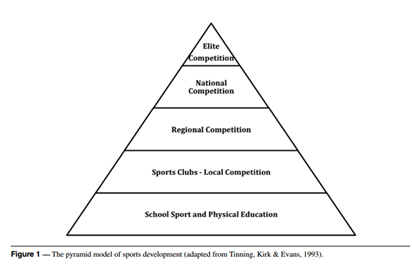
The Standard Model of Talent Identification
( Bailey, R.P: & Collins, D. The Standard Model of Talent Development and its

Discontents, Kinesiology Review, 2, 248-259)

In a recent paper, Bailey and Collins introduce one of the most common models used in talent identification, the Standard Model of Talent Development (SMTD)

This is a pyramid structure that is based on erroneous presumptions.
  1. Development and performance are essentially linear.
  2. Early ability that is identified as talent indicates future ability and performance.
The selection process is done at the cost of the wider group where focus is placed on those who have been identified as talented ( Bailey, R.P: & Collins, D. The Standard Model of Talent Development and its Discontents, Kinesiology Review, 2, 248-259)

Selection: Based on current performance. Identify those as talented as early as possible.

Early specialization is deemed necessary to reach elite performance level in the future.

Early performance and ability is necessary for success in the future.

De-selection: Hard to return to the system. Questionable selection criteria (often based on early physical characteristics)
PYRAMID

District team selection often begins at the age of 13/14 and is part of this pyramid. Its influence is felt years before the actual selection process. I recently spoke with a Swedish U17 youth international who said that this process can create and feed a stressful environment. Over a year before the district team selection, every day at school, at training, on social media each match or training performance was put under the microscope of analysis. "How did you play? How did I play?  As well as being physically tired you would be mentally tired as well". The player went on to say "I was lucky because I had an external support structure, family and good adult mentors that really helped me, I don't know how I would have coped otherwise". Competition, failure and struggle are of course part of the sporting experience. They don't have to be negative experiences for children. The problems occur when it is all based on adult demands and values. These adult demands and values are appearing earlier and earlier in our sporting structures. The adult and the child, do they have the same motives?

There is no convincing evidence that most sports require an early investment of training in one activity. In fact, what evidence is available suggests that across a number of eventual elite players, early specialization is negatively correlated with eventual success (Gullich, 2011).

In the paper In the paper The Standard Model of Talent Development and Its Discontents (Bailey, R.P; & Collins, D. ) It is suggested that  "the apparent success of the SMTD is ultimately an optical illusion as there is no way of knowing who might have succeeded through different systems, and who were de-selected from the system but might have (under different circumstances) gone on to achieve high performance".

The paper goes on to suggest risks associated with ill-focused of incorrectly administered pyramids.
  1. Early adult like training can lead to over-use injuries. There is a particular high risk associated with intensive training during maturation.
  2. Early intensive training can lead to psychological problems. This can lead to drop out and burnout
Development is non-linear, learning is non-linear. Therefore talent is non-linear
Judging early performance during the formative years does have its problems. This is true especially when judging and identifying something that is non-linear using what is essentially a linear model.
  1. Miss out on identifying other factors that are associated with talent ( soft skills such as decision making, communication, awareness)
  2. Often fails to recognize potential due to a focus on the performance now.
  3. Many pyramid structures based on early talent identification discriminate against those born later in the sporting calendar year.
  4. Size and strength factors that are identified early contribute to a temporary advantage resulting in short term superior performance. This all evens out after maturity. There is a risk that the player has been used for his temporary advantage (to win) and has not actually learned the game. This player will struggle when growth evens out when maturity is attained.
  5. Questionable accuracy with regard to measurement of ability, often affected by gender, ethnicity or socioeconomic background.
Are we judging biological maturation or talent?
Dutch Soccer coach Raymond Verheijen has presented data under the title "Growth spurt study in Dutch Youth Academy soccer". A 12 year study that included 36 professional clubs was carried out in Holland between the years 1997-2009. An analysis of a data base of over 10,000 players was carried out where factors such as height, weight, injuries and date of birth were taken in to consideration. The general idea was that month of birth should have no influence on talent. At the beginning of the study the Dutch schoolboy national teams were selected from August to July. Most players were born in the period August to October (43%) while only 10% of the players were born May-July. This phenomenon is often referred to as the Relative Age Effect (RAE).

Relative age effect (RAE): A bias that seems to favor a higher participation rate amongst those that are born early in the selection period).

Hancock, Adler, & Cote in a study from 2013 suggested that RAE is more than just a physical advantage. The research suggested that there are also some powerful social influences at play.
  1. Parents (Matthew effect) – The rich get richer. Those who are perceived to have ability are given preferential treatment and extra support. This in turn increases that ability which leads to more support.
  2. Coach (Pygmalion effect) – The higher the expectation placed on people the better is their performance. Those who are perceived to have ability are given more attention. Others feel neglected.
  3. Athletes (Galatea effect) – A player may see that she is able to perform better than her peers. This performance can be due to due to early maturation A players opinion about her ability and his self-expectations about her performance largely determine the performance.
During this study the Dutch FA changed the cut-off date for its national youth teams to the Jan-Dec period. The RAE adjusted accordingly. It seemed that the scouting system was primarily based on how old the player was as opposed to how talented that player is or could be. Countries with small populations have a relatively small player pool.

Focusing on winning during the early stages of development just encourages the RAE, in turn making the player pool even smaller. It becomes more about the survival of the fittest as opposed to survival of talent.

The various traits slowly appear and differentiate over time….. infancy, adolescence, and even adulthood will see the latent components undergoing various transformations (Simonton,1999,p442)

In the research paper "Swedish soccer is searching for talent but finding age" Tomas Peterson says why players are chosen in accordance with their physical development is not known "but one may assume that there is a silent agenda dictating that these players will be the most successful in the forthcoming selection steps" from club to district team to national youth team. The material and data collected "indicates that selection on the grounds of physical development is already at work in groups of 5-12 year olds and " and the effect of this process is very clear when these children reach 13 and enter an even harder selection process. It is Tomas Petersons opinion that this is counter- productive to the development "of all the football talent that exists within every yearly cohort of girls and boys. I also believe that its goes against the goals of both the sports movement and the community in general".


Many current methods of focusing on early indicators of talent are very static and linear approaches. They ignore the fact that development is individual and that differences in performance can be explained by differences in maturation. Coaches that judge early talent evaluate and focus on the contemporary level of performance where physical characteristics are fundamental factors in the talent identification process. This brings to the surface three fundamental problems that need to be addressed with early talent ID.
  1. Coaches gamble on the wrong players- (misuse of resources)
  2. Miss out on those with more long term potential
  3. Environment problem (development of a non-inclusive environment. No clear pathway back in to the system)
If we want to keep players viable over what is essentially a long, complex and sensitive development process then the aim should be to keep as many as possible as long as possible active within our sporting organization. What are we doing to help certain players overcome struggles that will appear during their development (non-linear)? What role does the environment play in creating these struggles?  We should remember that failure and struggle is also part of the learning process. Our environment should be a place where these failures and struggles can be met head on and dealt with through patience, encouragement, understanding and support.

Does the environment we create influence the selection process and favor those that possess attributes that give them a temporary advantage while at the same time disqualifying those who at that moment in time are struggling to adapt?


Sent from my iPhone

The Missing Ingredient in US Talent Development | Changing the GameProject


The Missing Ingredient in US Talent Development | Changing the Game Project
16 year -old Gareth Bale at Southampton

http://changingthegameproject.com/the-missing-ingredient-in-us-talent-development/

The Missing Ingredient in US Talent Development

In 2005, the coaches at one of the top English Premier League Youth Soccer Academies held one of their semiannual meetings to decide upon which players they would keep for the upcoming cycle, and whom they would let go. As they were evaluating their players –many of whom would go on to star not only in the EPL, but internationally as well – they were stuck on one particular 15 year old boy. He had been a good player when he first entered their Academy, but recently he had grown a bit and was no longer scoring well in their physical testing, nor playing like he had a few years earlier. In fact, the once speedy player was now only the 7th fastest kid on the team!

These incredibly qualified and highly respected coaches were torn; some wanted to keep him and offer him a scholarship to continue his training; others thought they should let him go. It was touch and go.

To break the tie, the coaches brought in their chief scout, a man named Rod Ruddick, to help them decide. Ruddick was the scout who had found the boy play at age 9 and had first invited him to join. He also had a hunch that the player was going through a difficult time as he grew, and that soon the kid he remembered would reemerge. He cast his tie-breaking vote to keep the player (read more about Ruddick here)

Within two years the player would make his first team senior debut for the club, and become the youngest international player in his country's history. In 2013, that speedy winger proved that the staff at Southampton were right to keep him, as he became the most expensive signing in world soccer history when he was bought by Real Madrid for $120 million.

His name was Gareth Bale.

The story of Gareth Bale, and other late developing athletes such as Danish international soccer player Simon Kjaer (whom I have written about here), Michael Jordan, or NFL QB Steve Young, are worth retelling because they beg the question "Would these kids have made it today in the US?"

Would we keep a player who seemed to be declining in ability? Would we keep a player that did not help us win today? Can we identify not just the talent that shines bright, but the talent that whispers?

Currently, in many places the answer is no, we would not keep a player who is not helping right now, because American youth sports is missing the most important prerequisite of talent development.

Giants Top Minor League Prospects

  • 1. Joey Bart 6-2, 215 C Power arm and a power bat, playing a premium defensive position. Good catch and throw skills.
  • 2. Heliot Ramos 6-2, 185 OF Potential high-ceiling player the Giants have been looking for. Great bat speed, early returns were impressive.
  • 3. Chris Shaw 6-3. 230 1B Lefty power bat, limited defensively to 1B, Matt Adams comp?
  • 4. Tyler Beede 6-4, 215 RHP from Vanderbilt projects as top of the rotation starter when he works out his command/control issues. When he misses, he misses by a bunch.
  • 5. Stephen Duggar 6-1, 170 CF Another toolsy, under-achieving OF in the Gary Brown mold, hoping for better results.
  • 6. Sandro Fabian 6-0, 180 OF Dominican signee from 2014, shows some pop in his bat. Below average arm and lack of speed should push him towards LF.
  • 7. Aramis Garcia 6-2, 220 C from Florida INTL projects as a good bat behind the dish with enough defensive skill to play there long-term
  • 8. Heath Quinn 6-2, 190 OF Strong hitter, makes contact with improving approach at the plate. Returns from hamate bone injury.
  • 9. Garrett Williams 6-1, 205 LHP Former Oklahoma standout, Giants prototype, low-ceiling, high-floor prospect.
  • 10. Shaun Anderson 6-4, 225 RHP Large frame, 3.36 K/BB rate. Can start or relieve
  • 11. Jacob Gonzalez 6-3, 190 3B Good pedigree, impressive bat for HS prospect.
  • 12. Seth Corry 6-2 195 LHP Highly regard HS pick. Was mentioned as possible chip in high profile trades.
  • 13. C.J. Hinojosa 5-10, 175 SS Scrappy IF prospect in the mold of Kelby Tomlinson, just gets it done.
  • 14. Garett Cave 6-4, 200 RHP He misses a lot of bats and at times, the plate. 13 K/9 an 5 B/9. Wild thing.

2019 MLB Draft - Top HS Draft Prospects

  • 1. Bobby Witt, Jr. 6-1,185 SS Colleyville Heritage HS (TX) Oklahoma commit. Outstanding defensive SS who can hit. 6.4 speed in 60 yd. Touched 97 on mound. Son of former major leaguer. Five tool potential.
  • 2. Riley Greene 6-2, 190 OF Haggerty HS (FL) Florida commit.Best HS hitting prospect. LH bat with good eye, plate discipline and developing power.
  • 3. C.J. Abrams 6-2, 180 SS Blessed Trinity HS (GA) High-ceiling athlete. 70 speed with plus arm. Hitting needs to develop as he matures. Alabama commit.
  • 4. Reece Hinds 6-4, 210 SS Niceville HS (FL) Power bat, committed to LSU. Plus arm, solid enough bat to move to 3B down the road. 98MPH arm.
  • 5. Daniel Espino 6-3, 200 RHP Georgia Premier Academy (GA) LSU commit. Touches 98 on FB with wipe out SL.

2019 MLB Draft - Top College Draft Prospects

  • 1. Adley Rutschman C Oregon State Plus defender with great arm. Excellent receiver plus a switch hitter with some pop in the bat.
  • 2. Shea Langliers C Baylor Excelent throw and catch skills with good pop time. Quick bat, uses all fields approach with some pop.
  • 3. Zack Thompson 6-2 LHP Kentucky Missed time with an elbow issue. FB up to 95 with plenty of secondary stuff.
  • 4. Matt Wallner 6-5 OF Southern Miss Run producing bat plus mid to upper 90's FB closer. Power bat from the left side, athletic for size.
  • 5. Nick Lodolo LHP TCU Tall LHP, 95MPH FB and solid breaking stuff.