Showing posts with label Umpires. Show all posts

Tuesday, May 29, 2018

MLB reportedly admits Anthony Rizzo's controversial slide vs. the Pirates should have been called illegal

Image result for rizzo slide dirty


There, that didn't take long now did it? St. Joe probably will still maintain that we should be teaching our kids to be dirty players, but that's his problem.
  • We now have rules not being enforced that were put in place to enforce prior rules that were in place but not being enforced by umpires.
  • We now have instant replay that is consistently not picking up mistakes made by the umpires on the field. And apologies to teams impacted by these errors are just not going to do the trick too much longer. 
MLB and Instant replay are a joke. But, at least they aren't as big a joke as Joe Maddon and Anthony Rizzo. 

from cbssports.com
MLB reportedly admits Anthony Rizzo's controversial slide vs. the Pirates should have been called illegal

Breaking: Source indicates the league believes interference should have been called yesterday re Anthony Rizzo's 8th inning slide at home plate. Both teams have been informed of that decision which differs from the call on the field and the umpires video review.  
Rizzo had already been forced out at the plate before the slide. Had the play been called interference, the Pirates would've been given the out on Diaz's throw to first base. It would've made a significant difference in the game. Consider the situations:
  • Rizzo slide called legal: Cubs up 5-0, runner on second with one out.
  • Rizzo slide called illegal: Cubs up 3-0, runners on second and third with two outs.
Maybe those runners score and the Cubs take a 5-0 lead anyway. Who knows? I do know a 5-0 game is very different than a 3-0 game though. Both Cubs manager Joe Maddon and Pirates manager Clint Hurdle would've used their bullpen differently.
MLB rule 6.01(i) says the "runner attempting to score may not deviate from his direct pathway to the plate in order to initiate contact with the catcher (or other player covering home plate), or otherwise initiate an avoidable collision." Rizzo, clearly, deviated from his path to initiate an avoidable collision. Was it a dirty slide? I'm not sure. Was it against the rules? For sure.
For whatever reason, MLB's replay crew did not see it that way at the time, and the play stood. The slide was called legal. Now MLB has reportedly backtracked, and informed both teams the slide should've been ruled illegal. That doesn't help the Pirates now, but at least the league is acknowledging the mistake.

Shared via CBS Sports
http://cbssportsapp.com


Sent from my iPhone

Was Anthony Rizzo's slide at home dirty?


He's been down this road before with Padres catcher Austin Hedges. Maddon continues to defend him and denigrate the rule. Until one of his guys gets blasted. The fact that Rizzo apologized to the Pirates catcher before his next AB indicates he knew he was wrong.

 I watched the Pirates broadcast and then the Cubs and two different perceptions of reality and the ruling. MLB needs to get a handle on this if, as the Pirates broadcasters were discussing, there appears to be a lack of enforcement on the part of the umpires. As I've discussed before, this is the initial problem that precipitated both the Posey rule and the Utley rule. Lack of enforcement of existing rules on the books. 

So now it appears we will need the Rizzo corollary and the St. Joe Maddon addendum's to the Posey rule and then another set for the Utley rule when a Cubs player decides to go old-school at 2B.

Thanks Cubs!! Rizzo is a dirt bag for doing it, but Maddon is a bigger scuz bag for condoning it. Why don't we just changed the MLB rule book to "The World According to St. Joe"? 

Saturday, December 16, 2017

'Skunk in the outfield' -- How the most epic trick play in history broke baseball


'Skunk in the outfield' -- How the most epic trick play in history broke baseballThis is what you'll see in HS baseball. Happened to me when I was on the bases for a varsity game in IL with a "more decorated" partner who had the play rule wrong. Luckily, he didn't interject during the play, only together during conference. He thankfully left it to me to explain it to the coach whose team butchered the play on defense. That was the easy part. He didn't like it, thought I was wrong, but if he did his research of the rule book after the game, he would have, and probably did, found out he was wrong. I only hope my partner that day got his nose a little dirty in the rule book. But a lot of those "more decorated" types seem to have an aversion, almost an allergy, to the rule book. 
          This article was a trip down memory lane. With great graphics. 

'Skunk in the outfield': How the most epic trick play in history broke baseball


For two minutes and 32 seconds of pure chaos, a high school state championship game in Rhode Island entered a parallel universe -- and unleashed the longest hardball stalemate of all time. Todd Detwiler

The Portsmouth High Patriots, like almost every high school baseball team, kept a trick play in their pocket.

Theirs was called the "phantom pickoff throw": The pitcher would spin as if making a pickoff attempt but keep the ball tucked in his glove. His fielders would act as if the throw had gone wild, make a lot of noise and chase after it, and the runner -- tricked -- would start to run to the next base. The pitcher would casually throw him out.

This play worked. Pitcher Brendan Solecki remembers using it twice, once when he was on the freshman team and once as a sophomore on the varsity. Both times the runner fell for it. "Against Woonsocket, the parents were not very happy," he says. "Like, 'That's not baseball, that's bush league.'"

But high school baseball, and maybe only high school baseball, is built for trick plays. At levels lower than high school, everybody is just trying to have fun, trying to learn, and it seems cruel to try too hard to humiliate your opponent. At higher levels, a play like that would never work. High school is the intersection between childhood and adulthood: The young men on the field are good enough to throw in the high-80s, strong enough to play on full-sized fields in front of major league scouts, polished enough to speak in clichés. They're also young enough to fall for a trick play straight out of "Little Big League."

In 2005, a parent approached Portsmouth coach Dave Ulmschneider about an interesting book he'd found. It turned out to be more of a pamphlet:
There were 16 plays, with a page or two of explanation for utilizing and defending each. A lot of the plays were clearly cheating, such as the runner going from second to home, skipping (or "cutting") third base when the umpires were looking the other way. Some were just plain baseball, stuff every team did, like a delayed steal. Some didn't seem likely to work, and some didn't seem realistic. Then there was a play called "skunk in the outfield."

That's how it came to be that Portsmouth sophomore named Johnny Pedrotty stood in right field in Game 2 of the Rhode Island state championship series, and a crowd of a thousand fans erupted into profane chaos, and a star infielder almost blacked out from the stress, and Ulmschneider found himself unsure of how to stop what he'd unleashed. It's how, for two minutes and 32 seconds, baseball broke.


LET'S DEFINE A baseball play like this: It is a sequence of actions during which events in progress cannot be stopped by a timeout. A runner is actively attempting to advance or retreat, or he is exposed and the defense is chasing after him. The ball is live. The only way for the play to end is for the runner to advance, retreat or become the next out.


A play can take only so much time. The physical space of the field is confined, and baserunning is a closed circuit that takes only about 15 seconds to complete. Barring a rundown -- when a baserunner goes backward -- it takes only that long before the runner scores or is tagged out, and is no longer advancing or retreating or being chased. A baseball game has no clock, but a baseball play has its own internal countdown, as the sprawl of defenders progresses toward order, funneling all the wide-open ambition of a baseball field into an ever-smaller space.

A typical stolen base is over within four seconds; a typical single within eight; a typical triple within 12. The most elaborate and disorienting plays might get to 20 seconds. I have found a play that took 26 seconds, and one that took 29 seconds, but I have never seen a play that took longer. But I've heard one, and it sounds like this:
"Bracey checks his runners. From the stretch, he delivers and gets that outside corner again and gets ahead of Jimmy Ayars no balls, two strikes."
The East Greenwich Avengers knew the Patriots well. In 2002, Portsmouth's Little League team had won the state championship, moving past East Greenwich in the state's final four. (East Greenwich would watch Portsmouth play in the regional finals on ESPN.) Three years later, many of the players met again in the semifinals of the 2005 state high school championship; Portsmouth knocked East Greenwich out after a miraculous comeback. You had to cross two bridges to get to Portsmouth from East Greenwich, so it was far enough away to be The Other. But it's Rhode Island. You see the same faces, over and over.

On June 17, 2006, East Greenwich ace Dan Bracey was on the mound at McCoy Stadium -- the Triple-A home of the Pawtucket Red Sox, a glamorous setting for a state tourney. East Greenwich's home bleachers sat 50; there were a thousand fans, maybe more, for this game. East Greenwich students had been let out early to go to it. The team had chartered a bus. "At that point it's 100 percent the biggest moment of our lives," says second baseman Matt Streich.

The Patriots were favored. They had brought back all but one starter from the previous season and added two sophomores: Ryan Westmoreland, a budding superstar; and Pedrotty, whose home run in the Little League regionals had pushed Portsmouth to within one game of Williamsport. The Patriots had the best regular-season record in the division; they had already won the first game of the three-game championship series, and they led 2-0 in the sixth inning of Game 2. They were three outs away.
Bracey's 100th pitch of the night put him ahead 0-2 on Portsmouth's No. 9 hitter, Jimmy Ayars. There were two outs. Pedrotty was on first and Solecki was on third. Bracey set and looked in for the sign, when, suddenly, everybody started yelling.

"Look at John Pedrotty, running out toward right field. And Bracey is walking toward second base and John Pedrotty is standing in shallow right field, out of the baseline. No call has been made yet. East Greenwich doesn't know exactly what to do."
PEDROTTY WAS THE skunk.
In the rulebook, the baseline is not -- contrary to what most people think -- the line between two bases. Rather, it's a straight line between wherever the runner is and the base he's going for when a tag is attempted. As the MLB rulebook puts it:

Any runner is out when: (1) He runs more than three feet away from his base path to avoid being tagged. ... A runner's base path is established when the tag attempt occurs and is a straight line from the runner to the base he is attempting to reach safely.

If no defender is attempting to tag the runner, there is no baseline, and the runner can go anywhere he wants. He can walk into right field if he wants.
"What I decided to do was to run him out on the grass to try to get somebody to chase him," Ulmschneider would explain after the game.
"One, they've got, out deeper there, a longer throw. They're running towards him -- they have to stop, throw off a turn, throw off balance, and I like our chances in that scenario. Or we're looking for them to throw to somebody. If they make a throw, we just try and score from third."
First-and-third situations are breeding grounds for gimmick plays in high school. Often, the runner on first will attempt to steal second, hoping to draw a throw that will allow the runner to score from third. But defenses will rarely make that throw, so offenses have designed ways to tempt the defense into going after the trail runner while letting the lead runner sneak home. Sometimes, when the pitch is delivered, the base stealer will stop halfway and try to get in a rundown. Sometimes he'll start walking to second base while the pitcher still has the ball. There's a balk/steal play, where the runner takes off sprinting once the pitcher gets set, the goal being to startle the pitcher so that he'll make an illegal move off the mound in reaction.

These plays -- and "skunk in the outfield" -- all have the same paradoxical premise: It's more valuable to the team that's at bat for the runner to be on first base. If he wanted to go to second, he could just steal. But as long as he's on first -- or, at least, not yet on second -- he might be able to ignite something weird. When Ulmschneider had his team run the play in practice for the first time just before the championship series, his pitcher on the mound -- Solecki, coincidentally -- immediately balked and then started yelling that the runner can't do that.

"Bobby Downey [of East Greenwich] is one of the best coaches I've ever coached against," Ulmschneider says now. "If we do a walk-off steal there, if we steal a base and slide short, get in the rundown -- they'll defend it." Indeed, East Greenwich practiced their reactions to these plays all the time. "I go, 'If Solecki's reaction is what it was, what's to say Bracey's won't be?' So I gave the sign."

Westmoreland was in the on-deck circle, and he saw the sign from Ulmschneider, who served as the third-base coach. "I was speechless. I couldn't believe it, to do it in Game 2 of the state final. I remember thinking to myself in the on-deck circle, 'I wouldn't be surprised if we lost this game.'"

"They will walk over toward third base and keep Brendan Solecki near the bag, and the ball will go back to the mound and they will ignore Pedrotty, out there in shallow right field, trying to draw some attention. Bracey has the ball in his hand behind the mound and he's waiting to see what happens."
STEP 1 HAD been to make Bracey panic. He didn't. He stepped off the rubber and walked down to the flat grass area behind the mound, so if he had to make a throw it wouldn't be on a slope. East Greenwich fans tried to get the umpire to call Pedrotty out of the baseline, but by the rulebook he wasn't. Bracey tried to call a timeout -- as he'd be allowed to do when any other baserunner was taking a lead -- but at some undefined point Pedrotty had taken more than a lead.

"There wasn't a Step 2," says Portsmouth's catcher, Nick Grande.
"I don't think we really practiced what you did once you're out in right field," Solecki says. "The initial part of it was, like, 90 percent of it. Get the other team to do something stupid or balk."

"To be honest, I didn't know what to do," Pedrotty says. "I didn't know the rules. I didn't know, if I deviated from my path, would I get called out? If I went to second base, I didn't know if I'd get called out. It was awkward: You're standing there, just you and the pitcher, looking back and forth, like, what am I supposed to be doing here?"

So Pedrotty just stood there, hands on his knees, staring into the eyes of an increasingly agitated Bracey. The pitcher could have simply gone back to the mound and delivered a pitch, let Pedrotty have second, but this situation was so wrong that it felt like they had to do something to put things back in place. Bracey was making pump throws, faking like he was going to run the ball at Pedrotty -- but the ball never left the area behind the mound. Coach Downey was yelling, "Ice, Dan, ice!" That was their designated instruction for delayed steals, and it meant: Throw the ball to the second baseman. But everybody was yelling. Even Bracey was yelling.


Meanwhile, East Greenwich first baseman Steve Salvator was trying to counter the play with his own trick play. Recalls Streich, the second baseman: "Salvator, it was like he's crawling through the Vietnam jungle, getting low to the ground and taking a parabolic angle behind this kid. Like nobody sees what he's doing, like we're going to do a quick throw. He's showing me his hand, like, 'Throw me the ball,' and our coach is yelling, 'Don't throw him the ball!'"

Solecki, on third base, kept bluffing toward home, but the ball was closer to the plate than he was.

Bracey finally looks toward Downey, arms outstretched, furious: What do you want me to do? Downey tells him to give the ball to Streich, the second baseman, who had the best arm in the infield. Bracey didn't want to -- in this moment, he's the only person he trusts to make a throw home.
"I don't blame the kid," Streich says. "I didn't want me to have it, either. What am I going to do, just stand there? I was praying to God that the kid did not run home, because I would have thrown the ball five rows into the stands, my hands were so sweaty. No chance I could have made that throw."

Streich doesn't even remember taking the ball -- "I think I blacked out for a good minute or two" -- but eventually Bracey handed it gently to him. "I told him, 'Don't screw this up,'" Bracey says. "Like if your dad gives you $20 to go out, and he gives you that look, like, 'I'm trusting you, don't let me down.'"

The longer the play got, the darker it all started to feel. At first it was funny, but as time ticked by nobody seemed to be having fun. The players in the Portsmouth dugout were starting to feel embarrassed, some guys complaining in real time that it was a stupid play. After about one minute, says Streich, "It was like a snap of the finger, and the whole mood [in the stadium] totally changed -- pure chaos!" East Greenwich fans were screaming across the stands at Portsmouth fans.

"It was an interesting evolution from that puzzlement to the anger," says Bracey's father, Jim, whose downturned camera caught some of the audio. "I had a good friend of mine there who had no real direct interest in the game, but he was a great athlete, his kids were great athletes, and oh my God, was he fired up. He was pissed, he was yelling. What ended up happening was Coach Ulmschneider became the target of it."

"This is a show! I can't believe this is going on! Dave Ulmschneider has to be loving this!"

EVERYBODY IN RHODE Island baseball called him Umpy, a nickname he'd inherited from his dad when the younger Ulmschneider started coaching in 1993. He was a volunteer assistant coach at first, earning his first paying job in 1998 and his first head-coaching job in 2000. In 2002, a bunch of incoming Portsmouth freshmen came to him and told him they were going to win Ulmschneider a state championship. Those freshmen were seniors in 2006.

"There were very few situations where he put us in a situation to fail," Pedrotty says. "I have the utmost respect for him."

He was a player's coach. He didn't try to mess with guys' swings or pitching mechanics. He let leaders emerge among the players so they could learn from each other.

"He was a really good coach," says Bobb Angel, a Rhode Island Radio Hall of Famer and the play-by-play broadcaster for the 2006 championship series. "Totally understanding of the ins and outs and all the angles. My guess is he just put one and one together."
The trick plays book had ways to defend the skunk play. The most ingenious defense is a huddle play, where the pitcher, second baseman and shortstop all huddle near the mound. One of them takes the ball, but the offense can't see which one. Then the shortstop goes toward the runner on third, and the second baseman goes toward the runner in right field. Both runners have to retreat, not knowing whether he's in danger of being tagged out.

But Ulmschneider knew East Greenwich had never seen this play and wouldn't know those defenses. He might even have foreseen that in a worst-case scenario, where Bracey doesn't panic and East Greenwich doesn't make a mistake, he'd end up in a stalemate like this. What he hadn't foreseen was how it would feel.
It felt terrible. Totally unexpectedly, he felt embarrassed, for himself and for Pedrotty and for his opponents and for his team. But until you do something, until you see the way it changes the atmosphere, the way that reactions pick up momentum, it's hard to know. He could have been the hero.
"It's a fine line," he says. "I remember saying after the fact -- you know, we've all seen where somebody has done something, and they're legendary coaches and they can do it. But believe me, I was no legend. I was just a D-II high school coach in Rhode Island."

"The ball is in the hands of the second baseman, Matt Streich. Pedrotty now is gonna go back to first base, because nobody's going to throw over there. And now we are back the way we were. That was wild! East Greenwich fans don't like it. The Portsmouth fans are loving it. And John Pedrotty's back on first base."
THE LONGEST PLAY ever, and it's not even a line in the play log. Nothing happened. "I just remember being, like, I'm over this," Pedrotty says.

"It was like an Andy Kaufman routine, but not quite long enough," Bracey says. "Long enough to get everybody mad, not long enough for them to get the joke."

Nine years later, Dave Ulmschneider was inducted into the Rhode Island Baseball Coaches Association Hall of Fame. Bob Downey, the East Greenwich coach, gave the introductory speech. Downey called Umpy beforehand and mentioned he was going to bring up the Pedrotty play.

"I said, 'Please don't, Bobby.' He was going to, and I said, 'Bobby, please,'" Ulmschneider says.

Bobby didn't. And given what happened after the play, it might have seemed like gloating if he had.

BRACEY GOT BACK on the mound to throw his 101st pitch of the night. "I was fine if all the ligaments in my arm broke on that pitch," he says. "I really wanted to strike him out." Just before the pitch gets to the plate, a fan screams "See ya!" Ayars hits a routine grounder to Streich, and the same fan again yells, "See ya!"

Bracey stomps off the mound, pumping his fist. He steps over the foul line just as Ulmschneider is jogging toward him on the way to the first-base dugout. Bracey, out of character, gives him a dirty look, might have even said something. East Greenwich's reserves empty out of the dugout to give Bracey fives and fist bumps, but Bracey keeps his arms down and he shoulders through his teammates. He's furious.

So is the rest of the team. They'd been battling against a team that, in their hearts, they secretly knew was better than them. As one Avenger puts it, "We were well-rounded. They were well-rounded and they had superstars."

East Greenwich kids had been losing to Portsmouth kids since Little League. But for two and a half minutes, Portsmouth had treated them like clowns, and that was over the line.

"I think they thought they were totally in control of this situation," Streich says, but by running that play the emotions of the game got out of control. "In that situation, you let a sleeping dog lie. Once Dan got that guy out and gave the biggest roar and fist pump I've ever seen, I'm pacing in the dugout and I said to our backup catcher, 'I'm going to hit a home run in this inning, I don't care.' I don't swing for the fences, but if somebody gets on in front of me, we're winning because I'm going to hit a home run. I was irate. That was the most emotional I've ever been on a playing field. We didn't like them to begin with, and they're trying to make us look bad, trying to make us s--- ourselves, and we didn't do it. That's what sparked the rally."

Solecki, who had been the runner on third for the Pedrotty play, went back to the mound. He'd thrown only 76 pitches and allowed only four hits. But Nick Rossetti hit a pinch-hit single and Salvator followed with a single to right; Pedrotty bobbled the ball for an error, allowing Rossetti to score. Brandon Palmer singled to tie the game, and Streich came up. On the second pitch, he homered into the bullpen. In just four minutes, East Greenwich had turned the series around. They would add another run and win 5-2.

"Somebody said they think that fired 'em up," Ulmschneider said in a radio interview after the game. "You know what? In a state championship, you're down 2-0 in the seventh, you're down to the last three outs -- they're gonna come out guns blazing and leave it all on the field."
He might be the only person at the field that day who believes that. "It definitely rattled us," Westmoreland says.

Says Pedrotty: "I just felt like we did something that was probably the only thing we could have done to swing momentum in that situation."
The Patriots woke up the next morning and saw Downey quoted in the local paper, crediting the play with helping inspire East Greenwich's comeback.

"For East Greenwich," the writer wrote, "successfully defending the play was about more than preventing a run. It was about finally beating the Patriots."

THE NEXT DAY, Portsmouth won Game 3 and the championship. They were the better team. Westmoreland threw a three-hitter, struck out nine, and in a lot of ways it was his coming-out party. He was already great, but the next two years he was the state's best player, carrying Portsmouth until the Red Sox drafted him and gave him a $2 million signing bonus.
An East Greenwich fan at Game 3 had a big sign that read "UMBRAGE." It was a response to Ulmschneider's postgame interview, when he explained the play, disputed that there was anything controversial about it, but added, "I guess some fans took umbrage."

After the Pedrotty play, Ulmschneider spent a lot of time thinking about umbrage, and it started to change his coaching style. "There's a school of thought among a lot of people that you get to the run rule" -- a mercy rule -- "so you can save pitching whenever you can. But I think I'm more cautious now about being the guy on the other end. We're not going to rub anybody's face in the game. We're not going to run when we're up by five. All anybody wants, whether you win, lose or draw, is to be respected by people for being a good guy and being knowledgeable. I kind of felt after this that I had put winning a game in front of that. I try to be more considerate of what it's like on the other end."

This is good. It's also, though, a little bit of a loss. There was nothing wrong with the Pedrotty play. It was within the rules, and it was easy enough to defend. "Bush league" is usually a slur teams throw around to try to convince another team to act against their own interest.

"You know, really -- it was not bush," says Jim Bracey now. "We just defined it that way. He was intelligently exploiting the rules. He ultimately blinked." And Ulmschneider blinked because the crowd yelled "Bush" at him.


A few weeks after the game, Dan Bracey started dating one of the girls who'd been in the stands that day. (They're now married.) He pitched even better as a senior, topping 90 mph, which is plenty to dominate in high school. He committed to pitch for Columbia University. In the final high school game of his career, his team lost -- on a walk-off phantom pickoff throw.

Coach Downey told the seniors what a sham it was for a team to pull such a bush-league play and end their high school careers that way. "In the heat of the moment," Bracey says, "I was pissed.

"But looking back, it was brilliant."


Tuesday, May 23, 2017

Close Call Sports & Umpire Ejection Fantasy League: Dangerous Precedent - GHSA Overturns Judgment Call

Close Call Sports & Umpire Ejection Fantasy League: Dangerous Precedent - GHSA Overturns Judgment Call


This is a very disturbing development since now that you have precedent, you have encouraged legal do-gooders nationwide to step in and do the same thing. Similar to the economics rule that says when you subsidize something, you get more of it, in law once you establish a precedent, it gives birth to copy cat cases nationwide.

Ridiculous stuff. Thanks Georgia, and thanks MLB because in my opinion this is the unintended consequence of instant replay.

And soon, one of these days, these same do-gooders will be calling for instant replay in HS baseball games, subsidized by John and Jane Taxpayer. Because the law of unintended consequences never stops there when government bureaucrats and lawyers are involved. It takes the stupid unintended consequences and tries to "fix" it thereby giving birth to more stupid unintended consequences. And billable hours for the lawyers BTW.

So buckle your seat belts folks we're in for a really perilous, slippery slope kind of journey in the world of youth sports.

Don't say I didn't warn you.

http://www.closecallsports.com/2017/05/dangerous-precedent-ghsa-overturns.html?m=1

Dangerous Precedent - GHSA Overturns Judgment Call

In a decision contradicting years of legal precedent & NFHS rules, GHSA reversed an umpire's judgment call as the result of a post-game protest filed by the losing team.

Last week, we reported the curious case of Lee County vs Johns Creek High School and the Georgia playoff game that hinged on a single appeal play ruling in the bottom of the last inning of regulation.

To recapitulate, with two outs and the bases loaded in the bottom of the 7th, a Johns Creek batter received a fourth ball and walk to force the apparent winning run. After a protest from defensive Lee County's head coach that Johns Creek baserunner R2 failed to touch third base, the umpires ruled the runner out on appeal, pursuant to NFHS Rule 9-1-1, and cancelled the run pursuant to 9-1-1 Note 2.

Lee County went on to win the ballgame, and Johns Creek protested that it should have won instead due to an umpires' error.

Upon receiving Johns Creek's initial protest, GHSA Executive Director Gary Phillips on Thursday ruled the umpires' decision was one of judgment and, therefore, not protestable; the ruling must stand.

Board of Trustees President Glenn White.
GHSA counsel Alan Connell disagreed and granted Johns Creek not a protest, but an "appeal."

On Friday, a GHSA Appeals Board heard the appeal and, like Phillips, declined to uphold it.

On Monday, the GHSA Board of Trustees elected to overturn the umpires' call—based on the rationale that the Board of Trustees felt that the judgment call had been incorrect.

POLITICAL SIDEBAR: The GHSA has been dealing with organizational issues, even prior to the Johns Creek & Lee County baseball incident. In February, GHSA Board of Trustees President and Model High School Principal Glenn White voted to recommended that Executive Director Phillips resign; Phillips accordingly agreed to retire at the end of the 2016-17 school year. Meanwhile, Georgia House Bill 415 and Senate Bill 2013 proposed that the state replace the GHSA with a new statewide governing body.

Georgia State Representative John Meadows in February "said he gets more complaints about the GHSA – from schools, referees, coaches and parents – than about everything else put together, 'and basically I'm sick of it.' He added, 'I don't think they know what their job is.'"

Clearly not.

Contrary to decades of legal precedent, Trustees President White made it clear that the Trustees sustained the appeal and overturned the on-field officials' call based on a matter of judgment—not on an issue of rule interpretation:
It swayed me to believe that the wrong call was made and that it was not in the best interest of students to support that call. The bottom line is what's right and what's wrong, and I thought it was right for Johns Creek to go back to Lee County and play a third game. 
If it's the second inning of a baseball game or second quarter of a football game, you've got plenty of time to overcome a bad call,'' White said. ''This situation is a different. It's a semifinal state playoff game in baseball, and it's the end of the game. I just see that differently. That had lot to do with swaying my opinion. 
It's just not practical to review every missed call and every kid that was (called) safe but was actually out. We have set a precedent, so we need to get ready because there will probably be other people coming to see us.
This is odd, as GHSA Bylaw 2.92(e) states, "The National Federation prohibits the use of video tape to review an official's decision."

As for the legality of overturning an umpire's on-field judgment call after-the-fact, the Courts have routinely ruled, for approximately 35 years, that such practice is not legally tenable:

> 1981: Georgia High School Association vs Waddell: The Georgia Supreme Court ruled that it does not possess authority to review the decision of a high school sports official. In what was, at the time, a landmark decision to establish long-term precedent, the Supreme Court held, "We go now further and hold that courts for equality in this state are without authority to review decisions of football referees because those decisions do not present judicial controversies."

> December 2005: Brown vs. OSSAA. Referees ejected player Tucker Brown for fighting at the end of a game, resulting in an automatic two-game suspension, pursuant to state association rules. Brown's mother sued the OSSAA seeking an injunction to allow Tucker to play. In an Oklahoma Supreme Court decision, the Court opined, "It is not within our province to act as 'super referees' to alter or overturn the referee's determinations. Neither may we, because a referee does not make a call, do so for the official -- we may not 'call the game' or construe the official's failure to see every infraction as arbitrary."

> December 2005: Haverstraw Stony-Point Central School District vs NYSPHSAA. The District and high school wrestler Frank Rodriguez filed a lawsuit against the state after a referee's assessment of a two-point penalty against Rodriguez cost him his state title match. A judge refused to entertain the District's lawsuit, writing that, "To establish a precedent of reviewing and potentially reversing a referee's judgment call from the distant ivory tower of a judge's chambers would cause unending confusion in the interscholastic athletic system."

> December 2015: Oklahoma City School District vs OSSAA. The District, on behalf of Douglass High School, filed a lawsuit against OSSAA claiming that an on-field official's judgment call caused its team to lose a game, and that OSSAA failed to allow it to replay the game so as to remedy the situation. In ruling for the OSSAA, Judge Bernard Jones wrote that "what transpired during and to some degree after the disputed quarterfinal could be considered by many as a tragedy. More tragic, however, would be for this Court to assert itself in this matter...There is neither statute nor case law allowing this Court discretion to order the replaying of a high school football game."

> November 2016: Fenwick High School vs. IHSA. Fenwick filed a lawsuit after the IHSA failed to reverse an on-field ruling. The judge ruled in favor of the IHSA, writing that it is not the court's responsibility or jurisdiction to overturn an on-field referee's call, even though Fenwick suffered irreparable harm as the result of an official's failure to properly apply a rule.


Perhaps Judge Jones wrote it best, "this slippery slope of solving athletic contests in court instead of on campus will inevitably usher in a new era of robed referees and meritless litigation due to disagreement with or disdain for decisions of gaming officials—an unintended consequence which hurts both the court system and the citizens it is designed to protect."

Thus, GHSAA Board of Trustees President and robed referee White's decision runs in direct contravention to not only years of legal precedent as specified above, but the NFHS baseball rulebook itself. Although, as we wrote, the NFHS vs GHSA allowance of protests is legally ambiguous (NFHS requires a clearly delineated protest procedure, GHSA doesn't specify one in its Bylaws), let us assume for the purpose of discussion that protests are authorized.

Rule 10-4 states, "Any umpire's decision which involves judgment, such as whether a hit is fair or foul, whether a pitch is a strike or a ball, or whether a runner is safe or out, is final." Rule 10-5 states, "The use of videotape or equipment by game officials for the purpose of making calls or rendering decisions is prohibited."

Rule 4-5 states, "It is optional on the part of a state association as to whether protests are permitted. When allowed, protests are permitted regarding rules one through nine only."

Thus, a protest concerning the umpires' conduct (the Johns Creek complaint alleged "inappropriate conduct" on the part of the umpires)—such as a judgment call delineated by 10-4, or any other conduct related to Umpiring Rule 10—is prohibited by Rule 4-5.

Johns Creek's original protest cited Official Baseball Rule 5.08(b), as opposed to the High School rule 9-1-1, regarding runner responsibility to touch bases on a game-winning walk (OBR requires just the batter and runner from third to touch their respective bases; NFHS requires all runners to touch up).

As for the question of the appeal's validity, while OBR requires all appeals to be live ball in nature, NFHS authorizes dead ball appeals. At the end of the game, appeals may be filed at any time until the umpires leave the playing field (umpires remained on the field throughout the process).

Conclusion: GHSA Board of Trustees President Glenn White "thought it was right" to overturn an on-field official's judgment call because he felt "that it was not in the best interest of students to support [the on-field] call," which he deemed a "wrong call."

In an odd reversal of fates, Official Baseball Rule 7.04 states, "No protest shall ever be permitted on judgment decisions by the umpire," whereas NFHS Rule 4-5 does not explicitly state this (though it certainly implies it by saying that protests shall only be permitted regarding rules one through nine only), leaving it up to the state to delineate the protest procedure. The GHSA Constitution and Bylaws, however, fail to prescribe such a process for baseball protests.


Sent from my iPhone

Sunday, March 13, 2016

Carter Capps delivery ruled illegal (I told you so)


Sorry boys, we ruled on this last July over here at The Slav's Baseball Blog. 


http://slavieboy.blogspot.com/2015/07/extra-baggs-questionable-delivery-etc.html

Not sure why it's taking all the big-wigs so long. MLB is really falling into a situation where they continue to try to implement so-called "new" rules when the solution is for the umpire to either grow a sack and enforce existing rules or exercise some common sense. Whether it's Matt Holliday's slide into Scutaro, Utley's slide into Tejeda, the Cousins missile launch into Posey, batter taking too much time, pitchers taking too much time, pace of game, bean balls, whatever. 

These want to be nice guys in a job which by its very nature does not lend itself to winning popularity contests or congeniality awards. Make the calls, enforce the rules, pick up pay check, line up for spread. It's not too hard. 

This would be an illegal pitch in girls high school softball and below. They let Jenny Finch get about this far off the slab in college softball, but they were trying to promote the sport and Jenny Finch was eminently promotable, if you know what I mean ;) ;) 

This is almost a hop, skip and a jump for cryin' out loud. 

This was sent to me by an Illinois umpires association assignor just last week.
Lastly, there is a rule interpretation on an illegal pitch by MLB pitcher Carter Capps who had a leap step where his pivot foot leaped forward, he regained ground and pushed off for his delivery 12 inches in front of the rubber.  MLB and the NCAA both made an official ruling this off-season calling that an illegal pitch.  The National Federation had not yet ruled on the move, however, the IHSA Rule Interpreters have.  This is now an illegal pitch in high school baseball in Illinois.  
See a clip of the move: https://www.youtube.com/watch?v=LycHv4CRHWY.  Make sure you watch the video to its conclusion.

Saturday, March 05, 2016

The Simple Technology That Accidentally Ruined Baseball | The Atlantic


The pendulum swings and when it does it often goes too far in one direction before swinging back the other way. We are seeing that in baseball. This is an excellent article by The Atlantic, a non-baseball publication,  that summarizes the landscape.

QOTY candidate:

Batters are typically worse when they fall behind the count—that is, when there are more strikes than balls—because they have to defend the plate to avoid striking out. Hitters are much more successful on 2-1 counts (two balls, one strike) than on 1-2 counts. "Having a 1-1 pitch that was called a ball in 2008 suddenly get called a strike in 2013 changes the batting environment," Jon Roegele writes in an excellent paper on the rise of low strikes. Strikes hurt hitters even without strike outs by forcing batters to shift to a protect-the-plate strategy rather than a swing-for-the-fences strategy.
QOTY candidate II:

The irony is that MLB did everything that an economist or corporate guru would have advised. Baseball embraced emerging technology rather than banish it. It used analytics to improve the work of its elite employees. It used reviews to encourage exceptional performance among umpires. And the league got exactly what they wanted: a more-perfect strike zone.

But is that really baseball's highest goal? A perfect strike zone, at the expense of steadily evaporating offense?

QOTY candidate III:

Baseball has done all the right little things while perhaps ignoring the big thing: It needs hitters. It needs home runs. Sports thrive and grow when national stars thrive on national television as marketing ambassadors of the game. Today, baseball is a national pastime without a truly national star. Mike Trout, the historic and absurdly young center fielder for the league-leading Los Angeles Angels, has one-third the name recognition of Derek Jeter, a telegenic veteran that even this Yankees fan named Derek will acknowledge was never half as good as Trout.

So the league has pitched itself into a corner. Its own rules have destroyed the offensive power surge that had captured America's attention in the late-'90s and early aughts. 

Umpires, empowered and/or cowered by technology, are better than ever. As a direct result, baseball has become a grind for fans who prefer sports with scoring.
Great article

===


theatlantic.com
The Simple Technology That Accidentally Ruined Baseball - The Atlantic

The Simple Technology That Accidentally Ruined Baseball

It's not the sort of accomplishment that ESPN is likely to crow about, but Philadelphia Phillies center-fielder Ben Revere is on track to set an astonishing baseball record—a mark that says as much about the game today as Barry Bonds's 73 home runs said about the swollen biceps that defined the early 21st century. Revere is currently batting just over .313, higher than any other player in the National League. That figure would match the lowest batting title in the NL's 138-year history and the fourth lowest in baseball since 1900.

Can't anybody hit, these days?

Baseball has become too boring is one of those popular but unfalsifiable statements about sports, like Curling is stupid and Americans should watch more soccer. But if you like guys crossing the plate and balls falling beyond the outfield walls, baseball's growing tedium is a straightforward observation. Both home runs-per-game and runs-per-game are down about 20 percent from their early-2000s highs. Strikeouts are up about a fifth. In the last decade, the number of players slugging higher than .500 has collapsed from 45 to 15.

Defense wins championships, as coaches like to say, but offense wins sweeps. Fans aren't tuning in to the Era of the Pitcher. Across a range of networks including Fox's Saturday game, TBS, and ESPN, ratings have fallen by between 25 and 35 percent since baseball's collective hitting slump started in the middle of the last decade.


"Moneyball"/RBC

In short, baseball is getting quantitatively less exciting, and fewer people watch with each passing year. Why?

The obvious answer—so obvious that its obviousness seems to dispel other explanations—is the rule against steroids. In the spring of 2006, Major League Baseball implemented a new drug policy, banning more than 100 substances and threatening one-year suspensions for two-time violators and lifetime bans for three-time offenders. You might say that performance-enhancing drugs were the chemical tailwind behind the home-run bonanza.

When baseball banished them, the tailwind died, and hitters' un-enhanced strength has proven inferior. Since 2006, the same year baseball introduced its drug policy, total home runs have fallen in a herky-jerky pattern. Total slugging, a more complete picture of power hitting, has eroded more steadily.

The End of Offense
League-wide home runs and slugging percentage: 1998 - 2013
baseballreference.com


Yes, steroids pumped up offenses, and yes, the rules against steroids have deflated them. But something else happened in 2006—something that baseball fans rarely talk about when they bemoan the offensive state of baseball. It wasn't something that baseball took away. It was, rather, something that baseball added.

A camera.

Umpiring the Umpires
On October 4, 2006, the Minnesota Twins hosted the Oakland Athletics in a first-round playoff game at the Metrodome. When the first pitch left Esteban Loaiza's fingers, a first-of-its-kind camera tracked the pitch's speed, break, and location, and relayed the data points to broadcasters and online viewers. By 2008, cameras with this Pitch f/x technology were installed in every stadium, capturing 95 percent of all balls and strikes, according to Hardball Times.

Rather than deem the cameras a threat to league integrity, baseball embraced them. For years, Major League Baseball had been pressuring umpires to submit to performance standards. With the introduction of Pitch f/x, MLB finally had cameras in every stadium to umpire the umpires. In 2009, the league implemented a policy called Zone Evaluation (ZE), which tracked missed calls after each game and judged umpires by their accuracy. After ZE's first year, three senior umpires were fired for their mistakes behind the plate. Those with good performance could get promotions and earn up to $400,000.

Better incentives make better workers. As economist Edward Lazear has shown, organizations become more productive when a job well done is rewarded with extra money and dumb mistakes are punished. So we shouldn't be surprised that, after the introduction of cameras, umpires have called the strike zone more consistently and more accurately each year since 2007, as Brian Mills explained in a brilliant paper.

Cameras Made Umpires More Accurate
Mills


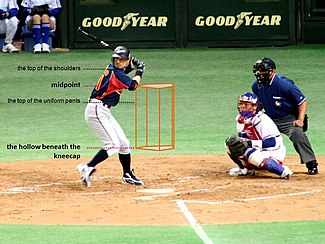
The strike zone morphed in the age of camera technology, as well. Before cameras, it turned out, umpires had been ignoring strikes around the knees. Pitches between 18 and 30 inches above the plate, which are technically in the strike zone, had been called balls for years. But the presence of cameras encouraged umpires to lower the strike zone.

As you're about to see, this swung the balance of power from the batters box to the pitching mound, shutting down baseball's thrilling home-run parade and inaugurating the Era of the Pitcher.

The New (Lower) Strike Zone
For both right- and left-handed batters, the strike zone has both narrowed and deepened. Since 2008, the strike zone has grown by about 30 square inches around a hitter's knees [see graph]. That is the equivalent of about five full baseballs placed side-by-side, according to Mills' research.

The New Strike Zone: Narrower and Lower

Since umpires opened up the basement of the strike zone, pitchers haven't just moved in. They've changed their permanent residence, painted the walls, and opened a co-op. The game of baseball has moved considerably closer to the plate in many ways ...
  • The share of pitches thrown less than 2.5 feet over the plate (i.e.: a "low" pitch) has grown every year since 2009.
  • In 2007, "low" pitches were 17 percent more common than higher pitches. By 2013, they were 43 percent more common.
  • The sinker, a fastball pitch that breaks downward, has grown from 35 percent of all pitches in 2007 to 38 percent today.
  • Hitters have swung at low pitches at a higher rate every year since 2009.
As the strikes moved down, the strikeouts went up. Swinging strikeouts are up 11 percent since 2008. Called strikeouts (on third strikes without a swing) are up 66 percent. The entire increase in strikeouts is happening on pitches between 18 and 24 inches off the ground.

The Rise in Strikeouts: It's All About Low Pitches
Y-axis: Annual strikeouts | "Bottom" = 18-24 inches above the plate
The Atlantic/Mills


To review, a lower strike zone invited more low pitches, more low strikes, and more strike outs. These variables on their own explain a good chunk of baseball's offensive drought. But let's throw in one more variable in there: hitter psychology.

Batters are typically worse when they fall behind the count—that is, when there are more strikes than balls—because they have to defend the plate to avoid striking out. Hitters are much more successful on 2-1 counts (two balls, one strike) than on 1-2 counts. "Having a 1-1 pitch that was called a ball in 2008 suddenly get called a strike in 2013 changes the batting environment," Jon Roegele writes in an excellent paper on the rise of low strikes. Strikes hurt hitters even without strike outs by forcing batters to shift to a protect-the-plate strategy rather than a swing-for-the-fences strategy.

To illustrate this point, consider the Florida Marlins' Giancarlo Stanton, the MLB-leader in home runs and RBIs. Here are his numbers on each count and after each count:
  • 1-1: 34 at-bats; .529 average; 1.176 slugging
  • 2-1: 38 at-bats; .385 average; .692 slugging
  • 1-2: 91 at-bats; .176 average; .297 slugging
     
  • After 1-1: 218 at-bats; .257 average; .459 slugging
  • After 2-1: 119 at-bats; .261 average; .445 slugging
  • After 1-2: 155 at-bats; .187 average; .297 slugging
Going from a 2-1 count to a 1-2 count has a staggering effect on Stanton's offense. On a 2-1 count, Stanton hits like Albert Pujols. On a 1-2 count, his slugging is worse than Ichiro Suzuki.
The upshot? When you add up the cumulative effects of a lower strike zone—more low pitches yielding worse hits, more strikes yielding worse counts for hitters, and more strike outs—they explain one-third of the offensive decrease over the last five years, Roegele found. Mills's research suggests that the figure is even higher: "As much as 40 percent of the decline in run scoring may be directly attributed to the increases in called strikes."

Why Baseball's Going Down
A bigger, lower strike zone might be the most important factor in baseball's offensive cold streak. That would not make it the only factor. For example:
  • In the last decade, managers have gotten smarter about defense, and many runs have potentially disappeared into the maw of improved defenders and advanced fielding.
  • The strategic deployment of hard-throwing middle relievers has blunted offensive power. The number of relief appearances since 1987 has doubled according to Joe Sheehan's newsletter, while the number of pitchers averaging a 95-mph fastball has increased from 11 to 25 since 2002.*
  • There are reports that temporary inconsistencies in baseball manufacturing in the 1990s created a bounty of "juiced balls," which traveled further than ordinary baseballs. Jay Jaffe produced interesting anecdotal evidence of the juiced-ball theory.
  • It's possible that baseball is going through a brief dry spell in home-run-hitting talent, or an extraordinary moment in pitching quality.
  • Perhaps most importantly, the harsh 2006 rules against performance-enhancing drugs offer a compelling explanation for baseball's dearth of power—although it's odd that baseball's minor leagues haven't seen a similar decline in offensive performance since their own steroid policy was implemented.  
But none of this rules out the astonishing impact that camera-technology and performance standards for umpires have had on baseball's hitters.

The irony is that MLB did everything that an economist or corporate guru would have advised. Baseball embraced emerging technology rather than banish it. It used analytics to improve the work of its elite employees. It used reviews to encourage exceptional performance among umpires. And the league got exactly what they wanted: a more-perfect strike zone.

But is that really baseball's highest goal? A perfect strike zone, at the expense of steadily evaporating offense?

Baseball has done all the right little things while perhaps ignoring the big thing: It needs hitters. It needs home runs. Sports thrive and grow when national stars thrive on national television as marketing ambassadors of the game. Today, baseball is a national pastime without a truly national star. Mike Trout, the historic and absurdly young center fielder for the league-leading Los Angeles Angels, has one-third the name recognition of Derek Jeter, a telegenic veteran that even this Yankees fan named Derek will acknowledge was never half as good as Trout.

So the league has pitched itself into a corner. Its own rules have destroyed the offensive power surge that had captured America's attention in the late-'90s and early aughts. 

Umpires, empowered and/or cowered by technology, are better than ever. As a direct result, baseball has become a grind for fans who prefer sports with scoring.


Sent from my iPhone


Giants Top Minor League Prospects

  • 1. Joey Bart 6-2, 215 C Power arm and a power bat, playing a premium defensive position. Good catch and throw skills.
  • 2. Heliot Ramos 6-2, 185 OF Potential high-ceiling player the Giants have been looking for. Great bat speed, early returns were impressive.
  • 3. Chris Shaw 6-3. 230 1B Lefty power bat, limited defensively to 1B, Matt Adams comp?
  • 4. Tyler Beede 6-4, 215 RHP from Vanderbilt projects as top of the rotation starter when he works out his command/control issues. When he misses, he misses by a bunch.
  • 5. Stephen Duggar 6-1, 170 CF Another toolsy, under-achieving OF in the Gary Brown mold, hoping for better results.
  • 6. Sandro Fabian 6-0, 180 OF Dominican signee from 2014, shows some pop in his bat. Below average arm and lack of speed should push him towards LF.
  • 7. Aramis Garcia 6-2, 220 C from Florida INTL projects as a good bat behind the dish with enough defensive skill to play there long-term
  • 8. Heath Quinn 6-2, 190 OF Strong hitter, makes contact with improving approach at the plate. Returns from hamate bone injury.
  • 9. Garrett Williams 6-1, 205 LHP Former Oklahoma standout, Giants prototype, low-ceiling, high-floor prospect.
  • 10. Shaun Anderson 6-4, 225 RHP Large frame, 3.36 K/BB rate. Can start or relieve
  • 11. Jacob Gonzalez 6-3, 190 3B Good pedigree, impressive bat for HS prospect.
  • 12. Seth Corry 6-2 195 LHP Highly regard HS pick. Was mentioned as possible chip in high profile trades.
  • 13. C.J. Hinojosa 5-10, 175 SS Scrappy IF prospect in the mold of Kelby Tomlinson, just gets it done.
  • 14. Garett Cave 6-4, 200 RHP He misses a lot of bats and at times, the plate. 13 K/9 an 5 B/9. Wild thing.

2019 MLB Draft - Top HS Draft Prospects

  • 1. Bobby Witt, Jr. 6-1,185 SS Colleyville Heritage HS (TX) Oklahoma commit. Outstanding defensive SS who can hit. 6.4 speed in 60 yd. Touched 97 on mound. Son of former major leaguer. Five tool potential.
  • 2. Riley Greene 6-2, 190 OF Haggerty HS (FL) Florida commit.Best HS hitting prospect. LH bat with good eye, plate discipline and developing power.
  • 3. C.J. Abrams 6-2, 180 SS Blessed Trinity HS (GA) High-ceiling athlete. 70 speed with plus arm. Hitting needs to develop as he matures. Alabama commit.
  • 4. Reece Hinds 6-4, 210 SS Niceville HS (FL) Power bat, committed to LSU. Plus arm, solid enough bat to move to 3B down the road. 98MPH arm.
  • 5. Daniel Espino 6-3, 200 RHP Georgia Premier Academy (GA) LSU commit. Touches 98 on FB with wipe out SL.

2019 MLB Draft - Top College Draft Prospects

  • 1. Adley Rutschman C Oregon State Plus defender with great arm. Excellent receiver plus a switch hitter with some pop in the bat.
  • 2. Shea Langliers C Baylor Excelent throw and catch skills with good pop time. Quick bat, uses all fields approach with some pop.
  • 3. Zack Thompson 6-2 LHP Kentucky Missed time with an elbow issue. FB up to 95 with plenty of secondary stuff.
  • 4. Matt Wallner 6-5 OF Southern Miss Run producing bat plus mid to upper 90's FB closer. Power bat from the left side, athletic for size.
  • 5. Nick Lodolo LHP TCU Tall LHP, 95MPH FB and solid breaking stuff.