Showing posts with label NFL Draft. Show all posts

Thursday, July 05, 2018

Top 5 QB Prospects: Performance by Throw Location - ACTA Sports

Top 5 QB Prospects: Performance by Throw Location - ACTA Sports


JACKSONVILLE - I heard about this type of analysis (on Wharton Moneyball podcast) being the deciding factor in the Browns decision to select Baker Mayfield over the other candidates for the #1 selection in the NFL Draft. The analysis indicated that Mayfield was simply better at hitting open receivers and that is the top predictor for success at the NFL level for collegiate QB's. The logic was something like, if they can't do the simplest task of an NFL QB how can you expect them to do the more difficult tasks? Also, the ability to hit wide open receivers doesn't improve in the NFL, so it's a WYSIWYG stat. 

Time will tell the tale and fitting into a systems can hide QB weaknesses and shortcomings to some degree. It almost looks like Lamar Jackson might be the next best prospect, but we shall see. 

from actasports.com
http://actasports.com/statoftheweektop-5-qb-prospects-performance-by-throw-location/

Top 5 QB Prospects: Performance by Throw LocationPosted by

Here at Sports Info Solutions, we track the direction and throw depth of every throw made at the FBS level, as well whether the ball was catchable or not. A huge conversation this draft season has been about the top five quarterback prospects and how well their true accuracy was represented by their Completion Percentage. Our On-Target Percentage statistic (simply catchable throws divided by all throws) captures a player's ball placement ability much better than Completion Percentage, as it isolates a quarterback's accuracy from his target's ability to catch the ball.

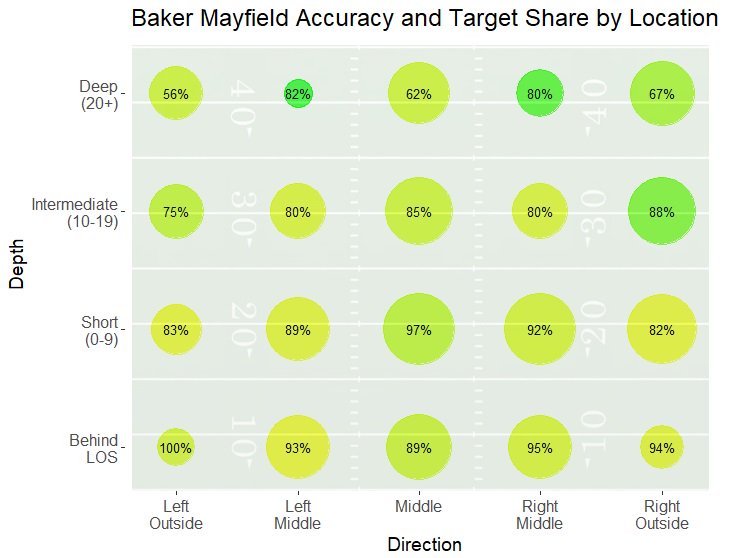
On that note, we have visualized each of the top five quarterback prospects' accuracy and Target Share (percent of total attempts) by location of their throw. The size of the circle represents the Target Share, the color represents their On-Target Percentage relative to FBS average for that location (red = bad, yellow = average, green = good), and the number in the circle is their observed On-Target Percentage. We've included both 2016 and 2017 for these players to increase their sample sizes. Baker Mayfield
In summary: Was consistently accurate all over the field.Baker Mayfield has had above average to elite accuracy almost everywhere on the field. Directionally, he most frequently threw passes between the hashes and to the right sideline outside the numbers.

From a throw depth perspective, he ranked in the top two (amongst these five QBs) in throws behind the line of scrimmage and in deep and intermediate areas. However, he threw by far the fewest passes in the 0-to-9 yard range of any QB in this group at 33% (which was seven percentage points less than any other QB).

When comparing his accuracy to FBS average, he had four of the five biggest differences in this group in On-Target Percentage: Deep Right Middle (+32%), Deep Left Middle (+31%), Intermediate Right Outside (+27%), and Deep Right Outside (+18%). Sam Darnold
In summary: Could stick a deep throw to the right sideline at an elite level.Sam Darnold presented more of a mixed bag. Directionally, he slightly favored his right, especially outside the numbers.

His accuracy was most impressive compared to FBS average in the Deep Middle (+17%) and Deep Right Outside (+15%), but he attempted three times as many throws (52 attempts vs. 17) to that Deep Right Outside area. Josh Rosen
In summary: Majority of throws were short, potential West Coast Offense fit.Josh Rosen absolutely loved throwing in that bread basket right in front of him in the short middle—he had a higher percentage of his attempts here than any other of these QBs had in any area (13%).

Likewise, this conservative throw distribution (whether by scheme or a bad offensive line) showed up again in his deep throw percentage, which ranked last by a considerable margin. By direction, nearly two-thirds of his throws were between the numbers.

His accuracy didn't really stand out in any area other than the Intermediate Left Outside (+14%); this was his only area which he placed in the top 20 (of the 100 depth and direction combinations) in terms of the difference between his On-Target Percentage and the FBS average. Lamar Jackson
In summary: Threw short the most, deep middle sweet spot.Jackson did have the highest percentage of throws to the short area (46%), but he had the second fewest percentage of throws behind the LOS (13%) and lowest in the intermediate area (23%).

Jackson really loved the Deep Middle—his Target Share in this area (6%) was highest of any prospects in any deep section, and his On-Target Percentage was elite (8% above FBS Average) on a big sample. However, his two most accurate areas compared to FBS average were interestingly both to the left and outside the numbers—specifically the Short Left Outside (+13%) and Intermediate Left Outside (+12%). Josh Allen
In summary: Works sideline and deep the most.And finally, we have Josh Allen, an inaccurate QB whose arm strength and mobility still entice teams to think about his potential. To be fair, Allen's throw locations were often to some of the hardest places to complete passes on the field, as his 51% Target Share outside the numbers was 12% more than the next QB (Darnold, 39%).

Correspondingly, he was averse to throwing in the middle and left middle areas, ranking last in both. He also led in the percentage of his throws that were deep (22%) and intermediate (27%), while having the least amount of easy throws behind the LOS.

While his accuracy generally was below average, he did excel in the Deep Right Middle compared to FBS average (+19%, which ranked fourth overall among these 100 combinations). However, that was on only 19 attempts, so sample size beware.

After diving deep into accuracy by ball location, a lot of the narratives from this draft season actually hold up pretty well. Allen was, in fact, asked to make harder throws than everyone else.

But even after controlling for the difficulty of throws, there is no QB who even came close to Mayfield in terms of being consistently accurate no matter where he threw the ball.


Sent from my iPhone

How to Identify Talent: Five Lessons from the NFL Draft - Behavioral Scientist

How to Identify Talent: Five Lessons from the NFL Draft - Behavioral Scientist


JACKSONVILLE - The Browns had a tough decision again for the franchise QB spot and this time I think they got it right with Mayfield. I think some of the other NFL GM's were trying to coax them into a mistake with leaked information about how great the other guys were, but they all had warts.  Mayfield struck me as almost a modern day, collegiate version of Jim McMahon, and that spells winner.

from behavioralscientist.org
http://behavioralscientist.org/how-to-identify-talent-five-lessons-from-the-nfl-draft/

How to Identify Talent: Five Lessons from the NFL DraftApril 23, 2018

This week the Cleveland Browns will decide which, if any, of the top quarterback prospects to acquire with the first pick in the NFL draft. There are four leading contenders, and the team has been evaluating them in detail for more than a year. They will pay the young man over $30 million, and his success or failure will drive the team's fortunes for years. No pressure. Never mind the sobering 52 percent success rate for picking between two players in the NFL draft.

Few industries invest as much into each "hire" as professional sports. I have seen this firsthand, working closely with NFL teams for more than 10 years and more recently with professional basketball and baseball teams. Their issues parallel those I see in nonsports organizations, from multinational corporations to graduate school admissions and urban nonprofits. The challenge of finding the next generation of talent is both ubiquitous and vexing. Successful track records are rare.

Yet, if there is one consistent yet underappreciated principle for making good hires, it is that process beats technology. It turns out that best practices in hiring have much in common with what psychologists have preached for decades.

More independence is often the biggest improvement an organization can easily make in their hiring process.

Why is it so hard to draft or hire well? One reason it is that it is so difficult to be consistent. A draft pick is the product of a year's work, by dozens of people, an outcome negotiated from diverse perspectives to satisfy diverse preferences. The process is overseen by owners and general managers subject to the shifting sentiment of outside forces. And the actors are constantly changing, with scouts and coaches moving between teams each year. This is hardly a recipe for consistency—and not that different from many nonsports organizations.

That is why a structured decision process is especially valuable. The best teams have philosophies and policies that firmly guide the draft process. There are few organizations capable of doing that consistently, and it's a real advantage for those who can.
There is no silver bullet. In sports or out, there is no test or technology that reliably distinguishes star from bust, despite all our advances and many promises otherwise. How should we do it then? What can we learn from how NFL teams draft? Here are five universal prescriptions.

#1: Understand Your Goal
I once worked for an NFL team that was much more successful drafting players one side of the ball than the other. One year we surveyed the staff about the kind of player they wanted to acquire at a particular position. The position was on the side they struggled with, and we discovered there was zero consensus on the type of player to pursue. Given the range of opinions, the group average was meaningless. No wonder they had trouble drafting the right guys!

To paraphrase Lewis Carroll, if you don't know where you're going, any road will get you there. An easy way to flub a hire from the beginning is to skip asking exactly what it is you're looking for. People often don't understand their decision objectives, but the most successful sports teams are clear about their goal and don't stray from the principles and attributes they've established.

#2: Keep Your Judges Apart

NFL teams have dozens of scouts and a complicated method of getting multiple looks at their prospects. Even marginal prospects are seen by more than one scout, and the top guys might be evaluated by a dozen different people. In some teams a scout will know the previous scouts' opinions before forming his or her own while other teams keep scouts blind to previous evaluations. This is a key difference.

Replicability is a referendum on your process.

People are impressionable. When they are exposed to other's opinions before forming their own, they tend to anchor on the existing view. More generally, the "wisdom of the crowd" depends on the independence of the respective opinions within the crowd. Yet that independence is easily compromised, in many ways—anchoring, of course, but also common backgrounds, training, friends, etc. You may think you're getting 5-6 opinions when effectively you're getting only 1.5!

A good hiring process explicitly pushes against these compromising factors: Don't let people talk to each other or see other's opinions before providing their own, expose the candidate to judges in different ways and at different points in time, and bring people with different perspectives into the process. More independence is often the biggest improvement an organization can easily make in their hiring process.

#3: Break the Candidate Into Parts …NFL teams break players down in minute detail. There are physical qualities: For a quarterback it includes, for example, arm strength, mobility, and release. And then there is their "makeup," or the intangibles considered critical for success. Ideally even these intangibles are broken into component parts, such as work ethic and selflessness. This decomposition means players are explicitly evaluated on many distinct dimensions.
This involves work. It's much easier to give one, global evaluation—like or dislike, hire or reject. These overarching evaluations are natural and efficient, but unfortunately, they are often biased. For a more reliable evaluation, you need to break the objective into component parts and evaluate them separately. Daniel Kahneman recognized the importance of this step years ago when designing performance evaluations for the Israeli military and has advocated for them since.

#4: … and Bring Them Back Together MechanicallyAn NFL executive once mused about what would happen if their draft board fell down (teams generally sort players by placing nametags on a physical board). After painstakingly ranking their prospects for months, would they be able to put them back up in the same order? His answer was no, and that troubled him. The logic is simple: If your hiring rankings aren't perfectly replicable, you have noise in the process; if you have noise in the process, you're more likely to take bad candidates and pass on good ones. Replicability is a referendum on your process.

The single best way to reduce noise is to aggregate opinions mechanically. This can mean finalizing a scout's opinion of a prospect by merely summing his or her component grades for an overall score. At the team level it can mean summarizing the group's collective opinion by simply averaging scouts' opinions. At the very least this approach provides a more systematic starting point for a group discussion. This sounds boring, but that's kind of the point.

Hiring is best thought of as a forecasting process, and the only way to improve forecasts is to map them against results and refine the process over time.

Letting a spreadsheet—or a model—summarize your judgment may seem like an abdication, but we've known for decades that simple linear models outperform intuitive judgment. This isn't because evaluators don't have expertise but rather because they apply their expertise inconsistently. Hiring decisions shouldn't depend on the loudest voice in the room or how many strong candidates were seen earlier that day. The best way to ensure this is to aggregate mechanically. It also happens to be a big time-saver, freeing you to focus on the issues humans handle better than machines. 

#5: Keep ScoreNFL scouts are always looking for a guy with "it"—the elusive quality that seems to distinguish those who excel in the pros from those who struggle. Eyes light up when scouts talk about a player they believe has "it." Trouble is we don't know how reliable these beliefs are. On one hand, intuition based on years of repeated exposure and pattern recognition can be quite good. On the other, unless that experience comes with clear and regular feedback it can be misleading.

Of course, the rest of us are no different than scouts in this regard. We've all been animated by the sense we've just seen the next star in our field. The trick is to capture those judgments and track them over time to learn how predictive they are. This applies to all judgments. Hiring is best thought of as a forecasting process, and the only way to improve forecasts is to map them against results and refine the process over time. By doing this, teams learn which tests matter most, which questions are more informative, and which scouts are best with each position on the field.

Many organizations don't bother keeping score, because the payoff is delayed; it can be years before enough data arrive for reliable insights. The kind of foresight and humility required is exactly what distinguishes good management.

At the moment, the defending champions in all three major professional sports—the Eagles, Astros, and Warriors—are unapologetic devotees of "Moneyball" in some form. Moneyball isn't about a model or a technology but rather a decision-making process. The tenets of that process suggest steps any organization can take to improve their hiring. They are deceptively easy. The challenge isn't understanding them; it's sticking to them amid the drama of high-pressure hires. Now, back to (ahem) the Browns.


Sent from my iPhone

Thursday, June 28, 2018

Listen to From Wharton Student to Eagles NFL Analyst in Podcasts


JACKSONVILLE - Namita Nadukumar is becoming a rock star in the data analytics world, she has put out some great research and analysis on the NHL Draft, which an NFL team obviously feels could be of value. From what I have read, some would also be of significant value in baseball.

Listen to From Wharton Student to Eagles NFL Analyst from Wharton Business Radio Highlights in Podcasts. 
https://itunes.apple.com/us/podcast/wharton-business-radio-highlights/id1147257638?mt=2&i=1000411032094

Namita Nandakumar, Wharton Senior, Teaching Assistant, and Research Analyst, joins hosts Cade Massey, Shane Jensen, and Adi Wyner to discuss her post-graduate move to Quantitative Analyst for the NFL's Philadelphia Eagles this season on Wharton Moneyball.

Sent from my iPhone

Wednesday, May 06, 2015

NY Giants undrafted free agents signings | NJ.com

 Image result for undrafted free agents nfl

These are guys who can make or break your special teams and eventually break into your starting lineup and be serious contributors. It looks like the G-Men went for size and/or speed except for LB Cole Farrand from Maryland, so my guess is he will be the pick of this litter.

from NJ.com
http://www.nj.com/giants/index.ssf/2015/05/giants_undrafted_free_agents_signings.html


DE Brad Harrah (Cincinnati)
He's 6-5, 270 pounds, and has the size the Giants like on their defensive line. Harrah can also play inside and out. He had 32 tackles and 3.5 sacks this past season.

TE Matt LaCrosse (Illinois)
He's a 6-6, 260-pound athletic tight end. Played tight end, fullback and H-back at Illinois, where he caught 14 passes for 117 yards and three touchdowns.

RB Akeem Hunt (Purdue)
Speedy running back who ran the 40-yard dash in 4.40 seconds. Hunt (5-9 3/4, 189) was a quality kickoff returner at Purdue and rushed for over 1,000 yards last season.

LB Cole Farrand (Maryland)
The inside linebacker is tough and a solid tackler who could bring a lot on special teams. He's not special athletically.

S Justin Currie (Western Michigan)
Currie (6-2, 210) is a big, strong safety. He put up 19 reps on the bench press at his Pro Day and had 105 tackles this past season.

OL Sean Donnelly (Tulane)
He's long and tall (6-foot-8) but not especially thick (298 pounds). The offensive tackle was a three-year starter for the Green Wave.


NY Giants rookie comps


I like the comps on these guys, solid if not spectacular players. The Giants in effect sacrificed their 4th round pick to get two first round picks. Traded quantity for quality.

On some of the mock drafts, you would have seen Landon Collins and Ereck Flowers both in the top 10-15 players listed. To secure both by the beginning of the second round was quite a coup and hats off to the staff for that. Perhaps they have done enough to make the Giants competitive for a playoff spot. 


from giants.com


NFL Experts made pro comparisons for the Giants 2015 Rookie Class

Over this past weekend in Chicago, the NFL ushered in the next generation of players. 

Time will tell how they stack up with their predecessors, but until then, Giants.com gathered comparisons of the six members of the New York Giants 2015 Draft Class with players currently in the league. 

ROUND 1: OL ERECK FLOWERS

Compared to:

Anthony Davis, San Francisco 49ers
"Flowers is a big, strong, power man. He's a powerful run blocker and has prototypical tackle traits. He reminds me of the 49ers' Anthony Davis when he came out of Rutgers." -- Mike Mayock, NFL Media

Cordy Glenn, Buffalo Bills
"Arguably plays with as much of an edge as any offensive lineman in this draft class. Stays engaged up to, and at times even through, the whistle. Wants to bury any defender in his path, with the strength to do so in the run game." -- Chris Burke, SI.com

ROUND 2: SAFETY LANDON COLLINS

Compared to:

Donte Whitner, Cleveland Browns
"Although Collins has said he idolizes former Washington safety Sean Taylor, draft gurus compare him to another run-thumping safety Donte Whitner, who was a first-rounder back in 2006." -- Chris Burke and Doug Farrar, SI.com

"Donte Whitner is a guy that has really found his niche in the league, a guy that can come down and really deliver big shots on runners in the hole but also has the ability to play in space and make plays on the ball. 

So when I look at Landon Collins, in the right system, he's a guy that can rock and roll at the safety position, meaning he can come down on some downs and play in the box, other downs he can play in the middle of the field." -- Bucky Brooks, NFL Media

ROUND 3: DE OWAMAGBE ODIGHIZUWA

Compared to:

Sam Acho, Chicago Bears
"Relentless and competitive. Never gives up on a pass rush. Expected to be a core special-teams talent. Can play 4-3 defensive end or 3-4 outside linebacker." -- Lance Zierlein, NFL Media

ROUND 5: SAFETY MYKKELE THOMPSON

Compared to:

Aaron Ross, Free Agent
"You are going to go through some growing pains when you play in the secondary, especially with one that is as aggressive as ours. We put some guys on islands back there. We can go through it with Aaron Ross and some of those great ones who had some struggles early in their careers and did fine by the time they left here. I see Mykkele much in that same stride." -- Duane Akina, former Texas Secondary Coach (now with Stanford)

ROUND 6: WR GEREMY DAVIS

Compared to: 

David Tyree, former New York Giants wide receiver
"Geremy Davis is a David Tyree, Jason Avant kind of guy, can be your fourth or fifth receiver and play special teams and can come in and play any of the receiver positions and make some big catches in tight spots for you." -- Jerry Reese, New York Giants, General Manager 

Jason Avant, Kansas City Chiefs
"Yeah, one of our scouts, Ryan Jones, compared him to Avant. That was a good one. Hopefully he can be an 'Avant.'" -- Marc Ross, New York Giants, Vice President Player Evaluation 

"He kind of reminds you of Jason Avant. I think that was a name somebody brought up in our meeting. One of those kind of guys that could be your fourth, fifth receiver, play on special teams, has size, can block, good route runner, and catch the ball nice." -- Jerry Reese, New York Giants, General Manager

ROUND 7: OL BOBBY HART

Compared to:

Ramon Foster, Pittsburgh Steelers
"Tape doesn't always treat Hart kindly, but his issues in pass protection as a tackle won't be the same issues he faces in the NFL as a guard. While he has physical limitations, Hart is a competitive player who flashes NFL power potential." -- Lance Zierlein, NFL Media


Monday, May 04, 2015

Future NY Giants prospects


The consensus grade for the Giants draft was B / B-. The Redskins early pick of Scherff forced the Giants hand and they went for the next best bet in Ereck Flowers. Some feel this was a bit of a reach, but if the Giants felt they had to address the OL early and if Flowers develops into a quality LT, this is a great pick. Even if he has to move over to RT or inside to guard, still a good pick. Flowers is 6-6, 329 with a mean streak so the Giants got bigger and badder on the front line, which was a serious need.

Moving up to get Alabama SS Landon Collins was a good move. He was graded as a first-round talent and it is a need position, so you get quality, value and fill a need on the roster. Collins is a sturdy strong safety at 6-0, 228 and well coached.

Owa Odighizuwa is an athletic 6-3, 270 DE from UCLA who has been described as Justin Tuck 2.0. That would be a good deal. He's a bit of a combine warrior who needs to translate his athletic gifts into useful football skills.

Texas DB Mykkele Thompson is versatile and big at 6-2, 191. Maybe more safety than CB, if he contributes as expected in nickel and dime packages, the Giants pass defense should be improved.

Sixth round WR Gerry Davis, 6-2, 216 from Connecticut, is probably a back up, possession type receiver and FSU guard Bobby Hart, a seventh rounder will provide depth and size on the OL at 6-5, 329.

Bottom line is the Giants added a guy who should come right in and start in Collins, a possible project in Flowers, who should contribute in first year, if not start immediately. Odighizuwa and Thompson are the wild-cards. How early and often they contribute will decide in hindsight how good this draft is for the Giants. They did get good value out of Collins and Odighizuwa at the top of the draft and a few draft pundits targeted Thompson as a sleeper pick (ie: good value). Hart could develop down the road.

Overall, it looks like a good draft for the Giants who really needed one at this point. I give it a solid B grade. They still need to address the LB position, but the addressed the need for a pass rusher and the offensive line.


Analysis from NFL.com


1.9 Ereck Flowers
http://www.nfl.com/draft/2015/profiles/ereck-flowers?id=2552452


OVERVIEW

As a junior in 2014, started all but one game at left tackle and was second-team All-ACC selection. Flowers suffered a knee injury in the middle of the season and reportedly underwent a surgical procedure to repair the injury but missed only one game because of it. Admonished for using an obscene gesture toward Nebraska fans after an on-field skirmish. In 2013, started all 13 games at left tackle. In 2012, started four games as a freshman at right tackle. Ranked as a four-star prospect by Scout and Rivals coming out of Miami Norland High School. Helped lead team to a 15-0 record and Class 5A state championship. Was the only player at the NFL Scouting Combine who decided not to hire an agent.

PRO DAY RESULTS


Vertical jump: 27 inches

ANALYSIS

STRENGTHS

 Big, athletic frame carrying more than 320 pounds with ease. Ascending mauler in the run game. Bender who is low man off snap and pops hips into block to leverage defender at the point. Combines hips, arm extension and upper-body power to consistently turn his man when base blocking. Once he gets upper hand in run game, he usually sustains and finishes. Secures combo block with a vengeance. Has feet to become solid zone blocker. Mean and highly competitive. Wants to dominate and gets surly when beaten on a snap. Special foot quickness in pass protection. Able to mirror and counter two-way rushers or B-gap blitzers. Uses quick feet and loose hips to turn, scramble and recover when beaten. Pass-set depth and technique improved as year progressed. Has played both tackle positions.

WEAKNESSES

 Pass protection needs plenty of work. Footwork gets sloppy and undisciplined, causing base to narrow. Ducks head into contact and is a leaner in pass pro, creating balance problems. Rarely flat-footed upon initial hand contact. Throws hands rather than firing authoritative punch. Hands ride too high and too wide. Content to become grabby around framework of defender. Flagged for six holding penalties over last two seasons. Slow to secure and climb on combo blocks and is often lacking balance on the way to target. Doesn't bring feet under him to sustain second-level blocks. Knocked off balance by smaller pass rushers due to poor balance. Hips looked tight and struggled to gain ground when asked to pass set in combine drills.

DRAFT PROJECTION

 Round 1

NFL COMPARISON

 Jack Mewhort

BOTTOM LINE

 Flowers has good size and short area foot quickness, but he also features some lower body tightness and struggles to get proper depth quickly to consistently meet edge rushers. Some of Flowers' pass protection issue may be difficult to overcome. On the hand, his strength as a run blocker and ability to uproot his man and get them turned is undeniable. Flowers may be drafted as a tackle, but his best position could end up being as a guard where I would put a draft grade on him of 6.12.
2.40 Landon Collins http://www.nfl.com/draft/2015/profiles/landon-collins?id=2552454


OVERVIEW

Played 41 career games, starting the last 23. As a junior in 2014, voted unanimous first-team All-American. Was first-team All-SEC selection and a finalist for the Nagurski Award, Lott IMPACT Trophy and Jim Thorpe Award. Led the team in tackles (103) and interceptions (3). Played both safety spots and started three games at dime back during three seasons at Alabama. Second-team All-SEC selection as a sophomore in 2013. As a freshman in 2012, tied for team lead with 10 special teams tackles and blocked a punt. Was rated No. 1 safety in the nation and top-10 overall prospect by 247sports.com coming out of Dutchtown (La.) High School. Became first player in Louisiana Sports Writers Association history to earn 5A All-State honors on both sides of the ball (rushed for 1,218 yards and 21 touchdowns).

PRO DAY RESULTS


Bench press: 16 reps of 225 pounds

ANALYSIS

STRENGTHS

 Thick safety with a no-nonsense demeanor typical of a Nick Saban-coached player. Decisive against the run. Gets high to low quickly and is all over the ball. Leverages running backs to sideline and keeps contain. A true sheriff against the run. Tracks and stalks ball carriers with patience. Hits the gas and explodes into his tackles with purpose. Feet are under him and balanced when ready to strike. Aggressive and tough with a desire to intimidate. Disciplined eyes -- is not easily moved around field by quarterbacks. Wrap-up tackler. Physical enough to match up against tight ends and has the feet to carry big, slot targets. Transitions to throws quickly in zone coverage and limits yards after catch. Finds and tracks ball and times his leaps well. Aggressive in playing the ball and disrupts the catch with his physicality. Core special-teams player.

WEAKNESSES

 Average hands. Dropped easy interceptions against Texas A&M and Arkansas. Looked much quicker in 2013 than he did in 2014. Can be beaten in a foot race. Average recovery speed. Sometimes shows too much confidence in recovery speed. Gets caught peeking into backfield and can be beaten over the top after a late jump. Inconsistent route recognition. Beaten for game-tying and game-winning touchdowns by Ole Miss. Shows some hip stiffness when asked to open up and run. Might be carrying too much bulk.

DRAFT PROJECTION

 Round 1

NFL COMPARISON

 Johnathan Cyprien

BOTTOM LINE

 Collins is a tempo-setter who can energize a defense with his downhill, aggressive style. He is at his best when he can attack rather than sit back in coverage and process. Collins' tackling, pursuit angles and speed to the sideline can help a defense shut down rushing attacks, but his inconsistencies in coverage will be tested by NFL offenses.


3.74 Owa Odighizuwa http://www.nfl.com/draft/2015/profiles/owamagbe-odighizuwa?id=2552275


OVERVIEW

Participated in 2015 Senior Bowl. Selected second-team All-Pac-12 in 2014, tying for team lead with 11.5 tackles for loss and finishing second on team with 6 sacks. Granted medical redshirt in 2013 after missing entire season following surgery on both hips. Played in 38 games from 2010-2012 with 8 starts. Was a Parade All-American and USA Today second-team All-American in high school, where he also lettered in basketball and track.

ANALYSIS

STRENGTHS

 Absolute Greek God with the pads off. Shredded physique with very little body fat. Strong at the point of attack. Plays with desired anchor and strong lower body. Run defender who can close down creases. Gets off ball with good pad level and has potential to convert speed to power. Hands are violent and active. Relentless and competitive. Never gives up on a pass rush. Expected to be a core special-teams talent. Can play 4-3 defensive end or 3-4 outside linebacker.

WEAKNESSES

 Not skilled as a pass rusher. Won't win around the edge often and must prove he can counter back inside. Has dealt with two surgeries on his hip and missed all of 2013 because of it. Lateral agility is limited. Range in pursuit in question. Could be mismatched if forced to cover in space. More unit fit than talented player.

DRAFT PROJECTION

 Round 2

SOURCES TELL US

 "He's not Courtney Upshaw, but he could be used kind of like that. I can see him playing in both 4-3 or 3-4, but he can't be counted on as a pass rusher and you have to know that he will be limited to just being a run stopper." -- AFC national scout

NFL COMPARISON

 Sam Acho

BOTTOM LINE

 Odighizuwa has some scheme versatility, but he's not necessarily a versatile player. Some scouts believe that he could open some eyes with his straight-line speed in his workout, but his marginal pass-rush skills and average athleticism could stunt his draft stock.

5.144 Mykkele Thompson http://www.nfl.com/draft/2015/profiles/mykkele-thompson?id=2553438


OVERVIEW

Appeared in every game (52) during his four seasons with the Longhorns.

PRO DAY RESULTS


40-yard dash: 4.47 and 4.48 seconds
Vertical jump: 36 inches
Broad jump: 10 feet, 6 inches
Short shuttle: 4.46 seconds
3-cone: 6.97 seconds
Bench: 18 reps of 225 pounds

ANALYSIS

STRENGTHS

 Versatile and can play corner and safety. Has good length and is a plus athlete.

WEAKNESSES

 Lacks bulk and strength and was a very inconsistent tackler who didn't always take good angles.
6.186 Geremy Davis 
http://www.nfl.com/draft/2015/profiles/geremy-davis?id=2552654


ANALYSIS


STRENGTHS

 Broad-shouldered target who makes himself presentable for the catch. Proficient route runner. Good use of leverage in his routes to create room at top of his routes. Makes heavily contested catches in the middle of the field. Keeps cornerbacks posted up on his hip. Plays with extended catch radius. Not a physical blocker, but walls off and shows flashes of getting after it with defender.

WEAKNESSES

 Lost snaps to younger players during 2014 season. Slow receiver lacking necessary timed and play speed for an NFL wide receiver. Doesn't have foot quickness to free himself from press coverage. Tight-hipped with prolonged gear-down into his break. Struggles to separate against quality cover corners who mirror and match him. Leans into routes, giving away his intentions. Won't do much after the catch.

DRAFT PROJECTION

 Undrafted

BOTTOM LINE

 Davis is a big, reliable target who simply falls well below the NFL standard for functional play speed at the wide receiver position. Maybe he will surprise at his workouts, but the tape doesn't show a player who can get much separation with necessary athleticism. He might not be strong enough to handle it, but additional weight on his frame could make him a candidate for a shot as a move tight end.

7. Bobby Hart  http://www.nfl.com/draft/2015/profiles/bobby-hart?id=2552335


OVERVIEW

2014: Third-team All-ACC. Started all 14 games at RT. 2013: Honorable mention All-ACC. Started all 14 games at RT. Blocked for a Heisman Trophy winner in Jameis Winston and helped lead FSU to an ACC championship and BCS national championship. 2012: Played in eight games as a backup guard and member of the field goal kicking team. 2011: Played in 11 games, serving as a reserve in the first two weeks and starting in the final nine games of the season at LT. Replaced injured senior Andrew Datko and maintained his starting role.

PRO DAY RESULTS


40-yard dash: 5.67 seconds
Vertical jump: 27 inches
Broad jump: 7 feet, 11 inches
Short shuttle: 5.07 seconds
3-cone: 8.08 seconds
Bench press: 22 reps of 225 pounds

ANALYSIS

STRENGTHS

 Bubble butt with power in his lower half. Improved from being a neutralizer to run-block winner in 2014. Can reestablish line of scrimmage when asked to maul. Wins in short yardage and near goal line. Gets hand on defender first and can latch on in pass protection. Turned 20 years old in August and body is still developing.

WEAKNESSES

 Stiff knees and hips limit his bend and leverage. Comes out of his stance too high. Shuffles feet rather than chops in pass pro, causing his base to narrow. Struggles to make his back-side cutoff blocks. Frenetic hands with too much wasted motion. Limited, small-area, guard-only prospect. Lethargic feet after contact.

DRAFT PROJECTION

 Round 6

NFL COMPARISON

 Ramon Foster

BOTTOM LINE

 Young, soft-bodied prospect who is best suited to play guard in the NFL. Tape doesn't always treat Hart kindly, but his issues in pass protection as a tackle won't be same issues he faces in the NFL as a guard. While he has physical limitations, Hart is a competitive player who flashes NFL power potential.

Friday, May 01, 2015

What is the value of doing things right? Ask the NFL for a distorted view


This is what NFL personnel directors have to sift through when making draft decisions after all the data they get from the combine. Now you have to figure out if the guy will be on the field for you, not just factoring in the risk of on-field injury, but the risk that you lose playing time due to the self-inflicted injury of poor decision making.

Good luck. It sounds as if we're just parsing levels of criminality and measuring it against ability in the ultimate risk vs. reward balancing act.

rom USA Today:
http://usatoday30.usatoday.com/sports/football/nfl/story/2012-04-20/NFL-draft-criminal-study/54433122/1

The study was done by Hamilton student Kendall Weir as his senior thesis for an economics degree and is being overseen by Wu. It included every player (around 1,200) taken in the 2005-2009 NFL drafts and their results at the scouting combine. Then it divided players into four groups based on comparable results and tracked their performance through the 2011-12 season. The four groups:
1.) Players with no suspensions or legal problems in college;
2.) Players suspended one game or more for violating team or university rules;
3.) Players arrested and charged with a crime;
4.) Players arrested, but not charged.
If you wanted the biggest bang for your buck and this were a multiple-choice quiz, the best answer would be No. 4.
Players in that group are usually drafted in the same spot as comparable players in the No. 1 group, yet wind up averaging two more starts per season. Suspended players dropped the farthest in the draft, 25 spots on average. They also fared the worst in performance terms when compared to the "clean" players, averaging two fewer starts per season, as well as having shorter careers. Players in the arrested-and-charged group tended to perform exactly the same as the clean group, but ended up being drafted 15 spots lower.
OBTW: Charles Manson is still on the board. I'm not sure what his most recent 40 time clocked in at.


The conclusions of this study are somewhat disturbing, not as disturbing as the Manson .gif, but,
"if you're on the fence about a player and worried about his criminal record, the data says take a chance" seems to me to be a recipe to eventually having your team owner testifying as a character witness at a murder trial.

Wait, that already happened right?

Image result for robert kraft testifies aaron hernandez

Put that in your "PR-nightmare scenario calculator" and smoke it. If there's no penalty....the behavior continues. If it is incentivized, which this study portraying the "convicts as draft bargains" implies, you get more of it.

The choir-boys are being over-valued relative to the convicts. Ain't that a kick in the head?

 Image result for who would have thunk it

So good luck to those hoping for the cultural landscape to improve and shame on those who want to turn a blind eye and act like it doesn't matter. It does.

The NFL wants to pay lip-service to these issues as they occur rather than doing anything to prevent them from occurring in the first place. It's not so much what you say that matters, it's what you do. And in many of these matters, the NFL does more harm than good.  

What the hell, what time is kick-off?

from thebiglead.com
http://thebiglead.com/2012/04/21/nfl-draft-study-on-character-issues-does-not-add-up/
A research study from Hamilton College claims that drafting players who have had legal incidents pays off.
“So if you’re on the fence about a player and worried about his criminal record,” said Stephen Wu, an economics professor at Hamilton College in Clinton, N.Y., “the data says take a chance.”
Not so fast. I know the words “regression analysis” make journalists’ eyes gloss over, but I went and found a draft of this study. I’ll go through it in a moment. Before we get to the numbers, though, take a look at this paragraph and consider whether the best teams are the ones employing this smart strategy.
Of the teams mentioned above, Arizona used 27 percent of its picks during the five-year span on players in the last three groups. Cincinnati, which has become a sort of “Boys Town East” for troubled free agents as well as draftees, was second at 25 percent, with San Francisco and Chicago tied for third at 20 percent. At the other end of the spectrum, Seattle drafted no players with character issues, followed by Atlanta (2 percent), Baltimore (3) and Green Bay (6).

On to Day 2:

from Yahoo Sports:
Randy Gregory, slew of defenders lead list of best available Day 2 players | Shutdown Corner - Yahoo Sports:

Even with Jameis Winston, Marcus Peters and Shane Ray going in the first 23 picks, it's clear that teams valued character seriously on Thursday.
Our top 10 best-remaining players include a few players who were taken off teams' boards — either for Round 1 consideration or altogether — with serious red flags for their off-field indiscretions. Here's our list: 
Nebraska DE-OLB Randy Gregory — Electric edge rusher who has had trouble keeping on weight and likely projects best to a 3-4 defense. He could be special if he keeps out of trouble and proves to his next team that's he's accountable and trustworthy.
Virginia DE-OLB Eli Harold — Thin-legged edge rusher with good burst off the ball and a frame that could handle more bulk in time. He brings energy to the field and would be an ideal 3-4 outside rusher.
Alabama FS Landon Collins — Athletically gifted, bulked up safety who can't play in space as well as he can up near the line of scrimmage. Those limitations likely are the reason he slid out of Round 1, but he could be a good player if used correctly.
Florida State DT Eddie Goldman — Bull-strong nose tackle or 1-technique who can play with force and leverage and should fit into most schemes. Goldman never will be a big sack producer, but he can block out the sun with his mass and be a factor stopping the run.
Arizona State WR Jaelen Strong — Linear "X" receiver with strong hands and good route-running and high-point ability. Similar to Jordan Matthews a year ago, Strong could end up being a Day 1 starter in the NFL and productive in the right system.
LSU CB Jalen Collins — Long-armed, super athletic press corner with some character concerns and limited experience (10 college starts).
UCLA LB Eric Kendricks — Excitable, playmaking linebacker who overcomes his size deficiencies with high effort and outstanding instincts. But Kendricks must be covered up and can't shed blocks against powerful offensive linemen that well.
Mississippi CB Senquez Golson — Undersized playmaker who has great ball skills and terrific confidence. A true game-changer if he can play in a scheme where he's not asked to match up, one on one, against massive receivers.
ex-Missouri WR Dorial Green-Beckham — Athletically blessed, mercurial, unreliable receiver with rare gifts and top-10 ability. His short, occasionally brilliant and often frustrating career at Mizzou showed both his potential as a receiver and his need to mature greatly.
Indiana RB Tevin Coleman — Straight-line home-run hitter who has great toughness and workhorse traits and can thrive in the right system. Behind a bad offensive line and with few playmakers around him, Coleman was a weekly wonder for the Hoosiers.
Gregory (positive drug test prior to the scouting combine), Jalen Collins (multiple failed drug tests in college) and Green-Beckham (kicked out of Mizzou following domestic abuse allegations) all had first-round physical traits and rare measurables for their respective positions. But their character issues knocked them down into a range where teams are more comfortable rolling the dice on players.
'via Blog this'

Giants Top Minor League Prospects

  • 1. Joey Bart 6-2, 215 C Power arm and a power bat, playing a premium defensive position. Good catch and throw skills.
  • 2. Heliot Ramos 6-2, 185 OF Potential high-ceiling player the Giants have been looking for. Great bat speed, early returns were impressive.
  • 3. Chris Shaw 6-3. 230 1B Lefty power bat, limited defensively to 1B, Matt Adams comp?
  • 4. Tyler Beede 6-4, 215 RHP from Vanderbilt projects as top of the rotation starter when he works out his command/control issues. When he misses, he misses by a bunch.
  • 5. Stephen Duggar 6-1, 170 CF Another toolsy, under-achieving OF in the Gary Brown mold, hoping for better results.
  • 6. Sandro Fabian 6-0, 180 OF Dominican signee from 2014, shows some pop in his bat. Below average arm and lack of speed should push him towards LF.
  • 7. Aramis Garcia 6-2, 220 C from Florida INTL projects as a good bat behind the dish with enough defensive skill to play there long-term
  • 8. Heath Quinn 6-2, 190 OF Strong hitter, makes contact with improving approach at the plate. Returns from hamate bone injury.
  • 9. Garrett Williams 6-1, 205 LHP Former Oklahoma standout, Giants prototype, low-ceiling, high-floor prospect.
  • 10. Shaun Anderson 6-4, 225 RHP Large frame, 3.36 K/BB rate. Can start or relieve
  • 11. Jacob Gonzalez 6-3, 190 3B Good pedigree, impressive bat for HS prospect.
  • 12. Seth Corry 6-2 195 LHP Highly regard HS pick. Was mentioned as possible chip in high profile trades.
  • 13. C.J. Hinojosa 5-10, 175 SS Scrappy IF prospect in the mold of Kelby Tomlinson, just gets it done.
  • 14. Garett Cave 6-4, 200 RHP He misses a lot of bats and at times, the plate. 13 K/9 an 5 B/9. Wild thing.

2019 MLB Draft - Top HS Draft Prospects

  • 1. Bobby Witt, Jr. 6-1,185 SS Colleyville Heritage HS (TX) Oklahoma commit. Outstanding defensive SS who can hit. 6.4 speed in 60 yd. Touched 97 on mound. Son of former major leaguer. Five tool potential.
  • 2. Riley Greene 6-2, 190 OF Haggerty HS (FL) Florida commit.Best HS hitting prospect. LH bat with good eye, plate discipline and developing power.
  • 3. C.J. Abrams 6-2, 180 SS Blessed Trinity HS (GA) High-ceiling athlete. 70 speed with plus arm. Hitting needs to develop as he matures. Alabama commit.
  • 4. Reece Hinds 6-4, 210 SS Niceville HS (FL) Power bat, committed to LSU. Plus arm, solid enough bat to move to 3B down the road. 98MPH arm.
  • 5. Daniel Espino 6-3, 200 RHP Georgia Premier Academy (GA) LSU commit. Touches 98 on FB with wipe out SL.

2019 MLB Draft - Top College Draft Prospects

  • 1. Adley Rutschman C Oregon State Plus defender with great arm. Excellent receiver plus a switch hitter with some pop in the bat.
  • 2. Shea Langliers C Baylor Excelent throw and catch skills with good pop time. Quick bat, uses all fields approach with some pop.
  • 3. Zack Thompson 6-2 LHP Kentucky Missed time with an elbow issue. FB up to 95 with plenty of secondary stuff.
  • 4. Matt Wallner 6-5 OF Southern Miss Run producing bat plus mid to upper 90's FB closer. Power bat from the left side, athletic for size.
  • 5. Nick Lodolo LHP TCU Tall LHP, 95MPH FB and solid breaking stuff.