Showing posts with label SPIN RATE. Show all posts

Monday, April 30, 2018

Spin Rate: What We Know Now - Driveline Baseball

Spin Rate: What We Know Now - Driveline Baseball

    This is a great article and since it's from 2016, we probably know a lot more now.

    from drivelinebaseball.com
    Image result for Neuroscience Can Project On-Base Percentages Now | FanGraphs Baseballhttps://www.drivelinebaseball.com/2016/11/spin-rate-what-we-know-now/

    Spin Rate: What We Know Now


    This article is intended to build a basis of knowledge of what we, at Driveline Baseball, understand about spin rate at this current time. We will hopefully answer some common questions that we receive and well as link out to resources that we've found helpful in understanding spin rate. This article will also be a reference point for some of our further research and writing on spin rate.

    Magnus Force and Spin Rate

    We know that we can look at a group of pitchers throwing fastballs at the same speed, say 92 MPH, and those pitchers can all have different rates of spin on their fastballs. The rough guidelines for an 'average' pitcher would be a pitch at 92 MPH fastball with a spin rate of 2200 Revolutions per minute (RPM). In reality pitchers can throw 92 and have spin rates ranging from 1800 RPM to 2400 RPMs.
    Why this happens can be explained by some simplified physics, in this case we'll focus on the Magnus force. If we picture a four seam fastball, which is thrown with backspin, the more backspin the less the ball is going to drop over its course from the pitcher's hand to the catcher's glove.
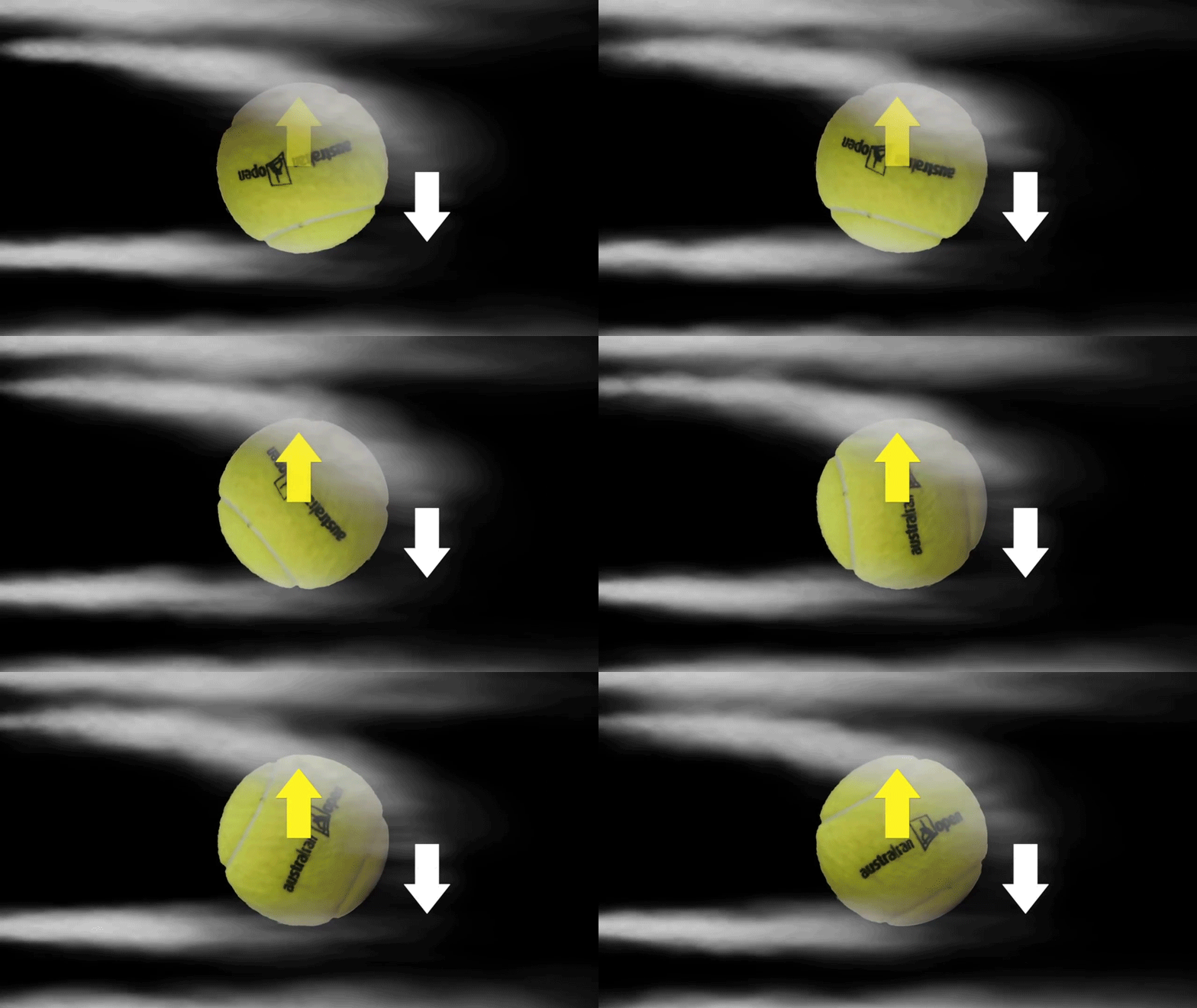
    Here is a great gif illustrating this effect. This ball is traveling to the left with backspin, meaning the ball is pushing the air downward behind it creating an equal and opposite force upward. So you can see the faster the backspin the faster the air is deflected downwards and the higher the force pushing the ball back upward.
    magnusforce
    This gif was created from a fantastic video on the Magnus effect from Veritasium titled: What Is The Magnus Force?
    So now let's think of the Magnus force in terms of spin rate.
    A 92 MPH fastball at 2200 RPM is going to travel on an 'average' path to the plate.
    If this 92 MPH fastball is thrown at 1800 RPM that means less spin, less Magnus force meaning the ball will drop further over its course to the plate than the 'average' fastball described above.
    If this 92 MPH fastball is thrown at 2400 RPM that means more spin, more Magnus force meaning the ball will drop less over its course to the plate the the 'average' fastball.
    These are small enough differences that a batter would not be able to tell before they decide to swing, but the balls will end up at different heights by the time they reach the plate.
    spinrate
    What do high/low spin rates mean to a hitter?
    One study has examined how pitches with the same velocity but different spin rates would affect hitters.
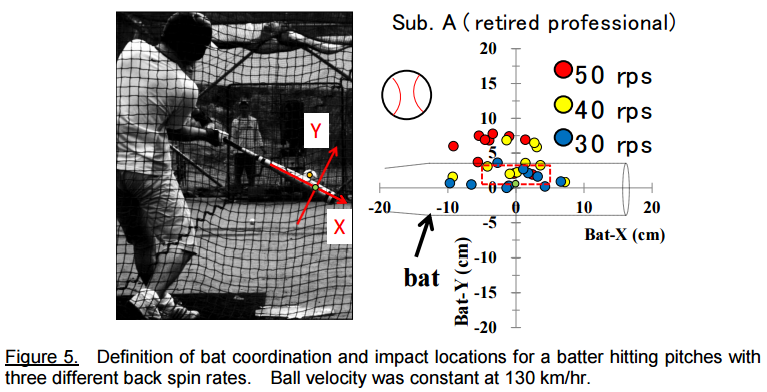
    This study used a pitching machine to throw pitches at 130 km/hr (80 MPH) at 50 RPS (Red 3000 RPM), 40 RPS (Yellow 2400 RPM), and 30 RPS (Blue 1800). You can see that even at the same speed hitters were consistently under the higher spin fastballs.
    spin-rate-hitting
    Picture from: Baseball Spin and Pitchers' Performance: Kanosue, et al. (Open Access)
    Now the highest spin fastball is spinning at faster than what we've seen in MLB pitchers, but the point still stands. Baseball is a game of millimeters when it comes to making or preventing good contact. So when you can throw fastballs with spin that are further away from average, the more beneficial it can be.
    This would be in line with what Zach Day examined in 2013 finding that higher spin fastballs had more swing and misses and fewer ground balls. Lower spin fastballs  the reverse, less swing and misses and more ground balls.
    So we can say that at the same velocity the higher the spin rate the more swing and misses the fastball is going to get.
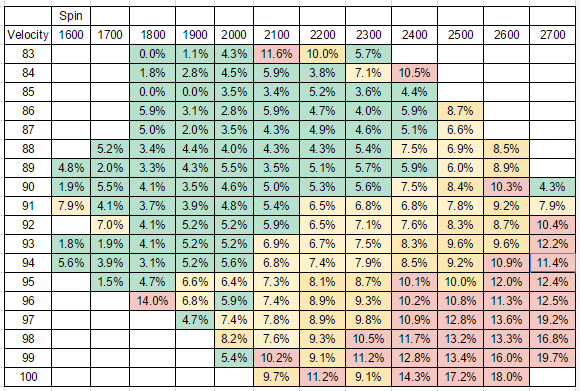
    This chart from Jeff Zimmerman also supports this idea , finding that when looking at fastballs at the same velocity the higher the spin rate the higher the percentage of swinging strikes. 
    screenshot-114
    Jeff Long recently examined the correlations between spin rate and swinging strike%, GB%, and FB% and only found very small relationships with regards to spin when looking at all pitches. In this instance the effects of high and low spin rate most likely equaled themselves out.
    Can you create higher or lower spin rate?
    Higher spin – not necessarily. Lower spin – maybe.

    With the knowledge that splitters have a noticeably lower spin rate than fastballs, we can assume that the splitter grip (where the index and middle fingers are very spread out on the ball) leads to a decrease in spin rate. Although we have not officially examined this theory, our preliminary testing agrees that an increased spacing between the fingers on the ball leads to a decrease in spin rate.
    Beyond that, nobody truly knows how to reliably and consistently change the spin rate of pitchers. Mostly because no one knows why the ball spins differently from pitcher to pitcher.
    What we do know if that there is good evidence that spin rate is created in an incredibly short amount of time.
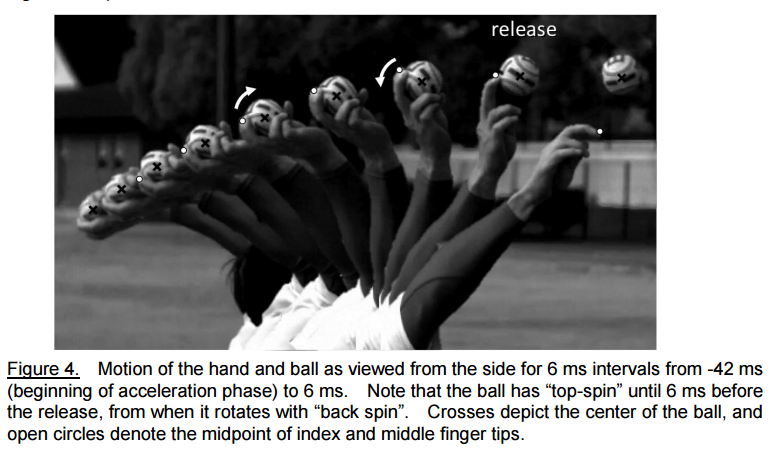
    spin-rate
    From: Baseball Spin and Pitchers Performance: Kanosue et al. (Open Access)
    Here the authors present picture evidence that suggests how quickly the ball goes from not rotating to rotating when a pitcher throws. Considering the acceleration phase of the throw lasts anywhere from 30-50 ms the suggestion that spin may be generated in only 6 ms(or just longer than that) of the motion is incredible. Each picture frame above is 6 ms long, you can see the ball goes from not rotating to rotating and being released in nearly one frame.
    What is the relationship between spin rate and velocity?
    We do have some evidence that spin rate is an innate characteristic, and is linearly related with velocity. We had 6 pitchers throw 20 pitches at velocities from 60-80 MPH. The pitchers were told to use the same fastball grip with the same mechanics and attempt to throw a fastball starting at 60 MPH followed by a pitch at 61 MPH all the way up to 80 MPH. The R^2 values between velocity and spin rate of the first 5 pitchers ranged from  0.83-0.96 which is quite a high relationship!
    You can find the data here.
    The 6th pitcher threw pitches from 60 – 80 MPH but was told to attempt to change his mechanics from pitch to pitch and you can see that the R^2 relationship dropped down to .541. Though this is merely a starting point for more research we can reasonably say that spin rate is an innate characteristic but unknown mechanical changes may also affect spin rate.
    So this data suggests that we can say there is an innate relationship between spin rate and velocity for an individual pitcher but not across a large population of pitchers.
    Meaning that if one pitcher could throw harder under the same mechanics and same grip his spin rate should increase. But his spin rate could 'max out' at 1900 at 92 MPH. While another pitcher may be able to throw harder under the same mechanics and same grip but his spin increase to 2400 at 92 MPH. This is obviously taking into considering a large assumption that they could throw harder with the same mechanics.
    So pitchers may be able to increase their velocity and spin rate but we don't know where they will end up on the scale of 1800 – 2400 RPM for fastballs. Not every pitcher throwing 98+ has a ridiculous high spin rate. Just like not every pitcher throwing 90 has a low spin rate.
    You can see this laid out further in this Statcast piece on velocity vs. spin rate.
    What are Bauer Units?
    BU = Spin Rate (RPM)/Velocity (MPH)
    This enables us to normalize the spin per the velocity of the pitch. If a pitcher is spinning a fastball at 2400 RPM, that is less impressive at 99 MPH and much more impressive at 89 MPH. Making spin rate more useful over a wide range of pitchers of varying velocities.
    To more effectively compare Bauer Units of varying pitchers, we can normalized Bauer Units into a new unit, called BU+, which accounts for the league average Bauer Unit of pitchers.
    BU+ = (Player BU/League Average BU)*100
    This gives you an idea of how much high or lower a pitcher's spin is vs. Major League average, where a BU+ of 100 is perfectly average. A BU+ of greater than 100 would indicate a higher than average spin rate fastball, where as a BU+ of less than 100 would be a lower than average spin rate fastball.
    Unfortunately, MLB and other statistic collecting agencies have yet to recognize our pioneering efforts into the field of baseball statistics.
    This was also discussed on Statcast's 8/26/16 Podcast: The Art of Spin Rate
    Are pitchers with higher spin rates more likely to be injured?
    No, not that we can tell.
    Though there is a growing belief that drastic changes in spin rate (usually sharp decreases) can be a sign of an injury or pending injury.
    Each pitcher is going to have a small range around their average spin rate. Sharp changes from that normal range can be seen as an early sign of unhealthy fatigue. So teams can monitor their pitchers spin rate to see if there are any sustained drops of spin rate from their average. This would also work hand in hand with monitoring a pitcher's velocity.
    Now this method of injury prevention hasn't been proven to be predictive over a large group of pitchers but it's simply another variable for teams to watch. Obviously at this time these types of analysis are only able to be done with MLB/MiLB pitchers.
    This idea was also explained further in these Fangraphs pieces: A New Way to Study Pitching Injury and Pitcher Spin Rates and Injuries.
    How can we use spin rate to our advantage?
    For pitchers that come to our facility we can use either Trackman or Rapsodo to get measurements of their spin rates and then make recommendations on how to best use their pitchers or make tweaks to improve their pitches. In the case of fastballs, again we don't know how to change spin rate, but we can make recommendations on how to sequence pitches or location preferences.
    An example would be a pitcher with a high spin fastball consistently being told to throw fastball at a hitters knees. In this case his fastballs aren't going to drop as much compared to the 'average' fastball meaning he might have a higher chance of getting hit being down in the zone. Pitching middle/up in the zone may be more beneficial in hopes of inducing pop-ups and swinging strikes.
    The reverse is true for pitchers who have low spin fastballs. Staying down in the zone would be the best option because hitters should swing just over the pitch resulting in more ground balls. If someone if sitting right in the average range then we move on to looking at the other pitches he throws. Because we want pitches that are further away from the 'average' spin.
    Hopefully this answers some basic questions on what we know about spin rate right now, we look forward to continuing our research with Trackman and Rapsodo.
    This article was co-written by Assistant Researcher Michael O'Connell, Engineering Intern Joe Marsh and edited by Kyle Boddy


    Sent from my iPhone

    Why Every Baseball Player, Regardless of Age, Should Care About Their Launch Angle and Exit Velocity | STACK


    Given that "Launch Angle" and "Exit Velocity" are the two biggest buzz words in the industry today, I figured I would get up to speed on this and some of the more advanced metrics listed above.  JK ;)

    from fangraphs.com
    https://www.fangraphs.com/tht/uncovering-dips/

    Let’s discuss the specific coefficients for a moment. As has generally been acknowledged (most importantly by Voros himself in introducing DIPS 2.0), strikeouts and home runs serve to drive down BABIP. Why? Well, to start, both are associated with fly ball tendencies, and fly ball pitchers allow less hits on balls in play. Strikeout pitchers may also allow easier to catch batted balls because their pitches are harder to hit (and, so the theory goes, to hit well).

    from STACK.com
    Why Every Baseball Player, Regardless of Age, Should Care About Their Launch Angle and Exit Velocity | STACK

    Launch angle.
    It's a term that was barely uttered five years ago, yet it's quickly become one every modern baseball player needs to know.
    Launch angle refers to the ball's vertical angle of trajectory off the bat. Anything below 0 degrees is an automatic ground ball, and advanced statistics have found ground balls to be one of least productive types of contact a hitter can make at any level. For decades, young ballplayers were told to "swing down on the ball." We know now that's a bunch of a baloney, as such a technique will likely lead to little more than groundouts, double plays and the occasional single that sneaks under an infielder's glove.
    In the MLB, where we have access to all batted ball data, there's been a clear trend toward higher launch angles. In 2015, the league average launch angle was 10.1 degrees. That crept up to 10.8 degrees in 2016 and 11.1 degrees in 2017. It's likely no coincidence there were 6,105 total home runs hit last season, smashing the previous league-high of 5,693 from the year 2000.
    Many have referred to this trend as the "fly ball revolution," but it might be more accurate to dub it the "ground ball revolt." The best teams are teaching their players to abhor ground balls and the launch angles associated with them. Inside the Los Angeles Dodgers' practice facilities, you'll find a sign that says "No Ground Balls Ever." At the University of Iowa, players take batting practice in front of a wall of nets which span from third base to first base. This "Wall of Launch Angles" helps the players focus on driving the ball over the nets, as opposed to blasting grounders into them.
    So if a launch angle under 0 is not ideal, what is? Well, any launch angle under 10 degrees isn't going to have a great shot of being an extra base hit, and any launch angle over 35 degrees is likely to be a sky-high fly ball easily tracked down by an outfielder. A launch angle between 10 and 25 degrees seems to be most fruitful, as it's a meaty trajectory that results in a high percentage of not only hits, but extra base hits. For pro hitters who can smoke the ball, the top end of that range is a bit higher. But launch angle is only half of the equation in this data-driven hitting revolution—the other being exit velocity. That refers to how fast the ball comes off, or exits, the bat. Being able to pair a high exit velocity with the right launch angle on a consistent basis is key to being a productive hitter. The average exit velocity for high school players is about 75 mph, while elite high school players often hover around 90. A player with an optimal or near-optimal average launch angle but a poor average exit velocity isn't going to be a great hitter, nor is one with a great average exit velocity but a poor average launch angle.
    "Even just a few years ago, no one talked about launch angle or exit velocity or spin rate of a pitch. Now, even at the youth level, it's going down into the academies. Colleges are starting to ask 'what's a kid's exit velocity or what's his spin rate?' All that data is really quantifiable and it's a great measuring tool for evaluation," says David Mayberry, a Baseball Application Specialist for FlightScope.
    FlightScope is the company collecting much of the data players and coaches now use to inform their swings. The technology actually has roots in the defense industry, where it was first used for missile tracking beginning in 1989. Thirty countries still rely on FlightScope for missile tracking data, but the tech has since crossed over into sport.
    After making inroads in cricket, golf and tennis, the tech came to baseball and softball about three years ago. It's since been a revelation for many pro and collegiate teams. The unit used in baseball, which is known as the FlightScope Strike, relies on 3D Doppler radar to track the full flight of a projectile. "It's sending out microwave signals, and then with the Doppler effect and the disturbance in the frequencies, we're able to detect the full flight of a projectile—whether it's a missile or a pitched or batted baseball," Mayberry says.
    The unit utilizes a built-in camera and Wi-Fi hotspot to easily display data on a tablet such as an iPad or Microsoft Surface. Its flexible mounting allows it to be deployed in about any game or practice situation you can imagine, including indoor batting cages. Once the unit is up and running, it collects data with no need for additional human input. The sheer number of metrics it can collect is astonishing:

    At $18,000 a unit, the FlightScope Strike isn't cheap. However, the number of college and pro teams who have invested in the technology are a testament to its value. The New York Yankees own three units solely for the purpose of scouting, and have deployed them in Venezuela and the Dominican Republic in an effort to identify the next international star. The Philadelphia Phillies plan to roll out the units at every level of their organization. Stanford, Illinois, Arkansas and Bucknell are among the collegiate teams looking to gain an edge with FlightScope.
    While the highest levels of baseball make use of most (if not all) the metrics collected by FlightScope, it's launch angle and exit velocity that have the most universal appeal and application. Showing ballplayers a 3D representation of their hit trajectory, exit velocity and launch angle on a tablet results in quick comprehension and a vested interest regardless of age.
    "Everybody's a visual learner these days, so when they can actually see the shape and trace of their hit, it becomes a part of their approach," Mayberry says. "Even in the youth level, 14-U and into high school, the players—when they see this data, they're visual learners and they're really engaged. The engagement factor is huge when it's on a screen—a lot of players tune out verbal cues or authoritative figures. But when it's on a screen, they're really engaged and taking ownership."
    The data gives purpose to practice. While a ball hit off the back of the batting cage used to be lauded as a great piece of hitting, we now know that it's likely to result in a ground ball. Technology like the FlightScope takes the guess work out of it and allows players to see, feel and repeat the type of contact they want to be making.
    "Traditionally, if a baseball player was training in a cage, a hard hit ball off the back of the cage was commendable. When it really shouldn't have been. That's a launch angle of 0 degrees—it's coming out straight. That's a ground ball. No matter how strong you are, if you hit if off the back of the cage at 0 degrees, that's a grounder," Mayberry says.
    Access to this data can also help better inform a player's sports performance training. If they see their average exit velocity and launch angle are improving over time, they can have confidence the work they're putting in in the weight room is translating to better functional strength, improved hand-eye coordination and harder contact.
    "I use this term cause and effect. You can make adjustments and see the real-time effects. If you're working on your ground reaction forces, how much force you're putting into the ground, you can immediately see what effect that has on your average launch angle, exit velocity, batted ball direction. Same thing if you're a pitcher, your velocity and spin rate. Then you can check your biomechanics. If you're doing a certain type of movement, and you're getting better torque from your hip and shoulder separation, then you can see the immediate cause and effect in real time," Mayberry says.

    The data can also be a valuable gauge for recovery—if a player is sitting at a significantly lower exit velocity than they're used to, perhaps they need to examine their recent habits. How much sleep have they been getting? What kind of foods have they been eating? Are they overtraining and need to ease up a bit? Feeling sluggish was not something easily quantifiable for baseball players in the past, but that no longer has to be the case.
    While this data is still fairly new in the world of baseball, teams have quickly learned that it has tremendous value. Although traditional stats like batting average or extra base hits can be skewed by factors like level of competition, luck, field dimensions, etc., these metrics do not lie. If a kid has an impressive average exit velocity and an efficient average launch angle, college and pro scouts know those skills are likely to translate to the next level. "Everything's evolving as we speak. I was talking to a youth academy located in South Carolina, and they said Clemson and the University of South Carolina are reaching out and asking about a 14-year-old player's exit velocity. So it's becoming a requirement," Mayberry says.
    Mayberry believes that even T-ball players aren't too young to be thinking about their average exit velocity and launch angle. Because at the end of the day, those two metrics are what determine how hard and how far you're going to hit the ball. Focusing on those two factors can help a young ballplayer build a powerful, athletic swing. "Ground balls should be getting out of their vocabulary. Maybe they'll hit it too high at first, but then they can zero in and bring (that launch angle) down," Mayberry says. "All of this rolls up to a better understanding for the player. They're taking ownership and they're being more accountable for their own success."
    Photo Credit: Icon Sportswire/Getty Images


    'via Blog this'

    Monday, April 23, 2018

    Johnny Cueto lowers ERA to 0.35 in Giants' win

    Johnny Cueto lowers ERA to 0.35 in Giants' win
    Cueto tosses six shutout frames

    Cueto's dominance should not be lost in Belt's AB. Cueto, and to a lesser extent Chris Stratton, have been keeping the ship somewhat steady as it takes on water. Now that Samardzija is back, and finally when Bumgarner returns, the Giants should be able to count on consistent starting pitching, which should help the stretched out bullpen.

    The mention from the mlb.com article,that this was the first series the Giants have won this season is almost as amazing in a negative way as Belt's AB was in the positive. The Giants, as currently constituted, appear to be, at best, a .500 team (81-81). At worst, you could make the argument that they are what they consistently do, which is lose three game sets (1-2). That's a (54-108) record. If you say, maybe somewhere in the middle, be careful what you wish for because that's (67.5 - 94.5) i.e. last year's team.

    They have to show signs of life, especially the offense, before Bumgarner returns, or the rebuild (not retool) has to begin.

    from mlb.com
    https://www.mlb.com/news/johnny-cueto-lowers-era-to-035-in-giants-win/c-273384986

    Cueto lowers ERA to 0.35 as Giants top Halos

    Righty takes no-hit bid into sixth; Belt homers for fourth straight game

    ANAHEIM -- It took three-plus weeks, a determined outing from Johnny Cueto and an epic day from Brandon Belt, but the Giants finally won their first series this season.

    Belt's historic 21-pitch at-bat in the first inning Sunday was the conversation piece, but his fifth-inning home run helped fuel a 4-2 victory over the Angels.

    Cueto contributed his fair share as well, holding the Angels to no runs on two hits after carrying a no-hitter into the sixth inning. He lowered his ERA to 0.35 after four starts.

    "It's great to get a series," Giants manager Bruce Bochy said. "You hate to wait this long to get one, but on the road against a club that has really been playing well this year, Johnny came through for us. What a great effort he gave us and we hung on."
    The Giants won two of the three games at Anaheim, in a rematch of the thrilling 2002 World Series won by the Angels.

    Cueto, who missed a recent start with an ankle sprain, pitched through some discomfort, even getting a visit from the trainer at one point. He did not give up a base hit until Ian Kinsler singled to lead off the sixth inning.

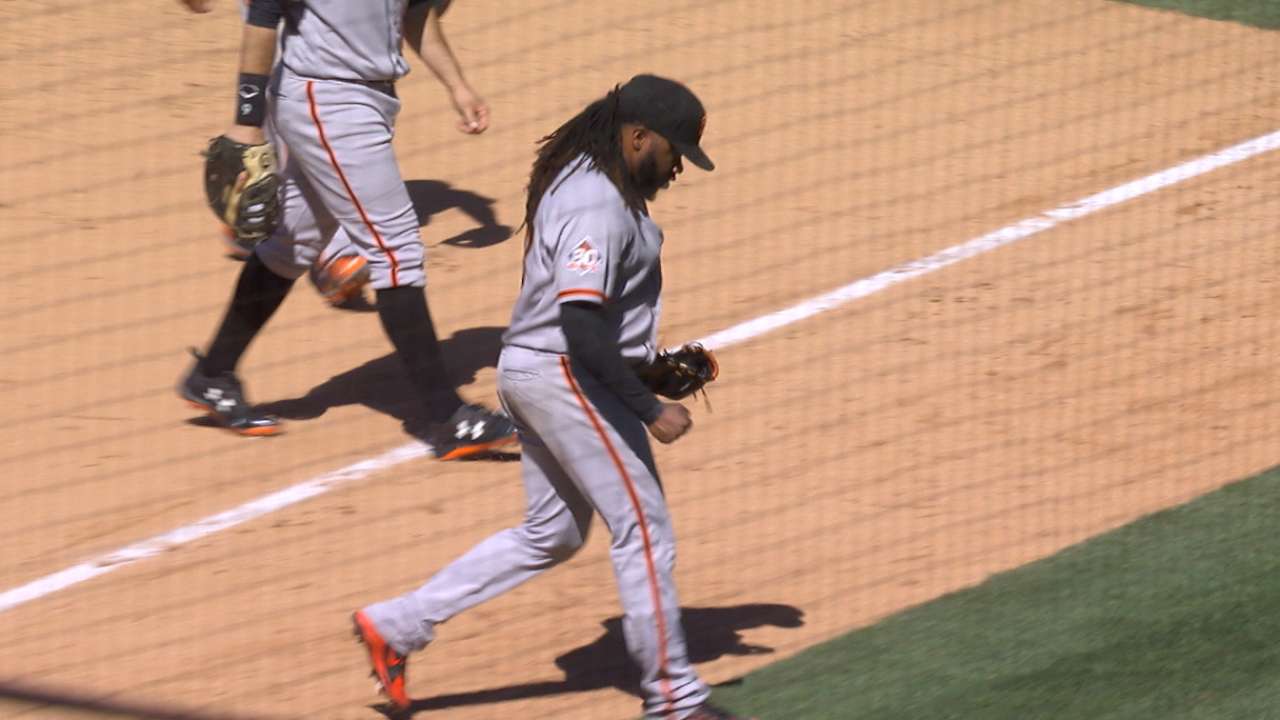
    He closed the sixth by loading the bases but getting Luis Valbuena to hit into a 3-6-1 double play to end the threat. Cueto did a spin and made a fist pump after recording the out at first base, which ended up being the final out of his outing.

    "Based on the situation I had to celebrate it," Cueto said.

    "It was a hard-fought game, but no question it's good to head home with a series under our belt," Bochy said.

    MOMENTS THAT MATTERED
    Cueto spun around like a top in celebration after working his way out of a bases-loaded situation in the sixth inning. After loading the bases with one out, Cueto got Valbuena to hit a ground ball to Belt at first base. Belt started a nifty 3-6-1 double play, with Cueto combining a spin with a pump of his fist following the last out of his outing.

    SOUND SMART
    Cueto's 0.35 ERA is the lowest for a Giants pitcher after four starts since Ray Sadecki had a 0.25 mark in 1968. Cueto has given up one run over 26 innings so far this season, firing scoreless outings at the Dodgers, Diamondbacks and now the Angels.

    Doug Padilla is a contributor to MLB.com.


    Sent from my iPhone

    Monday, April 16, 2018

    "Meet the Press" - By Popular Demand: Jackie Robinson and Other Baseball Highlights, 1860s-1960s | Digital Collections | Library of Congress

    "Meet the Press" - By Popular Demand: Jackie Robinson and Other Baseball Highlights, 1860s-1960s | Digital Collections | Library of Congress
    Image result for jackie robinson

    Another blast from the past. The entire interview excerpted previously by seamheads.com.

    https://www.loc.gov/collections/jackie-robinson-baseball/articles-and-essays/baseball-the-color-line-and-jackie-robinson/meet-the-press/

    "Meet the Press"

    Trascript of television and radio broadcast

    Program produced by Lawrence Spivak for the National Broadcasting Company, Sunday, April 14, 1957.
    Published by National Publishing Company, Washington, D.C., vol. 1, no. 15.
    (Library of Congress, Manuscript Division, Lawrence Spivak Papers)
    For additional information on the Spivak Papers you can leave this site and read a summary catalog record for the collection.
    Produced by: Lawrence E. Spivak
    Guest: Jackie Robinson
    Sunday, April 14, 1957
    Panel:
    William H. Lawrence, New York Times
    Frank van der Linden, Nashville Banner
    Jim Simpson, National Broadcasting Company
    Lawrence E. Spivak, Regular Panel Member
    Moderator:
    Ned Brooks
    Announcer: Now, MEET THE PRESS. The prize-winning program produced by Lawrence E. Spivak. Ready for this spontaneous, unrehearsed conference are four of America's top reporters. Please remember, their questions do not necessarily reflect their point of view; it is their way of getting a story for you. Here is the moderator of MEET THE PRESS, Ned Brooks.
    Mr. Brooks: And welcome once again to MEET THE PRESS.
    Another baseball season opens tomorrow. Our guest is one of baseball's all-time greats, Jackie Robinson, the first Negro to break the racial barrier in the major leagues. During his 10 years with the Brooklyn Dodgers, they won six pennants. His greatness lay in his versatility and his competitive spirit. He played the infield and the outfield with equal skill. He set records in fielding, batting and base running, and in 1949 he was voted the National League's Most Valuable Player.
    Jackie Robinson's activities have extended beyond the baseball diamond into the field of race relations. He has devoted much of his spare time to the National Association for the Advancement of Colored People, and last year he was awarded the organization's highest honor for achievement, the Spingarn Medal. From the beginning of his career Jackie Robinson was a center of controversy. His baseball association ended on a controversial note when he was traded to the New York Giants and when he announced his retirement in Look Magazine. Since retiring he has become a vice president of the Chock Full O'Nuts Company of New York, and he is on the staff of Look Magazine.
    Now, seated around the press table ready to interview Jackie Robinson are Jim Simpson of NBC, William Lawrence of the New York Times, Frank van der Linden of the Nashville Banner and Lawrence E. Spivak, our regular member of the MEET THE PRESS panel. Now, Mr. Robinson, if you are ready we will start the questions with Mr. Lawrence.
    Mr. Lawrence: Mr. Robinson, for the first time in 10 years you are not in a Major League uniform finishing up the exhibition games before the pennant race opens tomorrow. How does it feel; do you have any regrets about retiring?
    Mr. Robinson: None at all. I feel very, very good. I am awfully happy in my new job. I am with a bunch of fine people, and I like it very much.
    Mr. Lawrence: Now that you are out of baseball, are you going to be a regular fan and root from the grandstand for your favorite team?
    Mr. Robinson: My favorite team is the Dodgers, and I will root for them.
    Mr. Lawrence: Will you be going to the games?
    Mr. Robinson: I will occasionally, not too much.

    Mr. Lawrence: Now that you are vice president in charge of personnel for a large concern in New York, what will your attitude be on Tuesday when a large number of your employees resort to that age-old dodge and report the sudden deaths of their grandmothers, so they can get the Opening Day off to see the season open?
    Mr. Robinson: We are hoping that will not happen. I have had a very fine relationship with most of the people who are with us, and I do whatever I can to teach them or tell them the importance of being on the job all the time. We hope it is not going to happen.
    Mr. Spivak: I would like to get to more serious matters. Congressman Celler recently made this remark: "The few who own the Major League clubs aren't trying to benefit the public but only to make all the money they can by moving players around like pawns and chattels." You were one of the players who was moved around. Do you think that statement is true or false?
    Mr. Robinson: I can't say it is completely true, no. I think in most cases many of the club owners do have the thinking of the ball players in their hearts, but there are many, many instances where ball players are moved around. What the answer to eliminate it is, I don't know.

    Mr. Spivak: Do you think the reserve clause which permits a ball club to exercise virtually monopolistic rights over a player is good, either for baseball or for the player?
    Mr. Robinson: If there were some other means to handle the situation, I would think it should be handled, but I don't know of any other. If they didn't have the reserve clause, when we came down to the last month of the season where a ball club may need a good ball player to have them win the pennant, a club with a lot of money who would only be interested in a pennant could, by offering this ball player - if there wasn't some kind of a law to keep him from it - a lot of money, and I doubt very seriously if the player would refuse it.
    Mr. Spivak: Isn't it true, though, that a team like the Yankees - that is, a club that is very rich - has been able to garner a great many of the best ball players simply by having money? Does the reserve clause stop that in any way?
    Mr. Robinson: I don't think that is the reason why the Yankees are so successful. I think that, very frankly, a lot of ball players when they are young are very, very anxious to join the Yankee chain. I think that tradition that they hear about so much has a lot to do with it, and they get in the organization. I believe that is what it is, personally.
    Mr. Spivak: Mr. Robinson, professional baseball is now, I think, the only professional sport which has specifically been held by the Supreme Court to be outside the anti-trust laws. Do you think baseball should be exempt on the grounds that it is a sport and not a business?
    Mr. Robinson: I can't say that baseball is a sport, no, not if that is the reasoning. In my opinion, baseball is as big a business as anything there is. It has to be a business, the way it is conducted.
    Mr. Spivak: Do you see any reason why it should be given special treatment when football, basketball and hockey have all been held to be monopolistic when they have special arrangements of the kind that baseball has?
    Mr. Robinson: Since I don't know too much about the football and the basketball and the other situations, I would hate to get mixed up in it. I don't know what their situation is, actually. The only thing I know is that baseball, being the game that it is, there has to be some protection for them.
    Mr. Simpson: Mr. Robinson, in this reserve clause, Robin Roberts, who is the representative of the National League Players, says that he feels there should be some kind of revision of the reserve clause. He did not say what it should be. He didn't like the idea that the player could be stuck in the minor leagues for 7 years before he could be drafted by some other club.
    Affidavits evidently have been sent out to all players asking that they back up Major League baseball and its reserve clause. Eddie Yost of the American League feels that the players will be almost unanimous and back up the club owners and say the reserve clause is necessary.
    As a former player and being just out of baseball, do you think it is necessary to run the sport, or business, of baseball?
    Mr. Robinson: At the present time I would have to go along with it, because there has to be some sort of protection. Until they find some other way to handle all these situations, I think that - it is a personal observation, but I think they have to continue it. In all my years of baseball I have always expected to be traded. I never liked the idea. I expected it because that is the way baseball has been run all along, but I don't see at this time any way that they can handle the situation.
    Mr. Simpson: Have you ever run across, aside from the obvious ones that have gone to court, anybody in baseball who is unhappy and dissatisfied because of the reserve clause? Specifically, can you tell us the case?
    Mr. Robinson: Well, there have been - there is no need for me to mention any names - just fellows who feel they could be better off on another team, and because of the clause they can't display their abilities on another team. One ball club may be overloaded with talent. I have heard complaints that they can't show what they can do because they are on a team which has such good talent they sit on the bench, and, therefore, they are not able to do the things they would like to be able to do, at least insofar as their playing is concerned.
    Mr. Van der Linden: Mr. Robinson, you are the Chairman of the Freedom Fund Campaign of the NAACP and, according to news reports, you are trying to raise $1 million.
    Mr. Robinson: That is correct.
    Mr. Van der Linden: If you get the $1 million, what will you do with it?
    Mr. Robinson: Me personally, I am not going to do anything. It is going to be used in our efforts to secure first-class citizenship for all American citizens.
    Mr. Van der Linden: As a leader of NAACP, would you use the money to hire lawyers, for instance, to press school segregation cases?
    Mr. Robinson: I want to make one thing clear: I am not what you call a leader of the NAACP. I happen to be vice president of a restaurant firm. They have asked me if I would head the Freedom Fund for this year - their campaign - and I said yes. I just don't believe in being a person who signs his name to letters. If I am going to do something, I like to get in and do the job that I think can be done by actually applying myself.
    So, if we are going to talk about, actually, the workings of - what the money is going to be used for, that is hard to say. I don't touch the money; I don't see it when it goes in. I have nothing to do with it.
    Mr. Van der Linden: Of course, your name is being used to promote the campaign and secure money.
    Mr. Robinson: That is right.
    Mr. Van der Linden: And, of course, it would be of public interest to someone who is going to contribute to know whether the money would be used to hire lawyers, or to press for lobbying, say, for civil rights bills. I assume you favor the civil rights bill?
    Mr. Robinson: I certainly do. The money, the way I see it, is going to be used in our fight to achieve first-class citizenship. We have had to, through legal means all of these years, go through the courts to get the things that are rightfully ours under the Constitution. We haven't picked up arms to do anything to achieve the rights that belong to us; we have done it legally through the courts. Money is needed to hire lawyers to handle these specific cases. I would imagine they are going to use a considerable amount of money. I don't know whether the Freedom Fund is used for lawyers or whether it goes through the other branch that they have.
    Mr. Lawrence: I would like to return, if I might, to this reserve clause business a moment. In defending it, or saying it was necessary as you saw it, you cited the case of the closing days of a pennant race where a club with a chance to win might buy up all the players. Isn't that handled rather by the deadline on buying and trading players rather than by the reserve clause?
    Mr. Robinson: If the reserve clause wasn't there, I think that they would be able to do so. I think that is one of the protections that the club owners are using the reserve clause for.
    Mr. Lawrence: Doesn't the league lay down the date beyond which you may not buy a player and use him, or you may not trade after a certain date?
    Mr. Robinson: Buying, I don't know - it is September 30 for buying of players; that is correct.
    Mr. Lawrence: If that kind of control could be exercised so that you would avoid this problem of one club buying up all the talent, you know, towards the end of the season, what would be the defense of the reserve clause in the winter time when a ball player would have a better chance to move from some eighth place outfit that isn't making any money to a club that is in the contention and is drawing enough patrons that it can afford to pay him a decent salary?
    Mr. Robinson: It is just simply that there are a lot of club owners, in my opinion, who could not compete in that market if they threw it open for actually bidding for services of all ball players. I think most clubs in the American League today have enough trouble competing with the Yankees without worrying about their finances, too.
    In the National League where you have a ball club like Milwaukee, if they could get one man that would insure them the pennant, they draw so very, very well that they could do so - I am just using this as an example. I do not say they would do this, but they could in the winter time. They start figuring "How can we improve our ball club during the winter?" They would bid for ball players during the winter that would virtually assure them of a pennant during the next year, whereas, a ball club that hasn't been going well and hasn't been taking in money couldn't compete in that market, and fellows who are in baseball for the love of the game - I know very few of them.
    Mr. Lawrence: Let's translate that to the player, though. We can't get much out of it as long as he is stuck with - I won't use the name, but the 8th place club that frequents this town - why shouldn't he have a chance to go out?
    Mr. Robinson: I agree. I wish that there was some way that they could do something about it, but I doubt very seriously if everybody tried to get on the Yankee ball club that many people would come out the next year to see the ball game, if they were going to run away with it any more than they do now.
    Mr. Spivak: Mr. Robinson, before your trade was announced, did the Dodgers discuss this with you at all? Were you sold and then told, or was this discussed with you, or were you just treated as a chattel and told where to go?
    Mr. Robinson: I was told where to go.
    Mr. Spivak: No discussion?
    Mr. Robinson: No.
    Mr. Spivak: Nobody discussed this with you; nobody asked you whether you would like to go or anything?
    Mr. Robinson: No.
    Mr. Spivak: Do you think that is a good system?
    Mr. Robinson: I think it is until something better comes along. I don't know what the answer would be there. Frankly, I haven't given it too much thought because we, as ball players, have been under this rule for so long that we have accepted it in most part. I agree that if there was a vote taken that most of them would probably go along until something came along that was better.
    Mr. Spivak: Why should baseball be any different from life? If you make a contract in business, and you are not satisfactory, and your company is not satisfactory, after the period of your contract you can go where you want and do as you please? Why shouldn't there be a system like that? A contract, yes - if a baseball club wants to sign a man up for five years and pay him a certain amount and take that obligation, fine.
    Mr. Robinson: Mr. Spivak, I don't know why I'm defending this reserve clause; really, I don't know why I am doing it, so, I will just say here, for the players' benefit certainly something should be done, but I hope it doesn't have to be done through the courts. I hope that the baseball owners will think enough of the ball players themselves to say, "Well, I'm going to do something for the players besides selling them whenever I can - maybe giving them a piece of the money when they are sold." I hope it's done that way rather than through the courts.
    Mr. Spivak: You do feel that something ought to be done about it.
    Mr. Robinson: Definitely, I think something should be done.
    Mr. Spivak: I would like to switch, if I might, to another subject. You have become one of the leaders of your race. The rate of crime in the Negro race is much greater than the rate in the population as a whole. I know a good deal of the responsibility is on the white people, who have treated the Negro the way they have during these past years, but what do you see as the responsibility of the Negro himself and, maybe, of the NAACP in this area?
    Mr. Robinson: It is a question that certainly should be pressing in the minds of all of us. I hope that the NAACP and all groups that are interested in that, not only in the Negro but in America, will try to do something for this particular problem.
    I think, and I agree with you, if I can interpret what you are saying, that the Negro himself has a responsibility, here. As you say - and I agree also - a lot of it is due to the lack of opportunities that we have had, but I think it is the obligation of the Negro leaders, not only to seek their rights as first-class citizens, but, also, to impress upon all of our people that it is very important that they cut down anything that brings discredit to us.
    Mr. Spivak: How do you answer those people who insist that the NAACP is moving very, very fast to get the rights for the Negro but seems to be doing not enough to impress upon the Negro his own responsibility as he gets these rights?
    Mr. Robinson: When they say that the NAACP is moving too fast - you know, I heard that, Mr. Spivak, when I was out in Pasadena, California, trying to get into the YMCA: Take your time. Be patient. Patience is fine. I think if we go back and check our record, the Negro has proven beyond a doubt that we have been more than patient in seeking our rights as American citizens. "Be patient," I was told as a kid. I keep hearing that today, "Let's be patient; let's take our time; things will come." It seems to me, the Civil War has been over about 93 years; if that isn't patience, I don't know what is.
    I agree, also, that perhaps we should emphasize the importance of cutting down upon the rate of crime. There is too much, but again we've got to understand that a lot of people are oppressed, and they run into these situations because of their surroundings. It is our responsibility as much as it is anyone else's, but I must remind - this is my own opinion - I think it is not only the Negro's obligation, but it is every American citizen's obligation, that if the Negro rate of crime is to great, then we should try to do something about it, not as Negroes but as Americans.
    Mr. Simpson: You have been quoted several times as saying that you do not miss baseball. Is that because you have such a wonderful position and everything, or did you have any bad moments in baseball, or was baseball at the end of your career just a chore for you?
    Mr. Robinson: Now, which one do we want to start with first?
    Mr. Simpson: Let's start at the end: Did you enjoy your baseball career?
    Mr. Robinson: I enjoyed my baseball career tremendously up through the years. I enjoyed it very much.
    Mr. Simpson: In other words, you would recommend it as a career for someone else in spite of this reserve clause and all the rest of it?
    Mr. Robinson: My little boy wants to play baseball, and I am going to help him in every way that I possibly can. I think it is a great game for youngsters. It gives them a chance to meet and know people of all faiths, and I think that is something that everyone should get an opportunity of doing.
    Mr. Simpson: You were the first Negro in baseball. Now that you are out, are you satisfied with the Negro's position in baseball and in professional sports?
    Mr. Robinson: Oh, no, I am never satisfied; let's face it.
    Mr. Simpson: What are you facing now, if you are not satisfied? What do you think should be done, or must be done, that is not being done?
    Mr. Robinson: Well, I don't know -
    Mr. Simpson: Do you think anyone is being denied playing in professional sports?
    Mr. Robinson: Not today; not in baseball; I will put it that way - not in baseball. I think they are in golf, but in baseball I think if a person has the ability to make the major league, he will be able to get there on ability alone. I think that is what nine out of ten of the major league owners are looking for, ability and ability alone.
    Mr. Simpson: Golf is the only sport that you would put your finger on as one that does not allow an equal chance?
    Mr. Robinson: I would say golf. In the over-all picture there are cases where Negroes are allowed to participate in the golf tournaments, but in the great majority of tournaments they are not allowed.
    Mr. Brooks: You mentioned the circumstances under which you were notified that you were to be traded to the New York Giants. Hadn't you at the time made up your mind that you were going to retire this year?
    Mr. Robinson: I had. As a matter of fact, I had placed a call to Mr. Bavasi, I got his secretary two days before I made my decision, or my final decision. My reason for calling Mr. Bavasi was to tell him not to get rid of Randy Jackson, that I wasn't sure what I would do the next year.
    Mr. Brooks: But you had certain commitments that didn't enable you to tell the Dodgers that you were going to retire, isn't that true?
    Mr. Robinson: That is correct.
    Mr. Van der Linden: Mr. Robinson, you said a few minutes ago that you favored the Civil Rights Bill. There have been some amendments offered to the bill. Do you know of any reason why Congress should not adopt the proposed amendment which would give a jury trial to anyone who is accused under that bill?
    Mr. Robinson: I know very little about that bill, Mr. Van der Linden.
    Mr. Van der Linden: As an individual, yourself, if you should happen to be accused in any court case, on any matter, would you prefer to have a jury trial?
    Mr. Robinson: I think I would, yes, as an individual, yes.
    Mr. Spivak: Mr. Robinson, the Brooklyn Dodgers hired a clown, recently, for this season. Is that an indication that they don't think their ball team is going to keep the people interested?
    Mr. Robinson: I hope not. I think that the Brooklyn Baseball Club will be a very, very interesting one this year. I think their pitching is as good as there is in baseball, and when you have good pitching, you have an interesting ball team.
    Mr. Spivak: Sports Illustrated, I think, last week referred to them as a "team of old and ailing players." Do you think they are not too old and too ailing to win this pennant again, as you predicted?
    Mr. Robinson: I certainly don't think so. I think when you have fellows on the ball club like Pee Wee Reese, for instance - I think Pee Wee is perhaps the oldest player outside of the pitchers on the ball club - even when he is ailing and hurting, he is out there playing better baseball than a lot of the younger fellows, so, therefore, he is able to do a good job. I think his leadership will enable them to do a good job again.
    Mr. Spivak: May I ask you a personal question?
    Mr. Robinson: Indeed.
    Mr. Spivak: You seen so calm and gentle here today. How did you get your reputation for being so "tart-tongued" and "terrible-tempered?"
    Mr. Robinson: I don't know, Mr. Spivak, very frankly. I am calm; I like to be calm. When I am playing baseball, I give it all that I have on the ball field. When the ball game is over, I certainly don't take it home. My little girl who is sitting out there wouldn't know the difference between a third strike and a foul ball. We don't talk about baseball at home. I finish any game, give it all I have, but I don't take it home.
    Mr. Spivak: Is it the game itself that stirred up the competitive spirit or was it partly the way you were treated as the first Negro in baseball that resulted in your so-called tart tongue and terrible temper?
    Mr. Robinson: Oh, indeed not. Mr. Spivak, I can say this honestly; things weren't as bad as a lot of people would have liked to have made them out to be. I received very, very fine treatment in most cases. So, therefore, my activities on the ball field had absolutely nothing to do with the way that I conducted myself at any time.
    Mr. Brooks: I am sorry to have to interrupt, but I see our time is up.
    Our sincere thanks to Jackie Robinson, and before closing I would like to call your special attention to next week's program. Our guest will be Vladimir Poremsky, the head of the Russian underground called the NTS, and it is known by Soviet intelligence agents as the most dangerous enemy to the Soviet regime.
    Again, thank you very much, Jackie Robinson, for being with us; now here is our announcer.


    Sent from my iPhone

    Giants Top Minor League Prospects

    • 1. Joey Bart 6-2, 215 C Power arm and a power bat, playing a premium defensive position. Good catch and throw skills.
    • 2. Heliot Ramos 6-2, 185 OF Potential high-ceiling player the Giants have been looking for. Great bat speed, early returns were impressive.
    • 3. Chris Shaw 6-3. 230 1B Lefty power bat, limited defensively to 1B, Matt Adams comp?
    • 4. Tyler Beede 6-4, 215 RHP from Vanderbilt projects as top of the rotation starter when he works out his command/control issues. When he misses, he misses by a bunch.
    • 5. Stephen Duggar 6-1, 170 CF Another toolsy, under-achieving OF in the Gary Brown mold, hoping for better results.
    • 6. Sandro Fabian 6-0, 180 OF Dominican signee from 2014, shows some pop in his bat. Below average arm and lack of speed should push him towards LF.
    • 7. Aramis Garcia 6-2, 220 C from Florida INTL projects as a good bat behind the dish with enough defensive skill to play there long-term
    • 8. Heath Quinn 6-2, 190 OF Strong hitter, makes contact with improving approach at the plate. Returns from hamate bone injury.
    • 9. Garrett Williams 6-1, 205 LHP Former Oklahoma standout, Giants prototype, low-ceiling, high-floor prospect.
    • 10. Shaun Anderson 6-4, 225 RHP Large frame, 3.36 K/BB rate. Can start or relieve
    • 11. Jacob Gonzalez 6-3, 190 3B Good pedigree, impressive bat for HS prospect.
    • 12. Seth Corry 6-2 195 LHP Highly regard HS pick. Was mentioned as possible chip in high profile trades.
    • 13. C.J. Hinojosa 5-10, 175 SS Scrappy IF prospect in the mold of Kelby Tomlinson, just gets it done.
    • 14. Garett Cave 6-4, 200 RHP He misses a lot of bats and at times, the plate. 13 K/9 an 5 B/9. Wild thing.

    2019 MLB Draft - Top HS Draft Prospects

    • 1. Bobby Witt, Jr. 6-1,185 SS Colleyville Heritage HS (TX) Oklahoma commit. Outstanding defensive SS who can hit. 6.4 speed in 60 yd. Touched 97 on mound. Son of former major leaguer. Five tool potential.
    • 2. Riley Greene 6-2, 190 OF Haggerty HS (FL) Florida commit.Best HS hitting prospect. LH bat with good eye, plate discipline and developing power.
    • 3. C.J. Abrams 6-2, 180 SS Blessed Trinity HS (GA) High-ceiling athlete. 70 speed with plus arm. Hitting needs to develop as he matures. Alabama commit.
    • 4. Reece Hinds 6-4, 210 SS Niceville HS (FL) Power bat, committed to LSU. Plus arm, solid enough bat to move to 3B down the road. 98MPH arm.
    • 5. Daniel Espino 6-3, 200 RHP Georgia Premier Academy (GA) LSU commit. Touches 98 on FB with wipe out SL.

    2019 MLB Draft - Top College Draft Prospects

    • 1. Adley Rutschman C Oregon State Plus defender with great arm. Excellent receiver plus a switch hitter with some pop in the bat.
    • 2. Shea Langliers C Baylor Excelent throw and catch skills with good pop time. Quick bat, uses all fields approach with some pop.
    • 3. Zack Thompson 6-2 LHP Kentucky Missed time with an elbow issue. FB up to 95 with plenty of secondary stuff.
    • 4. Matt Wallner 6-5 OF Southern Miss Run producing bat plus mid to upper 90's FB closer. Power bat from the left side, athletic for size.
    • 5. Nick Lodolo LHP TCU Tall LHP, 95MPH FB and solid breaking stuff.