Showing posts with label Driveline Baseball. Show all posts

Monday, June 25, 2018

Using Swing Plane to Coach Hitters: a Deeper Look - Driveline Baseball


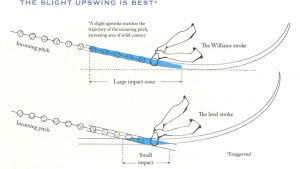
What has changed from Ted Williams' day is we now have the technology to measure the matching of the hitters swing plane to the angle of incoming pitch. That's it, folks.

from drivelinebaseball.com
https://www.drivelinebaseball.com/2018/05/using-swing-plane-coach-hitters-deeper-look/

Swing plane is a commonly used, and certainly not a new, idea. Ted Williams famously discusses it in his book The Science of Hitting in 1971 and includes this awesome graphic. Swing plane is incredibly important, but the swing plane problem is much more complex than how it’s being discussed.

Same is in pitching where we now have better tools to measure a pitchers velocity than we did back in Williams day where we measured Bob Fellers fastball by running a motorcycle with a speedometer on a track next to Feller throwing a ball. Real precise measurement tool back then.

BTW, pitchers may not be throwing harder than back in the day as we need to adjust for the inadequacy of the tools being used to measure the speed which reduced the speed number by anywhere from 3-5 MPH. There are certainly more pitchers throwing harder since these days the pitching gurus are entirely focused on throwing harder whereas back in the day the "pitching guru wars" focused on how to throw more efficiently i.e.: with "perfect mechanics".  The focus has shifted.

The advancement in technology has led to a regression in the value, worth and efficiency of most modern day baseball gurus in my opinion, but only time will tell.


Monday, April 30, 2018

Spin Rate: What We Know Now - Driveline Baseball

Spin Rate: What We Know Now - Driveline Baseball

    This is a great article and since it's from 2016, we probably know a lot more now.

    from drivelinebaseball.com
    Image result for Neuroscience Can Project On-Base Percentages Now | FanGraphs Baseballhttps://www.drivelinebaseball.com/2016/11/spin-rate-what-we-know-now/

    Spin Rate: What We Know Now


    This article is intended to build a basis of knowledge of what we, at Driveline Baseball, understand about spin rate at this current time. We will hopefully answer some common questions that we receive and well as link out to resources that we've found helpful in understanding spin rate. This article will also be a reference point for some of our further research and writing on spin rate.

    Magnus Force and Spin Rate

    We know that we can look at a group of pitchers throwing fastballs at the same speed, say 92 MPH, and those pitchers can all have different rates of spin on their fastballs. The rough guidelines for an 'average' pitcher would be a pitch at 92 MPH fastball with a spin rate of 2200 Revolutions per minute (RPM). In reality pitchers can throw 92 and have spin rates ranging from 1800 RPM to 2400 RPMs.
    Why this happens can be explained by some simplified physics, in this case we'll focus on the Magnus force. If we picture a four seam fastball, which is thrown with backspin, the more backspin the less the ball is going to drop over its course from the pitcher's hand to the catcher's glove.
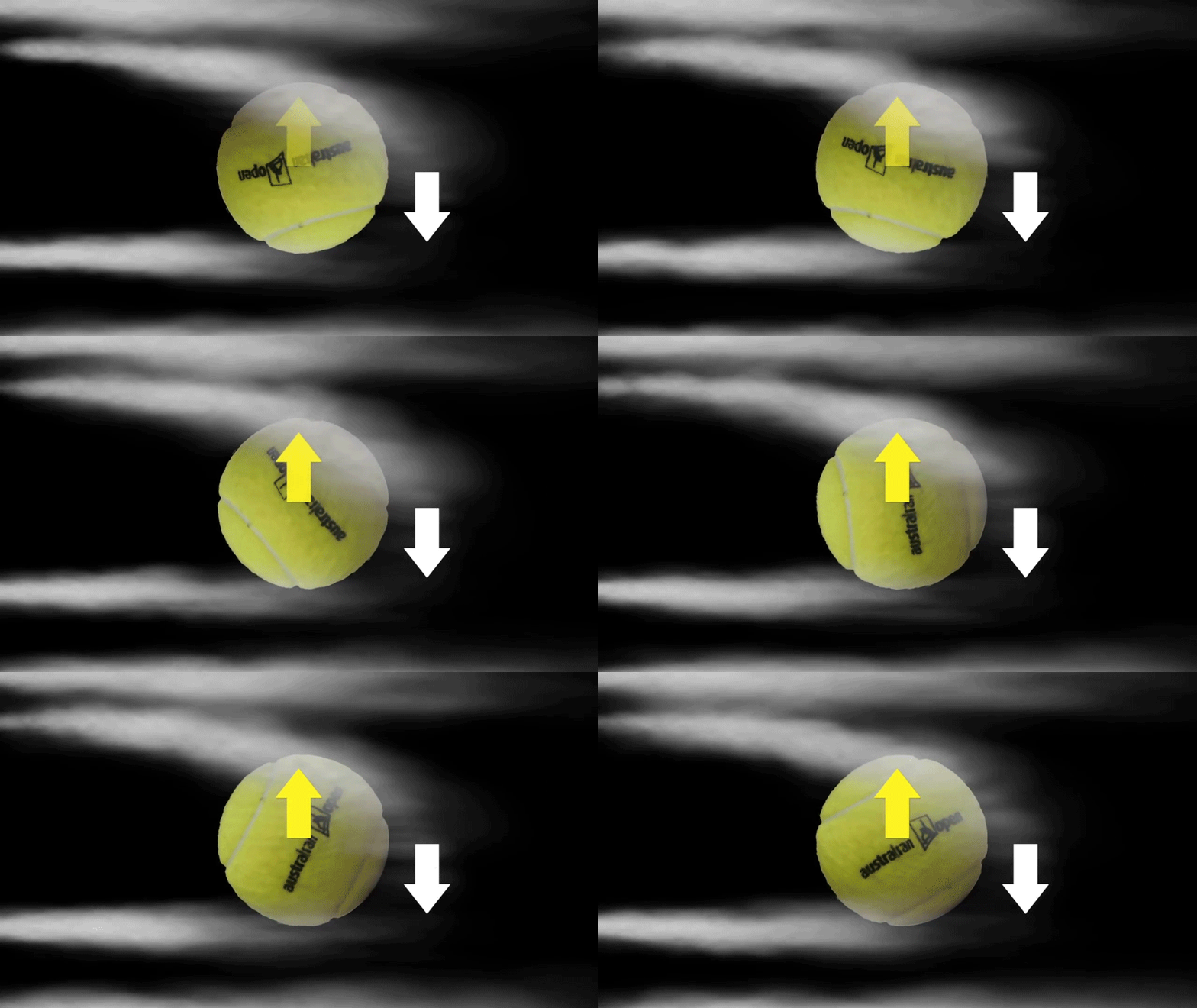
    Here is a great gif illustrating this effect. This ball is traveling to the left with backspin, meaning the ball is pushing the air downward behind it creating an equal and opposite force upward. So you can see the faster the backspin the faster the air is deflected downwards and the higher the force pushing the ball back upward.
    magnusforce
    This gif was created from a fantastic video on the Magnus effect from Veritasium titled: What Is The Magnus Force?
    So now let's think of the Magnus force in terms of spin rate.
    A 92 MPH fastball at 2200 RPM is going to travel on an 'average' path to the plate.
    If this 92 MPH fastball is thrown at 1800 RPM that means less spin, less Magnus force meaning the ball will drop further over its course to the plate than the 'average' fastball described above.
    If this 92 MPH fastball is thrown at 2400 RPM that means more spin, more Magnus force meaning the ball will drop less over its course to the plate the the 'average' fastball.
    These are small enough differences that a batter would not be able to tell before they decide to swing, but the balls will end up at different heights by the time they reach the plate.
    spinrate
    What do high/low spin rates mean to a hitter?
    One study has examined how pitches with the same velocity but different spin rates would affect hitters.
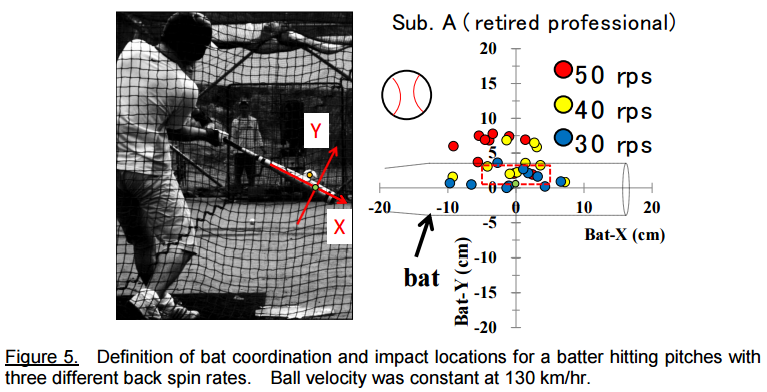
    This study used a pitching machine to throw pitches at 130 km/hr (80 MPH) at 50 RPS (Red 3000 RPM), 40 RPS (Yellow 2400 RPM), and 30 RPS (Blue 1800). You can see that even at the same speed hitters were consistently under the higher spin fastballs.
    spin-rate-hitting
    Picture from: Baseball Spin and Pitchers' Performance: Kanosue, et al. (Open Access)
    Now the highest spin fastball is spinning at faster than what we've seen in MLB pitchers, but the point still stands. Baseball is a game of millimeters when it comes to making or preventing good contact. So when you can throw fastballs with spin that are further away from average, the more beneficial it can be.
    This would be in line with what Zach Day examined in 2013 finding that higher spin fastballs had more swing and misses and fewer ground balls. Lower spin fastballs  the reverse, less swing and misses and more ground balls.
    So we can say that at the same velocity the higher the spin rate the more swing and misses the fastball is going to get.
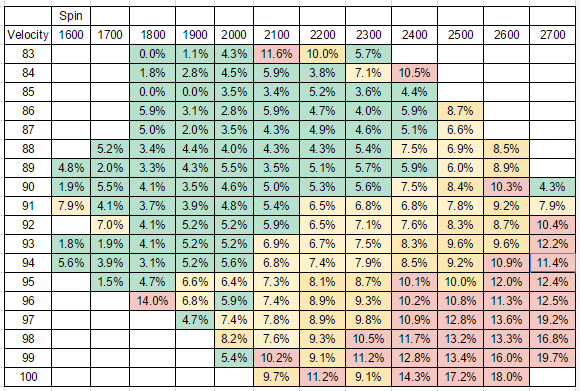
    This chart from Jeff Zimmerman also supports this idea , finding that when looking at fastballs at the same velocity the higher the spin rate the higher the percentage of swinging strikes. 
    screenshot-114
    Jeff Long recently examined the correlations between spin rate and swinging strike%, GB%, and FB% and only found very small relationships with regards to spin when looking at all pitches. In this instance the effects of high and low spin rate most likely equaled themselves out.
    Can you create higher or lower spin rate?
    Higher spin – not necessarily. Lower spin – maybe.

    With the knowledge that splitters have a noticeably lower spin rate than fastballs, we can assume that the splitter grip (where the index and middle fingers are very spread out on the ball) leads to a decrease in spin rate. Although we have not officially examined this theory, our preliminary testing agrees that an increased spacing between the fingers on the ball leads to a decrease in spin rate.
    Beyond that, nobody truly knows how to reliably and consistently change the spin rate of pitchers. Mostly because no one knows why the ball spins differently from pitcher to pitcher.
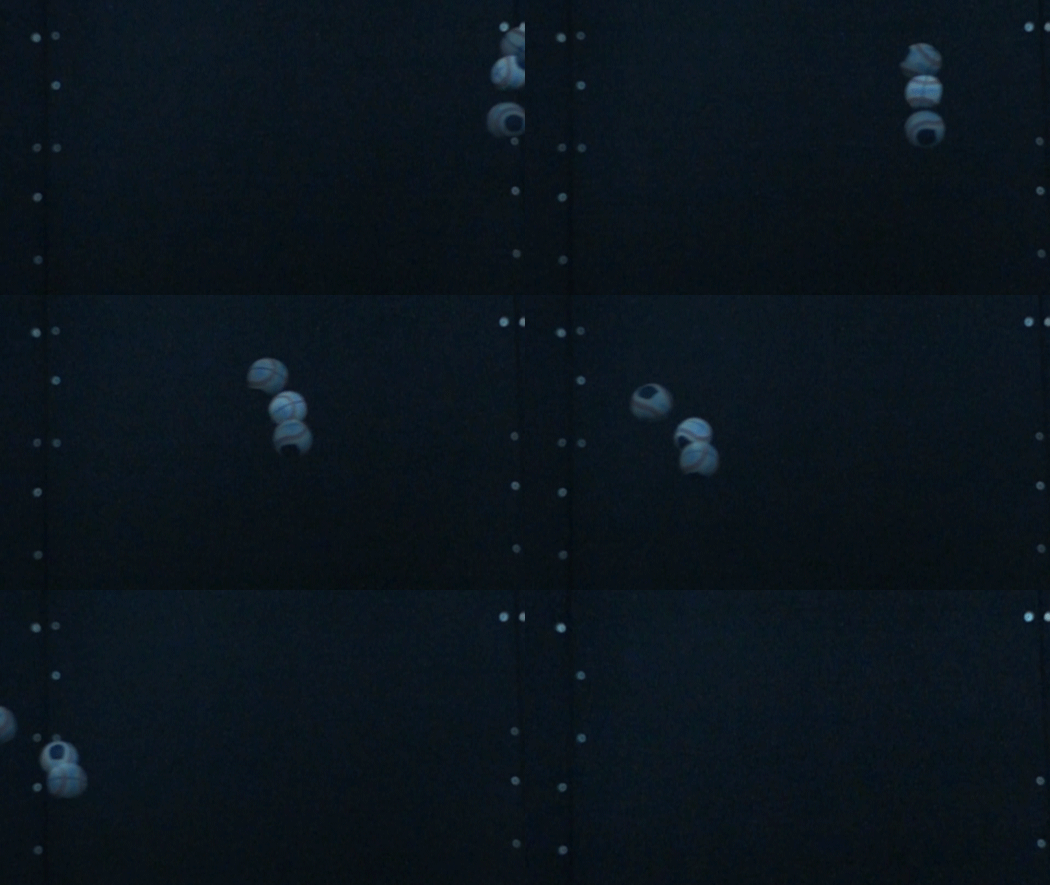
    What we do know if that there is good evidence that spin rate is created in an incredibly short amount of time.
    spin-rate
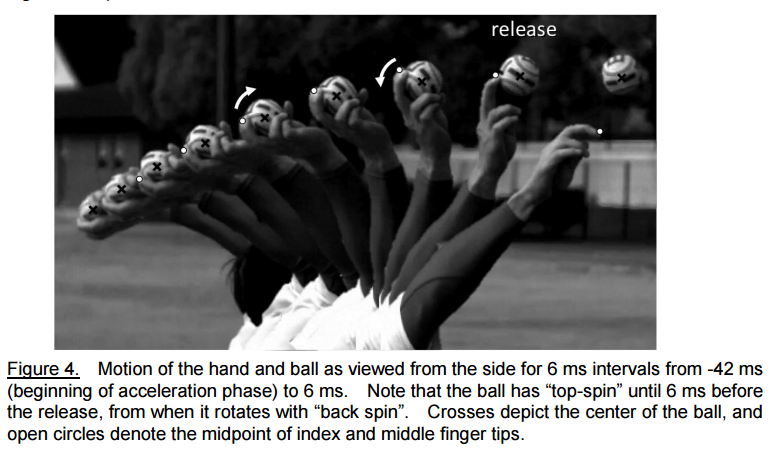
    From: Baseball Spin and Pitchers Performance: Kanosue et al. (Open Access)
    Here the authors present picture evidence that suggests how quickly the ball goes from not rotating to rotating when a pitcher throws. Considering the acceleration phase of the throw lasts anywhere from 30-50 ms the suggestion that spin may be generated in only 6 ms(or just longer than that) of the motion is incredible. Each picture frame above is 6 ms long, you can see the ball goes from not rotating to rotating and being released in nearly one frame.
    What is the relationship between spin rate and velocity?
    We do have some evidence that spin rate is an innate characteristic, and is linearly related with velocity. We had 6 pitchers throw 20 pitches at velocities from 60-80 MPH. The pitchers were told to use the same fastball grip with the same mechanics and attempt to throw a fastball starting at 60 MPH followed by a pitch at 61 MPH all the way up to 80 MPH. The R^2 values between velocity and spin rate of the first 5 pitchers ranged from  0.83-0.96 which is quite a high relationship!
    You can find the data here.
    The 6th pitcher threw pitches from 60 – 80 MPH but was told to attempt to change his mechanics from pitch to pitch and you can see that the R^2 relationship dropped down to .541. Though this is merely a starting point for more research we can reasonably say that spin rate is an innate characteristic but unknown mechanical changes may also affect spin rate.
    So this data suggests that we can say there is an innate relationship between spin rate and velocity for an individual pitcher but not across a large population of pitchers.
    Meaning that if one pitcher could throw harder under the same mechanics and same grip his spin rate should increase. But his spin rate could 'max out' at 1900 at 92 MPH. While another pitcher may be able to throw harder under the same mechanics and same grip but his spin increase to 2400 at 92 MPH. This is obviously taking into considering a large assumption that they could throw harder with the same mechanics.
    So pitchers may be able to increase their velocity and spin rate but we don't know where they will end up on the scale of 1800 – 2400 RPM for fastballs. Not every pitcher throwing 98+ has a ridiculous high spin rate. Just like not every pitcher throwing 90 has a low spin rate.
    You can see this laid out further in this Statcast piece on velocity vs. spin rate.
    What are Bauer Units?
    BU = Spin Rate (RPM)/Velocity (MPH)
    This enables us to normalize the spin per the velocity of the pitch. If a pitcher is spinning a fastball at 2400 RPM, that is less impressive at 99 MPH and much more impressive at 89 MPH. Making spin rate more useful over a wide range of pitchers of varying velocities.
    To more effectively compare Bauer Units of varying pitchers, we can normalized Bauer Units into a new unit, called BU+, which accounts for the league average Bauer Unit of pitchers.
    BU+ = (Player BU/League Average BU)*100
    This gives you an idea of how much high or lower a pitcher's spin is vs. Major League average, where a BU+ of 100 is perfectly average. A BU+ of greater than 100 would indicate a higher than average spin rate fastball, where as a BU+ of less than 100 would be a lower than average spin rate fastball.
    Unfortunately, MLB and other statistic collecting agencies have yet to recognize our pioneering efforts into the field of baseball statistics.
    This was also discussed on Statcast's 8/26/16 Podcast: The Art of Spin Rate
    Are pitchers with higher spin rates more likely to be injured?
    No, not that we can tell.
    Though there is a growing belief that drastic changes in spin rate (usually sharp decreases) can be a sign of an injury or pending injury.
    Each pitcher is going to have a small range around their average spin rate. Sharp changes from that normal range can be seen as an early sign of unhealthy fatigue. So teams can monitor their pitchers spin rate to see if there are any sustained drops of spin rate from their average. This would also work hand in hand with monitoring a pitcher's velocity.
    Now this method of injury prevention hasn't been proven to be predictive over a large group of pitchers but it's simply another variable for teams to watch. Obviously at this time these types of analysis are only able to be done with MLB/MiLB pitchers.
    This idea was also explained further in these Fangraphs pieces: A New Way to Study Pitching Injury and Pitcher Spin Rates and Injuries.
    How can we use spin rate to our advantage?
    For pitchers that come to our facility we can use either Trackman or Rapsodo to get measurements of their spin rates and then make recommendations on how to best use their pitchers or make tweaks to improve their pitches. In the case of fastballs, again we don't know how to change spin rate, but we can make recommendations on how to sequence pitches or location preferences.
    An example would be a pitcher with a high spin fastball consistently being told to throw fastball at a hitters knees. In this case his fastballs aren't going to drop as much compared to the 'average' fastball meaning he might have a higher chance of getting hit being down in the zone. Pitching middle/up in the zone may be more beneficial in hopes of inducing pop-ups and swinging strikes.
    The reverse is true for pitchers who have low spin fastballs. Staying down in the zone would be the best option because hitters should swing just over the pitch resulting in more ground balls. If someone if sitting right in the average range then we move on to looking at the other pitches he throws. Because we want pitches that are further away from the 'average' spin.
    Hopefully this answers some basic questions on what we know about spin rate right now, we look forward to continuing our research with Trackman and Rapsodo.
    This article was co-written by Assistant Researcher Michael O'Connell, Engineering Intern Joe Marsh and edited by Kyle Boddy


    Sent from my iPhone

    Tuesday, June 20, 2017

    Hitting and the Power of Suggestion | FanGraphs Baseball

    Hitting and the Power of Suggestion | FanGraphs Baseball
    swingsquickslot

    Good stuff from Fan Graphs. It illustrates why whether it's hitting (as in this article)  or. pitching verbal cues results may vary from player to player. So say good bye to the cookie-cutter, one-size-fits-all approach and maybe soon the perfect pitching/hitting mechanics model. You'll have success with some players, but lose others but for want of a better verbal cue.

    from the article: 
    This fact, that there's no universal instruction for baseball development may be frustrating, but if you think about the difference from body to body, it makes sense. 

    Ochart himself had some thoughts along these lines. "Coaching, in many aspects, is approached as an art more than a science because the same verbal cue to a group of athletes can cause unique movement adaptations within the group," he told me in an email. "Learning what an athlete feels has always been a critical part of coaching movement, and technology is helping us figure out exactly what's happening and bridging the critical gap between 'feel' and 'do.'"

    from FanGraphs.com http://www.fangraphs.com/blogs/hitting-and-the-power-of-suggestion/?utm_source=Driveline+Baseball+Newsletter&utm_campaign=6ef49e1d1a-Sunday_Thunder_Nuggets_12_18&utm_medium=email&utm_term=0_d541cdd9d2-6ef49e1d1a-311453553&mc_cid=6ef49e1d1a&mc_eid=48e9d48f3e

    Hitting and the Power of Suggestion

    I was drinking a beer with Kevin Youkilis — or rather, I was drinking one of his new brewery's beers, and he was drinking water — and we were talking about the state of the game. I think I mentioned something about chopping wood — how young players are coached (badly?) to hit down on the ball, and how that leads to a lot of swing and miss as players have to try to swing to a point in space — and he stopped me. "Nobody ever swings out to a specific point in space when they're told to chop wood or swing down on the ball," Youkilis said. "What actually happens is that they end up quicker to the ball." My mind was blown.

    Youkilis pointed out that he spent his whole career with that philosophy, and though one player's strikeout rate (18.7%) and power (.197 isolated slugging percentage) don't prove anything, it was an eye opener for me. He basically was saying that the power of suggestion might actually have some value, even if the content of that suggestion was technically wrong. And once I thought about it, I realized I'd heard a few smart hitters — including Mark Trumbo — tell me something similar before, but I hadn't been listening right.

    In any case, this is one of those testable situations with today's tools of the trade. I asked Jason Ochart of Driveline Baseball if he could create two situations and chart the outcomes using the data collection devices for which Driveline is famous on the pitching end.

    In the first situation, Ochart told his hitter to be "quick to the ball." This is maybe not exactly the same thing as telling them to chop wood, but I didn't complain. I don't want him to tell his hitters something he doesn't want to tell them, and what he did tell them still permits us to (attempt to) answer our question: is it possible to change a hitter's swing metrics just by changing what you say to him?

    In the second situation, Ochart gave his hitter the advice followed enthusiastically by modern hitters: "Get your hands to the slot first, and then swing." A fundamentally different coaching statement.

    The results were different, too. In very interesting ways.

    First, a table. Ochart used his Diamond Kinetics app to measure the player's swing by hand speed and distance in the zone. This player is a major-league baseball player.

    Swing Stats for One Hitter, Two Conditions

    Condition Hand Speed Distance in Zone
    Quick to Ball 24 mph 23 inches
    Hands to Slot 21 mph 28 inches

    SOURCE: Diamond Kinetics / Driveline Baseball

    Major league hitter told to be "quick to the ball' or "get hands to slot first" in two conditions.

    For this hitter, the cue had an interesting result. Being quick to the ball was better for his bat speed, and bat speed begets power. However, he was in the zone for a shorter period, meaning that his swing was steeper and he was more likely to miss the ball. He wasn't giving his hands as much chance to get to the ball.

    Here's what the two swings looked like, mapped by that Diamond Kinetics app. "Quick to the ball" is the green swing and "hands to slot" is in orange.


    It looks like the "quick to the ball" cue compelled the batter to get his hands down to the slot faster! That might have cost him some time in the zone, though. And that missing time comes early on in the swing, when the brain may still have time to alter the path of the bat some.

    The orange swing looks like it's better for a steeper launch angle, though, and that's something that the league's hitters have been seeking to do more over the last year-plus. Thanks to Bill Petti, we can see that baseball's hitter are hitting fewer balls in the 0 to -20 degree angles that produce poor outcomes. Maybe this is from more "hands to slot" coaching happening around the league, and maybe that coaching is due to analysis based on these Statcast stats.

    launch_angle_fre_yr_consec-2

    Now it's time for a step back. We can't universalize this small finding to all players, not in a direct manner. What we can probably take from this is that coaching matters, and that each of these conditions is probably better for a specific swing. In other words, there are maybe powerful guys with good launch angle who could benefit from being told to be "quick to the ball." And maybe there other are guys with decent power but who need to lift the ball more; perhaps they'd benefit from being told to get the "hands to the slot" first.

    This fact, that there's no universal instruction for baseball development may be frustrating, but if you think about the difference from body to body, it makes sense.
    Ochart himself had some thoughts along these lines. "Coaching, in many aspects, is approached as an art more than a science because the same verbal cue to a group of athletes can cause unique movement adaptations within the group," he told me in an email. "Learning what an athlete feels has always been a critical part of coaching movement, and technology is helping us figure out exactly what's happening and bridging the critical gap between 'feel' and 'do.'"

    And that's probably the perfect way to sum this up. Yes, it's probably not great to tell people to swing down on the ball. But if you take the kernel from that coaching, and tell them to be quick to the ball, you'll probably be saying the right thing to at least one type of hitter. Figuring out which type of hitter needs to hear which coaching is the next step.


    Sent from my iPhone

    Tuesday, June 13, 2017

    Draft Proves To Be Gut-Punch For Seniors | BaseballAmerica.com

    Draft Proves To Be Gut-Punch For Seniors | BaseballAmerica.com
    Logan Ratledge's draft experience focused on teams assessing his price tag, not his talent. (Photo by Brian Westerholt)

    from the Baseball America article:
    Baseball can be cruel. Ratledge found that out at the end of the college season and as his pro career began. But it doesn't have to be. The current draft rules make it imperative that teams find college seniors and basically exploit their dreams of playing pro ball so they can extend their budgets for other players.

    The system makes sense when you consider the bonus slots as assets. It doesn't when you consider them as people.
    A lot of it revolves around this dynamic:

    Charles SlavikTweet text
     
    You would be amazed how many picks from the 4th or 5th round down are made where the slot says $100K or more and the bonus paid is reported as $5,000. It's like the MLB Draft equivalent of trading down for extra picks in the NFL Draft.

    Teams bank the savings and pay it to a later draft slot to a guy who slipped a couple of rounds. The first guy gets his ego stroked and his bank account screwed. The second guy gets paid what he thinks he deserved earlier.

    It can be an illogical, illusory system in some regards, but in theory everybody gets what they want.

    from Baseball America:
    http://www.baseballamerica.com/draft/draft-proves-gut-punch-seniors/#bWOw6Mlb8KfiFtdG.97

    Draft Proves To Be Gut-Punch For Seniors

    Logan Ratledge's draft experience focused on teams assessing his price tag, not his talent. (Photo by Brian Westerholt)

    Everyone knows baseball is a business.

    North Carolina State infielder Logan Ratledge discovered the full extent of it, however, particularly for a college senior going through the current draft system.
    Seniors have always been considered budget-minded draft picks because they have no amateur leverage left; it's pro ball or nothing. But they have become essential commodities under the new draft rules, a way for teams to stretch their draft signing budgets. Signing a senior for $5,000 when his draft slot is valued at, say, $160,000, yields a savings of $155,000 that can be applied elsewhere. And the savings add up with more seniors.
    A few clubs took this approach in 2012, the first draft held under the new rules. The process has been refined since then and many more clubs have adopted it, especially when they draft players considered tough signs higher in the draft.
    Seniors know the system, but even if they've been drafted before, it's hard to be prepared for the process. It's a process that sees the players simply as assets, and as a result, the players are often treated poorly.
    Coming off a fall shoulder injury, Ratledge had controlled his controllables all spring. Two-thirds of the way through the season the 5-foot-11, 192-pounder moved over from second base to shortstop, defending capably and helping push the Wolfpack to a strong finish.
    He finished the year batting .329/.431/.558 with 10 homers and 11 stolen bases, leading the team in all those categories.
    "It was the most fun team I've ever been a part of, and I've been part of an Omaha team," said Ratledge, a three-year teammate of 2014 first-rounders Carlos Rodon and Trea Turner and a starter for the 2013 Pack team that reached the College World Series. "We had so many guys who were really, really hungry. We had a lot of competition all year long, starting in the fall, and it paid off. We had great relationships and friendships, so the way it ended really hurt."
    Ratledge's college career ended in an excruciating 9-8 loss in the Fort Worth regional when the Pack blew an 8-1 lead to Texas Christian. He returned to North Carolina, then home to Charlotte, to await the draft.
    Names Have Been Changed
    To tell the story, we have left out the names of the organizations involved because honestly it could have been any of 30 teams. It also could have been any of scores of college seniors, but I know Ratledge, and this is his story.
    The draft started to get weird on the second day, which spanned rounds three through 10. Prior to the start of the third round, one team called and asked if Ratledge would sign for $100,000, which would have been a savings of more than $500,000 against its bonus pool. The same club did the same thing in the fourth round. Both times, Ratledge was ready to sign but both times the club chose a different player (not a senior).
    Ratledge and his agent fielded calls all day. Ratledge remembers one offer in the sixth round, then two in what turned into a crazy ninth round. Seniors were coming off the board fast and furious; 14 in all were selected among the ninth round's 30 selections.
    One club offered $10,000, but Ratledge declined. A second club offered $20,000, which Ratledge said he would accept. But as the pick approached, an official from a third club called with an offer.
    "(They) said they'd be able to give me a $100,000 bonus," Ratledge said, "but I'd have to tell teams not to draft me the rest of the day." So Ratledge called to ask the club offering $20,000—let's call it Team B—not to select him.
    Team B wasn't happy; it had to find a new senior to save money, but the area scout had a plan in place and found one. Ratledge, though, had to wait a nervous night until the next day. The 11th round came and went, and the third team didn't draft him. The same thing happened in the 12th; still no pick, and no $100,000 bonus. Ratledge says his nerves were shot. He was ready to just get it over with.
    "I 100 percent believed they were going to take me, but they kept passing and passing," he said. "I was expecting it wouldn't be easy, and I know it's a business, but I wasn't expecting it to be so cutthroat."
    Ratledge told his agent to just go ahead and tell any team to draft him. The Pirates snapped up Ratledge in the 13th round and quickly signed him for all of $5,000.
    The way Ratledge figures it, at least he was drafted; teammate Bubby Riley, who was playing his best ball at the end of the year, wasn't selected. Ratledge reported to the Pirates complex in Bradenton, Fla., for his physical and awaited his first pro assignment.
    Baseball can be cruel. Ratledge found that out at the end of the college season and as his pro career began. But it doesn't have to be. The current draft rules make it imperative that teams find college seniors and basically exploit their dreams of playing pro ball so they can extend their budgets for other players.
    The system makes sense when you consider the bonus slots as assets. It doesn't when you consider them as people.


    Sent from my iPhone

    Giants Top Minor League Prospects

    • 1. Joey Bart 6-2, 215 C Power arm and a power bat, playing a premium defensive position. Good catch and throw skills.
    • 2. Heliot Ramos 6-2, 185 OF Potential high-ceiling player the Giants have been looking for. Great bat speed, early returns were impressive.
    • 3. Chris Shaw 6-3. 230 1B Lefty power bat, limited defensively to 1B, Matt Adams comp?
    • 4. Tyler Beede 6-4, 215 RHP from Vanderbilt projects as top of the rotation starter when he works out his command/control issues. When he misses, he misses by a bunch.
    • 5. Stephen Duggar 6-1, 170 CF Another toolsy, under-achieving OF in the Gary Brown mold, hoping for better results.
    • 6. Sandro Fabian 6-0, 180 OF Dominican signee from 2014, shows some pop in his bat. Below average arm and lack of speed should push him towards LF.
    • 7. Aramis Garcia 6-2, 220 C from Florida INTL projects as a good bat behind the dish with enough defensive skill to play there long-term
    • 8. Heath Quinn 6-2, 190 OF Strong hitter, makes contact with improving approach at the plate. Returns from hamate bone injury.
    • 9. Garrett Williams 6-1, 205 LHP Former Oklahoma standout, Giants prototype, low-ceiling, high-floor prospect.
    • 10. Shaun Anderson 6-4, 225 RHP Large frame, 3.36 K/BB rate. Can start or relieve
    • 11. Jacob Gonzalez 6-3, 190 3B Good pedigree, impressive bat for HS prospect.
    • 12. Seth Corry 6-2 195 LHP Highly regard HS pick. Was mentioned as possible chip in high profile trades.
    • 13. C.J. Hinojosa 5-10, 175 SS Scrappy IF prospect in the mold of Kelby Tomlinson, just gets it done.
    • 14. Garett Cave 6-4, 200 RHP He misses a lot of bats and at times, the plate. 13 K/9 an 5 B/9. Wild thing.

    2019 MLB Draft - Top HS Draft Prospects

    • 1. Bobby Witt, Jr. 6-1,185 SS Colleyville Heritage HS (TX) Oklahoma commit. Outstanding defensive SS who can hit. 6.4 speed in 60 yd. Touched 97 on mound. Son of former major leaguer. Five tool potential.
    • 2. Riley Greene 6-2, 190 OF Haggerty HS (FL) Florida commit.Best HS hitting prospect. LH bat with good eye, plate discipline and developing power.
    • 3. C.J. Abrams 6-2, 180 SS Blessed Trinity HS (GA) High-ceiling athlete. 70 speed with plus arm. Hitting needs to develop as he matures. Alabama commit.
    • 4. Reece Hinds 6-4, 210 SS Niceville HS (FL) Power bat, committed to LSU. Plus arm, solid enough bat to move to 3B down the road. 98MPH arm.
    • 5. Daniel Espino 6-3, 200 RHP Georgia Premier Academy (GA) LSU commit. Touches 98 on FB with wipe out SL.

    2019 MLB Draft - Top College Draft Prospects

    • 1. Adley Rutschman C Oregon State Plus defender with great arm. Excellent receiver plus a switch hitter with some pop in the bat.
    • 2. Shea Langliers C Baylor Excelent throw and catch skills with good pop time. Quick bat, uses all fields approach with some pop.
    • 3. Zack Thompson 6-2 LHP Kentucky Missed time with an elbow issue. FB up to 95 with plenty of secondary stuff.
    • 4. Matt Wallner 6-5 OF Southern Miss Run producing bat plus mid to upper 90's FB closer. Power bat from the left side, athletic for size.
    • 5. Nick Lodolo LHP TCU Tall LHP, 95MPH FB and solid breaking stuff.