Showing posts with label THE AMERICAN DREAM. Show all posts

Thursday, July 16, 2015

"It Takes A Village" ( no, it doesn't )


"The problem today IS the village...." 
Hillary Clinton says it takes a village to raise a child, but the real 'village' is founded on strong parents, supported by family, friends, churches, schools and the local community. Big government isn't a village. And bureaucrats in Washington are not better able to make decisions for children than loving parents. The village must be an environment in which families are supported and strengthened. The problem today IS the village.
Cultural pollution, crime, violence, liberal government policies, sexually explicit images, unresponsive educators, and anti-faith bigotry are among the 'village forces' that work against families trying to teach their children right from wrong and trying to give them a sense of the American dream.
Sent from my iPhone

Monday, April 06, 2015

HOW TO DESTROY AMERICA - Sounds like they have checked all the boxes


We need look no further than his Rules for Radicals (published in 1971) to see the blueprints of what is transpiring today throughout the developed world:

How To Create a Social State by Saul Alinsky
There are 8 levels of control that must be obtained before you are able to create a social state. The first is the most important.
1) Healthcare - Control healthcare and you control the people
2) Poverty - Increase the Poverty level as high as possible, poor people are easier to control and will not fight back if you are providing everything for them to live.
3) Debt - Increase the debt to an unsustainable level. That way you are able to increase taxes, and this will produce more poverty.
4) Gun Control - Remove the ability to defend themselves from the Government. That way you are able to create a police state.
5) Welfare - Take control of every aspect of their lives (Food, Housing, and Income)
6) Education - Take control of what people read and listen to - take control of what children learn in school.
7) Religion - Remove the belief in God from the Government and schools
8) Class Warfare –Divide the people into the wealthy and the poor. This will cause more discontent and it will be easier to take (Tax) the wealthy with the support of the poor.

How To Destroy America | Dick Lamm | Safehaven.com
image
How To Destroy America | Dick Lamm | Safehaven.com
First, to destroy America, turn America into a bilingual or multi-lingual and bicultural country." History shows that no nation can survive the tension, con...
Preview by Yahoo


(Editor's note: A 2004 speech on the dangers of multiculturalism in the United Stated titled "I Have a Plan to Destroy America", became famous after being frequently forwarded as an email. With the immigration debate again heating up, it is time to revisit the speech. Reprinted with permission.)

We know Dick Lamm as the former Governor of Colorado. In that context his thoughts are particularly poignant. Recently there was an immigration overpopulation conference in Washington, DC, filled to capacity by many of American's finest minds and leaders. A brilliant college professor by the name of Victor Davis Hansen talked about his latest book, Mexifornia, explaining how immigration - both legal and illegal was destroying the entire state of California. He said it would march across the country until it destroyed all vestiges of The American Dream.

Moments later, former Colorado Governor Richard D. Lamm stood up and gave a stunning speech on how to destroy America. The audience sat spellbound as he described eight methods for the destruction of the United States. He said, "If you believe that America is too smug, too self-satisfied, too rich, then let's destroy America. It is not that hard to do. No nation in history has survived the ravages of time. Arnold Toynbee observed that all great civilizations rise and fall and that 'An autopsy of history would show that all great nations commit suicide.'"

"Here is how they do it," Lamm said:

"First, to destroy America, turn America into a bilingual or multi-lingual and bicultural country." History shows that no nation can survive the tension, conflict, and antagonism of two or more competing languages and cultures. It is a blessing for an individual to be bilingual; however, it is a curse for a society to be bilingual. The historical scholar, Seymour Lipset, put it this way: 'The histories of bilingual and bi-cultural societies that do not assimilate are histories of turmoil, tension, and tragedy.' Canada, Belgium, Malaysia, and Lebanon all face crises of national existence in which minorities press for autonomy, if not independence. Pakistan and Cyprus have divided. Nigeria suppressed an ethnic rebellion. France faces difficulties with Basques, Bretons, and Corsicans."

Lamm went on: Second, to destroy America, "Invent 'multiculturalism' and encourage immigrants to maintain their culture. I would make it an article of belief that all cultures are equal. That there are no cultural differences. I would make it an article of faith that the Black and Hispanic dropout rates are due solely to prejudice and discrimination by the majority. Every other explanation is out of bounds.

Third, "We could make the United States an 'Hispanic Quebec' without much effort. The key is to celebrate diversity rather than unity. As Benjamin Schwarz said in the Atlantic Monthly recently: 'The apparent success of our own multiethnic and multicultural experiment might have been achieved not by tolerance but by hegemony. Without the dominance that once dictated ethnocentricity and what it meant to be an American, we are left with only tolerance and pluralism to hold us together.' Lamm said, "I would encourage all immigrants to keep their own language and culture. I would replace the melting pot metaphor with the salad bowl metaphor. It is important to ensure that we have various cultural subgroups living in America enforcing their differences rather than as Americans, emphasizing their similarities."

"Fourth, I would make our fastest growing demographic group the least educated. I would add a second underclass, unassimilated, undereducated, and antagonistic to our population. I would have this second underclass have a 50% dropout rate from high. school."

"My fifth point for destroying America would be to get big foundations and business to give these efforts lots of money. I would invest in ethnic identity, and I would establish the cult of 'Victimology.' I would get all minorities to think that their lack of success was the fault of the majority. I would start a grievance industry blaming all minority failure on the majority population."

"My sixth plan for America's downfall would include dual citizenship, and promote divided loyalties. I would celebrate diversity over unity. I would stress differences rather than similarities. Diverse people worldwide are mostly engaged in hating each other - that is, when they are not killing each other. A diverse, peaceful, or stable society is against most historical precedent. People undervalue the unity it takes to keep a nation together. Look at the ancient Greeks. The Greeks believed that they belonged to the same race; they possessed a common language and literature; and they worshipped the same gods. All Greece took part in the Olympic games. A common enemy, Persia, threatened their liberty. Yet all these bonds were not strong enough to overcome two factors: local patriotism and geographical conditions that nurtured political divisions. Greece fell. E. Pluribus Unum -- From many, one. In that historical reality, if we put the emphasis on the 'pluribus'. Instead of the 'Unum,' we will balkanize America as surely as Kosovo."

"Next to last, I would place all subjects off limits; make it taboo to talk about anything against the cult of 'diversity.' I would find a word similar to 'heretic' in the 16th century - that stopped discussion and paralyzed thinking. Words like 'racist' or 'xenophobe' halt discussion and debate. Having made America a bilingual/bicultural country, having established multi-culturism, having the large foundations fund the doctrine of 'Victimology,' I would next make it impossible to enforce our immigration laws. I would develop a mantra: That because immigration has been good for America, it must always be good. I would make every individual immigrant symmetric and ignore the cumulative impact of millions of them."

In the last minute of his speech, Governor Lamm wiped his brow. Profound silence followed. Finally he said, "Lastly, I would censor Victor Davis Hanson's book, Mexifornia. His book is dangerous. It exposes the plan to destroy America. If you feel America deserves to be destroyed, don't read that book."

There was no applause. A chilling fear quietly rose like an ominous cloud above every attendee at the conference. Every American in that room knew that everything Lamm enumerated was proceeding methodically, quietly, darkly, yet pervasively across the United States today. Discussion is being suppressed. Over 100 languages are ripping the foundation of our educational system and national cohesiveness. Even barbaric cultures that practice female genital mutilation are growing as we celebrate 'diversity.' American jobs are vanishing into the Third World as corporations create a Third World in America - take note of California and other states - to date, ten million illegal aliens and growing fast. It is reminiscent of George Orwell's book, 1984. In that story, three slogans are engraved in the Ministry of Truth building: "War is peace," "Freedom is slavery," and "Ignorance is strength."

Governor Lamm walked back to his seat. It dawned on everyone at the conference that the future of our great nation is deeply in trouble and worsening fast. If we don't get this immigration monster stopped quickly, it will rage like a California wildfire and destroy everything in its path, especially The American Dream. 

--


LENIN QUOTES

ECONOMICS
The best way to destroy the capitalist system is to debauch the currency. 

MARRIAGE
Destroy the family, you destroy the country.

2ND AMENDMENT
A system of licensing and registration is the perfect device to deny gun ownership to the bourgeoisie.

POLITICAL CORRECTNESS / MEDIA
We can and must write in a language which sows among the masses hate, revulsion, and scorn toward those who disagree with us.

EDUCATION
Give me four years to teach the children and the seed I have sown will never be uprooted.

OBAMACARE
Socialized medicine is the keystone to the arch of the socialist state.

COMPROMISE
We do not have time to play at “oppositions” at “conferences.” We will keep our political opponents... whether open or disguised as “nonparty,” in prison.


Monday, March 02, 2015

White Sox legend Minoso passes away | whitesox.com

MLB says goodbye to Minoso


Sad news this weekend, RIP Minnie Minoso. This has been a tough winter for Chicago, first losing Mr. Cub and now losing someone who could definitely be called Mr. White Sox.

from whitesox.com
White Sox legend Minoso passes away | whitesox.com:
Minnie Minoso spent 17 years in MLB, 12 of which were with his beloved White Sox. Early Sunday morning, the seven-time All-Star and three-time Gold Glover passed away at the age of 92.

Born in Cuba, he was, in the words of Orlando Cepeda, "to Latin ballplayers what Jackie Robinson is to black ballplayers." He began his American baseball career in the Negro Leagues, where he played, fittingly, with the New York Cubans from 1946 to 194
'via Blog this'

Once again, shame on the Hall of Fame voters. And really, how many times must we say "shame on the Hall of Fame voters before we take the job away from this pitiful lot? Is this really the kind of press the Hall of Fame and Major League Baseball wants thrust upon it time and time again? It's getting a bit ridiculous and at times just indecent.

Shame on the whole sorry lot of them for their inaction.


from Yahoo Sports:
http://sports.yahoo.com/blogs/mlb-big-league-stew/taking-a-look-at-minnie-minoso-s-hall-of-fame-case-182819285.html

Minnie Minoso wanted nothing more than to be honored by his peers and recognized by the game he loved. As he stated many times, it was his final dream in life. Just to have that moment and know he truly belonged among baseball's elite.
“'My last dream is to be in Cooperstown, to be with those guys,”' Minoso said. “'I want to be there. This is my life's dream.”
It's a feeling Minoso carried with him and echoed right up until his final day. On Saturday, Minoso talked to Christina Kahrl of ESPN, and once again spoke of the heart break he felt after falling short on the Hall of Fame's Golden Era ballot this past winter.
Truly, I'm hurt. You know why? Because I've seen so many guys – and all of my respect is for them – get inducted [into Cooperstown], but my records are better. And I played more years. That's what's breaking my heart. I go to these card shows, and most guys there are Hall of Famers. Some of them got in later, but what difference should there be?
Making Minoso's disappointment even more disheartening is that it's an honor he deserved.

from Grab Some Bench:
http://grabsomebench.com/root/thoughts-analysis/minnie-minoso-hall-of-fame-worthy.html
 It is for these reasons and more that Minnie Minoso deserves the honor of being immortalized alongside the greats of the game in Cooperstown. He was a one-of-a-kind player, and those deserve to be remembered.
Minoso Quote
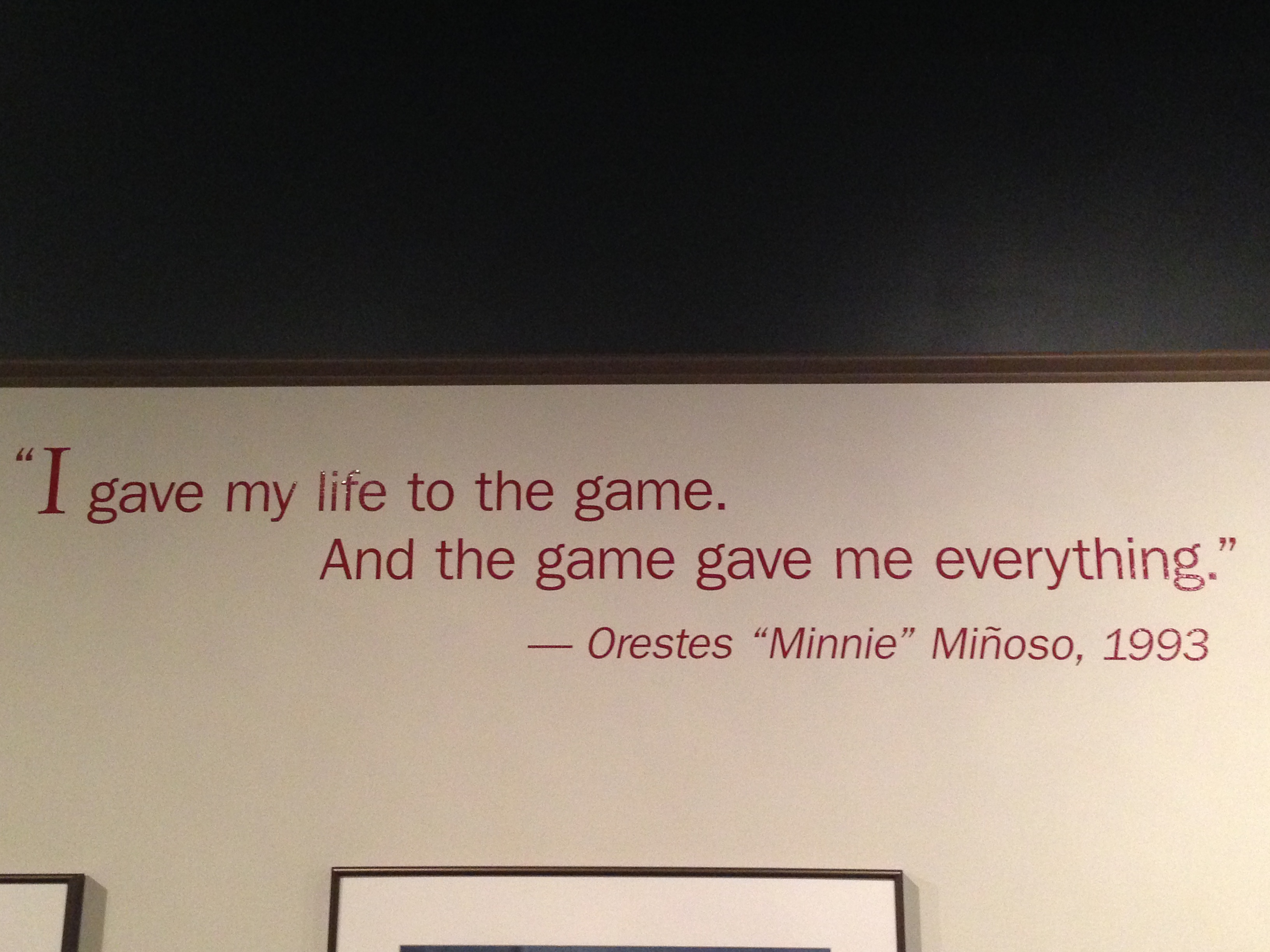
There is a quote on the wall in the third floor of the Baseball Hall of Fame from Minnie that says, “I gave my life to the game. And the game gave me everything.” I think the game owes him one last thing, and I think it’s time he got it.

Sunday, March 01, 2015

Glenn Flesig On Tommy John Incidence | MLB Trade Rumors


When looking for the magic bullet in the correlation / causation argument, a key phrase from the article sticks out in my mind.

 "since the recovery rate is so high, teams are willing to project a return to normality for prospects". 


Looking back to the 70's - 80's and even the early 90's, having Tommy John surgery was considered a Hail Mary pass for aging veterans. Since 1994-95, due to the miracle of modern medicine and advances in rehabilitation, the surgery has gone from pariah to panacea for pitchers of all ages. 

It used to be considered like a major overhaul to the pitching arm and now it's looked on as more akin to a tune-up. It has become almost an enhancement to a prospects career more than a detriment. All in one generation. 

Oh, The Times They Are A-Changin'.......... Thanks Bob.
Come writers and critics
Who prophesize with your pen
Keep your eyes wide
The chance won't come again
Don't speak too soon
For the wheel's still in spin
And there's no tellin' who
That it's namin'
For the loser now
Will be later to win
For the times they, they are a-changin'

Read more: Bob Dylan - The Times They Are A-changin' Lyrics | MetroLyrics 

from MLB Trade Rumors:
Glenn Flesig On Tommy John Incidence – MLB Trade Rumors:

Injury expert Glenn Flesig discussed the latest Tommy John surgery epidemic at the annual Sloan Sports Analytics Conference, writes Matthew Leach of MLB.com. Flesig, who holds a doctorate in biomedical engineering, is the partner of Dr. James Andrews at the American Sports Medicine Institute (ASMI). The institute aims to “improve the understanding, prevention and treatment of sports-related injuries through research and education.”
Flesig presented data on both professional and youth pitchers. At the professional level, 16% of pitchers have had Tommy  John surgery. Flesig found that once pitchers have recovered from the procedure, “they have the typical flexibility and typical mechanics. So they’re back to normal.” Of course, lost time and the potential for complications means that it’s best to avoid the issue in the first place.
Of course, UCL replacement can often impact free agency and the trade market. The increased incidence of the injury last season had some teams reaching for outside help. The Braves were able to call upon Ervin Santana on a one-year deal when Kris Medlen and Brandon Beachy both required a second procedure. Atlanta forfeited a draft pick when they signed Santana. We saw both Medlen and Beachy sign short-term, incentive-laden contracts this winter.
Since the recovery rate is so high, teams are willing to project a return to normality for prospects. Last June, the Blue Jays drafted Jeff Hoffman ninth overall. The Nationals took Erik Fedde with the 18th pick. Both pitchers had Tommy John surgery shortly before the draft.
A study of youth pitchers could reveal the way to decrease the incidence of elbow injury. Flesig offered a few convincing correlations. Youth pitchers who threw over 80 pitches in a game were four times more likely to require surgery. Those who pitched for more than eight months a year were five times more likely.
Pitching when fatigued was the biggest risk indicator. Youth who self-identified as having “often pitched” when fatigued were 36 times more likely to go under the knife. For the parents in the audience, don’t let your kid pitch too often or when fatigued.
'via Blog this'

I like that the stats community is getting interested in this and disseminating some of the knowledge down to where it belongs, at the youth level. The professionals are just that, professionals. They can do what they want and they have the best of the best out there helping them make informed decisions.

It seems like there are still organizations scattered out there that are thirsting for this type of direction and information. It appears that MLB has to get a grip on issues like this and that may require a bit of centralization. Colleges, high schools and youth leagues are going to have to be willing to give up some autonomy in exchange for some of this information. We'll see at that point who really cares about kids and who cares more about pocketbooks and bottom lines.

New commissioner Rob Manfred has made some noises about a USA Baseball type of umbrella,

Get the right information into the right hands and let's see what happens.

from Irvine Youth Sports Parents Blog:
http://irvineyouthsportsparents.com/

IYSPNMission
The mission of the Irvine Youth Sports Parents Network is to provide a forum for parents to exchange ideas and information on youth sports while promoting  the ideals of student-athlete citizenship.
Irvine is a city known for its cultural diversity, academic excellence and love of athletics. Our children are citizens first, students second and athletes third.
We believe in “sport as metaphor” – that 99.9% of our children will not go on to become professional athletes but take what they learn from athletics and pursue excellence and competition in other endeavors.
It is our hope that this organization can support the early nurturing of those dreams.

youth-sports-coach
Youth sports is a serious business.
Take a look at this piece in the Boston Globe on a proposed $150 MILLION Youth Sports Facility backed by Red Sox executive Dan Duquette and slated for construction on Cape Cod.  The growing money trend in youth sports is incredible. It’s estimated that the Travel Ball world of tournaments ALONE represents $7 billion per year and is projected to grow at 4% per year.Not only are athletic fields being constructed all over the country but so are the hotels for housing players and their families.
The benefits of youth sports have morphed from fun and development into trophies and cash.  The payoff has shifted from kids to adults.
When kids are polled about why they play sports their top three answers are:
1. To have fun
2. Be with friends
3. Do something I’m good at.
Nothing there about cash or hardware.
Clubs that get paid money to coach kids need to remember that sports doesn’t last forever.
But the values they impose do.
And the best values of sport are based on character…not cash.
IrvineYouthSportsBaseball

“We mathematically, statistically, scientifically have proven that the kids who play baseball year-round are three times more likely to end up on a surgery table by their 20th birthday that those who don’t,”
Glenn Fleisig, of the American Sports Medicine Institute, citing a 10-year study targeting teenagers who pitch more than 100 innings in a calendar year.

A lot of youth baseball parents have lost their minds.
That is the only conclusion any rational human being can come to when they are faced with the reality of this chart below indicating the exponential rise of Tommy John Surgeries for baseball pitchers.
Tommy-John-Surgery-Rise
What is it going to take before we parents realize that not only are we wasting too much of our time and money on travel ball and tournaments but we are also wasting the physical health of our children.
Isn’t that ironic?
Here we are putting our boys in a situation to enjoy their physicality and fun with friends and twisting it all up in a perfect mess of ego gratification and delusions of grandeur.
“Major League Baseball gets the blame for pitchers getting injured,” says Fleisig, “But the fact is these pitchers definitely have some damage in their arm when they get them.”
Consider the case of Jameson Taillon.  His elbow gave out recently at the age of 22 and after just 382 professional innings, all of them monitored with extreme caution by the team that handed him $6.5 million out of high school, the Pittsburgh Pirates. Taillon had been throwing more than 90 miles per hour since he was 16 and a sophomore in high school. He threw as hard as 99 mph as a senior.
According to Sports Illustrated…
Beginning in July 2008, when he was 16 years old, Taillon threw at six events sponsored by Perfect Game, one of the country’s top youth baseball services, in a 13-month period. Those events occurred in the summer, fall and winter. (In the spring, he was busy pitching for his high school team in The Woodlands, Texas.) His top velocities were meticulously recorded: 92, 93, 95, 96, 96 and 97. Every high school pitcher is known by the top velocity he “hits,” even if he gets there once, as much as his very name.
As a high school senior, Taillon hit 99. In June of that year, 2010, the Pirates selected him with the second pick of the draft, in between Washington selecting Bryce Harper and Baltimore taking Manny Machado. He was labeled as another “can’t miss” in the long line of Texas schoolboy power pitchers, including Josh Beckett and Roger Clemens.
Now he joins another long line: First-round high school pitchers who are blowing out their arms before they even accrue any major league mileage — a line that hardly existed as recently as five years ago.”
The problem is that parents and coaches are seeing results in all the private training, tools and techniques they are using to capture “increased velocity”, the buzzphrase of the moment in baseball.  The combination of year round travel ball and too many tournaments is putting a strain on young arms while the average speed of major league pitchers has increased from 90 MPH to 92 MPH.
But forget for a moment that you’re a parent of a prodigy because, like me, you’re not.
But you still have to suffer in this system and so does your boy.
The suffering comes whether he is an average player or shows a bit of promise.
If he’s average he’s going to be relegated to the worst positions on the field and he’s going to stop playing with some of his friends who are moving up to more competitive divisions.  If he’s got a little something extra, welcome to increased batting practice, throwing lessons and all kinds of private training just to keep up.
It can become stressful on everyone.
The difficulty is that you can see differences, measurable differences, in kids that put in extra time and those that don’t.  You CAN get results and that’s what gets everyone in a lather.  The reality is your really don’t know what you have until post puberty.
My wife and I struggle with this and try to remind ourselves…they’re kids.  And they deserve not be burdened with our unfulfilled ambitions but to simply experience the short-lived joy of being a kid.


Thursday, February 26, 2015

Econlib: What Every HS Junior should know before going to college

image
What Every High School Junior Should Know About Goin...
EconLog reader Meretta Marks sent me the following request:Would you consider the following topic for your EconLog blog:
Preview by Yahoo


EconLog reader Meretta Marks sent me the following request:

Would you consider the following topic for your EconLog blog:
"What every high school junior should know before thinking of going to college"
Suppose.....it's the beginning of the school year in high school.  Many members of the junior class are starting to think about planning for college, i.e. do they want to go and why, how they should start the process, what questions should they think to be asking, etc.

Here's what I'd say...

Dear Juniors,

You've spent the last eleven years of your life in school.  When you started, you were a child, and treated like a child.  Now you're almost an adult, and you're finally facing some adult choices.  One of the biggest: Should you stop school after you graduate from high school, or continue on to college?

Going to college definitely sounds better.  Almost every authority figure in your life - educators and family alike - recommend it to each and every student.  But as you may have noticed, authority figures are often untrustworthy.  Indeed, they usually bend the truth whenever honesty makes them look bad.  This doesn't mean you shouldn't go to college, but it is a reason to second-guess the party line, to seek out ugly facts parents and educators would rather ignore.  

Fortunately, you need not seek far.  Unlike most educators, I put candor above social acceptability.  Skim my writings if you don't believe me.  In all candor, then, here's what I have to say about going to college.  

1. College is a good deal for good students, a mediocre deal for mediocre students, and a poor deal for poor students.  

2. Once in a long while, a poor student morphs into good student.  But expecting any particular poor student - yourself included - to morph into a good student is wishful thinking.  

3. How do you know if you're a good, mediocre, or poor student?  Look at your past academic performance - your grades and standardized test scores.  If you're in the top 30%, you're good.  If you're in the next 20%, you're mediocre.  If you're in the bottom half, you're poor.
  
4. This 30/20/50 breakdown is relative to all American high school students.  If your high school is academically strong, the breakdown is probably more like 45/30/25.  If your high school is academically weak, it's probably more like 10/20/70.  If this baffles you, I'm afraid you're probably not a good student.

5. The main reason why college is a good deal for good students, a mediocre deal for mediocre students, and a poor deal for poor students: good students usually finish college, mediocre students usually don't, and poor students almost never do.  And most of the payoff for college comes from finishing.

6. The secondary reason why college pays better for better students: hard majors pay better than easy majors, and better students gravitate toward harder majors.

7. One bad argument against college: "What professors teach isn't relevant in the real world."  In the labor market, degrees in the most irrelevant subjects still open doors and raise pay.  Many jobs simply require a college degree in... whatever.  Thedifficulty of your major matters a lot more to employers than its relevance.

8. Completion rates at two-year colleges are well below those at four-year colleges - even for students who look the same on paper.  If you can't handle a four-year college, you probably can't handle a two-year college either.  Two-year college is not a happy medium between four-year college and no college.

9. When you decide whether to go to college, you should consider the college experience as well as the career benefits.  But the college experience is greatly overrated.  A good rule of thumb: If your studies bore you in high school, they'll probably bore you in college too.

10.  Don't go to college because you have no idea what career to pursue.  Most recent college graduates feel the same bewilderment.  In both cases, you need to dive into the labor market and try your luck.  

High school juniors, I don't want to crush your dreams.  But I'd rather crush your dreams than see you waste years of your lives and many thousands of dollars.  When teachers and parents reassure you that "Every student is a good student," that is a flowery lie.  

Suppose your 150-pound friend dreams of being a professional football player.  Would a true friend urge him on?  No, he'd warn his mid-weight friend that he is astronomically unlikely to succeed in football, and needs to consider more realistic careers.  I'm trying to play the same role for mediocre and poor students who expect to succeed in college.

Please don't get mad at me.  I am only a messenger.  If you're going to get mad at anyone, get mad at all the authority figures who give you counter-productive advice to spare your feelings - and their own.

In friendship,

Bryan Caplan
Professor of Economics
George Mason University


Giants Top Minor League Prospects

  • 1. Joey Bart 6-2, 215 C Power arm and a power bat, playing a premium defensive position. Good catch and throw skills.
  • 2. Heliot Ramos 6-2, 185 OF Potential high-ceiling player the Giants have been looking for. Great bat speed, early returns were impressive.
  • 3. Chris Shaw 6-3. 230 1B Lefty power bat, limited defensively to 1B, Matt Adams comp?
  • 4. Tyler Beede 6-4, 215 RHP from Vanderbilt projects as top of the rotation starter when he works out his command/control issues. When he misses, he misses by a bunch.
  • 5. Stephen Duggar 6-1, 170 CF Another toolsy, under-achieving OF in the Gary Brown mold, hoping for better results.
  • 6. Sandro Fabian 6-0, 180 OF Dominican signee from 2014, shows some pop in his bat. Below average arm and lack of speed should push him towards LF.
  • 7. Aramis Garcia 6-2, 220 C from Florida INTL projects as a good bat behind the dish with enough defensive skill to play there long-term
  • 8. Heath Quinn 6-2, 190 OF Strong hitter, makes contact with improving approach at the plate. Returns from hamate bone injury.
  • 9. Garrett Williams 6-1, 205 LHP Former Oklahoma standout, Giants prototype, low-ceiling, high-floor prospect.
  • 10. Shaun Anderson 6-4, 225 RHP Large frame, 3.36 K/BB rate. Can start or relieve
  • 11. Jacob Gonzalez 6-3, 190 3B Good pedigree, impressive bat for HS prospect.
  • 12. Seth Corry 6-2 195 LHP Highly regard HS pick. Was mentioned as possible chip in high profile trades.
  • 13. C.J. Hinojosa 5-10, 175 SS Scrappy IF prospect in the mold of Kelby Tomlinson, just gets it done.
  • 14. Garett Cave 6-4, 200 RHP He misses a lot of bats and at times, the plate. 13 K/9 an 5 B/9. Wild thing.

2019 MLB Draft - Top HS Draft Prospects

  • 1. Bobby Witt, Jr. 6-1,185 SS Colleyville Heritage HS (TX) Oklahoma commit. Outstanding defensive SS who can hit. 6.4 speed in 60 yd. Touched 97 on mound. Son of former major leaguer. Five tool potential.
  • 2. Riley Greene 6-2, 190 OF Haggerty HS (FL) Florida commit.Best HS hitting prospect. LH bat with good eye, plate discipline and developing power.
  • 3. C.J. Abrams 6-2, 180 SS Blessed Trinity HS (GA) High-ceiling athlete. 70 speed with plus arm. Hitting needs to develop as he matures. Alabama commit.
  • 4. Reece Hinds 6-4, 210 SS Niceville HS (FL) Power bat, committed to LSU. Plus arm, solid enough bat to move to 3B down the road. 98MPH arm.
  • 5. Daniel Espino 6-3, 200 RHP Georgia Premier Academy (GA) LSU commit. Touches 98 on FB with wipe out SL.

2019 MLB Draft - Top College Draft Prospects

  • 1. Adley Rutschman C Oregon State Plus defender with great arm. Excellent receiver plus a switch hitter with some pop in the bat.
  • 2. Shea Langliers C Baylor Excelent throw and catch skills with good pop time. Quick bat, uses all fields approach with some pop.
  • 3. Zack Thompson 6-2 LHP Kentucky Missed time with an elbow issue. FB up to 95 with plenty of secondary stuff.
  • 4. Matt Wallner 6-5 OF Southern Miss Run producing bat plus mid to upper 90's FB closer. Power bat from the left side, athletic for size.
  • 5. Nick Lodolo LHP TCU Tall LHP, 95MPH FB and solid breaking stuff.