Friday, June 05, 2015

Should the Red Sox be concerned about Pablo Sandoval? - CBSSports.com

It has already been a long year for Pablo Sandova -- with the bat and the glove. (Getty Images)


Hate to say we told you so Boston, but we told you so. Good luck getting a good return on that $95 million, you're off to a good start. At least SF had Matt Duffy to turn to when a low-budget McGehee went soft and flaccid. Where do you go and how good does the replacement player have to be to bench a $95 million dollar A$$ET? Schadenfreude, schadenfreude wonderful schadenfreude.

from CBSSports.com
Should the Red Sox be concerned about Pablo Sandoval? - CBSSports.com:
Maybe Sandoval's playing through an injury -- that's always a possibility when a player struggles badly, broadly and suddenly. Maybe it's just a bad stretch that he'll come out of soon enough. Or maybe it's premature decline. Sandoval's still just 28, so he shouldn't be seeing any widespread erosion of his skills just yet. However, it must be said that Sandoval's relationship with basic conditioning is complicated, and he has a body type that tends to age quite poorly. Given the trends we're seeing and given the player we're talking about, yes, premature decline is a possibility. The Red Sox, of course, have invested $95 million in Sandoval, so they're certainly hoping all of this corrects itself soon enough. As mentioned, that may well be the case. That may even be the most likely near-term outcome -- the various projection systems certainly see it that way. However, you need not look very hard to find reasons to worry about Sandoval.
'via Blog this'

I love how the quotes from the story tip-toe around the issue (which is part of the problem dealing with Pablo, IMO).

"Sandoval's relationship with basic conditioning is complicated".
You think? Try virtually non-existent.

"He has a body type that tends to age quite poorly".
Understatement? From the photo above he has a body type that looks like it's about to deliver twins. Not the traditional body type seen on major league 3B men indeed and not one that lends itself to transitioning to DH. But WDIK?

"...premature decline is a possibility".
Well, I suppose there are worse descriptions a man could want to heat about his performance, but not too many.

Good luck with the relationship to both Boston and Pablo. It sure sounds complicated.

Isn't that what you hear just before the break-up? Anybody?

Brandon Crawford’s Development, plus thoughts on blogging and beer money and clickbait, Oh My!!

crawford_2014crawford_2015

If there is one thing I like better than graphs, it's moving .gif's. This article from FanGraphs provides both. Simply mesmerizing.

Plus, it has pics of Brandon Crawford, proven clickbait (buzzword alert) for the younger female demographic. Plus, it has some insightful thoughts on Crawford's development as a Giant, therefore it is baseball related. Plus, Brandon Crawford and swinging in such close proximity should also provide more clicks, especially from the much coveted San Francisco market.

 Sounds like a win-win or a plus-plus-plus or something like that. It literally "checks all the boxes" (buzzword alert) for Grade-A blogging material.

from Wikipedia:
Clickbait is a pejorative term describing web content that is aimed at generating online advertising revenue, especially at the expense of quality or accuracy, relying onsensationalist headlines to attract click-throughs and to encourage forwarding of the material over online social networks. Clickbait headlines typically aim to exploit the "curiosity gap", providing just enough information to make the reader curious, but not enough to satisfy their curiosity without clicking through to the linked content.[1][2][3]
By 2014, the ubiquity of clickbait on the Internet had begun to lead to a backlash against its use.[3][4] Satirical newspaper The Onion launched a new website, ClickHole, that parodied clickbait websites such as Upworthy and Buzzfeed,[5] and in August 2014, Facebook announced that it was taking technical measures to reduce the impact of clickbait on its social network,[6][7][8] using, among other cues, the time spent by the user on visiting the linked page as a way of distinguishing clickbait from other content.[9]

Well, thank God we don't really do any advertising here at The Slav's Baseball Blog 'cause that whole "clickbait" scene sounds a little creepy, if you know what I mean. Plus, some would say we don't really even provide Grade-A blogging material, but that's another story.

I'll just stick with my graphs and moving .gif's if you don't mind. I don't really need the beer money (slang term) anyway.

Again, to reiterate, I do like moving .gif's and graphs and of course long walks on the beach and candlelit dinners ( with Mrs. TheSlav, of course )
from FanGraphs Baseball:

This was the first paragraph of an article from March 2012:

There are people in the Giants' organization who think you're crazy. You don't think Brandon Crawford can hit major-league pitching, but they believe you're wrong. As the exhibition season opened Saturday, under a cloudless sky at Scottsdale Stadium, Crawford took the first steps toward resurrection.

There was a time, really, when Crawford reminded people a little of Brian Bocock. And it's not like Crawford debuted at an especially young age — when he came up, he was a firm 24. Ordinarily, glove-first middle infielders remain glove-first middle infielders. The Giants believed Crawford could be more than that. The Giants, at least, believed Crawford could hit enough to play. His defense hasn't slipped. His hitting has taken off.
I promised you images. Here's one of them. I don't know all the ins and outs of how Crawford has gotten better; I just know that he has. As evidence, consider his isolated power:

 brandon-crawford-power


Thursday, June 04, 2015

Myths and Causes of Income Inequality | Just Facts Daily


Myths and Causes of Income Inequality
By James D. Agresti
May 22, 2015
New York Times economics analyst Eduardo Porter recently penned two columns about income inequality in which he claimed that the "job market is not working to distribute wealth" and "has lost much of its power to deliver income gains to working families" over the past four decades. As proof of this, he quoted data on "household incomes" from the U.S. and other countries.
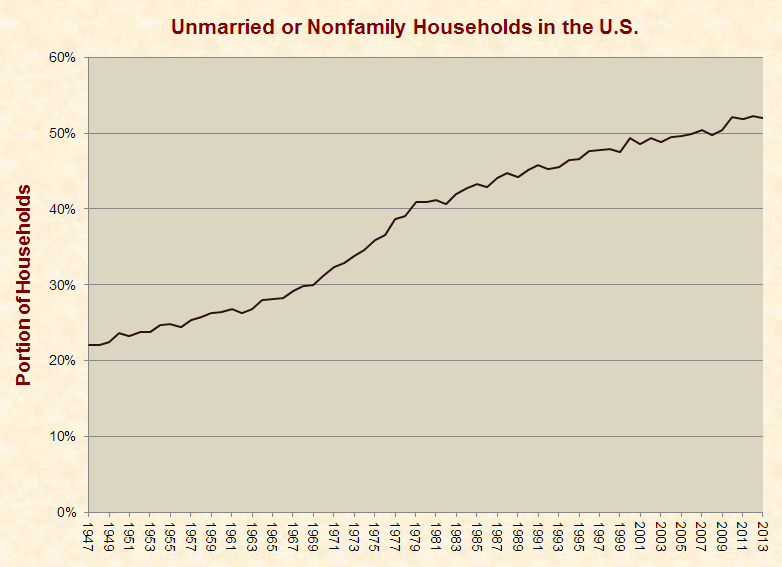
Such logic, which is common among those who claim that income inequality is at historic highs, suffers from a fatal flaw. This is because the disintegration of families has spread workers' wages over an increasing number of households during this era. As shown in the graph below, between 1967 and 2013, the portion of unmarried or nonfamily households in the U.S. rose from 29% to 52%:
unmarried_nonfamily_households_1947-2013A consequence of this marked decline in traditional family households is that household wages significantly understate job market gains. For instance, when a couple who each earns $50,000 per year gets separated or divorced, their incomes often remain the same, but their average household income drops from $100,000 to $50,000. In cases where only one spouse earns income, his or her earning power may decline due to the added responsibilities of single parenthood, and this single income may be split among two households due to alimony payments.
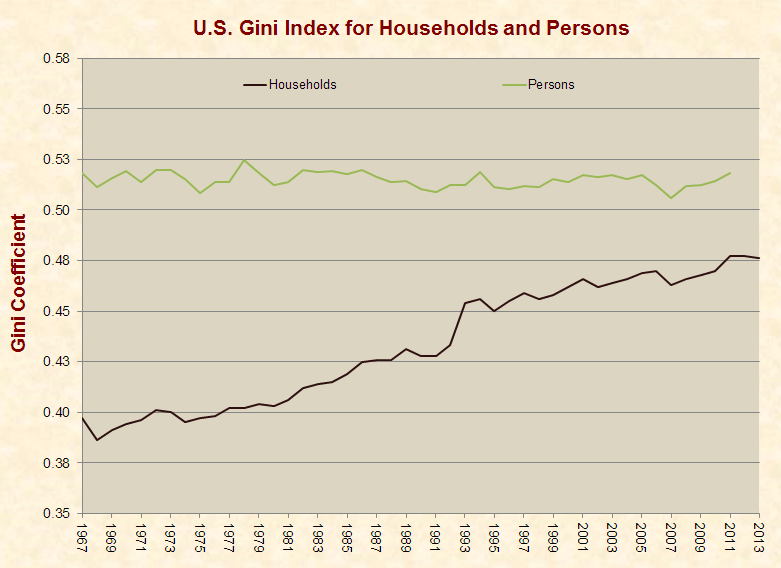
The effects of these family dynamics are evident in the Gini index, which is widely recognized by monetary institutions, economics textbooks, and academic journals as the most common measure of income inequality. Since 1967, which is as far back as the Census Bureau provides this data, the Gini index for households has consistently risen, prompting the Huffington Post (and others) to report that income inequality is at a "record high." That claim, however, is deceptive, because the Gini index for persons has been generally level throughout this period (hat tip: Political Calculations and Ivan O. Kitov):
gini_households_persons_1967-2013This stark difference between the Gini index for households and persons shows that rising household income equality has not been driven by "an inadequate job market" as Porter claims—but by the breakdown of families. Other facts relating to household structure and income underscore this reality:
  • Among children living with married parents, 35.6% have family incomes of $100,000 and above; while among children living with unmarried parents, 4.6% have family incomes of $100,000 and above.
  • Among people who are married, the poverty rate is 6%, as compared to 18% for people who are divorced, and 21% for people who have never married.
  • The poverty rate for black two-parent families is 9%, as compared to 27% for white single-mother families and 15% for white single-father families.
Liberals often argue that conservatives have mistaken the effect for the cause, and that economic hardship has spurred the decline of intact families instead of vice-versa. For example, Jeff Spross, the economics and business correspondent at The Week, has assertedthat the "primary" reason for the collapse of marriage in the U.S. is the "demise of good middle-class jobs and economic security." This notion is at stark odds with the fact that the median real income of U.S. households rose by 40% between 1979 and 2011.
A more nuanced and academic version of the argument made by Spross is that a decline in material welfare is not the cause of family breakdown but "a sense of economic despair" felt by poorer people because of the wealth gap between themselves and richer people. This theory, which is based on the Gini index for households, conflicts with the fact that the Gini index for persons has stayed flat for decades while the rates of unmarried and nonfamily households have soared. If this hypothesis had any merit, the Gini index for persons would have preceded and mirrored the decline in family cohesiveness.
Additionally, the Gini index does not capture all income and taxes, and if it did, it would likely show lower levels of inequality over the past several decades. This is evidenced by the Census Bureau's more comprehensive measures of household income, which are available from 1979 to 2003. These data account for numerous forms of income and taxes that are not included in the Bureau's standard measure of income, and the most comprehensive of these measures shows Gini figures and trends that are lower than the Bureau's standard measure.
A rational and factually coherent explanation for the decline of families is changes in ethics about extra-marital sex, divorce, and unwed child-bearing. Since Gallup began polling Americans on these issues in 2001, moral acceptance of extra-marital sex rose from 53% to 66%, divorce from 59% to 69%, and having a baby out of wedlock from 45% to 58%. These changes transpired in just the last 13 years, and much larger changes surely occurred during the sexual revolution that began in the 1940s and burgeoned in the 1960s to 1980s.
Summarizing the facts above, personal income inequality has not risen for half a century, and the rise of household income inequality stems from family disintegration driven by changing attitudes toward sex, marital fidelity, and familial responsibility.

The Brandons and the Giants' Farm System | Huffington Post

BRANDON BELT CRAWFORD

So now the comparison goes from Casey McGehee vs. Pablo Sandoval to Matt Duffy vs. Pablo Sandoval.  For the Giants, it seems as if a veteran retread has to come in and fail miserably before a rookie can come to the rescue. Dan Uggla begets Joe Panik, Now Casey McGehee releases Matt Duffy from Prospect Prison. Before that one of the Molina's blocked one Buster Posey's path and Brandon Crawford had to wait for one of the Cabrera's to falter.

It's always something. 

from Huffington Post:
The Brandons and the Giants' Farm System | Lincoln Mitchell:
The Giants' ability to produce impact players from within has been central to their impressive success in recent years. The evolution of the Brandons from solid regulars to stars, and the development of another not very widely heralded prospect, Joe Panik, into a very solid starter are the most recent examples of this. The Giants have also gotten a bit lucky with their farm system. For example, although it is unlikely to look this way at the end of the season, Matt Duffy, a player about whom a year ago all but the most intense Giants fans had heard nothing, is quietly having a better year (.279/.324/.388) than the major star, Pablo Sandoval (.251/.317/.371), who he replaced. In an era that is more competitive, with more teams, and more safeguards against dominance by wealthier teams, the Giants continue ability to produce quality players from within is an extraordinary accomplishment and one that goes a long way towards explaining those three rings.
'via Blog this'


It almost seems as if this franchise is mentally locked in to their early 2000's draft and player development record, which was putrid. However, since about 2005 or 2006,  the Giants have been about as good at drafting and developing as any franchise going. The Bonds era was laden with free-agent signings and lost draft picks, the post-Barry era is loaded with draft picks and home grown talent.

The results speak for themselves. Bonds era, zero championships. The post-Bonds era, three World Championships. Draft and develop rules.  The Huffington Post has a sports section? Sheesh!!!


Friday, May 29, 2015

Posey perfects the art of framing with the walk-off, 3rd strike frame

buster
http://www.mccoveychronicles.com/2015/5/28/8685049/sf-giants-recap-scoreless-streak

There is no better Buster than cocky Buster. 


This was the highlight of the game, other than the good Chris Heston showing up to out-duel the Braves starter Shelby Miller.  Buster leaves the stage entirely to the umpire to display his punch-out mechanic. Our work is done boys. Let's hit!! 

Jake Peavy's rehab assignment didn't go too well last night. If he can't get minor-leaguers out, how does he take this kid's spot?

With Heston and Vogie clicking and Timmy starting to pick up the pace, I've hardly noticed Peavy and Cain not being around. Short of "Brandon Crawford's magical glove", Chris Heston is the runner-up answer in the "Where would the Giants be without.....?" contest. 


Bummmer, Timmy, Timmy, Vogie and Heston - Not bad. A little tilted to the right-side, but not bad. When they keep it in the park, these guys can keep opponents down. 

10 bizarre baseball rules you won't believe actually existed


from mlb.com

http://m.mlb.com/cutfour/2015/05/22/124363454/
 1. Batters had the right to request a low or high pitch from 1867 to 1887

Imagine Mike Trout walking up to the plate and telling David Price exactly where he wanted the ball. In the game's infancy, that was a reality: Prior to every at-bat, batters would request a high or low strike zone -- either from the knee to the belt or the belt to the shoulder -- and the pitcher had to put it there. Awfully demanding of you, late-19th-century batsmen.
2. Fly balls could be caught off a bounce until 1864, and foul balls until 1883
This may seem bizarre to baseball fans today, but the logic behind the one-bounce rule was actually fairly straightforward: It was a holdover from other favorite childhood games, like jacks, and in the days before gloves it allowed players to avoid catching a very hard ball with their bare hands.
As the 19th century wore on, though, support for the rule waned. After years of hilariously acrimonious debate -- at a convention in New York, one delegate even dubbed it a "boy's rule" -- the rule was officially voted out for fair balls in 1864. Foul balls, however, could still be caught on a bounce for another 20 years. 
3. Pitchers were required to throw underhand until 1883
Baseball owed much of its origin to cricket, and one of the game's first codified sets of rules -- the Knickerbocker rules, drafted in 1845 for New York's Knickerbocker baseball club --speak to those roots: "The ball must be pitched, not thrown, for the bat." "Pitched", in the traditional sense of the term: a stiff, underhanded motion, almost like bowling.
The first man to go electric, according to MLB's official historian John Thorn, was Tommy Bond: He raised his delivery just above the waist in the mid-1870s, and from there, it was only a matter of time before the overhand delivery was born, if only because this is not the face of a man you want to mess with:
Tommy Bond
But at least the Chad Bradfords of the world can rest a little bit easier tonight, knowing that, once upon a time, they were the normal ones.
4. One side of the bat was allowed to be flat from 1885 to 1893
Concerned about a lack of scoring in the National League (league-wide ERA: 2.37, so quit bragging, Kershaw), Cincinnati Red Stockings organizer Harry Wright proposed a rule change to help juice offense: Allow bats to have a flat face, much like cricket. After much hand-wringing, the NL adopted the policy in 1885, and, combined with changes to the pitching distance, runs began to increase -- until everyone soon realized that flat bats had a tendency to splinter, and the rule was rescinded in 1893.
5. Walks were scored as hits for one year, in 1887
If you read the above and thought, "Wow, that seems destined to cause all kind of record-keeping difficulties," well, you would be absolutely correct!
A staggering 11 players hit .400 that season, nine of whom wouldn't have had walks not counted as an at-bat. The statistics were even rewritten in 1968 by the Special Baseball Records Committee, with drastic consequences: Cap Anson, who hit .421 to lead the league in 1887, had 60 hits taken away, which stripped him of not only the batting title but the honor of first-ever member of the 3,000-hit club. In 2001, MLB reversed the Committee's decision, and Cap now sits proudly in the Hall of Fame with over 3,400 hits and one stellar mustache:
Cap Anson
As for the rule itself, it was deeply unpopular even at the time -- with a New York Times article even referring to walks as "phantom hits" -- and it was quickly rectified after one year.
6. Umpires in the 19th century had it made
The plight of the umpire is a difficult one: You try tracking a small white ball traveling at ridiculously high speeds, with a stadium full of people and the entire Internet ready to castigate you if you're wrong.
Being an umpire at the turn of the 20th century, though? Thatactually sounds pretty great: They were chosen from the crowd prior to first pitch -- they were often prominent members of the local community -- and rather than spend all that energy to squat behind the catcher, umpires were given easy chairs in the general vicinity of home plate. And that was just the beginning of the perks. From Ohio's Marion Star newspaper in 1916:
"The old time umpires were accorded the utmost courtesy by the players. They were given easy chairs, placed near the home plate, provided with fans on hot days and their absolute comfort was uppermost in the minds of the players. The umpire always received the choicest bits of food and the largest glass of beer."
Sign us up, please.
7. Rather than crouching, catchers would stand a few feet behind home until the early 1900s
Nowadays, catchers serve a vital defensive purpose -- from calling a game to the art of framing pitches to throwing out baserunners. In the mid-1800s, though, their responsibilities were far simpler: Just get in the way of the ball, please. Catchers were originally conceived as glorified backstops, standing a few feet behind home plate and making sure balls didn't roll past them. A couple of innovative souls began to buck this trend in the 1870s, but the crouching we're accustomed to wouldn't truly spread until the beginning of the 20th century.
8. The spitball was outlawed in 1920 -- but pitchers who had been throwing it for years were grandfathered in
Pitchers doctoring baseballs was always an ethical gray area, but it was a fairly common practice in the early days, and spit wasn't nearly the worst of it: pitchers would use mud, grease, soap, anything they could think of to make the ball dance in unpredictable ways.
Wanting to bring more offense to the game, MLB responded in 1920, outlawing the practice for good. But several famous spitballers were in the middle of their careers, and so the league came up with a compromise: a grandfather clause, allowing those who had thrown it before the rule to continue to do so. Righty Burleigh Grimes carried the "last official spitballer" mantlefor 14 more years, grossing out all of his teammates until his retirement in 1934:
Burleigh Grimes
9. It was pretty difficult to hit a walk-off homer until 1920
The batter steps to the plate in the bottom of the ninth, bases loaded, the score tied. He swings, and blasts one over the 400-foot sign in left field! The crowd roars as our hero celebrates his walkoff ... single, at least for the game's first few decades. Until 1920, hitters were only given credit for the number of bases the winning run advanced -- so, for example, a walkoff home run that scored a runner from second would only be considered a double, because that runner only advanced two bases. The only way a home run could stand as a walk-off was if the batter himself was the winning run.
Setting aside the impact this rule had on the record books, just think of the home plate celebrations baseball's earliest fans were deprived of.
10. Ground rule doubles were actually home runs as recently as 1930
Yes, really: Any ball that bounced off the ground and over the fence was ruled a home run. Rumor has it that at least one of Lou Gehrig's home runs during his 1927 home run race with Babe Ruth was actually a ground rule double.
In fact, at one point the very concept of a home run was an alien one: According to Thorn, on May 21, 1880 -- a time when few parks had ground rules stipulating that a ball clearing the wall was a home run -- a player hit a ball over the fence and into a river, and the right fielder, confused as to what to do next, actually hopped into a boat to go retrieve the thing. (He eventually gave up, unsuccessful in his pursuit. Stay forever weird, baseball.)


Strange but True Rules from MLB rule book


Tough being in umpire nowadays.

I had the uncaught third strike almost come back to bite me in the butt when I was working with a partner who was apparently not aware that a third strike had to be caught on the fly. He came flying down the line from 1B and stopped the batter-runner from trying to reach first after the catcher didn't properly catch strike three.

Luckily for us, the coach was unaware that we were wrong or just erroneously assumed we were right rather than conflicted and confused as we seemed by both having different opinions. It's gotta be tougher on the big stage where stuff happens faster and under more stress and scrutiny.  However, umpires on the lower levels have the added burden of dealing with different rules books and interpretations depending on the level and the governing body administering the rules.

10 strange-but-true rules from MLB's official rulebook
10. Runners advance one base if a pitched ball "lodges in the umpire's or catcher's mask or paraphernalia." Rule 5.09(g)
9. A designated hitter is specifically prohibited from sitting in the bullpen, unless serving as a bullpen catcher. Rule 6.10(b)(15)
8. A runner is out when they are hit by a fair batted ball, whether they are on a base or not, except when the infield fly rule is called. In that case they are not out if hit by the ball while on base, but are still out if hit by the ball off a base. Rule 7.08(f)
7. When a manager, coach or player are ejected, they are expressly permitted to take a seat in the stands, as long as they change into street clothes and are "well removed from the vincinity of his team's bench or bullpen." Rule 4.07
6. If a fielder deflects a fair ball into the stands, it counts as a home run; unless the deflection somehow manages to occur 250 feet or closer to home plate, in which case all runners only advance two bases. Rule 6.09(h)
5. If a player pinch-hits for a batter in the middle of an at-bat with two strikes, and strikes out, the at-bat and strikeout are credited to the replaced batter. Any other outcome is credited to the pinch-hitter.  Rule 10.15(b)
4. The umpire has the specific authority to, in the case of wet weather, instruct the pitcher to put the rosin bag in his pocket. Rule 8.02(a)
3. All runners, including the batter, advance three bases if a fielder intentionally touches a fair batted ball with their cap, mask or any other part of their uniform "detached from the proper place on his person." All runners advance two bases if the same thing happens on a thrown ball.Rule 7.05(b-e)
2. If there are two strikes on the batter, and a runner steals home, and the pitch hits the runner in the strike zone, the batter is out. The run does not score if there are two outs; if there are less than two outs, it does. Rule 6.05(n)
1. Pitchers are allowed to switch their throwing arm in the middle of an at-bat, but only if they have injured the other one. If one does, they do not get an opportunity to warm up with the other arm. Rule 8.01(f)
-- Dan Wohl / MLB.com

--

from wikipedia.com
http://en.m.wikipedia.org/wiki/Uncaught_third_strike

In baseball and softball, an uncaught third strike (sometimes referred to as dropped third strike) occurs when the catcherfails to cleanly catch a pitch for the third strike. A pitch is considered uncaught if the ball touches the ground before being caught (a bouncing ball), or if the ball is dropped after being grasped (see also catch). In Major League Baseball, the specific rules concerning the uncaught third strike are addressed in Rules 6.05 and 6.09 of the Official Baseball Rules.[1]

On an uncaught third strike with no runner on first base or with two outs, the batter immediately becomes a runner. The strike is called, but the umpire does not call the batter out. The umpire may also actively signal that there is "no catch" of the pitch. The batter may then attempt to reach first base and must be tagged or forced out. With two outs and the bases loaded, the catcher who fails to catch the third strike may, upon picking up the ball, step on home plate for a force-out or make a throw to any other fielder.

The purpose of the "no runner on first base or two outs" qualification is to prevent the catcher from deliberately dropping a third strike pitch and then initiating an unfair double or triple play with possible force plays at second base, third base, or home plate, in addition to putting the batter out at first base. The logic of the situation is similar to that which led to the infield fly rule.

Regardless of the outcome of an uncaught third strike, the pitcher is statistically credited with a strikeout. Because of the uncaught third strike rule, it is possible for a pitcher to register more than three strikeouts in an inning.

In Little League, in the Tee-Ball and Minor League divisions, the batter is out after the third strike regardless of whether the pitched ball is caught cleanly by the catcher. In Little League (or the Major Division), Junior, Senior, and Big League divisions, a batter may attempt to advance to first base on an uncaught third strike. Little League Major Division Softball and many other youth baseball leagues (such as the USSSA) also follow the rule.


Giants Top Minor League Prospects

  • 1. Joey Bart 6-2, 215 C Power arm and a power bat, playing a premium defensive position. Good catch and throw skills.
  • 2. Heliot Ramos 6-2, 185 OF Potential high-ceiling player the Giants have been looking for. Great bat speed, early returns were impressive.
  • 3. Chris Shaw 6-3. 230 1B Lefty power bat, limited defensively to 1B, Matt Adams comp?
  • 4. Tyler Beede 6-4, 215 RHP from Vanderbilt projects as top of the rotation starter when he works out his command/control issues. When he misses, he misses by a bunch.
  • 5. Stephen Duggar 6-1, 170 CF Another toolsy, under-achieving OF in the Gary Brown mold, hoping for better results.
  • 6. Sandro Fabian 6-0, 180 OF Dominican signee from 2014, shows some pop in his bat. Below average arm and lack of speed should push him towards LF.
  • 7. Aramis Garcia 6-2, 220 C from Florida INTL projects as a good bat behind the dish with enough defensive skill to play there long-term
  • 8. Heath Quinn 6-2, 190 OF Strong hitter, makes contact with improving approach at the plate. Returns from hamate bone injury.
  • 9. Garrett Williams 6-1, 205 LHP Former Oklahoma standout, Giants prototype, low-ceiling, high-floor prospect.
  • 10. Shaun Anderson 6-4, 225 RHP Large frame, 3.36 K/BB rate. Can start or relieve
  • 11. Jacob Gonzalez 6-3, 190 3B Good pedigree, impressive bat for HS prospect.
  • 12. Seth Corry 6-2 195 LHP Highly regard HS pick. Was mentioned as possible chip in high profile trades.
  • 13. C.J. Hinojosa 5-10, 175 SS Scrappy IF prospect in the mold of Kelby Tomlinson, just gets it done.
  • 14. Garett Cave 6-4, 200 RHP He misses a lot of bats and at times, the plate. 13 K/9 an 5 B/9. Wild thing.

2019 MLB Draft - Top HS Draft Prospects

  • 1. Bobby Witt, Jr. 6-1,185 SS Colleyville Heritage HS (TX) Oklahoma commit. Outstanding defensive SS who can hit. 6.4 speed in 60 yd. Touched 97 on mound. Son of former major leaguer. Five tool potential.
  • 2. Riley Greene 6-2, 190 OF Haggerty HS (FL) Florida commit.Best HS hitting prospect. LH bat with good eye, plate discipline and developing power.
  • 3. C.J. Abrams 6-2, 180 SS Blessed Trinity HS (GA) High-ceiling athlete. 70 speed with plus arm. Hitting needs to develop as he matures. Alabama commit.
  • 4. Reece Hinds 6-4, 210 SS Niceville HS (FL) Power bat, committed to LSU. Plus arm, solid enough bat to move to 3B down the road. 98MPH arm.
  • 5. Daniel Espino 6-3, 200 RHP Georgia Premier Academy (GA) LSU commit. Touches 98 on FB with wipe out SL.

2019 MLB Draft - Top College Draft Prospects

  • 1. Adley Rutschman C Oregon State Plus defender with great arm. Excellent receiver plus a switch hitter with some pop in the bat.
  • 2. Shea Langliers C Baylor Excelent throw and catch skills with good pop time. Quick bat, uses all fields approach with some pop.
  • 3. Zack Thompson 6-2 LHP Kentucky Missed time with an elbow issue. FB up to 95 with plenty of secondary stuff.
  • 4. Matt Wallner 6-5 OF Southern Miss Run producing bat plus mid to upper 90's FB closer. Power bat from the left side, athletic for size.
  • 5. Nick Lodolo LHP TCU Tall LHP, 95MPH FB and solid breaking stuff.